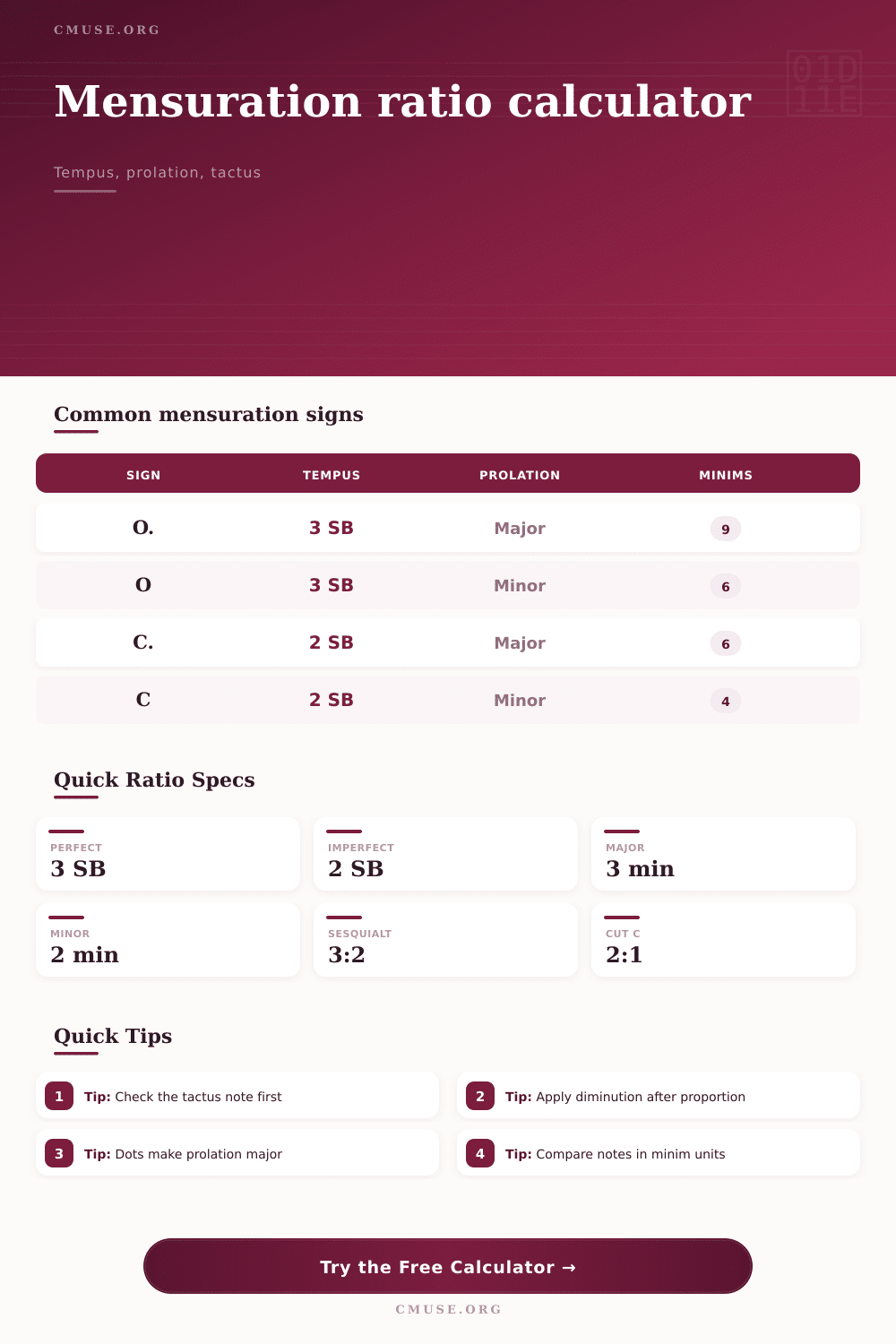
Mensuration Ratio Calculator
Convert Renaissance mensuration into practical proportions: tempus, prolation, note values, tactus, diminution, augmentation, and sounding duration.
🎼Real Mensuration Presets
📝Mensuration Inputs
Mensuration Results
📊Current Spec Grid
📐Mensuration Sign Table
| Sign | Tempus | Prolation | Breve Value |
|---|---|---|---|
| O. | Perfect: 3 semibreves | Major: 3 minims | 9 minims per breve |
| O | Perfect: 3 semibreves | Minor: 2 minims | 6 minims per breve |
| C. | Imperfect: 2 semibreves | Major: 3 minims | 6 minims per breve |
| C | Imperfect: 2 semibreves | Minor: 2 minims | 4 minims per breve |
🔁Proportion and Diminution Table
| Relation | Notation Meaning | Duration Factor | Rate Result |
|---|---|---|---|
| 1:1 integer valor | One written value keeps regular time | 1.000 | Unchanged |
| 3:2 sesquialtera | Three written values in the time of two | 0.667 | 1.500x faster |
| 3:1 tripla | Three written values in the time of one | 0.333 | 3.000x faster |
| 2:3 proportio minor | Two written values in the time of three | 1.500 | 0.667x slower |
| Cut C diminution | Notes are commonly read in half value | 0.500 | 2.000x faster |
🎚Note Value Conversion Table
| Note Value | Minim Units | In C Mensuration | Use in Calculator |
|---|---|---|---|
| Breve | 4 | 1 breve | Long span unit |
| Semibreve | 2 | 2 per breve | Common tactus option |
| Minim | 1 | 4 per breve | Base calculation unit |
| Semiminim | 0.5 | 8 per breve | Fast note comparison |
📋Common Proportional Scenarios
| Scenario | Typical Setting | Main Ratio | Practical Check |
|---|---|---|---|
| Perfect major passage | O. with 9 minims per breve | 3 semibreves x 3 minims | Count in groups of 9 minims |
| Common imperfect minor | C with 4 minims per breve | 2 semibreves x 2 minims | Semibreve tactus often aligns cleanly |
| Sesquialtera entry | Proportion 3:2 over same note values | 3 in the time of 2 | Duration becomes two thirds |
| Diminished section | Cut sign or explicit 2:1 diminution | Half note value | Effective tactus doubles |
| Augmentation canon | One voice expanded against another | 2:1 or 3:1 slower voice | Compare total minims per voice |
There it is, a copy of Josquin des Prez, looking at the opening bars of his music, feeling a tug on your heartstrings between a desire for musical momentum and historical accuracy. It all appears straightforward: the notation; those crosses and circle are directions for timing. But they tells you things like measurement signs which determine note relationships, a hierarchy beyond what we count in our heads today using quarters and eighths.
Unless you understand them, you might sing a whole note when the composer want a half note. You might also drag a passage that needs to move with mathematical accuracy. It’s as much about learning the maths as it is about learning the tune.
How to Read Old Music Notation
There’s also the clever calculator above that perform all this complicated maths for you. This takes out guesswork of deciding on prolation and tempo, leaving you free to concentrate on phrasing. Before taking these figures provided by the calculator as truth, it might of been helpful to know exactly what is being calculated.
At the heart of it are two option, and each one have two choices. Is it perfect time or imperfect time? Is it major prolation or minor prolation? Perfect is represented by a circle; here we divide into threes. Imperfect (also known as C clef) is marked with a broken circle or ‘C’. To change from major to minor prolation, you place a dot in the centre of the circle.
The effect is that number of minims that fill a semibreve will change. That may sound dry and academic, but consider how a simple dot alter the whole feel of a phrase. Take for example the idea of the tactus, which is the underlying pulse on which everything else are based. During the Renaissance period it would have been experienced as a moderate walking pace on the semibreve.
When your score changes from cut time to common time what you see are smaller notes. What you are also experiencing is reduction whereby half the amount of time is taken up by the same number of written values. For the calculator, this means dividing each note value down into a single common unit that is usually the minim. That way they can be accurately compared from one mensuration to another. It also stops people from making the common mistake of comparing a perfect breve to an imperfect breve without considering their different division structures.
Proportions add another level of complication. Think of these as time signatures embedded in other time signatures, they are often represented by a specific sign or number such as a 3. What that means is you has to place three values where there would normally be two. In this way, you have a duple backing with a flowing triple feel.
While this sounds smooth the challenge is accurate counting. Get this wrong and you’ll find yourself racing through the music or dragging behind the rest of the group. In this way, it handles these overlapping ratios by treating them as a multiplier on the starting duration. You get a clear sound time result from the tool.
The danger here is that it’s so easy to be swept away with the theory without thinking about how this work practically as a performer. When performing early music, singers frequently had to rely on pattern recognition and intuition instead of continuous calculation. What is the difference between an imperfect breve and a perfect one? How does that feel?
With a reference point such as this, you will not embarrass yourself by mismatching speeds when approaching challenging polyphonic music or learning new material. This reference table on the page clearly sets out what each of these signs mean for you. Before you have sung a note, you can identify the metre.
On the other hand, augmentation and diminution stretch or shorten the length of a note to add contrapuntal interest or canon. For example, an augmented voice could play half the number of notes but twice the duration of original. This gives a drone effect that supports the other voices flitting on top. If the ratio is incorrect, then the counterpoint falls from step and ruins the structure of the composition. The calculator makes it possible for you to put these elements into the equation explicitly. You’ll see precisely what beat lengths to expect in each voice.
So how does this help? Ultimately, it is about more than accurate counting; it is about making sense of the music. Realizing that a dot inside a circle means there are nine minims within each breve helps you group the notes together rather than seeing them as individual dots on a page. It allows you to see the structure of the piece.
Apply these methods to untangle some of the uncertainty found in early notation then step back from the mathematics and listen to the music. The mathematics will support the rhythm but the rhythm supports the expression.