Memorization Chunk Count Calculator
Estimate phrase chunks, section groups, recall passes, and spaced review load for music, lyrics, scripts, or spoken repertoire.
🎵Real Memorization Presets
🧠Chunking Inputs
Memorization Chunk Plan
📊Memory Spec Grid
📘Chunk Size Reference
| Material | Starter Chunk | When to Shorten | Typical Recall Passes |
|---|---|---|---|
| Single-line melody | 4 to 8 bars | Leaps, sequence shifts, or breath changes | 3 to 5 clean passes |
| Lyrics with melody | 1 lyric line or 2 to 4 bars | Similar verses or altered endings | 4 to 6 clean passes |
| Polyphonic keyboard | 1 to 2 bars | Hand independence or dense harmony | 5 to 8 clean passes |
| Jazz head and changes | 2 to 4 bars | Turnarounds, modulations, or hits | 4 to 7 clean passes |
| Spoken script | 1 thought unit or 20 to 45 seconds | Repeated phrases or cue-dependent lines | 4 to 6 clean passes |
⏱Spaced Review Table
| Plan | Review Days | Best For | Daily Review Load |
|---|---|---|---|
| 4-touch | 1, 2, 4, 7 | Short songs, light memorization, familiar style | Moderate early, light later |
| 5-touch | 1, 2, 4, 7, 10 | Most recital, choir, and ensemble parts | Balanced across two weeks |
| 6-touch | 1, 2, 4, 7, 10, 14 | Audition, exposed solo, or mixed-language material | Steady and resilient |
| 7-touch | 1, 2, 4, 7, 10, 14, 21 | High-pressure performance or long programs | Heavier calendar commitment |
🎼Material Complexity Table
| Complexity | Multiplier | Memory Risk | Useful Adjustment |
|---|---|---|---|
| Very predictable | 1.00x | Low: patterns are easy to group | Use longer phrases and fewer overlap drills |
| Light variation | 1.15x | Low-medium: small changes can blur | Name each variation before recall |
| Moderate detail | 1.30x | Medium: harmony, text, or cues matter | Keep section anchors visible during learning |
| Dense rhythm or harmony | 1.55x | High: mistakes cluster around transitions | Shorten phrase length and add overlap |
| Highly exposed or irregular | 1.85x | Very high: recall must survive pressure | Raise clean passes and review days |
📝Common Memorization Projects
| Project | Measure Length | Chunk Count | Recall Focus |
|---|---|---|---|
| Short jazz standard head | 32 bars | 8 to 12 chunks | Form, bridge entry, and final turnaround |
| Choir anthem | 72 bars | 18 to 30 chunks | Text order, entrances, and repeated endings |
| Intermediate sonatina movement | 96 bars | 24 to 48 chunks | Sequences, cadences, and hand choreography |
| Opera or musical aria | 120 bars | 30 to 60 chunks | Text, breath, cue, and harmonic arrival |
| Spoken audition monologue | 3 minutes | 8 to 18 chunks | Thought shifts, cues, and emotional beats |
✨Memorization Tips
When you glance down on a piece of sheet music, maybe you can’t even process what it says. If you’re an actor, a speaker or any other kind of musician, this feeling of panic is real. The music appears to be a wall of notes; you think to yourself: okay I’ll just plough my way from the top and work note-by-note, measure by measure. And more often than not it doesn’t work.
That’s because it fails to take into account how memory works. Your brain doesn’t remember in one continuous stream but rather in connected clusters. Before you begin, you need to create these cluster or else your mind will insert random ones that is fragile when tested under pressure.
How to Learn Music Faster
With your chosen level of complexity and phrase length(s), simply plug those figures into the calculator above. From there, it do the work for you. Avoid underestimating what’s needed to retain something reliabley over time.
We often mix up remember/recall with recognise. For example, you may be able to look at notation on page and ‘recognise’ the tune, but that’s not the same as being able to recall it without the sheet music in front of you. This matters if you’re about to perform something with no safety net!
Chunking is a way of taking an extended journey and turning it into more manageable peaks and troughs. Similarly, you could attempt to learn a forty-eight bar sonatina movement all at once but there’s every chance you’ll exceed your own working memory capacity and give up! Instead, by subdividing it into say six or eight individual phrases, you provide yourself with anchor points that you can bounce off of if things start to fall apart. One mistake doesn’t then destroy the whole run-through.
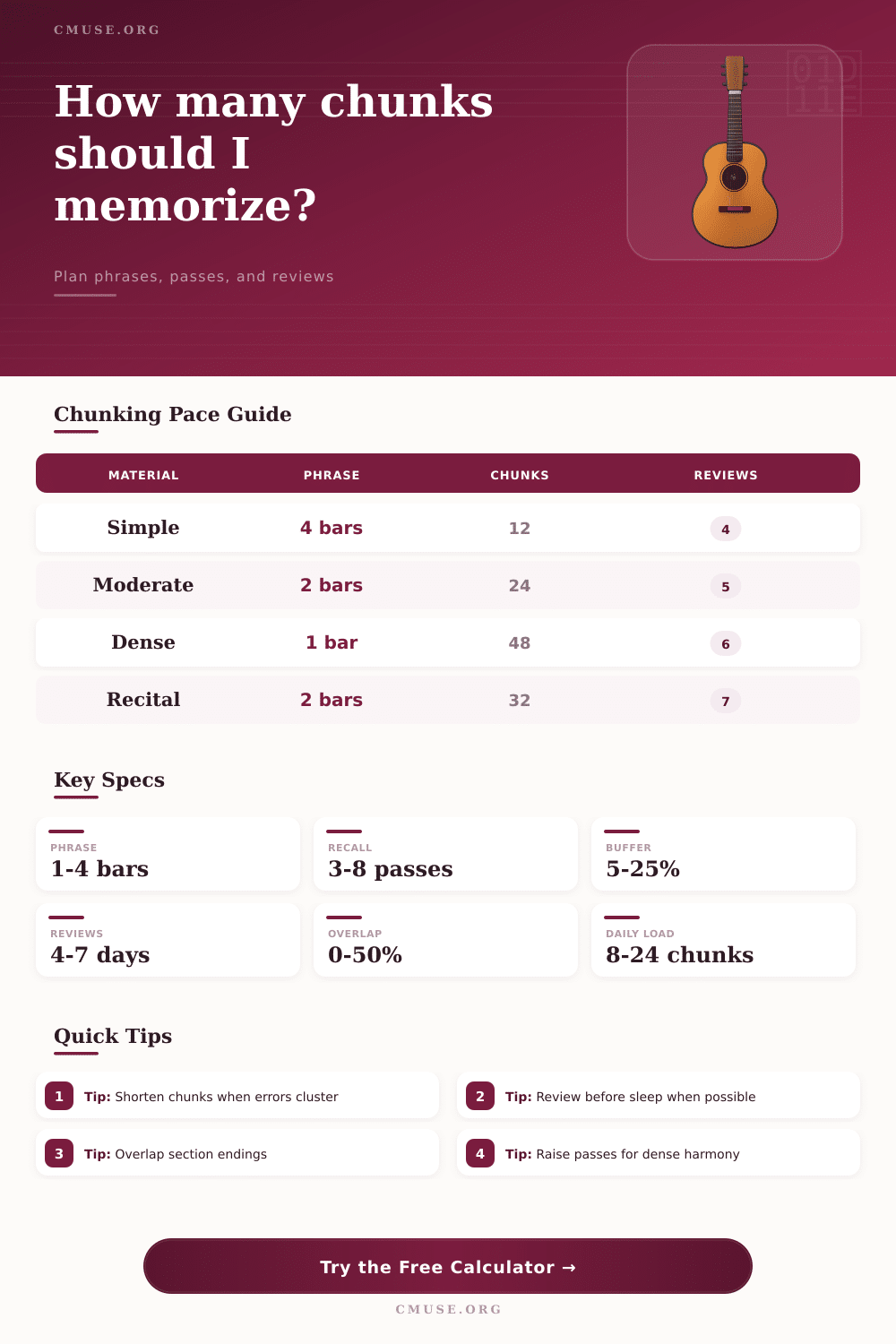
On the page, the reference table presents typical phrase lengths for various types of material and this can be helpful if you’re not sure what comes naturaly. The other variable that tends to trip people up is complexity. A single line melody demand far fewer mental resources than a piece of music that has complex harmonies, dense key changes, or a complicated polyphonic keyboard part.
The more complex the material, the more you want to overlap and give yourself smaller chunks. By overlap, I mean drill the last bar of a phrase with the first bar of next. It is a small thing, but it makes all the difference because memory failure almost always happen during transitions. You might be able to play each section by itself perfectly but freeze at the point where they joins.
The second half of this equation? Space it out. Your cramming sessions creates brittle memories that are easily broken. If you space out your reviews across multiple days, you’ll reinforce these memory traces far better than any amount of cramming. Reviewing on day one, two, four, seven and ten will move your materials from short-term to long-term storage. It will stop the feeling that you know the material, where you feel fluent after a large study session but blank out during the morning hours. The spaced reviews plug the gaps.
There’s no substitute for memorizing, though: It could of been done better by conscious strategy than brute force. The more precise you are about what “chunk” you’re going to work on, and how frequently you’ll review it, the less anxious you’ll feel…and the more likely you are to be reliable.
It doesn’t matter so much whether you’ve internalized something or not; what matters is that you’re able to perform it under pressure, no notes required. As long as you think of memory as a project, with clear steps to completion rather than a vague wish, you’ll begin to overcome the dread of forgetting. Instead of gaping at that wall of music, you’ll recognize the specific actions required to leap over it.