Mediant Calculator
Find the mediant and submediant chords in a key, compare chromatic mediant options, and estimate common-tone voice leading between related third-root chords.
Preset use: Load a key and harmonic color, then adjust spelling, scale type, chord quality, and chromatic mediant direction for your progression.
Calculation Breakdown
| Scale Type | Mediant Degree | Submediant Degree | Common Function |
|---|---|---|---|
| Major | iii, a minor triad on scale degree 3 | vi, a minor triad on scale degree 6 | Relative color, tonic expansion, pop progression link |
| Natural minor | III, a major triad on scale degree 3 | VI, a major triad on scale degree 6 | Relative major lift and darker plagal color |
| Harmonic minor | III+, an augmented triad on scale degree 3 | VI, a major triad on scale degree 6 | Raised leading tone creates a tense mediant sonority |
| Dorian | bIII, a major triad on scale degree 3 | vi°, a diminished triad on scale degree 6 | Modal minor color with a bright sixth degree |
| Root Move | Semitones | Typical Chord Quality | Sound |
|---|---|---|---|
| Upper minor third | +3 | Usually same quality as the source | Strong color shift with compact root motion |
| Upper major third | +4 | Often same quality or parallel major/minor | Bright cinematic lift from the tonic area |
| Lower minor third | -3 | Usually same quality as the source | Dark neighboring third relation |
| Lower major third | -4 | Often same quality or borrowed quality | Broad harmonic turn with strong contrast |
| Key Center | Diatonic Mediant | Diatonic Submediant | Strict Chromatic Mediants |
|---|---|---|---|
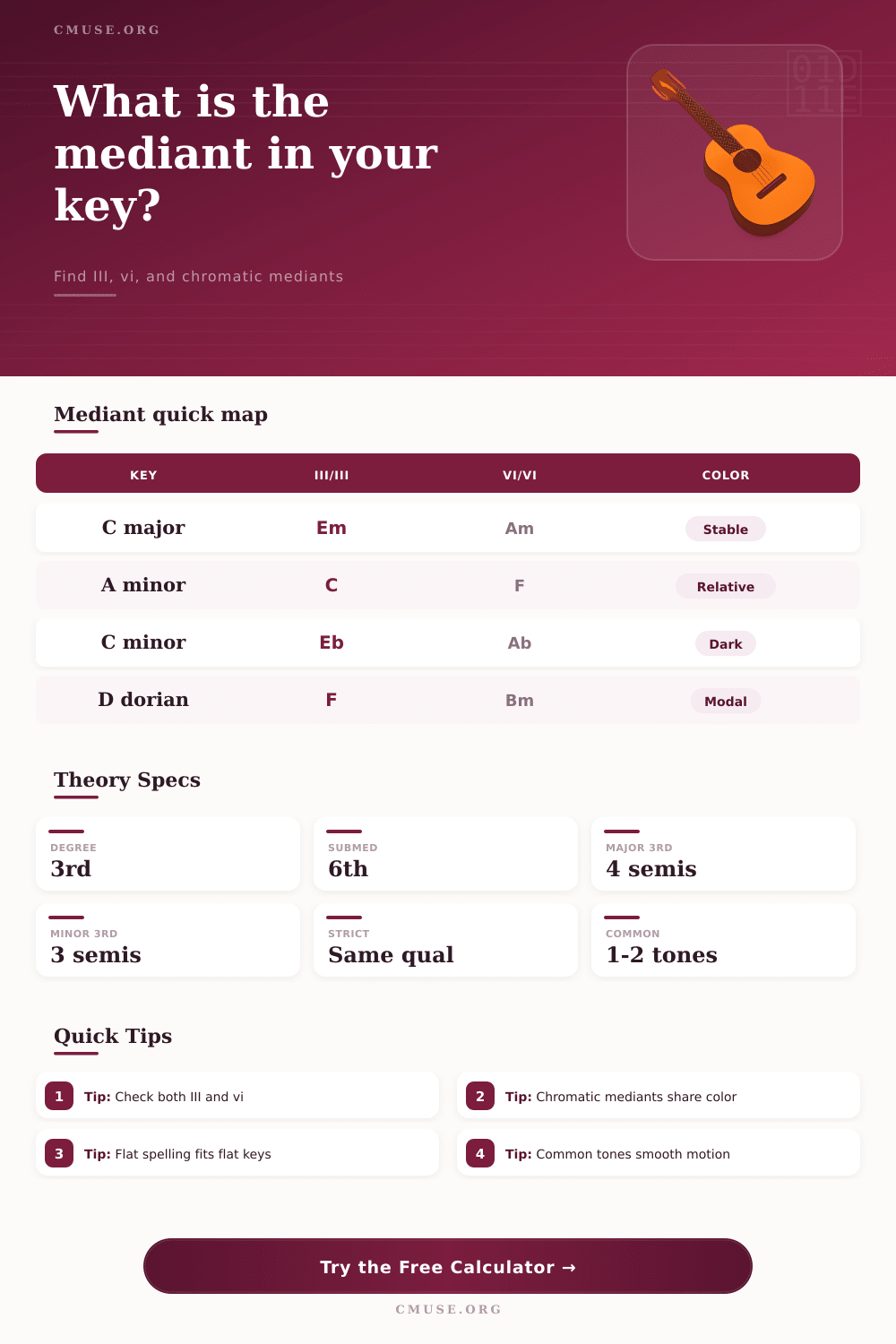
| C major | Em (iii) | Am (vi) | Eb, E, Ab, A major or minor colors |
| A minor | C (III) | F (VI) | C, C#, F, F# for A-root source chords |
| F major | Am (iii) | Dm (vi) | Ab, A, Db, D for F-root source chords |
| E major | G#m (iii) | C#m (vi) | G, G#, C, C# for E-root source chords |
| Candidate | Root | Chord | Voice-leading Notes |
|---|---|---|---|
| Mediant | E | Em | Shares one tone with C major |
| Submediant | A | Am | Shares two tones with C major |
| Chromatic | Eb | Eb | Strict same-quality chromatic mediant |
| Chromatic | Ab | Ab | Strict same-quality chromatic mediant |
The mediant is a chord that exist in the third degree of a scale, and it allow composers to change the sound of a progression by using a chord. For instance, in C major, the mediant is an E minor chord. The E minor chord share two tone with the tonic chord.
By using the mediant, the composer ensure that a musical progression dont sound mechanical. This same principle can be applied to changing to different musical mode or borrowing chords from other keys in the same song. The submediant is the chord located on the sixth degree of the scale.
How to Use the Mediant and Submediant in Songs
Many musician know the difference between the mediant and the submediant. Furthermore, a calculator tool can show how each of these chord changes with the alteration of the musical scale. For instance, changing from a major scale to a harmonic minor scale change the mediant to an augmented chord.
However, the submediant remains the same in a harmonic minor scale. Compare this to a natural minor scale, where the submediant will again be the same than in a major scale. Chromatic mediant are chords whose roots are a third away from the original chord root but dont belong to the current musical key.
Using a calculator tool, a person can select where to move the root of the chord to either a major third up, a minor third down, or both direction. Choosing to move the chord root up a major third will make the chord sound brighter, while moving the root of the chord down a minor third will make the chord sound darker. Furthermore, the tool can calculate how many pitch class the new chord will share with the original chord.
Knowing how many pitch class a chord shares with the original chord allow a composer to determine the type of voice leading that will be used with the chord. Another setting within the calculator is the voice-leading tolerance. A tight voice-leading tolerance will show the chords that share tones that are three semitones or less apart.
A wide voice-leading tolerance allow for adventurous change in the chord progression. Furthermore, the tool will tell the composer whether the change from the original chord to the mediant chord is very smooth, moderate, or bold. This is useful for both film cue and pop song.
One limitation of the calculator is that it cannot account for the memory that a listener has of the chord that came before it. For instance, it is true that the chromatic mediant will share two tone with the chord that comes before it. However, the chromatic mediant may still sound surprising if the rhythm of the music change at the same time.
Furthermore, the diatonic mediant may sound fresh with a melody that leap into the third of the mediant chord. The character of the chord also depend upon the placement of those chord in time. Another consideration in the use of mediants and submediants is in the spelling of the chord.
In keys with flats, using flats instead of sharps for the submediant and the mediant chord is easier for the composer to read. The calculator will respect this setting so that the lead sheet will remain legible. For instance, a performer might get confuse if the sheet music include a G-sharp in a song that is based off F.
The same logic apply to extended chord.
Adding sevenths that are diatonic to the scale does not change the relationship of the roots of the chords but does change which tone are used for common-tone connections between chords. For instance, the major seventh on the mediant chord share tone with the tonic chord but the seventh note of the mediant may need to resolve to the tonic note. The tool include these additional notes so that the composer can decide whether to include them or not in the song.
The calculator make the mediant visible to the composer and scores the voice leading of each chord option. The composer can use this information to determine which chord to use in the song. When presented with these option for each chord, the composer can use what is already in there mind when composing their song.