
The heartbeat of any marching band is its percussion section. Those crisp snaps, rumbling lows, and soaring crashes are what make the music feel alive on the field. Without them the horns might as well be practicing in a vacuum.
Yet for many new band parents or curious students the world of marching percussion looks like a confusing forest of metal, wood, and plastic. Understanding the instruments themselves changes everything. It helps you march better, write better parts, teach more effectively, and simply enjoy the sound more deeply.
The instruments have evolved over decades of innovation and tradition. What works on a still summer morning rehearsal might fall apart during a fast halftime show in ninety-degree heat. Each piece carries its own personality, demands its own technique, and solves a specific musical problem.
The list that follows walks through the core marching percussion instruments you will encounter in most high-school and college ensembles. Each one earns its place by the unique voice it adds to the overall texture.
Essential Marching Band Percussion Instruments to Know
1. Snare Drums
Snare drums sit at the center of the battery sound. These are shallow, ultra-responsive instruments built with high-tension Kevlar heads that can withstand repeated rim shots and stick clicks without losing clarity. A good marching snare cuts through brass and winds even at the back of a stadium.
Players spend years perfecting the controlled buzz roll that gives the snare its signature sustained tone. The instrument looks simple, yet the margin between a clean crisp sound and a muddy mess is razor thin. That is the part most new players miss.
The snare is not just a drum. It is the conductor’s metronome made physical.
2. Tenor Drums
Tenor drums, often called quints or toms depending on how many drums are mounted together, deliver the melodic heart of the percussion section. A typical setup features five or six pitched drums ranging from about 8 to 14 inches in diameter. Because they are tuned to specific notes, skilled tenor players can perform running scales, arpeggios, and intricate patterns that function like a portable drum set with melody.
The physical challenge is real. Marching with twenty pounds of drums strapped to your chest while executing flips and spins requires core strength most people underestimate. When a tenor line locks in with the snares the whole band seems to lift six inches off the grass.
3. Bass Drums
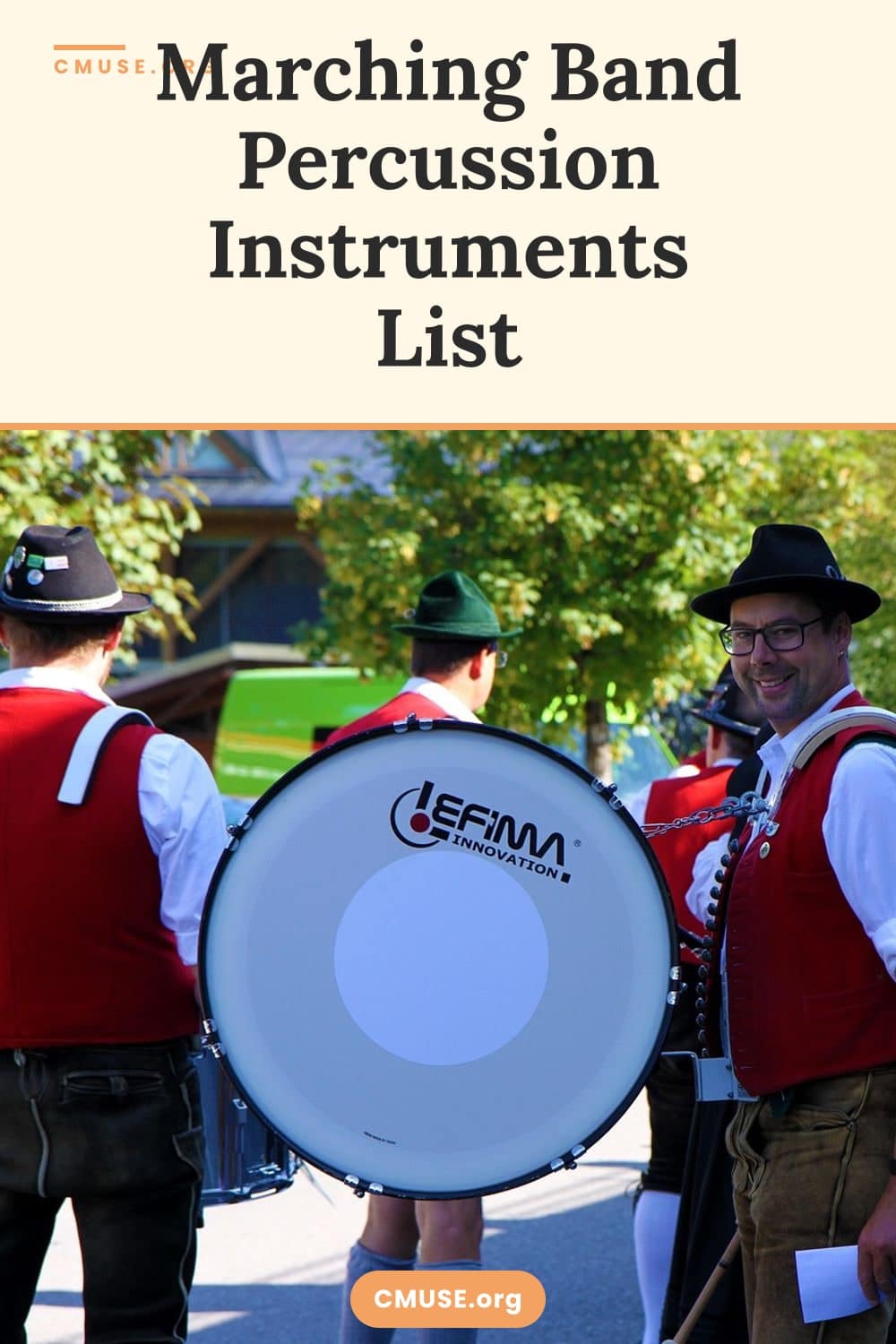
Bass drums provide the low-end foundation that you feel in your ribcage before you hear it. Marching bass lines usually run from 18 to 32 inches in diameter and are carried in sets of five or six players. The largest drum often plays on the beat while smaller ones handle off-beat patterns and feature work.
Their sheer size means they move a lot of air. A well-tuned bass drum line can make an entire stadium vibrate. The trick is learning to mute each stroke with the left hand so the sound stays articulate instead of turning into a muddy wash.
That muting technique separates good lines from great ones. Without clean bass drums the whole ensemble feels late even when it is perfectly on time.
4. Cymbals
Cymbals are the only instrument in the battery that gets played with the whole body instead of just the arms. Marchers hold one cymbal in each hand and crash them together in choreographed patterns that add both visual flair and bright metallic accents. The most common sizes are 18 to 20 inches.
Players must learn to angle the cymbals so they open and close with a clean choke rather than letting them ring forever. A choked cymbal gives a short stab of sound perfect for accenting horn hits. An open crash adds shimmer that floats above the field.
The physicality is deceptive. After four minutes of continuous marching and crashing your shoulders will remind you this is an athletic event as much as a musical one.
5. Front Ensemble
The front ensemble, sometimes called the pit, brings an entirely different set of tools to the marching band. These instruments stay on the sideline or are carried by a small group of players who move on and off the field. Marimbas and xylophones lead the melodic work in the pit.
A marching marimba usually has resonators that have been cut short so the instrument can be rolled without dragging on the turf. The bars are made from synthetic materials that survive temperature swings and rain better than traditional rosewood. Pit players often double on vibraphones which add a shimmering sustain when the motor is engaged.
The contrast between the dry battery sound and the warm ringing tones of the front ensemble is what gives a modern marching show its emotional range.
6. Glockenspiels
Glockenspiels, or bells, cut through everything with their bright piercing tone. These small metal-bar instruments are carried on harnesses or played from a stand in the pit. Because each bar is fixed in place the player can focus entirely on speed and accuracy.
Glock parts often feature rapid scalar passages that would be impossible on a moving marimba. The instrument’s high register makes it perfect for doubling tricky trumpet lines or adding sparkle to woodwind flourishes. Its downside is that one missed note stands out like a firework in daylight.
There is nowhere to hide in a glock part.
7. Timpani
Timpani have found their way into many high-level marching bands over the last twenty years. A single 26- or 29-inch timpano can be mounted on a cart or carried with a lightweight harness. Tuned to the key of the show, these drums add a warm round tone that no other marching instrument can match.
The player uses a foot pedal to change pitch on the fly which opens up chromatic runs and dramatic glissandos. Transporting and protecting timpani during a show is a logistical headache. That is exactly why only bands with strong support crews attempt it.
When it works the payoff is enormous.
8. Auxiliary Percussion
Auxiliary percussion instruments fill in the gaps and add color. Tambourines, cowbells, woodblocks, and shakers get passed around the pit or attached to drum harnesses. A well-placed sleighbell hit during a quiet ballad can raise goosebumps across the stands.
These smaller tools often go to the youngest or newest members of the section. That is a smart tradition. It teaches them to listen critically and find their place inside a much larger sound.
Mastering when not to play is as important as mastering the part itself.
The percussion section as a whole functions like the engine of the marching band. Each instrument has a job description written in decades of marching tradition and acoustic science. The snare drives, the tenors sing, the basses thunder, the cymbals flash, and the front ensemble paints everything with melody and warmth.
Learning these roles does more than help you pick the right instrument at band camp. It teaches you how to listen, how to balance, and how to make one unified voice out of fifteen different timbres.
Next time you stand on the sidelines and feel that familiar lift in your chest when the drums kick in, you will hear each layer more clearly. That awareness is the real gift. The instruments are not just tools.
They are voices in a conversation that has been going on for more than a century, and every new marcher gets to add their own sentence to the story.