🎻 Mandolin String Spacing Calculator
Calculate precise nut & bridge string spacing for any mandolin style — A-style, F-style, octave & more
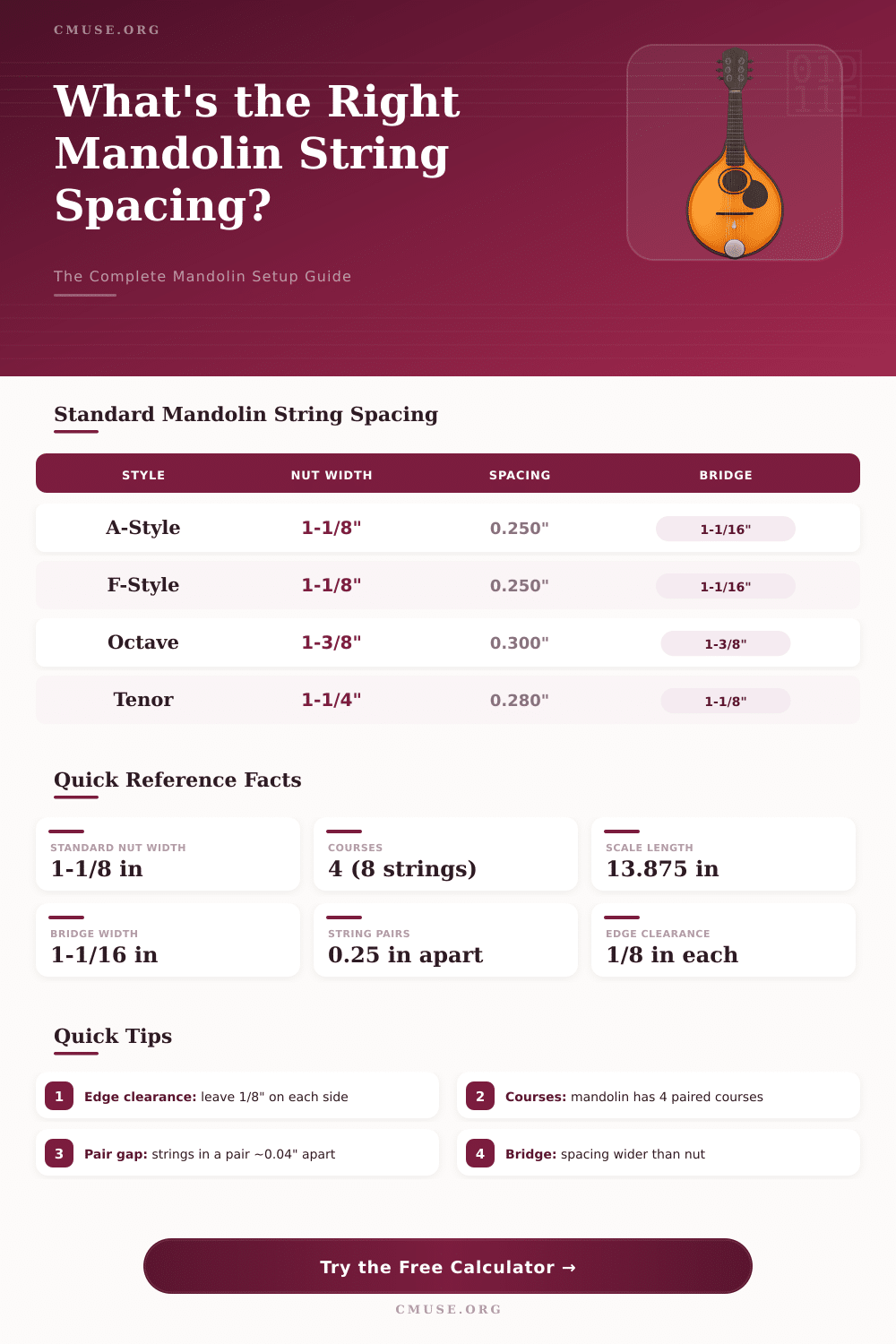
| Style | Nut Width | Bridge Width | Courses | Course Spacing (nut) | Scale Length |
|---|---|---|---|---|---|
| A-Style Standard | 1-1/8" (28.6mm) | 1-1/16" (27.0mm) | 4 | ~0.219" (5.56mm) | 13.875" (352mm) |
| F-Style Standard | 1-1/8" (28.6mm) | 1-1/16" (27.0mm) | 4 | ~0.219" (5.56mm) | 13.875" (352mm) |
| Bluegrass Wide | 1-3/16" (30.2mm) | 1-1/8" (28.6mm) | 4 | ~0.234" (5.95mm) | 13.875" (352mm) |
| Octave Mandolin | 1-3/8" (34.9mm) | 1-3/8" (34.9mm) | 4 | ~0.281" (7.14mm) | 20.0" (508mm) |
| Mandola | 1-3/16" (30.2mm) | 1-1/8" (28.6mm) | 4 | ~0.234" (5.95mm) | 16.5" (419mm) |
| Tenor Mandolin | 1-1/4" (31.8mm) | 1-1/8" (28.6mm) | 4 | ~0.250" (6.35mm) | 14.5" (368mm) |
| Mandocello | 1-3/4" (44.5mm) | 1-5/8" (41.3mm) | 4 | ~0.375" (9.53mm) | 25.5" (648mm) |
| Classical Narrow | 1" (25.4mm) | 15/16" (23.8mm) | 4 | ~0.188" (4.76mm) | 13.875" (352mm) |
| Nut Width | Edge Clear | Playable Width | 4-Course Spacing | 5-Course Spacing | 6-Course Spacing |
|---|---|---|---|---|---|
| 1" (25.4mm) | 1/8" each | 0.750" | 0.188" (4.76mm) | 0.150" (3.81mm) | 0.125" (3.18mm) |
| 1-1/16" (27mm) | 1/8" each | 0.813" | 0.203" (5.16mm) | 0.163" (4.13mm) | 0.135" (3.43mm) |
| 1-1/8" (28.6mm) | 1/8" each | 0.875" | 0.219" (5.56mm) | 0.175" (4.44mm) | 0.146" (3.70mm) |
| 1-3/16" (30.2mm) | 1/8" each | 0.938" | 0.234" (5.95mm) | 0.188" (4.76mm) | 0.156" (3.97mm) |
| 1-1/4" (31.8mm) | 1/8" each | 1.000" | 0.250" (6.35mm) | 0.200" (5.08mm) | 0.167" (4.23mm) |
| 1-3/8" (34.9mm) | 1/8" each | 1.125" | 0.281" (7.14mm) | 0.225" (5.72mm) | 0.188" (4.76mm) |
| 1-3/4" (44.5mm) | 1/8" each | 1.500" | 0.375" (9.53mm) | 0.300" (7.62mm) | 0.250" (6.35mm) |
| String | Course | Tuning | Position from Edge (in) | Position from Edge (mm) | Center from Nut Edge (in) |
|---|---|---|---|---|---|
| 1st (outer G) | G (1st) | G4 | 0.125" | 3.18mm | 0.125" |
| 2nd (inner G) | G (1st) | G4 | 0.165" | 4.19mm | 0.165" |
| 3rd (outer D) | D (2nd) | D4 | 0.344" | 8.74mm | 0.344" |
| 4th (inner D) | D (2nd) | D4 | 0.384" | 9.75mm | 0.384" |
| 5th (outer A) | A (3rd) | A4 | 0.563" | 14.30mm | 0.563" |
| 6th (inner A) | A (3rd) | A4 | 0.603" | 15.32mm | 0.603" |
| 7th (outer E) | E (4th) | E5 | 0.782" | 19.86mm | 0.782" |
| 8th (inner E) | E (4th) | E5 | 0.822" | 20.88mm | 0.822" |
The mandolin string spacing on a mandolin is one of those topics that seems easy, but actually needs quite a lot of precise work. If one spaces the strings too broadly, they do not feel right. The thick bass strings look almost combined.
Each gap must be a bit different, so that it feels good for the player. The rule for mandolin string spacing deals with this trouble, and it works for guitars, basses, mandolins and banjos.
How to Space Mandolin Strings
The rule of mandolin string spacing is figured carefully so that each step gets bigger than the last. When one applies it to nuts, the bass strings get the needed space, and the treble strings end up just right. It works with any nut size, from mandolin-big to extra-broad.
Most mandolins own eight strings, arranged in four pairs or courses. In a course the two strings sound as if one alone. The standard width of nut on F-style mandolin is 1 1/8 inches.
The thick strings should sit within 1/16 inch of the edge of the fretboard. Between the strings of a pair should stay 1/16 inch. The mandolin string spacing between pairs should stay the same, which gives a gap of 5/32 inch.
A width of 30 mm for nut is another popular choice. The distance of the outer G-string and of the outer E-string to the edge of the board beside the nut is around 2/32 inch. Usually the thick strings sit at 1/8 inch from the outer edge of the neck to the middle line of the string.
On instruments with thinner strings, that distance can drop to 0.100 inches. Mandolin strings have high tension, so one can bring them to the edge more than on guitar, because players do not commonly bend the notes.
A sized divider helps well for spacing the nut. One end takes the whole width, while the others mark every string space. It works for mandolins, although the extra strings a bit complicate the task.
While one builds a bridge, the question comes up, weather to keep the full width of every course the same or the spaces between courses the same.
The mandolin string spacing affects the playability a lot. Commonly the spacing inside a pair is around 3 mm, but on some instruments it reaches 4 mm at the bottom G-string and narrows to 3 mm at the upper E. That bigger mandolin string spacing can make the instrument feel harder to play. Players with big fingers sometimes wonder whether a mandolin with broader nut would be useful.
Getting used to broader spacing could slow the change to other mandolins, because most have narrower setup. After the strings are spaced right, the height beside the nut should drop as low as possible without buzz on the first fret. Factory mandolins commonly set the string height beside the nut two or three times higher thannecessary.
A nut that sits too tight will change the sound, no matter how good the instrument is.