Mandocello String Tension Calculator
Estimate paired-course pull for CGDA mandocello sets by scale length, tuning, gauge, construction, and target feel.
C Course
G Course
D Course
A Course
Calculation Breakdown
| Course | Note | Gauge | One String | Course Total | Target Delta |
|---|
| Tuning | Courses Low To High | Use Case | Tension Note |
|---|---|---|---|
| Standard fifths | C2 G2 D3 A3 | Classical mandolin family | Balanced by course |
| Open C-G-C-G | C2 G2 C3 G3 | Drones and chord shapes | D and A courses loosen |
| GDAD variant | G2 D3 A3 D4 | Folk melody voicings | Higher total pull |
| Octave lower pairs | C2/C3 G2/G3 D3 A3 | Broader low courses | Low pairs need care |
| Set Type | C Course | G Course | D Course | A Course | Best Match |
|---|---|---|---|---|---|
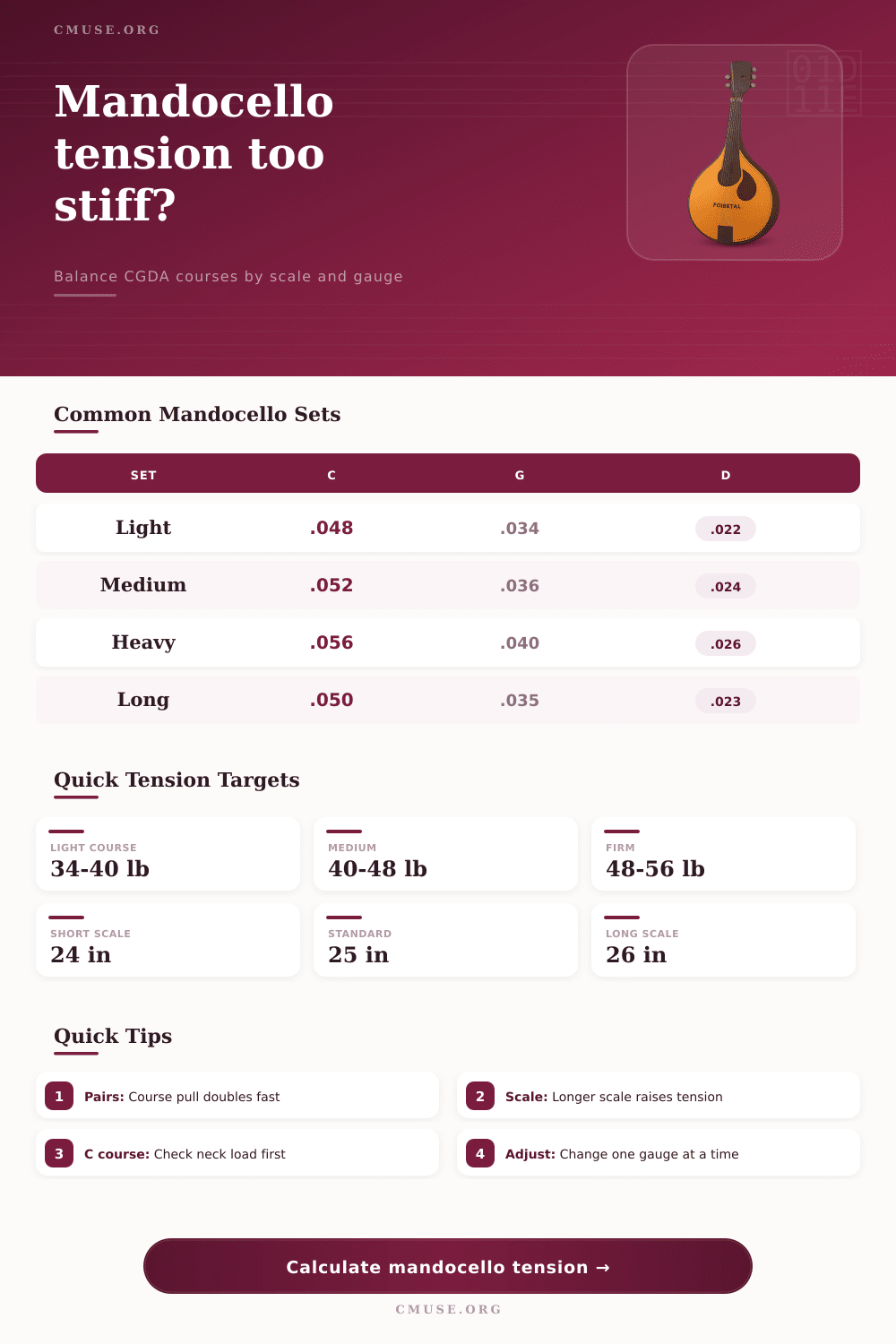
| Light | .048 | .034 | .022 | .015 | Short scale, light touch |
| Medium | .052 | .036 | .024 | .016 | Standard CGDA feel |
| Heavy | .056 | .040 | .026 | .017 | Firm rhythm response |
| Long scale | .050 | .035 | .023 | .015 | 26 inch instruments |
| Scale | Metric | Same Gauge Effect | Typical Adjustment |
|---|---|---|---|
| 24 in | 610 mm | Lower pull | Can use medium gauges |
| 25 in | 635 mm | Reference feel | Medium set baseline |
| 25.5 in | 648 mm | About 4% tighter | Check C and G courses |
| 26 in | 660 mm | About 8% tighter | Often drop one gauge |
| Construction | Model Factor | Feel | Calculator Use |
|---|---|---|---|
| Phosphor bronze wound | 0.82 | Warm, standard | Default mandocello estimate |
| 80/20 bronze wound | 0.80 | Bright response | Slightly lower model pull |
| Nickel wound | 0.78 | Smoother electric feel | Useful on pickup builds |
| Flatwound | 0.86 | Smooth, firmer | Raises estimated load |
| Course Pull | Feel | Good For | Caution |
|---|---|---|---|
| 34-40 lb | Light | Older instruments, easy fretting | Can feel loose low C |
| 40-48 lb | Medium | Most CGDA mandocellos | Watch large spread |
| 48-56 lb | Firm | Strong rhythm attack | Check neck relief |
| 56+ lb | Very firm | Special setups only | May overload light builds |
With the mandocello, you pluck a low C but worry about the neck. It may well snap or even bend under tension. The issue is that it has double courses. That’s the risk with any lute that have pairs. The issue isn’t usually just a single string but two that combine to form one sound. A reasonable gauge for a line doubles its burden on the neck joint and bridge.
Think of tension as force acting on wood, not just a quality of wire. It’s simple physics. But it trips people up even very experienced players, because our intuition doesn’t apply when we get down to really small scales. For example, a longer scale length will need more string tension to reach the same pitch and thickness than a shorter one. That sounds wrong until you think of the leverage involved. You have to pull harder on a twenty-five inch scale then you do on a twenty-four inch neck to achieve standard pitch using an equivalent set of strings.
Why String Tension Matters for Your Mandocello
Your calculator does this math for you. Simply enter your own configuration into box above. You won’t have to guess how much more structural stress that extra inch puts on the instrument.
The standard target tension for most builders fall in the range of forty to forty-eight pounds. That provides enough control for fingerstyle playing without overwhelming older bracing patterns. Thirty-five pounds may be light. It’s floppy but forgiving to vintage necks. Past fifty pounds becomes heavy, it provides a punchy rhythm response. It can cause neck relief problems.
The key is that each of the four course has a consistent tension. When high A stretches only thirty-two pounds while the low C pulls fifty-five, it feels lopsided. You sail over the treble notes and struggle with the bass.
Beyond the numbers on the gauge, there are complexities in material construction. Even within the same gauge category, density of a phosphor bronze wind will be different than a flat wound or nickel option. The model factors takes these nuances into account and apply them to your estimate to make sure it is based off string physics, not theoretical wire strength. When you’re attempting to nail an attack tone, the difference between flatwound and roundwound has everything to do with how mass is distributed across the length as it vibrates. That means they’ll feel more firm.
Tunings change everything. Most strings aims at a standard CGDA fifths tuning as a starting point. Open tunings such as C-G-C-G reduces the tension considerably on the higher courses. It can be liberating when you want lots of drone in folk style playing, but there’s a risk of the higher strings being thin and rattling across frets if gauge is not heavy enough. The load tables that come with the tool illustrate where common presets alter these tensions. As you will easy see, lowering down to say a GDAD variant increases overall pull. Lower gauges then becomes necessary to keep things even.
People also tend to change out a whole set because of brand marketing without even considering what they’re accustomed to or what neck width they like best. First look at the C course. That is where all the action happens and decides how stable the neck will be. Go down a size if it appears aggressive before ordering anything. Individual courses can then be tweaked to your liking. Don’t settle for someone else’s compromise.
Adjusting an eight string instrument is a process that happen incrementally. Each time is part of a larger system that calls for both patience and thinking of it all as one piece of machinery. Once you get it right tension wise, the mandocello does not fight against you anymore. The notes stays in tune, the neck remains straight and the sound comes out clear. You wouldn’t of worried about whether this thing will hold together anymore. It’s now time to focus on making music. And that sense of quiet confidence is well worth the additional calculation.