📏 Male Organ Size Calculator
Measure length & girth accurately — compare with real global statistical data
| Category | Length (inches) | Length (cm) | Approx. Percentile |
|---|---|---|---|
| Very Small | Under 3.5" | Under 8.9 cm | Below 5th |
| Small | 3.5" – 4.5" | 8.9 – 11.4 cm | 5th – 15th |
| Below Average | 4.5" – 5.0" | 11.4 – 12.7 cm | 15th – 35th |
| Average | 5.0" – 5.5" | 12.7 – 14.0 cm | 35th – 65th |
| Above Average | 5.5" – 6.3" | 14.0 – 16.0 cm | 65th – 90th |
| Large | 6.3" – 7.0" | 16.0 – 17.8 cm | 90th – 97th |
| Very Large | Over 7.0" | Over 17.8 cm | Above 97th |
| Category | Girth (inches) | Girth (cm) | Approx. Percentile |
|---|---|---|---|
| Very Narrow | Under 3.5" | Under 8.9 cm | Below 5th |
| Narrow | 3.5" – 4.0" | 8.9 – 10.2 cm | 5th – 20th |
| Below Average | 4.0" – 4.4" | 10.2 – 11.2 cm | 20th – 40th |
| Average | 4.4" – 4.8" | 11.2 – 12.2 cm | 40th – 65th |
| Above Average | 4.8" – 5.2" | 12.2 – 13.2 cm | 65th – 85th |
| Wide | 5.2" – 5.7" | 13.2 – 14.5 cm | 85th – 97th |
| Very Wide | Over 5.7" | Over 14.5 cm | Above 97th |
| Measurement | Flaccid Avg | Erect Avg | Study Source |
|---|---|---|---|
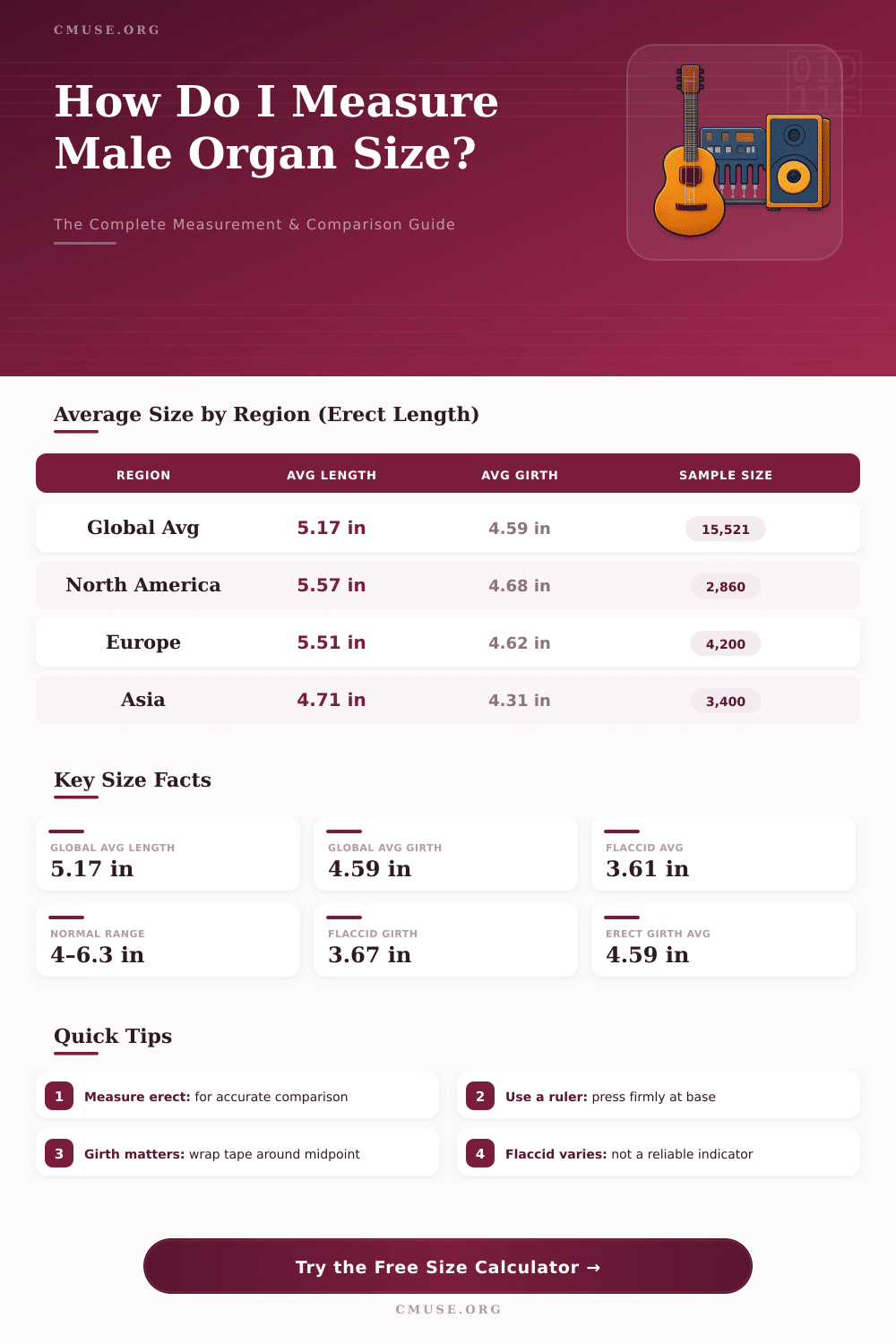
| Length | 3.61" / 9.16 cm | 5.17" / 13.14 cm | BJU Int. 2015 |
| Girth | 3.67" / 9.31 cm | 4.59" / 11.66 cm | BJU Int. 2015 |
| Stretched Length | 5.11" / 12.98 cm | — | BJU Int. 2015 |
| Penile Volume | — | ~77 cm³ | Anatomical Est. |
| Method | Abbrev. | Description | Typical Difference |
|---|---|---|---|
| Bone-Pressed Erect Length | BPEL | Ruler pressed to pubic bone | +0.5" vs NBPEL (est.) |
| Non Bone-Pressed Erect | NBPEL | Ruler at base, no pressure | Standard self-measure |
| Flaccid Stretched Length | FSPL | Flaccid, stretched taut | ≈ Erect length |
| Erect Girth | EG | Tape at mid-shaft erect | Most girth studies use this |
The human body has around 78 organs, and each of them has different form and weight. Skin ranks as the biggest of them. Folks commonly think that the liver or the brain wins that honor, even so skin truly beats.
Between the internal solids, the liver is the most large, after it comes the brain and the lungs. Moreover it weighs the most, around 1,6 kilos.
Which Organs Are Biggest and How They Grow
Oddly, it stays mysterious, how the body decides exactly, whether form and weight must reach every organ during growth. In the fetus, organs start to form about three weeks after the joining. Cell amount and cell weight controls the finish of that size.
If the process fails, it can lead to diseases like ovregrowth.
Study of organ weight involves a mix of internal and outer signals. Those internal help to set the identity of organ, its shape and growth traits. Later, body systems adapt to change and surroundings, changing the growth.
Like this, no only one factor decides, how heavy an organ becomes.
Genetics play a role also. Genetic variety maybe does organ a bit bigger or less big, but usually the changes are not major. Folks with naturally bigger height probably own organs that are more large, although the relation is not direct or linear perfectly.
A person in good health, weighing 225 pounds, usually have organs bigger than one weighing 150 pounds, but not exactly 50 percent more. Men tend to own some organs bigger then women of same height.
Interesting, there is a bit positive link between whole physical weight and sizes of separate organs. Height alone do not describe everything, because it does not consider other parts of physical size. Taller folks commonly require hearts, that work more strongly to pump blood upward to the head and back from the feet, what directly affects the heart.
Not every organ can recover just as well. Blood, liver and muscle fabric fits to handle cell toll. Liver stands out, because even a bit of adult liver, moved to a child (usually around 20 percent); can regrow on its own.
Pancreas works otherwise. Its weight depends on the number of born cells, that sets itself during embryonic growth. Similarly, organs like lung, kidney and thymus can be limited, and that maybe explains, how well they recover.
Between mammals, the size of adult body ranges roughly, from around 1,5 grams at Etruscan shrews until almost 150 millions of grams at blue whales. Even so, all they grow from eggs of almost same size. Portions of various organs and tissue parts change a lot between species, although they share alike physical structure.
Weight matters also for performance of organs. Heart and lungs require well matched size, what does transplant of adult to child less common for them. Even eyes stay aroundlikewise big at every adult, of 23,5 until 24 millimeters.