🎵 Lute String Calculator
Calculate ideal string gauge, tension & frequency for any lute course, scale length & tuning
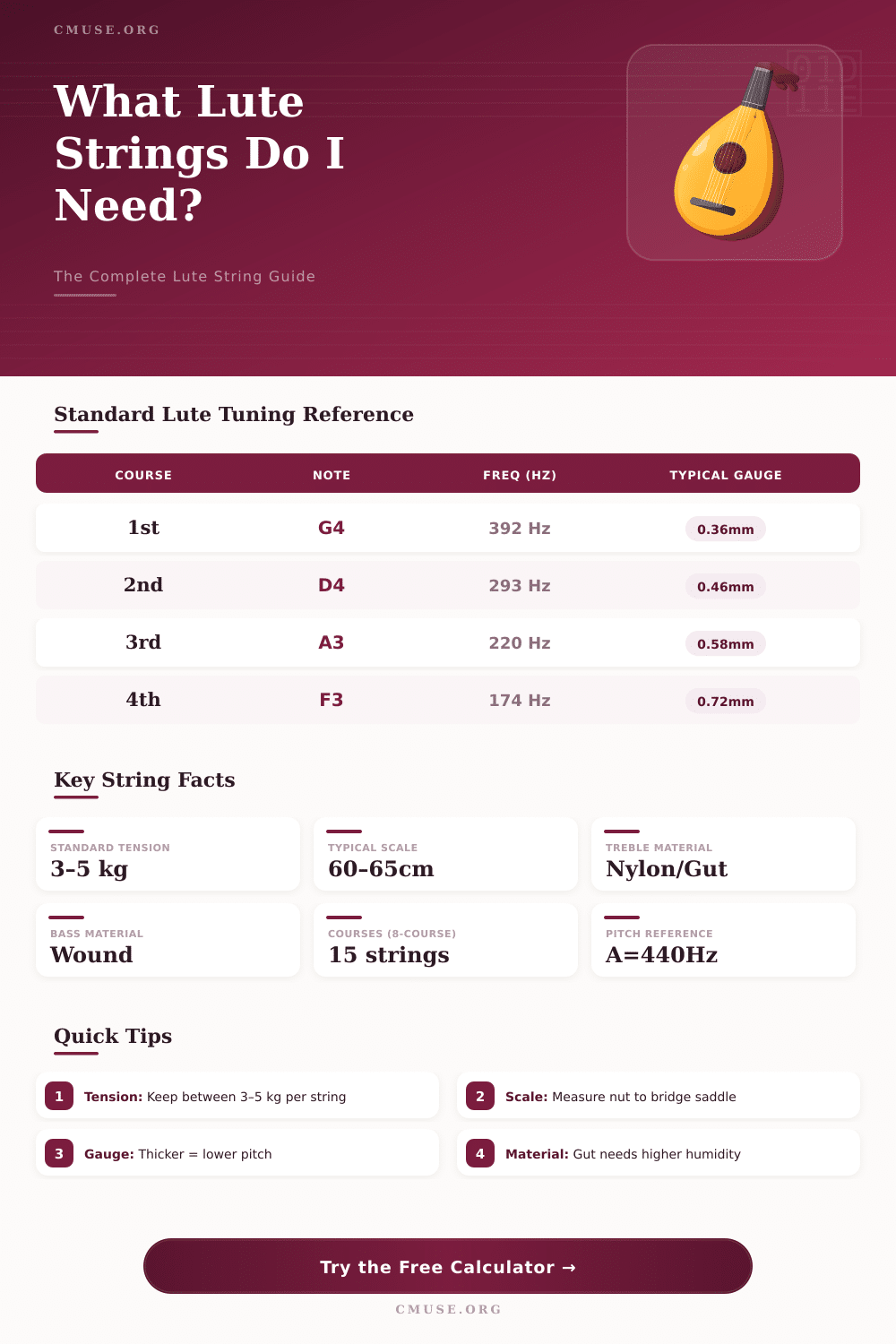
| Course | Renaissance G (440) | Baroque D (415) | Freq at 440Hz (Hz) | Typical Gauge (mm) |
|---|---|---|---|---|
| 1st (Chanterelle) | G4 | F#4 | 392.0 | 0.34–0.40 |
| 2nd Course | D4 | D4 | 293.7 | 0.42–0.50 |
| 3rd Course | A3 | A3 | 220.0 | 0.56–0.66 |
| 4th Course | F3 | F3 | 174.6 | 0.70–0.85 |
| 5th Course | C3 | D3 | 130.8 | 0.90–1.10 |
| 6th Course | G2 | A2 | 98.0 | 1.20–1.60 |
| 7th Course | F2 | G2 | 87.3 | 1.40–1.80 |
| 8th Course | E2 / D#2 | F#2 | 82.4 | 1.60–2.10 |
| Scale Length | Gauge 0.34mm | Gauge 0.38mm | Gauge 0.42mm | Gauge 0.46mm |
|---|---|---|---|---|
| 58 cm | 2.41 kg | 3.01 kg | 3.68 kg | 4.41 kg |
| 60 cm | 2.57 kg | 3.20 kg | 3.92 kg | 4.70 kg |
| 63 cm | 2.84 kg | 3.54 kg | 4.33 kg | 5.19 kg |
| 65 cm | 3.01 kg | 3.76 kg | 4.60 kg | 5.51 kg |
| 68 cm | 3.29 kg | 4.11 kg | 5.03 kg | 6.02 kg |
| 70 cm | 3.49 kg | 4.36 kg | 5.33 kg | 6.38 kg |
| Lute Type | Courses | Scale Length | Typical Tuning | Pitch |
|---|---|---|---|---|
| Renaissance Lute | 6 | 58–63 cm | G Major | 440 Hz |
| 7-Course Lute | 7 | 60–65 cm | G Major + F2 | 440 Hz |
| 8-Course Lute | 8 | 62–67 cm | G Major ext. | 440 Hz |
| 10-Course Lute | 10 | 63–68 cm | G or D | 415/440 |
| 11-Course Baroque | 11 | 65–70 cm | D Major | 415 Hz |
| 13-Course Baroque | 13 | 65–72 cm | D Major/Minor | 415 Hz |
| Archlute | 13–14 | 65+90 cm | G or D | 415 Hz |
| Theorbo | 14 | 75–100 cm | G Major (re-ent.) | 415 Hz |
| Angélique | 17 | 70–80 cm | D Minor diat. | 415 Hz |
| Orpharion | 6 | 52–58 cm | G Major | 440 Hz |
| Mandora | 6 | 54–60 cm | G Major | 440 Hz |
Lute strings come in various kinds, between gut, nylon, nilgut and carbon. Strings from gut sound rich and strong especially the highest. Nilgut versions offer fresh sound, that stays clear and quiet, even though they are not like real gut, or like nylon.
The brand Aquila with its nilgut strings ensure pleasant playing and reliable tone for renaissance lutes. For clear nylon or carbon strings one measures the width by means of millimeters.
How to Choose Lute Strings
For choosing the right strings for a lute, many things matter. The length of the vibrating part, from the bridge until the nut, plays a role. Also the pitch of the instrument, that one calls according to the highest lute string, is important.
The style of setup, renaissance or baroque (affects the choice). Moreover, the quality of the sound is a factor. Most lutes use the modern tuning at 440 Hz, or the baroque version, that is a half step lower at 415 Hz.
Tension of the strings also matters, because thin ones with low tension or thick with a bit higher can give the same note. Even so, lutes do not handle too strong pull, because their build stays too delicate.
Simple renaissance lutes usually have six pairs of strings. The highest, called the chanter, commonly are alone. So, one has five pairs with two strings plus one alone, what does eleven entirely.
Some models have seven or eight pairs. Tuning lutes can bee difficult, because it uses pegs instead of machines. Imagine a twelve string guitar with such tools, that would be a difficult task, and a lute is something alike, only with maybe more than twelve strings.
Average guitar strings do not really work for a lute. Even those for oud do not suit for renaissance setup. A browser for lute strings can help find the right width.
One plays the lute by means of fingers, it has a shorter neck then guitar, but broader than typical classical. Some have moving nuts from gut, that one binds around the neck.
Too high action makes the strings hard to play in tune. Lutes need higher action than steel string guitars, but not too much, only to escape buzzing. To lower it, one commonly removes the top and shaves wood from the body, so a luthier should handle that.
Rough spots at the nut can cause breaking of strings. Let a luthier smooth the nut, and the problem goes away. Tension of strings on a lute is much lower than on a classical guitar.
The sound of a lute changes according to the place of plucking, frommetallic beside the bridge to round close to the neck.