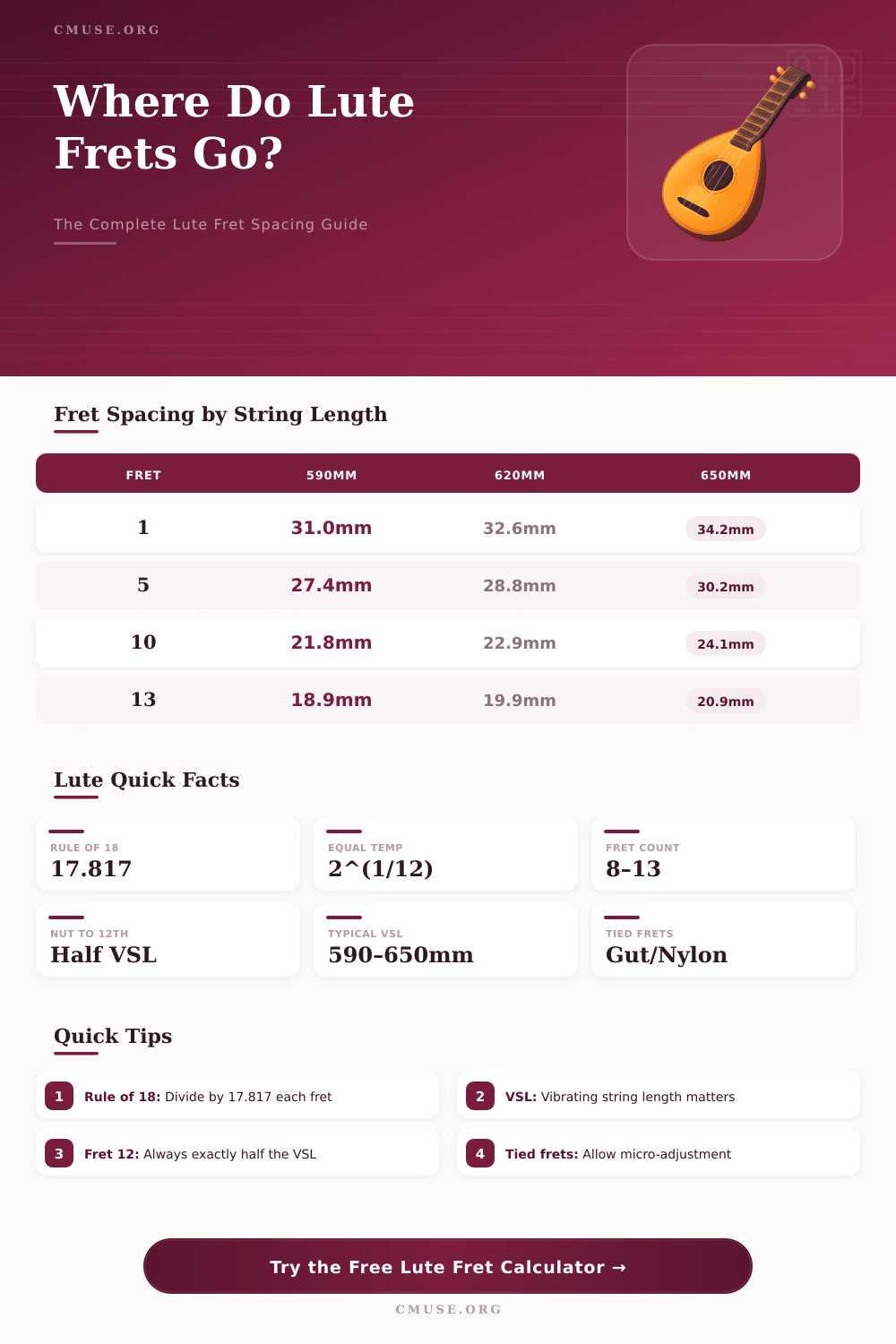
🎵 Lute Fret Calculator
Calculate precise fret positions using equal temperament or the historical Rule of 18
| Lute Type | VSL (mm) | VSL (inches) | Typical Frets | Tuning |
|---|---|---|---|---|
| Small Renaissance | 550–575mm | 21.7–22.6" | 8 | g’ d’ a f c G |
| Renaissance Lute | 575–600mm | 22.6–23.6" | 8–9 | g’ d’ a f c G |
| Baroque Lute (11-course) | 600–630mm | 23.6–24.8" | 10–12 | f’ d’ a f d A |
| Archlute | 630–660mm | 24.8–26.0" | 10–13 | e’ b g d A E |
| Theorbo | 730–820mm | 28.7–32.3" | 8–10 | a e B G D A |
| Oud (Arabic) | 610–650mm | 24.0–25.6" | No frets | Various |
| Vihuela | 620–650mm | 24.4–25.6" | 10 | g’ d’ a f c G |
| Fret # | Distance from Nut (590mm) | Distance from Nut (620mm) | Distance from Nut (650mm) | Interval |
|---|---|---|---|---|
| 1 | 33.1mm | 34.8mm | 36.5mm | Minor 2nd |
| 2 | 64.4mm | 67.6mm | 70.9mm | Major 2nd |
| 3 | 93.9mm | 98.6mm | 103.4mm | Minor 3rd |
| 4 | 121.9mm | 128.0mm | 134.2mm | Major 3rd |
| 5 | 148.4mm | 155.8mm | 163.3mm | Perfect 4th |
| 6 | 173.4mm | 182.1mm | 190.9mm | Tritone |
| 7 | 197.0mm | 206.8mm | 216.7mm | Perfect 5th |
| 8 | 219.2mm | 230.1mm | 241.2mm | Minor 6th |
| 9 | 240.1mm | 252.1mm | 264.2mm | Major 6th |
| 10 | 259.8mm | 272.8mm | 286.0mm | Minor 7th |
| 11 | 278.2mm | 292.1mm | 306.2mm | Major 7th |
| 12 | 295.0mm | 310.0mm | 325.0mm | Octave (1/2 VSL) |
| 13 | 310.8mm | 326.5mm | 342.2mm | Minor 9th |
| Fret Interval | 590mm VSL | 620mm VSL | 650mm VSL | Note (from open A) |
|---|---|---|---|---|
| Open → Fret 1 | 33.1mm / 1.30" | 34.8mm / 1.37" | 36.5mm / 1.44" | A→A#/Bb |
| Fret 1 → Fret 2 | 31.3mm / 1.23" | 32.9mm / 1.30" | 34.4mm / 1.35" | Bb→B |
| Fret 2 → Fret 3 | 29.5mm / 1.16" | 31.0mm / 1.22" | 32.5mm / 1.28" | B→C |
| Fret 3 → Fret 4 | 27.9mm / 1.10" | 29.3mm / 1.15" | 30.7mm / 1.21" | C→C# |
| Fret 4 → Fret 5 | 26.3mm / 1.04" | 27.6mm / 1.09" | 29.0mm / 1.14" | C#→D |
| Fret 5 → Fret 6 | 24.9mm / 0.98" | 26.1mm / 1.03" | 27.4mm / 1.08" | D→D# |
| Fret 6 → Fret 7 | 23.5mm / 0.93" | 24.7mm / 0.97" | 25.9mm / 1.02" | D#→E |
| Fret 7 → Fret 8 | 22.2mm / 0.87" | 23.3mm / 0.92" | 24.4mm / 0.96" | E→F |
The Lute Fret are tied to the neck and usually made from the same gut skin, from that one does also the strings. Hence one can them space as desired by the musician. The most many lute players favor spacing different than the equal spacing of the modern guitar.
Here one from the traits, that identifies the lute from the guitars.
Lute Fret Spacing and Setup
When one sees photographs or films about lute players, the Lute Fret commonly seem spaced unequally, instead of in equal gaps. Sometimes they not even show nearly parallel to the others. To guitar players that can seem odd in the start.
The old way to estimate the position of every Lute Fret calls the Rule of 18. It works by means of division of the scale length, reduced by means of the distance of the nut until the prior Lute Fret, divide by means of 18, thus down repeated. Stories mention even older methods.
It involves use of thin ruler, cut according to the precise length of nut until teh bridge. The midpoint of that ruler points the place of the octave. Later one shares the distance of that center until the nut edge in three matches, for find the seventh Lute Fret, that results in perfect fifth.
On the net there are fret computers, that determine the spacing according to the length of the strings. Those programs fit to estimate positions for various setups, not limited to the equal setup.
For lute players it became usual to use uneven setups, chiefly because of practical reasons. Set like this, the lute sounds more smooth, more strongly and more harmonic in group with keyboard instruments, harps and other string instruments. Arguments four equal setup are convincing, even so exist also solid proofs favorable to final corrections by means of hearing instead of strict theory about fret spacing.
Actually the string leans a lot down of the nut, what does it the long side of triangle. Because of that the vibrating part of the string becomes longer, than the Rule of 18 would predict. That helps to understand, from where comes the commonly used tilt of the bridge saddles for correction.
Before the lutes had movable Lute Fret as ties, for ease the setup, also because the gut strings ranged a lot in thickness.
The liable vibration truly only helps the thick strings. No matter the chosen angle, the Lute Fret stays straight, so the pitch of the middle strings are not easily changed by means of that method.
The lutes own shorter necks than the guitars. The spacing of Lute Fret on the lute is like to that of guitar with capo on the third Lute Fret. Little classical guitar has Lute Fret spaced more near the nut than full adult.
The amount of Lute Fret on the neck depends on the ratio between body, neck and the place, where the bridge is stuck on the body. Hence one lute can have more Lute Fret on the neck than other model with other form.
About the height of Lute Fret on the body, the simple advice is choose the most possible height before starting the drone. Baroque lute should have graceful curve on the fingerboard, what alters the shape, according to that the fingers touch the strings. Usually the action is higher beside the bass strings, and the height of the most bottom string in the eighth Lute Fret should not pass 4,5 mm.
Many estimate 3,5 until 4 mmas ideal.