🎧 LUFS Calculator
Calculate integrated loudness, compare to streaming targets & get platform compliance status
| Platform / Standard | Target LUFS | Max True Peak | Tolerance | Normalization |
|---|---|---|---|---|
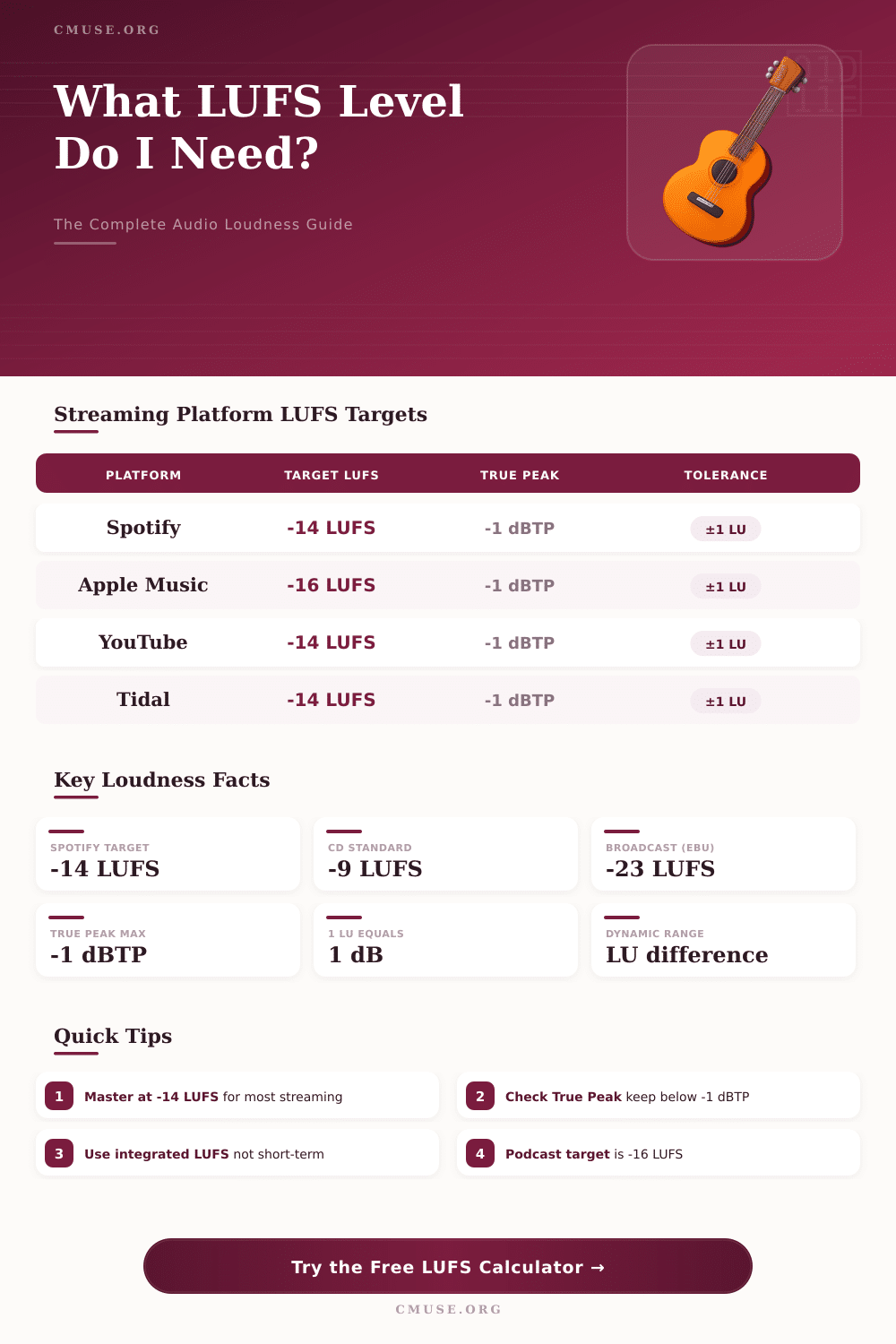
| Spotify | -14 LUFS | -1 dBTP | ±1 LU | Yes (down only) |
| Apple Music | -16 LUFS | -1 dBTP | ±1 LU | Yes (down only) |
| YouTube | -14 LUFS | -1 dBTP | ±1 LU | Yes (both) |
| Tidal | -14 LUFS | -1 dBTP | ±1 LU | Yes (down only) |
| Amazon Music | -14 LUFS | -2 dBTP | ±1 LU | Yes |
| SoundCloud | -14 LUFS | -1 dBTP | ±2 LU | Yes |
| Deezer | -15 LUFS | -1 dBTP | ±1 LU | Yes |
| Podcast (Apple) | -16 LUFS | -1 dBTP | ±1 LU | Recommended |
| EBU R128 (Broadcast) | -23 LUFS | -1 dBTP | ±0.5 LU | Required |
| ATSC A/85 (US TV) | -24 LUFS | -2 dBTP | ±2 LU | Required |
| Netflix | -27 LUFS | -2 dBTP | ±1 LU | Required |
| Amazon Prime Video | -27 LUFS | -2 dBTP | ±1 LU | Required |
| Integrated LUFS | Approx RMS (dBFS) | Difference | Typical Use Case |
|---|---|---|---|
| -6 LUFS | -8 dBFS | ~2 dB | Heavily compressed club masters |
| -9 LUFS | -11 dBFS | ~2 dB | CD standard, loud pop/rock |
| -12 LUFS | -14 dBFS | ~2 dB | Loud commercial masters |
| -14 LUFS | -16 dBFS | ~2 dB | Spotify / YouTube target |
| -16 LUFS | -18 dBFS | ~2 dB | Apple Music / Podcast target |
| -18 LUFS | -20 dBFS | ~2 dB | Classical, acoustic, wide dynamic |
| -23 LUFS | -25 dBFS | ~2 dB | EBU R128 broadcast standard |
| -27 LUFS | -29 dBFS | ~2 dB | Netflix / film dialog |
LRA measures dynamic variation in LU. Music: 6–12 LU typical. Podcast / speech: 3–7 LU. Film dialog: 15–20 LU. A low LRA (under 4) may sound over-compressed; a high LRA (over 20) may feel inconsistent for broadcast.
True Peak (dBTP) catches inter-sample peaks that standard peak meters miss. Always keep True Peak at or below -1 dBTP for streaming. For broadcast and film, -2 dBTP is the safe maximum. Exceeding these limits can cause distortion during codec encoding (e.g. AAC, MP3).
| Term | Full Name | Standard | What It Measures |
|---|---|---|---|
| LUFS | Loudness Units Full Scale | ITU-R BS.1770 | Perceived loudness (K-weighted) |
| LKFS | Loudness, K-weighted, Full Scale | ATSC A/85 | Same as LUFS (different name) |
| LU | Loudness Unit | EBU R128 | Relative difference (1 LU = 1 dB) |
| LRA | Loudness Range | EBU Tech 3342 | Dynamic variation (10th–95th %ile) |
| dBTP | decibels True Peak | ITU-R BS.1770-4 | Inter-sample peak level |
| dBFS | decibels Full Scale | General | Sample peak level |
| RMS | Root Mean Square | General | Average power (non-K-weighted) |
| Content Type | Recommended LUFS | True Peak Max | Typical LRA |
|---|---|---|---|
| Pop / EDM / Hip-Hop | -14 to -9 LUFS | -1 dBTP | 4–8 LU |
| Rock / Alternative | -14 to -10 LUFS | -1 dBTP | 5–10 LU |
| Classical / Acoustic | -18 to -14 LUFS | -1 dBTP | 10–20 LU |
| Podcast / Spoken Word | -16 to -19 LUFS | -1 dBTP | 3–7 LU |
| Film / TV Dialog | -27 to -23 LUFS | -2 dBTP | 15–20 LU |
| Game Audio (FX) | -20 to -16 LUFS | -1 dBTP | 8–15 LU |
| Commercial / Ad | -12 to -10 LUFS | -1 dBTP | 3–6 LU |
| Club / DJ Master | -8 to -6 LUFS | -0.3 dBTP | 2–5 LU |
LUFS measure loudness as human ear hear sound. Many use peak meter to measure sound. However, peak meters only measure the peak of the sound wave.
Another meter that many use is the RMS meter. However, RMS meters does not take into account how human ears can hear different frequency. The LUFS measurement does take into account the human ear by using a K-weighting filter to enhance the bass and treble frequencies that the human ear picks up best.
How LUFS Measures Loudness
Then, it will measure the loudness of the track from start to finish. Streaming platform use LUFS to even normalize the sound from track to track. Normalization is the process of even the volume of a track to meet a standard.
If the track is too loud, it will even it out to meet the standard. However, if the track is too quiet, streaming platform will rarely even that out. Instead, people must aim for the correct LUFS reading to even ensure that there track does not lose energy due to automatic volume reduction.
For instance, Spotify will even out sound to -14 LUFS. However, for broadcast television it will even out sound to -23 LUFS because they want to leave room for dialogue. For podcasts it will even out sound to -16 LUFS as it is the most comfortlevel for the ears of the listener.
Another measurement that producers use in music production is the True Peak measurement. This measurement is used to measure the actual peak of the waveform to avoid distortion throughout the song. When a song is being saved in MP3 or AAC formats, it can cause distortion in the sounds if the True Peak is too high.
In that case, producers and engineers must aim for a maximum True Peak of -1 dBTP to ensure that the highs of the track are evened out so that there is no distortion throughout the song. Otherwise, the song may sound harsh or even mangled after it is converted into the MP3 or AAC format. Another important measurement that is made is the Loudness Range or LRA.
The LRA measures the difference between the quiet parts of a song and the loud parts of the song. The lower the LRA the more compression there is in the song. A high LRA means there is a higher difference between quiet and loud parts of the song.
For example, pop songs has an LRA between 4 and 8 LU. However, classical music has an LRA of 20 LU. It is important to even ensure that the LRA is within an appropriate range so that the quiet parts of the song are not too low in volume then the loud parts of the song.
Another measurement that can be taken is the short term loudness. This measures the loudness of the song in three-second intervals. This can show the difference in loudness between certain parts of the song compared to other parts.
For instance, a verse may be quieter than a chorus. The next measurement is momentary loudness. This measurement looks at individual instances in the song.
For instance, there may be a kick drum hit in a song. The momentary loudness will pick that up. Even with the loudness of kick drums it is important to ensure that the short-term loudness and momentary loudness measurements are within the proper range.
If the verse in the song is 6 LU units lower than the chorus it may cause the listener to have to adjust the volume knob for the song. This will break the immersion of the listener in the song. Finally, there are compliance checks for the track.
These allow engineers to see if the track is compliant with the requirements of the different platforms. For example, a compliance check can determine if a track is suitable for YouTube or if it is risky for the song to be on Netflix. Different content has different requirements for loudness.
For example, film dialogue will even out to -27 LUFS. However, club masters will even out sound to -6 LUFS so it makes an impact on the dance floor. There are different standards for different content, so people must select their content type within the loudness measurement software for it to provide more accurate measurements regarding LUFS for that specific content type.
You should of checked the settings carefully. It isnt always easy to get the perfect sound. Actually, some people find it difficult to balance all these things, but its worth it to make sure your track sounds good.
The rooms size can also affect how you hear the LUFS levels. Most engineers find that they can recieve better results if they use a calibrated room.