Audio Low-Pass Filter Calculator
Design RC, RL, active, or DSP low-pass filters for smooth roll-off, speaker protection, and clean top-end control.
🎧 Preset Low-Pass Targets
⚙ Filter Setup
Passive RC low-pass
A source resistor and shunt capacitor create a simple low-pass corner. The real cutoff shifts with source and load impedance.
📊 Reference Tables
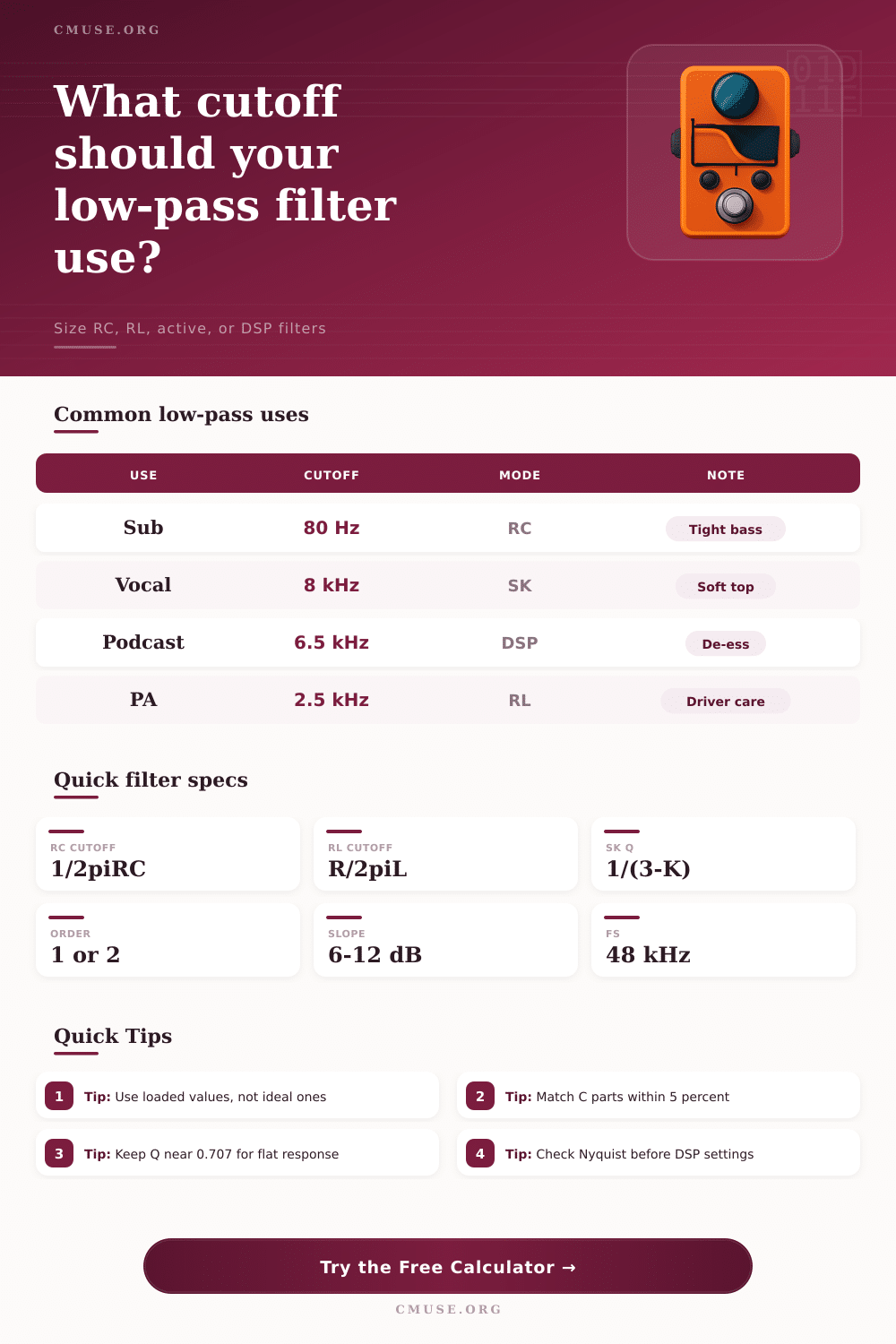
| Use | Freq | Mode | Note |
|---|---|---|---|
| Sub | 80 Hz | RC | Tight bass |
| Vocal | 8 kHz | SK | Soft top |
| Podcast | 6.5 kHz | DSP | De-ess |
| PA | 2.5 kHz | RL | Driver care |
| Mode | Formula | Best for | Note |
|---|---|---|---|
| RC | 1 pole | Smooth cut | Simple load |
| RL | R/2piL | Speaker use | Coil based |
| SK | Q = 1/(3-K) | Flat 2nd | Active gain |
| DSP | RBJ biquad | Retuning | Stable coef |
🧰 Filter Block Specs
💡 Practical Tips
A low-pass filter allow engineers to attenuate frequencies above a chosen cutoff frequency. Low-pass filters allows low frequencies to pass through the circuit, but they also reduces the volumes of high frequencies. Use a low-pass filter if you want to preserve certain frequencies and remove others.
For example, if you are mixing audio for a subwoofer, a low-pass filter can keep high frequencies from bleeding into the low frequencies. Another example of when to use a low-pass filter is to protect a PA systems driver from high-frequency sound wave. Several different type of low-pass filters exist.
Low-Pass Filters and How to Use Them
Passive RC low-pass filters use a resistor and capacitor. Passive RC low-pass filters is useful for applications involving line-level audio equipment. RL low-pass filters use an inductor and a resistor instead of a capacitor.
Engineers often use RL low-pass filters in speaker systems to protect the tweeters from high frequencies because inductors can handle high electrical current better than capacitors. Active Sallen-Key low-pass filters use an operational amplifier to provide more control over the filter. These active Sallen-Key circuits allow the engineer to adjust the damping of the low-pass filter.
Finally, DSP biquad low-pass filters are software-based and used in digital audio workstation to mix audio tracks. These software-based filters allow engineers to change the filter coefficients of a low-pass filter. When creating a passive low-pass filter, you must take the impedance of the source and the load of the circuit into consideration.
The impedance of the source and the load form a voltage divider that can change the corner frequency of the filter. The theoretical corner frequency is 1 divided by 2 pi R C. However, if the load of the filter change the corner frequency, the actual corner frequency can be different. In this case, calculate the loaded frequency of the filter.
The loaded frequency is the frequency the human ear will hear when the low-pass filter is in the circuit. The Q factor of a low-pass filter describes the peakiness of the filter’s response to frequencies. A Q factor of 0.707 will create a Butterworth response.
A Butterworth response does not have any ripple in the frequency response between the passband and stopband. If the Q factor is increased, a resonant bump will occur at the cutoff frequency of the low-pass filter. A resonant bump can cause phase issues in audio applications.
The slope of a low-pass filter determines the roll-off of high frequencies. The first-order low-pass filter rolls off at 6 dB per octave. A second-order low-pass filter rolls off at 12 dB per octave.
Use these filters depending on the attenuation of high frequencies needed in your project. For example, place a low-pass filter at 80 Hz in a subwoofer channel to ensure the bass frequencies dont interfere with the middle frequencies of the song. Additionally, place a low-pass filter at 8 kHz in a vocal audio channel to soften the high frequencies of the vocals.
Another factor to consider when building a low-pass filter is the component tolerance. Component tolerance is the actual value of the components in the circuit relative to the value printed on the component. For example, a capacitor’s printed value may state that it has a capacitance of 1000 µF with a five percent tolerance.
In this case, the actual capacitance could be five percent higher or lower than 1000 µF. Because the tolerance can change the cutoff frequency of the low-pass filter, it is important to measure the cutoff frequency of the built low-pass filter. Finally, consider the limitation of the hardware. For instance, high temperatures can alter the value of capacitors.
Additionally, inductors can become saturated with high levels of electrical power. In either of these case, you should of test the low-pass filter in the hardware to ensure it works as expected. It’s important to recieve accurate results.
There is alot of variables to check based off how the componets are layed out. You’ll need to check the rooms size and the moddern equipment too. Naturaly, you’re also going to want to check the furnitures.