Loudspeaker Sensitivity Calculator
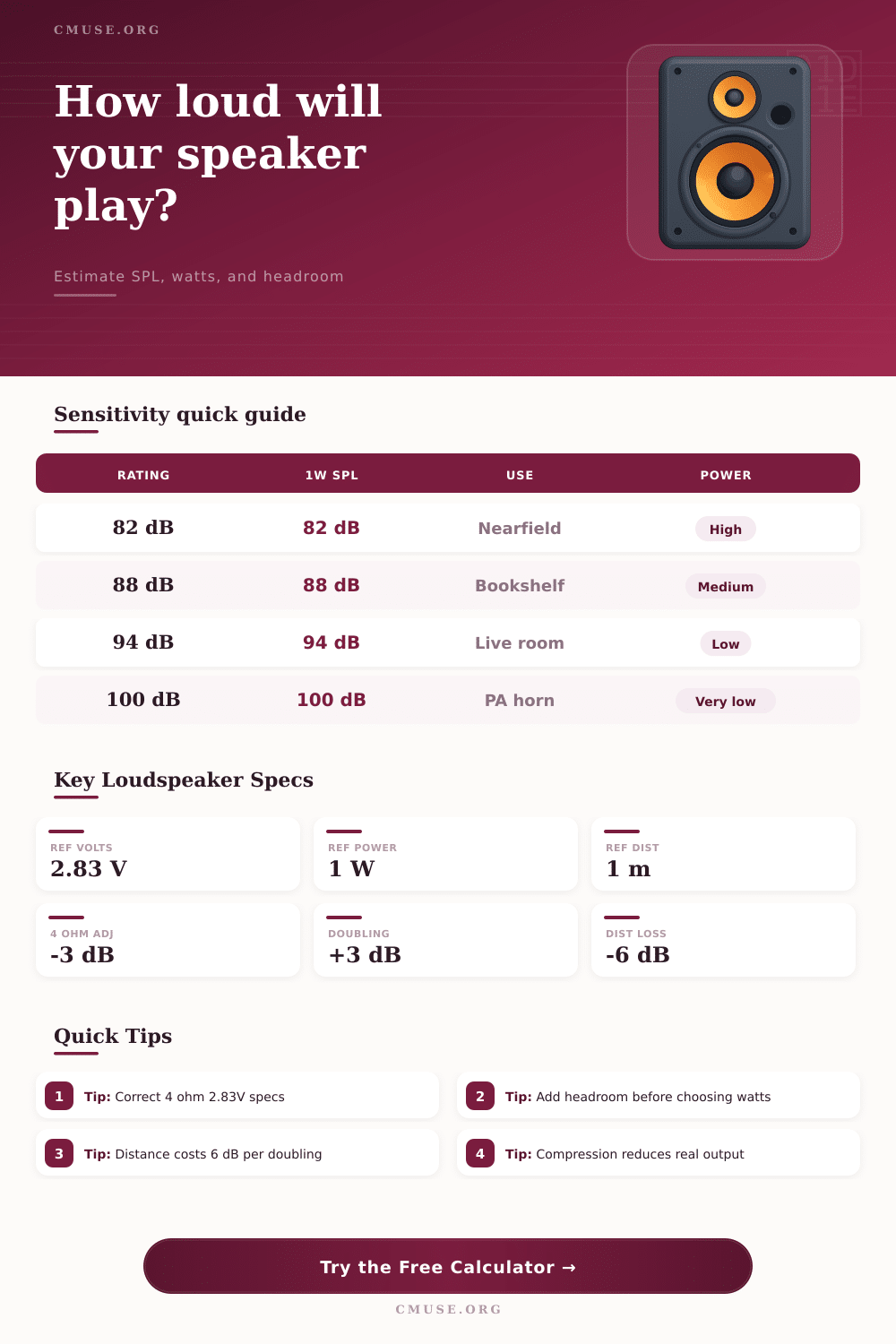
Convert sensitivity ratings, correct 2.83V specifications for impedance, estimate listening SPL, and calculate amplifier power for target loudness with headroom.
🔊 Quick Loudspeaker Presets
🎚 Sensitivity Inputs
Formula Trace
📊 Loudspeaker Spec Grid
📐 Reference Tables
| Nominal Impedance | Power at 2.83V | Correction to 1W | How to Read It |
|---|---|---|---|
| 4 ohms | 2.00 W | -3.0 dB | A 90 dB 2.83V speaker is about 87 dB at 1W/1m. |
| 6 ohms | 1.33 W | -1.3 dB | A 90 dB 2.83V speaker is about 88.8 dB at 1W/1m. |
| 8 ohms | 1.00 W | 0.0 dB | 2.83V and 1W sensitivity are effectively equivalent. |
| 16 ohms | 0.50 W | +3.0 dB | A 90 dB 2.83V speaker is about 93 dB at 1W/1m. |
Correction values assume nominal impedance. Real loudspeaker impedance changes with frequency, so measured data gives the best final comparison.
| Sensitivity Class | Typical 1W/1m Range | Common Speaker Type | Power Planning Note |
|---|---|---|---|
| Low sensitivity | 80 to 85 dB | Small sealed monitors, compact hi-fi | Needs much more amplifier power for the same SPL. |
| Moderate sensitivity | 86 to 90 dB | Bookshelf and many floorstanding speakers | Works well in small and medium rooms with normal distances. |
| High sensitivity | 91 to 96 dB | Large woofers, efficient home theater, small PA | Reaches strong output with lower watts and more headroom. |
| Very high sensitivity | 97 to 105 dB | Horn-loaded PA, cinema, stage cabinets | Often limited by coverage, compression, or maximum SPL before watts. |
| Distance | Metric Equivalent | Loss vs 1m | Practical Use |
|---|---|---|---|
| 3.3 ft | 1.0 m | 0.0 dB | Standard sensitivity reference point. |
| 6.6 ft | 2.0 m | -6.0 dB | Nearfield or small room listening distance. |
| 9.8 ft | 3.0 m | -9.5 dB | Typical sofa distance in a home room. |
| 32.8 ft | 10.0 m | -20.0 dB | Small venue or PA audience estimate. |
| 65.6 ft | 20.0 m | -26.0 dB | Outdoor throw or rear audience area. |
| Scenario | Typical Specs | Listener Distance | Expected Planning Focus |
|---|---|---|---|
| Nearfield studio monitors | 82 to 88 dB, 2 speakers | 1.0 to 1.5 m | Clean headroom and low compression matter more than huge watts. |
| Living room hi-fi | 86 to 91 dB, stereo pair | 2.4 to 3.5 m | Distance loss and musical peaks drive amplifier sizing. |
| Home theater front stage | 88 to 94 dB, 3 to 5 speakers | 2.5 to 4.5 m | Target SPL plus 10 to 12 dB headroom is a useful design check. |
| Small PA system | 94 to 100 dB, 2 tops | 8 to 15 m | Audience distance, coverage angle, and compression dominate results. |
| Outdoor event cluster | 97 to 105 dB, multiple boxes | 15 to 30 m | Use conservative room gain and allow real thermal compression. |
Another specification of loudspeakers are the sensitivity of the loudspeaker. Sensitivity isnt a measurement of how loud the loudspeaker will be at maximum volumes. Instead, loudspeaker sensitivity is a measurement of how many units of sound the loudspeaker will create from a given unit of an electrical input.
Many peoples will believe that the sensitivity of the speaker is the volume that they will hear with the loudspeaker system. However, one meter from the loudspeaker measures sensitivity. If the listener are nine feet away from the loudspeaker, the sound pressure will be less at that distance due to the inverse square law of sound.
Loudspeaker Sensitivity and Room Effects
This law states that the sound pressure will drop as the distance between the listener and the loudspeaker increase. A calculator can be used to determine the difference in decibels in sound at two different distance from the loudspeaker. Sensitivity is also another measurement for loudspeakers that is listed in different units.
For example, for an 8 ohm loudspeaker, 1 watt per meter and 2.83 volts per meter will have the same sensitivity. However, these two ratings is not the same for loudspeakers with other impedances. A 2.83 volt rating suggests that a loudspeaker with a low impedance will appear to be more efficient than it is because 2.83 volts indicates that the amplifier is pushing more than one watt of power into the loudspeaker.
Thus, you cant compare a 4 ohm loudspeaker to an 8 ohm loudspeaker using these two different measurement standards. The location of the loudspeaker in the room can change the sound that is heard from that loudspeaker. A loudspeaker in the middle of the room will sound different than a loudspeaker in one of the corners of the room.
The sound that reflects off of the walls and floors of the room will amplify the bass and low midrange sounds of the loudspeaker. This gain in volume caused by the reflections from the walls and floors is call boundary gain. By placing a loudspeaker in one of the corners of the room, the loudspeaker may recieve a 6 dB boost in volume from boundary gain.
A 6 dB boost is the same as double the power of the loudspeaker system amplifier. Boundary gain will boost the volume of the loudspeaker, but it can cause the bass of that loudspeaker to sound boomy due to the loss of control of the bass from boundary gain. Another factor to consider is the headroom that the loudspeaker system will require.
Headroom is the amount of extra wattage the loudspeaker amplifier have beyond the amount of power that is required to provide the desired volume. If it is calculated that 40 watts are required to create the desired volume, the loudspeaker system may experience clipping if the music contains dynamic elements. Many music tracks have dynamic ranges because they have sudden peaks in volume.
This peak in volume require more power to play at that volume than music that is steady in volume requires. A headroom of 12 dB or more will allow room for sudden peaks in the volume of music that is play. This extra headroom will allow the loudspeaker system to play dynamic music without distortion.
Another factor that will impact the loudspeaker system is power compression. This occurs when the voice coil of the loudspeaker heat up during play, increasing the resistance of that loudspeaker. If the loudspeaker have increased resistance, the amplifier will deliver less power to that loudspeaker.
Consequently, the loudspeaker will provide more watts, but less decibels of sound will radiate from the loudspeaker. This phenomenon is called power compression. In order to avoid making mistakes in the setup of the loudspeaker system, it is helpful to understand these factors and specifications of loudspeakers.
For instance, a loudspeaker with high sensitivity will require less power from the amplifier to play loud sounds than a loudspeaker with low sensitivity. Thus, if high sensitivity is desired from the loudspeaker, a large amplifier is not require. However, with loudspeaker sensitivity balanced with the physics of the room that the loudspeaker will be playing in, it is also possible to understand the performance of that loudspeaker in it’s designated environment.