Load-In Time Calculator
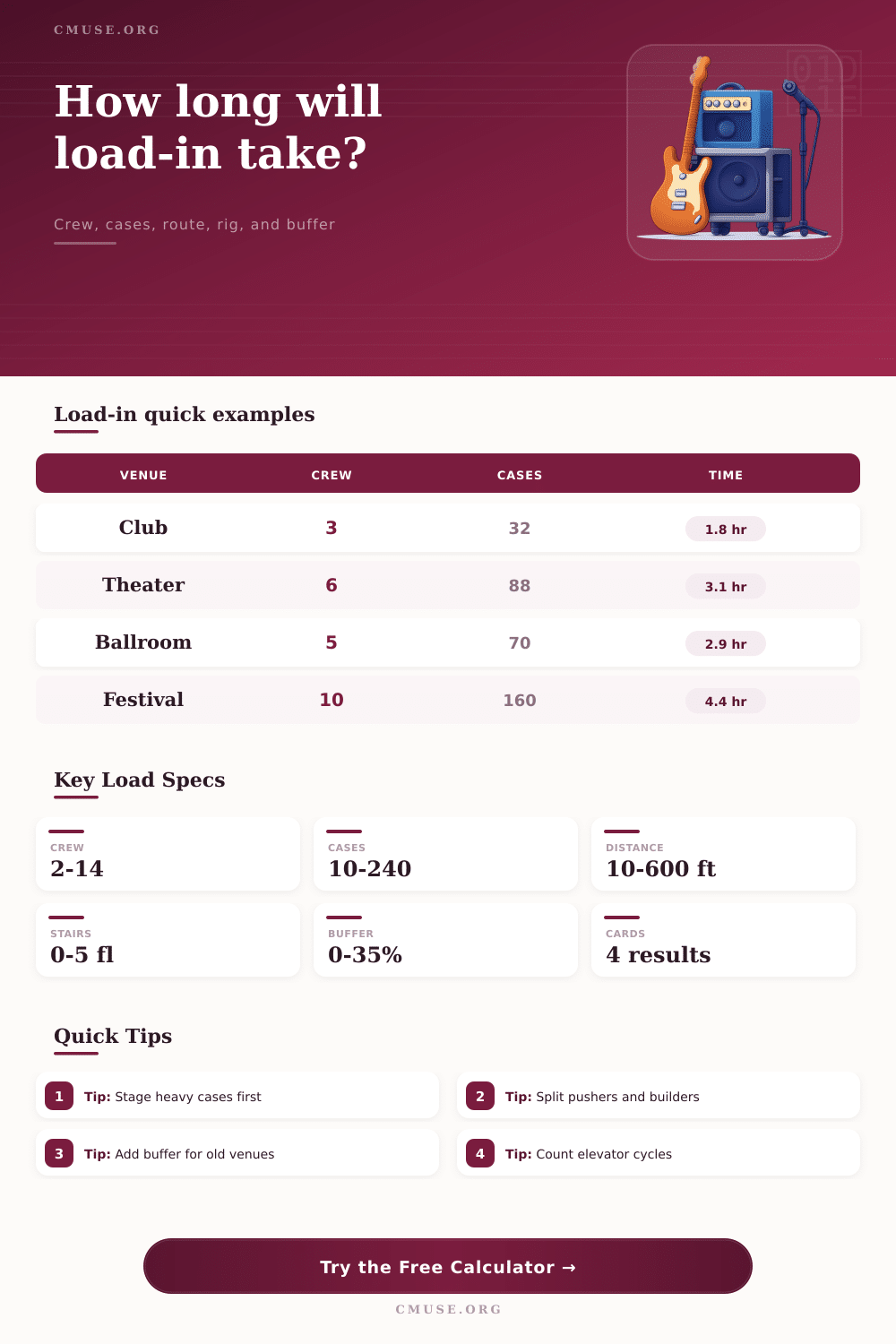
Estimate venue load-in time from crew count, case volume, route distance, stairs, elevator cycles, truck access, rig complexity, backline setup, sound package, and operational buffer.
Use case: Load a realistic show profile, then replace the numbers with the actual truck route, crew call, case count, stair/elevator details, backline package, and rig plan.
Load-In Breakdown
| Stage | What It Includes | Minutes | Operational Note |
|---|---|---|---|
| Waiting | Run the calculator | 0 | Results will appear here. |
| Route Type | Typical Drag | Best Crew Split | Watch Item |
|---|---|---|---|
| Direct dock to stage | Fastest | Two pushers, one stage stacker | Dock plate angle and truck order |
| Hallway with turns | Moderate | Push crew plus door spotter | Doorstops, carpet, corners, and cross traffic |
| Basement or balcony stairs | Slow | Carry team, catcher, and stage sorter | Heavy racks and repeated stair fatigue |
| Shared freight elevator | Variable | Loader, elevator operator, receiver | Cycle count and other departments waiting |
| Outdoor path or lawn | Variable | Wide carts and extra pushers | Weather, mats, ramps, and uneven ground |
| Rig Level | Build Pattern | Base Setup Effect | Typical Check |
|---|---|---|---|
| Line-and-go acoustic | Small PA, few stands, light backline | Low | Inputs and monitor wedge check |
| Club PA plus lights | Speakers, sub, basic lighting, compact drums | Medium | Patch, power, and vocal line check |
| Touring audio and backline | FOH racks, monitor world, full backline | High | Patch split, RF, playback, and backline check |
| Theater lighting and playback | Audio, cue playback, lighting focus updates | High | Comms, playback, cue line, and stage manager notes |
| Festival patch and risers | Rolling risers, shared backline, fast changeover | High | Stage plot match and input list verification |
| Arena support package | Trucks, racks, scenic, lighting, video handoff | Very high | Department sequencing and local crew deployment |
| Preset | Typical Load | Route Assumption | Primary Risk |
|---|---|---|---|
| Coffeehouse Duo | 12 cases, minimal loose gear | Short curb route | Solo carrying and small doorways |
| Basement Club | 40 cases, full band odds | Stairs and tight hall | Heavy cases moved by hand |
| Bar Band Night | 46 cases, combo backline | Normal door-to-stage route | Backline setup while cases arrive |
| Theater Tour | 88 cases, touring audio | Shared freight elevator | Elevator cycles and patch time |
| Hotel Ballroom | 70 cases, AV and band | Long service hallway | Distance, carpet, and guest traffic |
| Festival Side Stage | 160 cases, rolling risers | Outdoor ground and dock lift | Weather and stage queue |
| Arena Support | 220 cases, support package | Long dock and department split | Sequencing and local crew handoff |
| Orchestra Shell | 120 cases, chairs and stands | Theater dock to shell | Placement detail and quiet tuning setup |
| Buffer Level | Use When | Schedule Effect | Common Trigger |
|---|---|---|---|
| 0% to 5% | Known room, direct dock, repeat package | Tight | Experienced crew and no vertical route |
| 10% to 15% | Normal venue with a proven stage plot | Balanced | Minor re-stage or patch changes expected |
| 18% to 25% | Shared elevator, stairs, hotel, or festival day | Conservative | Cross traffic, weather, delayed keys, or local crew variance |
| 30% plus | New route, heavy rig, historic venue | Protective | Narrow doors, unknown dock, high case weight, or late truck access |
Load-in timing is an variable that determines whether the show will begin at the scheduled time or whether the band will still be tuning up once the house lights are lowered. While many crews may feel that load-in timing is a feeling, it is also a process that begins as soon as the truck begin to arrive at the loading dock. The number of individuals that will move the weight of the equipment is one of the variables that will impact load-in timing, as will the amount of time that is allotted for each of the tasks that occur after the equipment is delivered to the room.
Several different variable will impact how quickly the load-in process can occur. The size of the crew is one of the main variables, as is the way that the crew divides its labor between moving the cases and building the stage. The number of cases are another of the main variables, but the weight of those cases is another of the more important of those variables.
What Affects Load-In Time
The distance that must be traveled is a third of the main variables, but it is not the only one. Vertical access to the venue is one of the factor that is often ignored when estimating load-in times. The number of stairs that must be climbed and descended is one of the factors relate to vertical access.
The number of elevators and the cycles that each of those elevators takes to move from one area of the venue to another is also one of the variables. The difficulty of the route from the loading dock to the stage is a third of the variables related to vertical access. Rigging complexity and backline setup is a second of the variable that impacts load-in times.
The complexity of the audio package is one of the main variables related to backline setup. The placement of the drums and amplifier is also another of the main variables related to backline setup. Backline setup cannot begin until the crew opens the cases, however.
Line check is the final step related to backline setup. Any shortcut that are taken in the backline setup will impact the number of minutes that are needed to troubleshoot technical issues during line check. The buffer is another of the variables related to load-in times.
Many crews may not account for the buffer in their load-in time estimates, but the buffer is a necessary variable. The buffer can be set as a percentage of the total time that is calculate for the load-in using the load-in time calculator. A percentage of 10% may be sufficient for a well-known venue with a relatively light load of cases.
A larger percentage of the total estimated load-in time may be required for the same type of venue with stairs, shared elevators, or festival docks. The buffer for the estimated load-in time is not for laziness; it accounts for the time that may be required to wait for a specific key to be locate, to re-stage the cases that arrived in a different order than the one that is required for performance, or to wait for other local crew members to complete their own assigned tasks. The page provides the reference tables as a means of accounting for the fact that the specifics of the performance space may not always match those that is represented in the dropdown menus for the load-in time calculator.
For example, one basement club may have stairs and a narrow door to the venue, while another club of similar size may have a freight elevator that directly ascends to the main stage. Each of these venues will have different load-in times. The reference tables are a means of providing an example pattern of load-in times for each type of venue, allowing the crews to adjust the variables accordingly prior to calculating the total load-in time for that specific venue.
The output of the load-in time calculator is a total time from the moment that the first case is off the truck until the final minute of line check. The total time can be broken into its components of the time required for the cases to be moved to the stage and the time required to perform the setup for the band’s equipment. The number of labor hours that are required to perform the load and move the cases to the stage is also displayed.
Throughput is another of the variables that is displayed. Throughput is a measurement of the number of cases that each crew member can move during one hour of performance of this task. The calculator creates the call cue that is another of the main variables related to load-in times.
A call cue of early indicates that the load of cases is too heavy for the size of the crew, or that the vertical route for the cases is likely to slow the load-in process. A lean call cue indicates that the crew is very familiar with the venue, the load of cases that is to be moved, and that the load will be relatively light. Most crews will find the correct call cue for their specific situation by performing a few different scenarios in the calculator.
The process of load-in should be thought of as a series of tasks rather than one single task. Ensuring that the cases are sorted in a way that allows for the cases that will be opened first to be closest to the main door of the venue is one task that should be performed. Ensuring that one member of the crew is tasked with receiving the equipment from either the stairs or elevators ensures that the other members of the “push” crew do not have to wait for the drop-off of the load of cases.
The placement of the backline equipment should begin as soon as the cases that contain the backline equipment arrive; it is not necessary to wait for the remainder of the load to arrive at the venue. Each of these individual task will ensure that the time that is calculated for the load-in process is the time that is required to complete the task. The effectiveness of the load-in time estimate may be tested when a few small problems begin to emerge during the load-in process.
A problem in the load-in process can be missing a dolly, a door that remains closed to the crew, or the addition of an inexperienced crew member to a load-in process. The buffer is the only way to account for these problems. If the total load-in time appears to be too tight even after the buffer has been accounted for, an additional crew member should be added to the load-in process and the load-in should begin at an earlier time.
Thus, load-in timing is a relationship between the plan that is created for the load-in and the actual venue in which the band will perform… The load-in time calculator will provide the number that should be used to begin to formulate a plan, but adjustments to that plan will need to be made according to the way in which the cases actualy move during the load-in process.