Lip Slur Interval Calculator
Match a brass lip slur to the nearest same-fingering harmonic partial, then check cents drift, target frequency, useful tube length, tempo load, and recovery time.
Load a common brass exercise, then adjust the instrument, valve combination, starting partial, interval, tempo, and rest plan for your own routine.
Interval Breakdown
| Partial Move | Frequency Ratio | Equal-Temperament Neighbor | Natural Size | Brass Use |
|---|---|---|---|---|
| 1 to 2 | 2:1 | Octave | 1200 cents | Pedal to open octave; more common in low brass than high trumpet. |
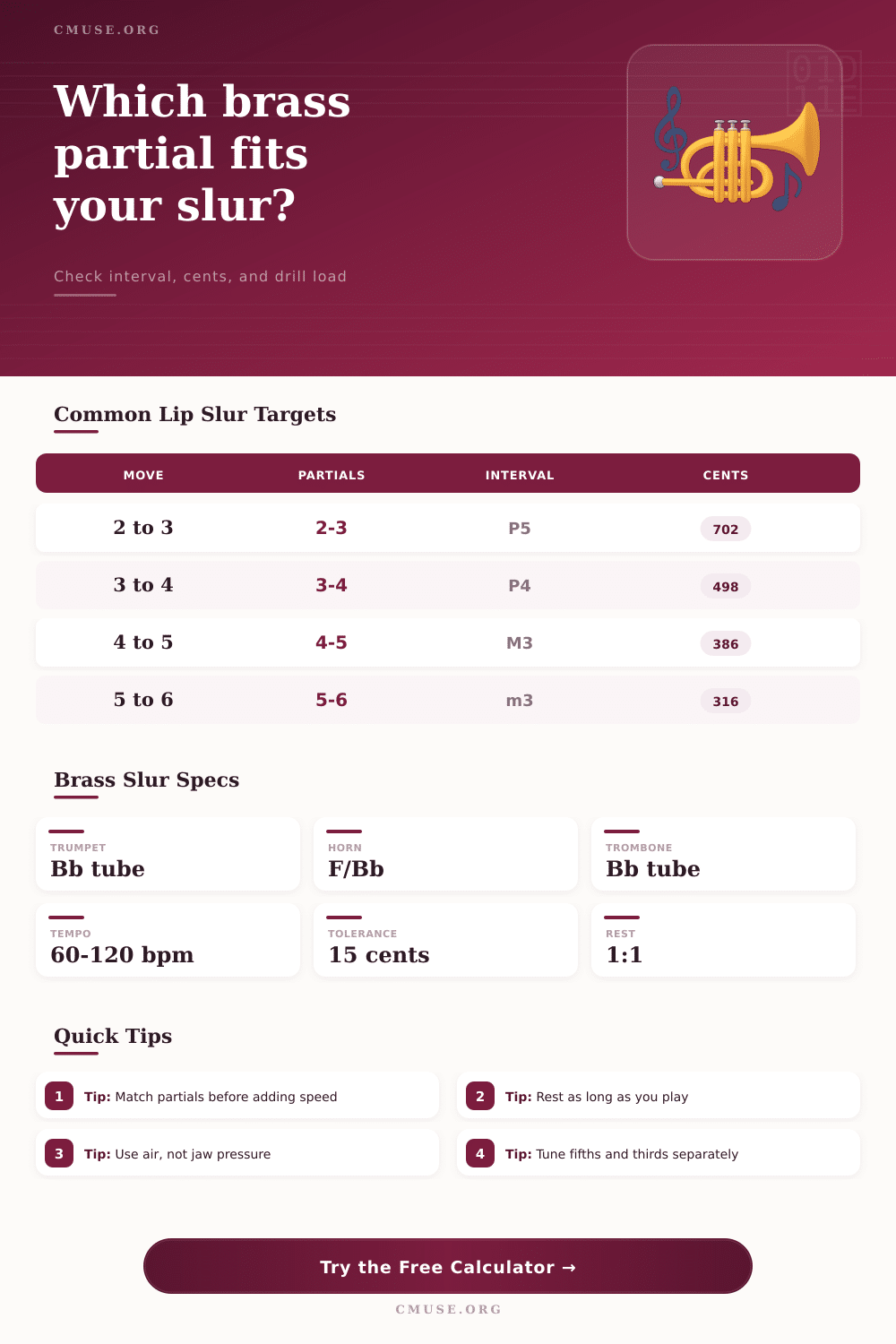
| 2 to 3 | 3:2 | Perfect fifth | 702 cents | Standard first flexibility slur for trumpet, trombone, euphonium, and tuba. |
| 3 to 4 | 4:3 | Perfect fourth | 498 cents | Connects middle-register response and exposes air support changes. |
| 4 to 5 | 5:4 | Major third | 386 cents | Feels narrower than equal temperament and needs centered vowel shape. |
| 5 to 6 | 6:5 | Minor third | 316 cents | Useful for smooth staff slurs once the fifth and fourth are reliable. |
| 6 to 7 | 7:6 | Minor third low | 267 cents | The seventh partial is flat; use with clear tuning awareness. |
| 7 to 8 | 8:7 | Major second high | 231 cents | Small high-register slot that can feel tight on cylindrical brass. |
| 8 to 9 | 9:8 | Major second | 204 cents | Good for upper flexibility when tone remains open and unforced. |
| Instrument | Open Fundamental | Approx Tube Length | Core Slur Zone | Practical Note |
|---|---|---|---|---|
| Bb trumpet / cornet | 58.27 Hz | 4.86 ft / 1.48 m | Partials 2-8 | Most method-book flexibility begins on open, 1st, and 1st+2nd tubes. |
| C trumpet | 65.41 Hz | 4.33 ft / 1.32 m | Partials 2-8 | Slightly shorter tube gives a brighter response and quicker slots. |
| F horn side | 43.65 Hz | 6.49 ft / 1.98 m | Partials 3-10 | Higher partial work is normal because the horn tube is long. |
| Bb horn side | 58.27 Hz | 4.86 ft / 1.48 m | Partials 3-10 | Often used for cleaner upper slurs and secure attacks. |
| Tenor trombone | 58.27 Hz | 4.86 ft / 1.48 m | Partials 2-7 | Slide positions mirror valve lengthening in half-step increments. |
| Euphonium / baritone | 58.27 Hz | 4.86 ft / 1.48 m | Partials 2-7 | Conical bore supports smooth low and middle-register flexibility. |
| Bb tuba | 29.14 Hz | 9.72 ft / 2.96 m | Partials 2-6 | Longer recovery and slower tempo usually keep response cleaner. |
| F mellophone | 43.65 Hz | 6.49 ft / 1.98 m | Partials 2-7 | Marching-horn slurs benefit from clear vowel changes, not pressure. |
| Setting | Nominal Drop | Length Factor | Typical Brass Use | Calculator Effect |
|---|---|---|---|---|
| Open / 1st position | 0 semitones | 1.000 | First reference for matching the harmonic series. | Uses open-tube fundamental. |
| 2nd valve | 1 semitone | 1.059 | Half-step tube length for short flexibility cells. | Lowers all partial frequencies by one semitone. |
| 1st valve | 2 semitones | 1.122 | Common whole-step slur pattern on valved brass. | Lengthens tube by about 12.2 percent. |
| 1st + 2nd | 3 semitones | 1.189 | Minor-third valve combination for mid-register checks. | Moves the same partial map lower. |
| 2nd + 3rd | 4 semitones | 1.260 | Alternate combination depending on instrument tuning. | Approximates a major-third lower tube. |
| 1st + 3rd | 5 semitones | 1.335 | Perfect-fourth length, like F attachment on Bb trombone. | Creates a longer tube and slower response. |
| 1st + 2nd + 3rd | 6 semitones | 1.414 | Useful for low-register flexibility, but intonation may need adjustment. | Uses the tritone-lower tube estimate. |
| F / Gb attachment | 4-5 semitones | 1.260-1.335 | Trombone and low-brass attachment patterns. | Maps slurs to the attachment tube length. |
| Practice Goal | Tempo Range | Reps | Rest Ratio | Best Partial Moves |
|---|---|---|---|---|
| Beginner slot matching | 50-72 bpm | 4-8 | 1:1 | 2-to-3, 3-to-4 |
| Middle-register control | 60-88 bpm | 6-12 | 1:1 | 3-to-4, 4-to-5 |
| Fast flexibility | 88-132 bpm | 8-24 | 0.5:1 | 4-to-5, 5-to-6, 6-to-8 |
| Low brass breadth | 44-72 bpm | 4-10 | 1.5:1 | 1-to-2, 2-to-3 |
| Range connection | 48-76 bpm | 3-8 | 2:1 | 5-to-6, 6-to-8, 8-to-10 |
| Audition consistency | 60-96 bpm | 8-16 | 1:1 | Clean fifths, fourths, thirds |
On the screen you choose the starting partial (e.g. The second one on an open trumpet), then instruct the app to go up a perfect fifth. The calculator determine the closest available harmonic and displays the cents drift, a measure of exact tuning error. A large number indicates that the length of tubes doesn’t support the desired pitch and applying jaw pressure won’t help. Either accept the partial or alter your fingering.
This is where students sometimes fail because they attempt to ‘bend’ the air rather then listen to what the tube produce. It converts a musician’s aspirations into sound.
How to Play Brass Better Using Data
Equal temperament divides the semi-tone perfectly, but brass instruments does not. They follow the Harmonic Series. The distance between parts of that series decreases as they rise up the register. Knowing this is half the battle to playing an instrument instead of against it.
The calculator then fills in the missing link based off physics and theory. It shows the places where natural gaps lie. Tempo is of secondary importance to the choice of starting note. If you consult those tables, they will show you that slurs across lower partials seems wider. The jump from five to six sounds like a smaller leap than the jump from two to three.
Your instrument’s valve(s) or slide placement alters the apparent length of tube as well. On a Bb trumpet, if you drop first valve it extends the system and changes all the partials. These are converted for you by the math of the calculator so you don’t need to second guess where the harmonic line up with your finger positioning.
Tempo and rest ratios are where flexibility actualy gets built or destroyed. Because many players see lip slur exercises as a kind of speed exercise, they fail to consider recovery time. For endurance exercises the tool offer specific ratios of rest to play. Ten minutes continuous playing without any rest will cause tension in your facial muscles and destroy the response. Better to perform fewer reps with a full recovery and perfect air flow.
The calculation also shows the overall duration of the exercise, allowing you to maintain the focus of session instead of making it exhausting.
People often think blowing harder makes a difference if they’re using air. You want to use less air with a smaller aperture, not necessarily more air. If you see there’s quite a difference in the cents error then look at vowel shape. A tight narrowing of mouth will push pitch too high and conflict with natural partial. Instead open up your throat, allowing the instrument to sing freely. You are inviting the note not forcing it.
Playing brass is a balance between your physical desires and your actual physcial limits. You can’t argue with the harmonic series; that’s set in stone. Know where the slots are and how wide they actualy are. Then, you can learn to navigate around them. Don’t replace your ear with data but use the data to direct your ear. Those squeaks goes away when you stop pursuing equal-tempered perfection. Since you aren’t trying to jump into air you have already created, it becomes smooth.