Linkwitz-Riley Crossover Calculator
Size LR2 and LR4 active crossover stages with clean starting values for low-pass or high-pass design.
🎵 LR Inputs
📊 Formula Reference
| Alignment | Stages | Per Section | Use |
|---|---|---|---|
| LR2 | 2 | 1st-order RC | 12 dB/oct |
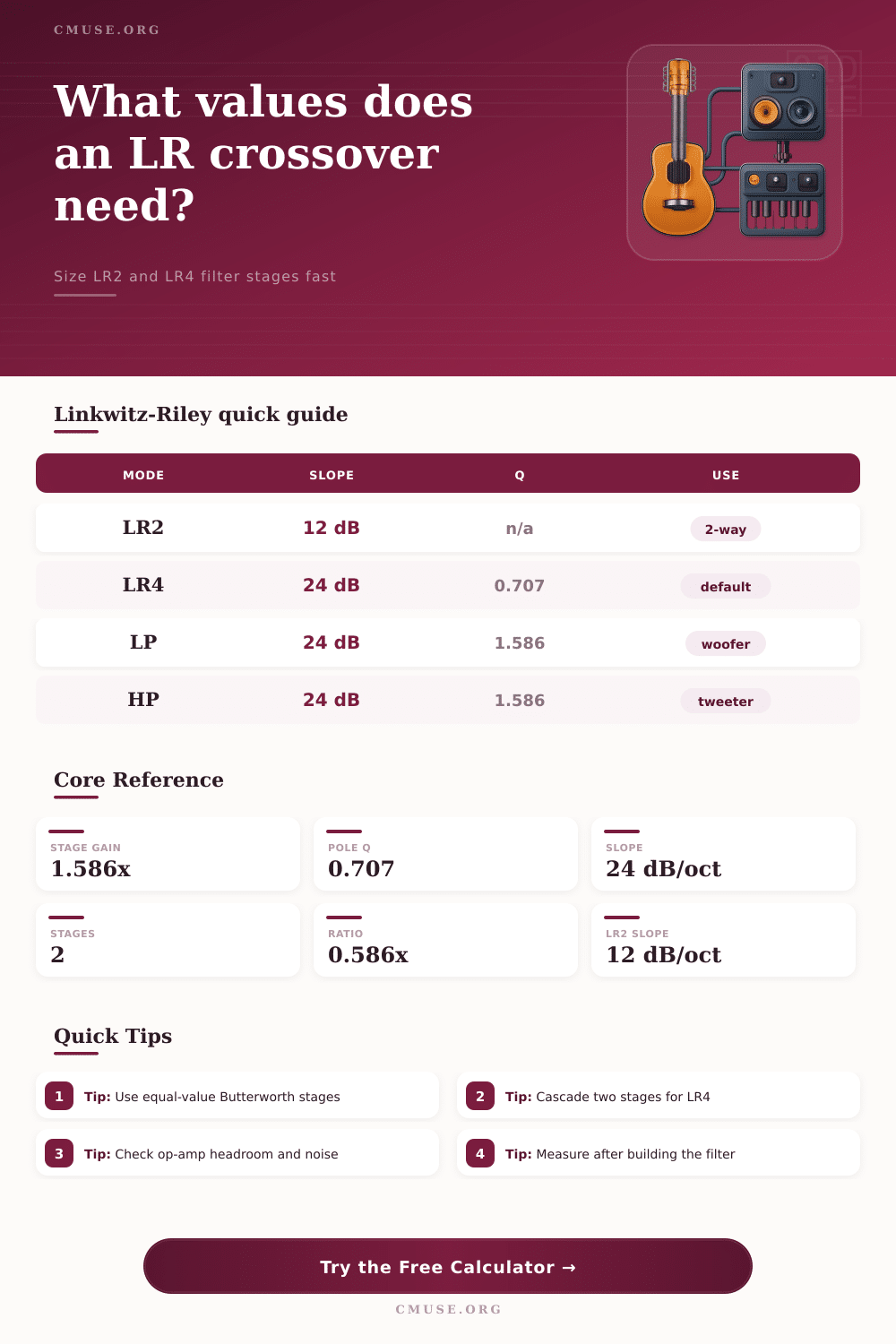
| LR4 | 2 | 2nd-order SK | 24 dB/oct |
| Butterworth | Q 0.707 | K 1.586 | Matched sum |
| Equal parts | R and C | Same value | Easy build |
🎶 Common Targets
| Build | Freq | Align | Notes |
|---|---|---|---|
| Sub / Sat | 80 Hz | LR4 | Deep split |
| Woofer | 250 Hz | LR4 | Clean handoff |
| Mid | 350 Hz | LR4 | 3-way band |
| Tweeter | 2.5 kHz | LR4 | Safe start |
🔧 Spec Grid
The crossover of speaker is electronic circuit that shares the audio signal according to frequencies between various drivers. Tweeters care about the high sounds, woofers about the low, and subwoofers about the deepest frequencies The crossover is the frequency where high frequencies surpass the low drivers.
Many speakers have several drivers and use crossover nets to send the right frequencies to each of them. Combinations of capacitors, spools and resistors lead the high frequencies to the tweeters and low to the woofers. High-pass filters direct high frequencies to tweeter, low-pass to woofers for the deep sounds, and bandpass filters to midrange drivers for the centres.
How a speaker crossover splits sound
Audio crossover net is compulsory disadvantage, because you alone speaker can not cover whole audio spectrum. For deep sounds it is needed to pump a lot of air, so you require big and heavy cone. On the other hand, for high notes you must use fast agill.
Hence you must share the whole spectrum in two or more parts.
Passive crossovers for speaker systems are very easy to install. They sit between amplifier and speaker, without need of power, switch or ground. Wire of the amplifier feeds into the crossover.
Active crossovers use operational amplifiers, while passive base on RCL-filters.
Home cinemas 5.1 with surrounding sound use crossover that separates the lowest frequencies for subwoofer. The other low, intermediate and high frequencies go to five speakers around the listener. New receivers allow to set crossover for every channel, which is more practical mode.
Like this full-range speakers can work freely, while others receive low filter in 80 until 100 hertz, especially for surrounding sound.
At the crossover must exist overlap, so that none frequency miss. Those limits are not strict (they slip a bit). Subs usually limit in 80 hertz up.
Good rule says: set the crossover at least 15; 20 hertz above the natural descent of the speakers. Many bookshelf speakers reach 60 or even 50 hertz, but crossover in 80 hertz reduce distortion in mid-bass. Also the place of subwoofer matter a lot…
Bad placed it can create nullity or sting in the crossover region.
Crossover carry resistors that confines the power to every speaker. For instance, three-way speaker with 100-watt RMS uses 100-watt bass driver, 40-watt midrange driver and 30-watt tweeter. Good crossover net considers not only the frequencies, but also the character of the drivers inside and outside his zones.
The best networks are designed specially for particular setofdrivers.