Linear Density String Calculator
Find string mass per length two ways — from diameter or from pitch — and cross-check the result
Calculation Breakdown
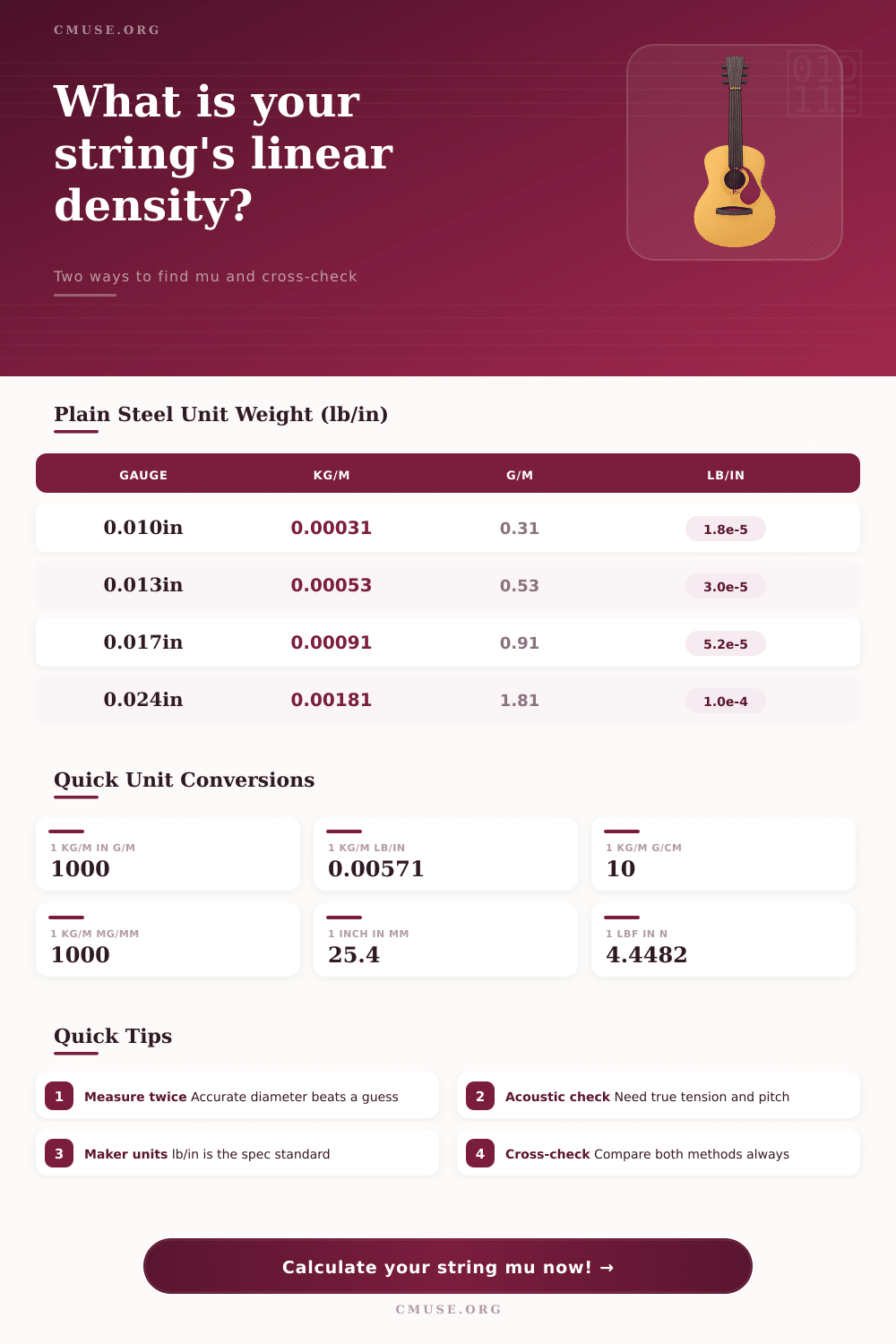
| Gauge | Type | kg/m | g/m | lb/in |
|---|---|---|---|---|
| 0.010 in | Plain | 0.000312 | 0.312 | 0.00001783 |
| 0.013 in | Plain | 0.000528 | 0.528 | 0.00003014 |
| 0.017 in | Plain | 0.000903 | 0.903 | 0.00005157 |
| 0.024 in | Wound | 0.001794 | 1.794 | 0.00010244 |
| 0.032 in | Wound | 0.003147 | 3.147 | 0.00017972 |
| 0.046 in | Wound | 0.006449 | 6.449 | 0.00036824 |
| From kg/m | Factor | To Unit | Note |
|---|---|---|---|
| kg/m → g/m | × 1000 | g/m | 1 kg = 1000 g |
| kg/m → lb/in | ÷ 175.126 | lb/in | maker spec unit |
| kg/m → g/cm | ÷ 10 | g/cm | 1 m = 100 cm |
| kg/m → mg/mm | × 1000 | mg/mm | 1 m = 1000 mm |
| Material | Density (kg/m³) | Use | Family |
|---|---|---|---|
| Plain Steel | 7850 | Plain strings | Steel |
| Nickel-Plated Steel | 8100 | Electric wound | Steel |
| Stainless Steel | 7900 | Bright wound | Steel |
| Phosphor Bronze | 8800 | Acoustic wound | Bronze |
| 80/20 Bronze | 8750 | Acoustic wound | Bronze |
| Nylon | 1150 | Classical treble | Synthetic |
| Fluorocarbon | 1780 | Classical/ukulele | Synthetic |
String tension might seem obvious; if I pull on it harder, it gets higher. But then how do I get that note correct? How can I do it without breaking the string?
Enter linear density (or mu, as it’s called in physics books). Linear density is just how much something weighs compared to its length. So a heavy bass string made of nylon is pretty linearly dense, there is lots of mass across its length. And a treble string made of thin steel are not very dense (there is not much material along its length). This makes all the difference in how playable your instrument is and what it sounds like.
What is Linear Density?
People generally tackle this issue by considering those gauge number things that say something like.010,.046 etc. That’s the diameter measurement. It’s not a weight measurement. Well, sort of. Diameter is important but it doesn’t tell the full story without taking into account the type of string it is. For example, take two strings with the exact same diameter. One is a bronze string, the other is a steel one. They’re both going to have different weights because they’re made of materials with different densities. In this case, steel is lighter than bronze per cubic inch. So if you assume they’re the same, you’ll get the tension calculation wrong.
Once you choose your material and plug it in, the calculator above do all the math for you so you don’t need to guess if your wound strings are heavy or light compared to other sizes. There are two ways you can figure out linear density.
One is the physical way (diameter times material density). That’s what manufacturers does before their string is ever wound. They choose a gauge, then pick a core material, wrap it with an alloy and then weigh the total mass per meter. It’s a direct measurement of shape and material.
The other is acoustic. You know the pitch you desire. You know the scale length of your instrument. And you know how much tension you’re willing to take. From that you can solve for the required linear density. When you try to match a specific feel on an instrument that is unconventional, this is a useful tool. It is also useful if you’re designing a custom setup.
Why? The industry uses three languages, and the results show up in different units. There’s kg/m, or the scientific standard. And then there’s g/m, the same thing times a thousand. And finally there’s what string makers actualy report on their spec sheets: lb/in. They’re all very easy to convert from one to another mechanically, but if you’re not accustomed to thinking in pounds per inch, it gets a little trippy conceptually.
For most strings, that’s a really small number. A standard.010 plain steel string has about 0.000018 lb/in of mass. It looks like nothing, but that fraction is enough to make the difference between a bowed guitar neck and a snapped one.
Here’s where cross checking comes into play. Given the real string in your hand, calculate what mu ought to be (the diameter method). Next, given how tight you want the string, calculate what mu must be for it to reach that note (the pitch method). If they don’t come close, then something has gone wrong. Perhaps your tension estimate was wrong. Perhaps you measured your scale length incorrectly. Or perhaps you’re thinking of a wound string as a plain string when calculating from its physical properties. A wound string is essentially metal wrapped around a core, which adds mass but not much diameter. This breaks the simple geometry assumption.
It all changes with material selection. Steel weighs somewhere between nylon and fluorocarbon. Fluorocarbon is heavier than nylon. Then there is bronze which are heavy. It also changes how tight something feels. The note might stay the same if you switch materials instead of gauge, but you are still changing the linear density, which affects the tension. That’s why electric guitar necks are narrow and classical guitar necks are wider. One uses high-tension string sets, while the other use low-tension string sets.
These tools here really lay out those pros and cons for you to understand the impact when purchasing your next set of strings. In conclusion, there is no direct relationship between diameter and what you hear. It’s the combination of mass and tension that you can hear. Get mu correct and not only will your instrument stay in tune, but it will remain comfortabley to play and deliver the tone you anticipate. Measure twice, calculate once and trust your numbers to point you towards your ears.