🔊 Line Array Calculator
Calculate speaker count, coverage angle, throw distance & SPL for your line array system
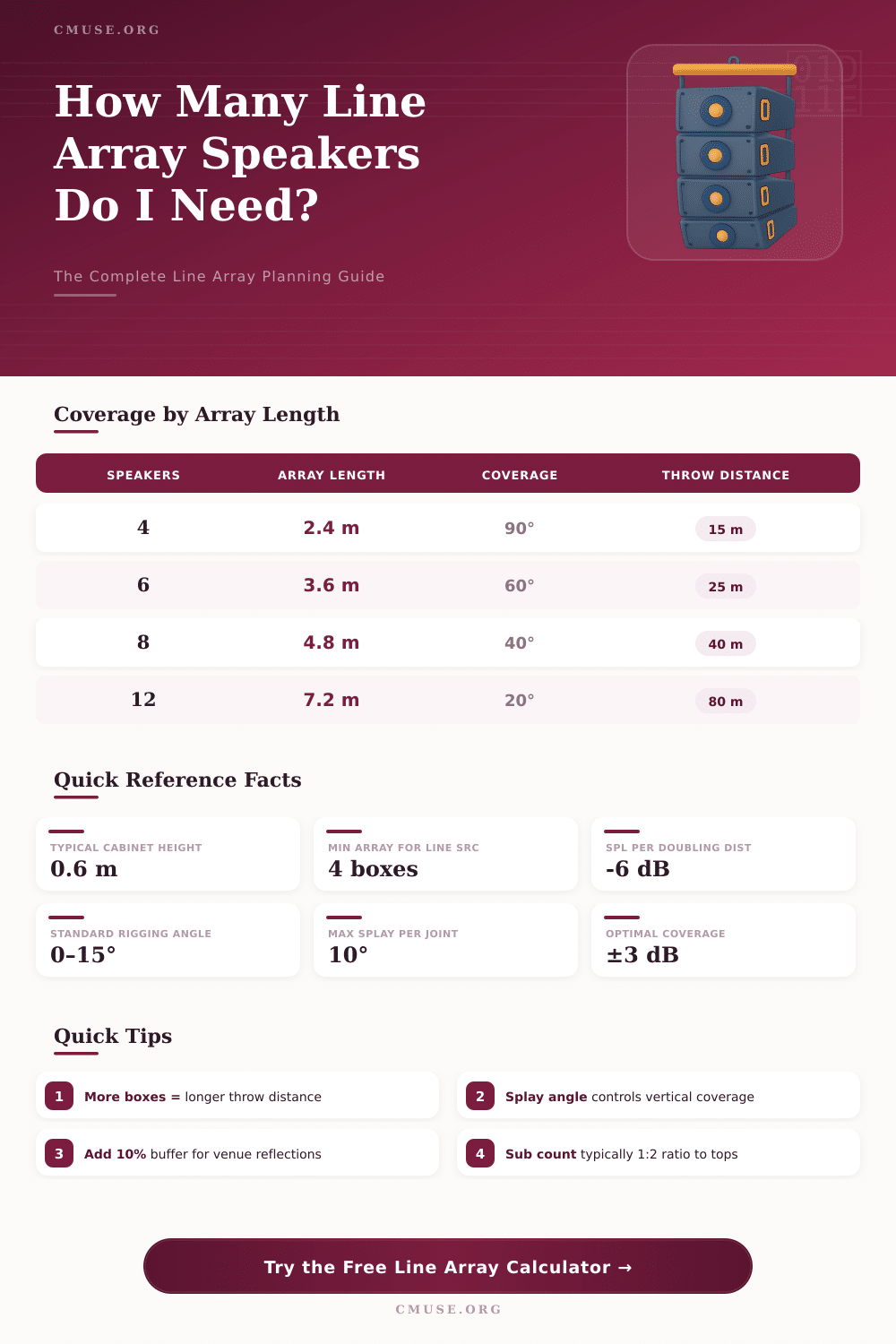
| Boxes | Array Length (m) | Approx Vert Coverage | Max Throw (m) | Max Throw (ft) |
|---|---|---|---|---|
| 2 | 1.2 | 80° – 90° | 8 m | 26 ft |
| 4 | 2.4 | 50° – 70° | 20 m | 66 ft |
| 6 | 3.6 | 30° – 50° | 35 m | 115 ft |
| 8 | 4.8 | 20° – 40° | 55 m | 180 ft |
| 10 | 6.0 | 15° – 30° | 70 m | 230 ft |
| 12 | 7.2 | 10° – 25° | 90 m | 295 ft |
| 16 | 9.6 | 8° – 15° | 120 m | 394 ft |
| 20 | 12.0 | 5° – 10° | 150 m | 492 ft |
| Distance (m) | Distance (ft) | SPL Loss from 1m ref | Result at 136 dB src |
|---|---|---|---|
| 1 m | 3.3 ft | 0 dB | 136 dB |
| 4 m | 13 ft | –12 dB | 124 dB |
| 10 m | 33 ft | –20 dB | 116 dB |
| 20 m | 66 ft | –26 dB | 110 dB |
| 40 m | 131 ft | –32 dB | 104 dB |
| 80 m | 262 ft | –38 dB | 98 dB |
| 120 m | 394 ft | –41.6 dB | 94.4 dB |
| Venue Type | Capacity | Rec. Boxes / Side | Typical Throw |
|---|---|---|---|
| Small Bar / Club | 50–200 | 3–4 | 10–20 m |
| Medium Club | 200–800 | 4–6 | 20–35 m |
| Theatre / Ballroom | 500–2000 | 6–8 | 30–50 m |
| Arena (small) | 2000–8000 | 8–12 | 50–80 m |
| Large Arena | 8000–20000 | 12–16 | 80–120 m |
| Stadium / Festival | 20000+ | 16–24 | 100–180 m |
To determine the correct number of speaker for a live sound system, a sound engineer must consider the dimension of the venue and the physics of sound. A sound engineer must decide how many speaker cabinet will be used in a line array because the number of speaker cabinets will impact how far the sound travels from the stage. If a sound engineer use too few speaker cabinets, the sound wont reach the back of the venue.
However, if a sound engineer creates a line array with to many speaker cabinets, the sound engineer will be moving more speaker equipment than necessary. Line arrays is used for focusing the sound wave from the speakers to travel further down the venue. Sound from a line array create a cylindrical wave, whereas point-source speakers will blast sound in all directions.
How Many Speakers Do You Need?
The cylindrical wave creates a tall and narrow wave of sound that will travel more further compared with point-source speakers. As the length of the line array increases, the line array will have better control over low frequencies and sound will travel further from the speaker array. For every doubling of the length of a line array, the sound coverage angle is halved and the distance that the sound travels are doubled.
The dimensions of the venue will determine the specifications of the line array. The depth of the venue will determine the sound throw distance. The width of the venue will determine the number of speaker needed to provide even sound coverage for the audience.
The splay angle will control the vertical spread of the sound. The splay angle is the angle between the speaker cabinets in a line array. A zero degree splay angle will focus the sound to travel long distances.
A wider splay angle will produce sound that covers a larger area but travels shorter distances. If the splay angle is to wide, it may produce lobing in the sound. Loning produces hot spots in the sound due to phase interference.
Sound Pressure Level, or SPL, is a measurement of how loud the sound is from the speaker. The SPL from a speaker cabinet decrease with distance. When there are multiple speaker cabinets in a line array, each speaker cabinet add to the SPL of the line array.
If you double the number of speaker cabinets in a line array, the SPL increase by 6 dB. Air absorption and reflections also affect SPL. Air absorption and reflections in the venue can reduce the SPL of the sound.
A line array must have a minimum number of speaker cabinets. A line array with fewer than four or five speaker cabinets will not have adequate control over the sound wavelengths below 80 Hz. For example, to fill a 200-seat theatre, a sound engineer may need to use six speaker cabinets per side of the stage to fill 40 degrees of vertical space.
For a festival with performances over 100 meters in distance, the line array will require sixteen speaker cabinets. In addition to the line array speakers, sound engineers must also consider subwoofers when setting up a sound system. Subwoofers are often ground stacked.
The subwoofers are set at a 1:2 ratio relative to the main speaker cabinets. For a stereo sound, sound engineers may use two separate line array hangs for the left and right speakers. For even sound throughout the venue, a center hang may be used to create an LCR sound system.
The goal is to have a uniformity of plus-minus three dB in sound pressure level throughout the sound system. To calculate the specifications for a line array, sound engineers can use software to determine the length of the line array, the total number of speaker cabinets required, the coverage angle of the speakers, and the SPL at a specific distance from the speakers. These programs avoid the logarithmic mathematics behind these calculations.
Using these programs will help sound engineer create a line array that provides balanced sound to all individuals in the venue. To determine the correct number of speaker for a live sound system, a sound engineer must consider the dimension of the venue and the physics of sound. A sound engineer must decide how many speaker cabinet will be used in a line array because the number of speaker cabinets will impact how far the sound travels from the stage.
If a sound engineer use too few speaker cabinets, the sound wont reach the back of the venue. However, if a sound engineer creates a line array with to many speaker cabinets, the sound engineer will be moving more speaker equipment than necessary. Line arrays is used for focusing the sound wave from the speakers to travel further down the venue.
Sound from a line array create a cylindrical wave, whereas point-source speakers will blast sound in all directions. The cylindrical wave creates a tall and narrow wave of sound that will travel more further compared with point-source speakers. As the length of the line array increases, the line array will have better control over low frequencies and sound will travel further from the speaker array.
For every doubling of the length of a line array, the sound coverage angle is halved and the distance that the sound travels are doubled. The dimensions of the venue will determine the specifications of the line array. The depth of the venue will determine the sound throw distance.
The width of the venue will determine the number of speaker needed to provide even sound coverage for the audience. The splay angle will control the vertical spread of the sound. The splay angle is the angle between the speaker cabinets in a line array.
A zero degree splay angle will focus the sound to travel long distances. A wider splay angle will produce sound that covers a larger area but travels shorter distances. If the splay angle is to wide, it may produce lobing in the sound.
Loning produces hot spots in the sound due to phase interference. Sound Pressure Level, or SPL, is a measurement of how loud the sound is from the speaker. The SPL from a speaker cabinet decrease with distance.
When there are multiple speaker cabinets in a line array, each speaker cabinet add to the SPL of the line array. If you double the number of speaker cabinets in a line array, the SPL increase by 6 dB. Air absorption and reflections also affect SPL.
Air absorption and reflections in the venue can reduce the SPL of the sound. A line array must have a minimum number of speaker cabinets. A line array with fewer than four or five speaker cabinets will not have adequate control over the sound wavelengths below 80 Hz.
For example, to fill a 200-seat theatre, a sound engineer may need to use six speaker cabinets per side of the stage to fill 40 degrees of vertical space. For a festival with performances over 100 meters in distance, the line array will require sixteen speaker cabinets. In addition to the line array speakers, sound engineers must also consider subwoofers when setting up a sound system.
Subwoofers are often ground stacked. The subwoofers are set at a 1:2 ratio relative to the main speaker cabinets. For a stereo sound, sound engineers may use two separate line array hangs for the left and right speakers.
For even sound throughout the venue, a center hang may be used to create an LCR sound system. The goal is to have a uniformity of plus-minus three dB in sound pressure level throughout the sound system. To calculate the specifications for a line array, sound engineers can use software to determine the length of the line array, the total number of speaker cabinets required, the coverage angle of the speakers, and the SPL at a specific distance from the speakers.
These programs avoid the logarithmic mathematics behind these calculations. Using these programs will help sound engineer create a line array that provides balanced sound to all individuals in the venue. To determine the correct number of speaker for a live sound system, a sound engineer must consider the dimension of the venue and the physics of sound.
A sound engineer must decide how many speaker cabinet will be used in a line array because the number of speaker cabinets will impact how far the sound travels from the stage. If a sound engineer use too few speaker cabinets, the sound wont reach the back of the venue. However, if a sound engineer creates a line array with to many speaker cabinets, the sound engineer will be moving more speaker equipment than necessary.
Line arrays is used for focusing the sound wave from the speakers to travel further down the venue. Sound from a line array create a cylindrical wave, whereas point-source speakers will blast sound in all directions. The cylindrical wave creates a tall and narrow wave of sound that will travel more further compared with point-source speakers.
As the length of the line array increases, the line array will have better control over low frequencies and sound will travel further from the speaker array. For every doubling of the length of a line array, the sound coverage angle is halved and the distance that the sound travels are doubled. The dimensions of the venue will determine the specifications of the line array.
The depth of the venue will determine the sound throw distance. The width of the venue will determine the number of speaker needed to provide even sound coverage for the audience. The splay angle will control the vertical spread of the sound.
The splay angle is the angle between the speaker cabinets in a line array. A zero degree splay angle will focus the sound to travel long distances. A wider splay angle will produce sound that covers a larger area but travels shorter distances.
If the splay angle is to wide, it may produce lobing in the sound. Loning produces hot spots in the sound due to phase interference. Sound Pressure Level, or SPL, is a measurement of how loud the sound is from the speaker.
The SPL from a speaker cabinet decrease with distance. When there are multiple speaker cabinets in a line array, each speaker cabinet add to the SPL of the line array. If you double the number of speaker cabinets in a line array, the SPL increase by 6 dB.
Air absorption and reflections also affect SPL. Air absorption and reflections in the venue can reduce the SPL of the sound. A line array must have a minimum number of speaker cabinets.
A line array with fewer than four or five speaker cabinets will not have adequate control over the sound wavelengths below 80 Hz. For example, to fill a 200-seat theatre, a sound engineer may need to use six speaker cabinets per side of the stage to fill 40 degrees of vertical space. For a festival with performances over 100 meters in distance, the line array will require sixteen speaker cabinets.
In addition to the line array speakers, sound engineers must also consider subwoofers when setting up a sound system. Subwoofers are often ground stacked. The subwoofers are set at a 1:2 ratio relative to the main speaker cabinets.
For a stereo sound, sound engineers may use two separate line array hangs for the left and right speakers. For even sound throughout the venue, a center hang may be used to create an LCR sound system. The goal is to have a uniformity of plus-minus three dB in sound pressure level throughout the sound system.
To calculate the specifications for a line array, sound engineers can use software to determine the length of the line array, the total number of speaker cabinets required, the coverage angle of the speakers, and the SPL at a specific distance from the speakers. These programs avoid the logarithmic mathematics behind these calculations. Using these programs will help sound engineer create a line array that provides balanced sound to all individuals in the venue.
To determine the correct number of speaker for a live sound system, a sound engineer must consider the dimension of the venue and the physics of sound. A sound engineer must decide how many speaker cabinet will be used in a line array because the number of speaker cabinets will impact how far the sound travels from the stage. If a sound engineer use too few speaker cabinets, the sound wont reach the back of the venue.
However, if a sound engineer creates a line array with to many speaker cabinets, the sound engineer will be moving more speaker equipment than necessary. Line arrays is used for focusing the sound wave from the speakers to travel further down the venue. Sound from a line array create a cylindrical wave, whereas point-source speakers will blast sound in all directions.
The cylindrical wave creates a tall and narrow wave of sound that will travel more further compared with point-source speakers. As the length of the line array increases, the line array will have better control over low frequencies and sound will travel further from the speaker array. For every doubling of the length of a line array, the sound coverage angle is halved and the distance that the sound travels are doubled.
The dimensions of the venue will determine the specifications of the line array. The depth of the venue will determine the sound throw distance. The width of the venue will determine the number of speaker needed to provide even sound coverage for the audience.
The splay angle will control the vertical spread of the sound. The splay angle is the angle between the speaker cabinets in a line array. A zero degree splay angle will focus the sound to travel long distances.
A wider splay angle will produce sound that covers a larger area but travels shorter distances. If the splay angle is to wide, it may produce lobing in the sound. Loning produces hot spots in the sound due to phase interference.
Sound Pressure Level, or SPL, is a measurement of how loud the sound is from the speaker. The SPL from a speaker cabinet decrease with distance. When there are multiple speaker cabinets in a line array, each speaker cabinet add to the SPL of the line array.
If you double the number of speaker cabinets in a line array, the SPL increase by 6 dB. Air absorption and reflections also affect SPL. Air absorption and reflections in the venue can reduce the SPL of the sound.
A line array must have a minimum number of speaker cabinets. A line array with fewer than four or five speaker cabinets will not have adequate control over the sound wavelengths below 80 Hz. For example, to fill a 200-seat theatre, a sound engineer may need to use six speaker cabinets per side of the stage to fill 40 degrees of vertical space.
For a festival with performances over 100 meters in distance, the line array will require sixteen speaker cabinets. In addition to the line array speakers, sound engineers must also consider subwoofers when setting up a sound system. Subwoofers are often ground stacked.
The subwoofers are set at a 1:2 ratio relative to the main speaker cabinets. For a stereo sound, sound engineers may use two separate line array hangs for the left and right speakers. For even sound throughout the venue, a center hang may be used to create an LCR sound system.
The goal is to have a uniformity of plus-minus three dB in sound pressure level throughout the sound system. To calculate the specifications for a line array, sound engineers can use software to determine the length of the line array, the total number of speaker cabinets required, the coverage angle of the speakers, and the SPL at a specific distance from the speakers. These programs avoid the logarithmic mathematics behind these calculations.
Using these programs will help sound engineer create a line array that provides balanced sound to all individuals in the venue. To determine the correct number of speaker for a live sound system, a sound engineer must consider the dimension of the venue and the physics of sound. A sound engineer must decide how many speaker cabinet will be used in a line array because the number of speaker cabinets will impact how far the sound travels from the stage.
If a sound engineer use too few speaker cabinets, the sound wont reach the back of the venue. However, if a sound engineer creates a line array with to many speaker cabinets, the sound engineer will be moving more speaker equipment than necessary. Line arrays is used for focusing the sound wave from the speakers to travel further down the venue.
Sound from a line array create a cylindrical wave, whereas point-source speakers will blast sound in all directions. The cylindrical wave creates a tall and narrow wave of sound that will travel more further compared with point-source speakers. As the length of the line array increases, the line array will have better control over low frequencies and sound will travel further from the speaker array.
For every doubling of the length of a line array, the sound coverage angle is halved and the distance that the sound travels are doubled. The dimensions of the venue will determine the specifications of the line array. The depth of the venue will determine the sound throw distance.
The width of the venue will determine the number of speaker needed to provide even sound coverage for the audience. The splay angle will control the vertical spread of the sound. The splay angle is the angle between the speaker cabinets in a line array.
A zero degree splay angle will focus the sound to travel long distances. A wider splay angle will produce sound that covers a larger area but travels shorter distances. If the splay angle is to wide, it may produce lobing in the sound.
Loning produces hot spots in the sound due to phase interference. Sound Pressure Level, or SPL, is a measurement of how loud the sound is from the speaker. The SPL from a speaker cabinet decrease with distance.
When there are multiple speaker cabinets in a line array, each speaker cabinet add to the SPL of the line array. If you double the number of speaker cabinets in a line array, the SPL increase by 6 dB. Air absorption and reflections also affect SPL.
Air absorption and reflections in the venue can reduce the SPL of the sound. A line array must have a minimum number of speaker cabinets. A line array with fewer than four or five speaker cabinets will not have adequate control over the sound wavelengths below 80 Hz.
For example, to fill a 200-seat theatre, a sound engineer may need to use six speaker cabinets per side of the stage to fill 40 degrees of vertical space. For a festival with performances over 100 meters in distance, the line array will require sixteen speaker cabinets. In addition to the line array speakers, sound engineers must also consider subwoofers when setting up a sound system.
Subwoofers are often ground stacked. The subwoofers are set at a 1:2 ratio relative to the main speaker cabinets. For a stereo sound, sound engineers may use two separate line array hangs for the left and right speakers.
For even sound throughout the venue, a center hang may be used to create an LCR sound system. The goal is to have a uniformity of plus-minus three dB in sound pressure level throughout the sound system. To calculate the specifications for a line array, sound engineers can use software to determine the length of the line array, the total number of speaker cabinets required, the coverage angle of the speakers, and the SPL at a specific distance from the speakers.
These programs avoid the logarithmic mathematics behind these calculations. Using these programs will help sound engineer create a line array that provides balanced sound to all individuals in the venue. To determine the correct number of speaker for a live sound system, a sound engineer must consider the dimension of the venue and the physics of sound.
A sound engineer must decide how many speaker cabinet will be used in a line array because the number of speaker cabinets will impact how far the sound travels from the stage. If a sound engineer use too few speaker cabinets, the sound wont reach the back of the venue. However, if a sound engineer creates a line array with to many speaker cabinets, the sound engineer will be moving more speaker equipment than necessary.
Line arrays is used for focusing the sound wave from the speakers to travel further down the venue. Sound from a line array create a cylindrical wave, whereas point-source speakers will blast sound in all directions. The cylindrical wave creates a tall and narrow wave of sound that will travel more further compared with point-source speakers.
As the length of the line array increases, the line array will have better control over low frequencies and sound will travel further from the speaker array. For every doubling of the length of a line array, the sound coverage angle is halved and the distance that the sound travels are doubled. The dimensions of the venue will determine the specifications of the line array.
The depth of the venue will determine the sound throw distance. The width of the venue will determine the number of speaker needed to provide even sound coverage for the audience. The splay angle will control the vertical spread of the sound.
The splay angle is the angle between the speaker cabinets in a line array. A zero degree splay angle will focus the sound to travel long distances. A wider splay angle will produce sound that covers a larger area but travels shorter distances.
If the splay angle is to wide, it may produce lobing in the sound. Loning produces hot spots in the sound due to phase interference. Sound Pressure Level, or SPL, is a measurement of how loud the sound is from the speaker.
The SPL from a speaker cabinet decrease with distance. When there are multiple speaker cabinets in a line array, each speaker cabinet add to the SPL of the line array. If you double the number of speaker cabinets in a line array, the SPL increase by 6 dB.
Air absorption and reflections also affect SPL. Air absorption and reflections in the venue can reduce the SPL of the sound. A line array must have a minimum number of speaker cabinets.
A line array with fewer than four or five speaker cabinets will not have adequate control over the sound wavelengths below 80 Hz. For example, to fill a 200-seat theatre, a sound engineer may need to use six speaker cabinets per side of the stage to fill 40 degrees of vertical space. For a festival with performances over 100 meters in distance, the line array will require sixteen speaker cabinets.
In addition to the line array speakers, sound engineers must also consider subwoofers when setting up a sound system. Subwoofers are often ground stacked. The subwoofers are set at a 1:2 ratio relative to the main speaker cabinets.
For a stereo sound, sound engineers may use two separate line array hangs for the left and right speakers. For even sound throughout the venue, a center hang may be used to create an LCR sound system. The goal is to have a uniformity of plus-minus three dB in sound pressure level throughout the sound system.
To calculate the specifications for a line array, sound engineers can use software to determine the length of the line array, the total number of speaker cabinets required, the coverage angle of the speakers, and the SPL at a specific distance from the speakers. These programs avoid the logarithmic mathematics behind these calculations. Using these programs will help sound engineer create a line array that provides balanced sound to all individuals in the venue.
To determine the correct number of speaker for a live sound system, a sound engineer must consider the dimension of the venue and the physics of sound. A sound engineer must decide how many speaker cabinet will be used in a line array because the number of speaker cabinets will impact how far the sound travels from the stage. If a sound engineer use too few speaker cabinets, the sound wont reach the back of the venue.
However, if a sound engineer creates a line array with to many speaker cabinets, the sound engineer will be moving more speaker equipment than necessary. Line arrays is used for focusing the sound wave from the speakers to travel further down the venue. Sound from a line array create a cylindrical wave, whereas point-source speakers will blast sound in all directions.
The cylindrical wave creates a tall and narrow wave of sound that will travel more further compared with point-source speakers. As the length of the line array increases, the line array will have better control over low frequencies and sound will travel further from the speaker array. For every doubling of the length of a line array, the sound coverage angle is halved and the distance that the sound travels are doubled.
The dimensions of the venue will determine the specifications of the line array. The depth of the venue will determine the sound throw distance. The width of the venue will determine the number of speaker needed to provide even sound coverage for the audience.
The splay angle will control the vertical spread of the sound. The splay angle is the angle between the speaker cabinets in a line array. A zero degree splay angle will focus the sound to travel long distances.
A wider splay angle will produce sound that covers a larger area but travels shorter distances. If the splay angle is to wide, it may produce lobing in the sound. Loning produces hot spots in the sound due to phase interference.
Sound Pressure Level, or SPL, is a measurement of how loud the sound is from the speaker. The SPL from a speaker cabinet decrease with distance. When there are multiple speaker cabinets in a line array, each speaker cabinet add to the SPL of the line array.
If you double the number of speaker cabinets in a line array, the SPL increase by 6 dB. Air absorption and reflections also affect SPL. Air absorption and reflections in the venue can reduce the SPL of the sound.
A line array must have a minimum number of speaker cabinets. A line array with fewer than four or five speaker cabinets will not have adequate control over the sound wavelengths below 80 Hz. For example, to fill a 200-seat theatre, a sound engineer may need to use six speaker cabinets per side of the stage to fill 40 degrees of vertical space.
For a festival with performances over 100 meters in distance, the line array will require sixteen speaker cabinets. In addition to the line array speakers, sound engineers must also consider subwoofers when setting up a sound system. Subwoofers are often ground stacked.
The subwoofers are set at a 1:2 ratio relative to the main speaker cabinets. For a stereo sound, sound engineers may use two separate line array hangs for the left and right speakers. For even sound throughout the venue, a center hang may be used to create an LCR sound system.
The goal is to have a uniformity of plus-minus three dB in sound pressure level throughout the sound system. To calculate the specifications for a line array, sound engineers can use software to determine the length of the line array, the total number of speaker cabinets required, the coverage angle of the speakers, and the SPL at a specific distance from the speakers. These programs avoid the logarithmic mathematics behind these calculations.
Using these programs will help sound engineer create a line array that provides balanced sound to all individuals in the venue. To determine the correct number of speaker for a live sound system, a sound engineer must consider the dimension of the venue and the physics of sound. A sound engineer must decide how many speaker cabinet will be used in a line array because the number of speaker cabinets will impact how far the sound travels from the stage.
If a sound engineer use too few speaker cabinets, the sound wont reach the back of the venue. However, if a sound engineer creates a line array with to many speaker cabinets, the sound engineer will be moving more speaker equipment than necessary. Line arrays is used for focusing the sound wave from the speakers to travel further down the venue.
Sound from a line array create a cylindrical wave, whereas point-source speakers will blast sound in all directions. The cylindrical wave creates a tall and narrow wave of sound that will travel more further compared with point-source speakers. As the length of the line array increases, the line array will have better control over low frequencies and sound will travel further from the speaker array.
For every doubling of the length of a line array, the sound coverage angle is halved and the distance that the sound travels are doubled. The dimensions of the venue will determine the specifications of the line array. The depth of the venue will determine the sound throw distance.
The width of the venue will determine the number of speaker needed to provide even sound coverage for the audience. The splay angle will control the vertical spread of the sound. The splay angle is the angle between the speaker cabinets in a line array.
A zero degree splay angle will focus the sound to travel long distances. A wider splay angle will produce sound that covers a larger area but travels shorter distances. If the splay angle is to wide, it may produce lobing in the sound.
Loning produces hot spots in the sound due to phase interference. Sound Pressure Level, or SPL, is a measurement of how loud the sound is from the speaker. The SPL from a speaker cabinet decrease with distance.
When there are multiple speaker cabinets in a line array, each speaker cabinet add to the SPL of the line array. If you double the number of speaker cabinets in a line array, the SPL increase by 6 dB. Air absorption and reflections also affect SPL.
Air absorption and reflections in the venue can reduce the SPL of the sound. A line array must have a minimum number of speaker cabinets. A line array with fewer than four or five speaker cabinets will not have adequate control over the sound wavelengths below 80 Hz.
For example, to fill a 200-seat theatre, a sound engineer may need to use six speaker cabinets per side of the stage to fill 40 degrees of vertical space. For a festival with performances over 100 meters in distance, the line array will require sixteen speaker cabinets. In addition to the line array speakers, sound engineers must also consider subwoofers when setting up a sound system.
Subwoofers are often ground stacked. The subwoofers are set at a 1:2 ratio relative to the main speaker cabinets. For a stereo sound, sound engineers may use two separate line array hangs for the left and right speakers.
For even sound throughout the venue, a center hang may be used to create an LCR sound system. The goal is to have a uniformity of plus-minus three dB in sound pressure level throughout the sound system. To calculate the specifications for a line array, sound engineers can use software to determine the length of the line array, the total number of speaker cabinets required, the coverage angle of the speakers, and the SPL at a specific distance from the speakers.
These programs avoid the logarithmic mathematics behind these calculations. Using these programs will help sound engineer create a line array that provides balanced sound to all individuals in the venue. To determine the correct number of speaker for a live sound system, a sound engineer must consider the dimension of the venue and the physics of sound.
A sound engineer must decide how many speaker cabinet will be used in a line array because the number of speaker cabinets will impact how far the sound travels from the stage. If a sound engineer use too few speaker cabinets, the sound wont reach the back of the venue. However, if a sound engineer creates a line array with to many speaker cabinets, the sound engineer will be moving more speaker equipment than necessary.
Line arrays is used for focusing the sound wave from the speakers to travel further down the venue. Sound from a line array create a cylindrical wave, whereas point-source speakers will blast sound in all directions. The cylindrical wave creates a tall and narrow wave of sound that will travel more further compared with point-source speakers.
As the length of the line array increases, the line array will have better control over low frequencies and sound will travel further from the speaker array. For every doubling of the length of a line array, the sound coverage angle is halved and the distance that the sound travels are doubled. The dimensions of the venue will determine the specifications of the line array.
The depth of the venue will determine the sound throw distance. The width of the venue will determine the number of speaker needed to provide even sound coverage for the audience. The splay angle will control the vertical spread of the sound.
The splay angle is the angle between the speaker cabinets in a line array. A zero degree splay angle will focus the sound to travel long distances. A wider splay angle will produce sound that covers a larger area but travels shorter distances.
If the splay angle is to wide, it may produce lobing in the sound. Loning produces hot spots in the sound due to phase interference. Sound Pressure Level, or SPL, is a measurement of how loud the sound is from the speaker.
The SPL from a speaker cabinet decrease with distance. When there are multiple speaker cabinets in a line array, each speaker cabinet add to the SPL of the line array. If you double the number of speaker cabinets in a line array, the SPL increase by 6 dB.
Air absorption and reflections also affect SPL. Air absorption and reflections in the venue can reduce the SPL of the sound. A line array must have a minimum number of speaker cabinets.
A line array with fewer than four or five speaker cabinets will not have adequate control over the sound wavelengths below 80 Hz. For example, to fill a 200-seat theatre, a sound engineer may need to use six speaker cabinets per side of the stage to fill 40 degrees of vertical space. For a festival with performances over 100 meters in distance, the line array will require sixteen speaker cabinets.
In addition to the line array speakers, sound engineers must also consider subwoofers when setting up a sound system. Subwoofers are often ground stacked. The subwoofers are set at a 1:2 ratio relative to the main speaker cabinets.
For a stereo sound, sound engineers may use two separate line array hangs for the left and right speakers. For even sound throughout the venue, a center hang may be used to create an LCR sound system. The goal is to have a uniformity of plus-minus three dB in sound pressure level throughout the sound system.
To calculate the specifications for a line array, sound engineers can use software to determine the length of the line array, the total number of speaker cabinets required, the coverage angle of the speakers, and the SPL at a specific distance from the speakers. These programs avoid the logarithmic mathematics behind these calculations. Using these programs will help sound engineer create a line array that provides balanced sound to all individuals in the venue.
To determine the correct number of speaker for a live sound system, a sound engineer must consider the dimension of the venue and the physics of sound. A sound engineer must decide how many speaker cabinet will be used in a line array because the number of speaker cabinets will impact how far the sound travels from the stage. If a sound engineer use too few speaker cabinets, the sound wont reach the back of the venue.
However, if a sound engineer creates a line array with to many speaker cabinets, the sound engineer will be moving more speaker equipment than necessary. Line arrays is used for focusing the sound wave from the speakers to travel further down the venue. Sound from a line array create a cylindrical wave, whereas point-source speakers will blast sound in all directions.
The cylindrical wave creates a tall and narrow wave of sound that will travel more further compared with point-source speakers. As the length of the line array increases, the line array will have better control over low frequencies and sound will travel further from the speaker array. For every doubling of the length of a line array, the sound coverage angle is halved and the distance that the sound travels are doubled.
The dimensions of the venue will determine the specifications of the line array. The depth of the venue will determine the sound throw distance. The width of the venue will determine the number of speaker needed to provide even sound coverage for the audience.
The splay angle will control the vertical spread of the sound. The splay angle is the angle between the speaker cabinets in a line array. A zero degree splay angle will focus the sound to travel long distances.
A wider splay angle will produce sound that covers a larger area but travels shorter distances. If the splay angle is to wide, it may produce lobing in the sound. Loning produces hot spots in the sound due to phase interference.
Sound Pressure Level, or SPL, is a measurement of how loud the sound is from the speaker. The SPL from a speaker cabinet decrease with distance. When there are multiple speaker cabinets in a line array, each speaker cabinet add to the SPL of the line array.
If you double the number of speaker cabinets in a line array, the SPL increase by 6 dB. Air absorption and reflections also affect SPL. Air absorption and reflections in the venue can reduce the SPL of the sound.
A line array must have a minimum number of speaker cabinets. A line array with fewer than four or five speaker cabinets will not have adequate control over the sound wavelengths below 80 Hz. For example, to fill a 200-seat theatre, a sound engineer may need to use six speaker cabinets per side of the stage to fill 40 degrees of vertical space.
For a festival with performances over 100 meters in distance, the line array will require sixteen speaker cabinets. In addition to the line array speakers, sound engineers must also consider subwoofers when setting up a sound system. Subwoofers are often ground stacked.
The subwoofers are set at a 1:2 ratio relative to the main speaker cabinets. For a stereo sound, sound engineers may use two separate line array hangs for the left and right speakers. For even sound throughout the venue, a center hang may be used to create an LCR sound system.
The goal is to have a uniformity of plus-minus three dB in sound pressure level throughout the sound system. To calculate the specifications for a line array, sound engineers can use software to determine the length of the line array, the total number of speaker cabinets required, the coverage angle of the speakers, and the SPL at a specific distance from the speakers. These programs avoid the logarithmic mathematics behind these calculations.
Using these programs will help sound engineer create a line array that provides balanced sound to all individuals in the venue. To determine the correct number of speaker for a live sound system, a sound engineer must consider the dimension of the venue and the physics of sound. A sound engineer must decide how many speaker cabinet will be used in a line array because the number of speaker cabinets will impact how far the sound travels from the stage.
If a sound engineer use too few speaker cabinets, the sound wont reach the back of the venue. However, if a sound engineer creates a line array with to many speaker cabinets, the sound engineer will be moving more speaker equipment than necessary. Line arrays is used for focusing the sound wave from the speakers to travel further down the venue.
Sound from a line array create a cylindrical wave, whereas point-source speakers will blast sound in all directions. The cylindrical wave creates a tall and narrow wave of sound that will travel more further compared with point-source speakers. As the length of the line array increases, the line array will have better control over low frequencies and sound will travel further from the speaker array.
For every doubling of the length of a line array, the sound coverage angle is halved and the distance that the sound travels are doubled. The dimensions of the venue will determine the specifications of the line array. The depth of the venue will determine the sound throw distance.
The width of the venue will determine the number of speaker needed to provide even sound coverage for the audience. The splay angle will control the vertical spread of the sound. The splay angle is the angle between the speaker cabinets in a line array.
A zero degree splay angle will focus the sound to travel long distances. A wider splay angle will produce sound that covers a larger area but travels shorter distances. If the splay angle is to wide, it may produce lobing in the sound.
Loning produces hot spots in the sound due to phase interference. Sound Pressure Level, or SPL, is a measurement of how loud the sound is from the speaker. The SPL from a speaker cabinet decrease with distance.
When there are multiple speaker cabinets in a line array, each speaker cabinet add to the SPL of the line array. If you double the number of speaker cabinets in a line array, the SPL increase by 6 dB. Air absorption and reflections also affect SPL.
Air absorption and reflections in the venue can reduce the SPL of the sound. A line array must have a minimum number of speaker cabinets. A line array with fewer than four or five speaker cabinets will not have adequate control over the sound wavelengths below 80 Hz.
For example, to fill a 200-seat theatre, a sound engineer may need to use six speaker cabinets per side of the stage to fill 40 degrees of vertical space. For a festival with performances over 100 meters in distance, the line array will require sixteen speaker cabinets. In addition to the line array speakers, sound engineers must also consider subwoofers when setting up a sound system.
Subwoofers are often ground stacked. The subwoofers are set at a 1:2 ratio relative to the main speaker cabinets. For a stereo sound, sound engineers may use two separate line array hangs for the left and right speakers.
For even sound throughout the venue, a center hang may be used to create an LCR sound system. The goal is to have a uniformity of plus-minus three dB in sound pressure level throughout the sound system. To calculate the specifications for a line array, sound engineers can use software to determine the length of the line array, the total number of speaker cabinets required, the coverage angle of the speakers, and the SPL at a specific distance from the speakers.
These programs avoid the logarithmic mathematics behind these calculations. Using these programs will help sound engineer create a line array that provides balanced sound to all individuals in the venue. To determine the correct number of speaker for a live sound system, a sound engineer must consider the dimension of the venue and the physics of sound.
A sound engineer must decide how many speaker cabinet will be used in a line array because the number of speaker cabinets will impact how far the sound travels from the stage. If a sound engineer use too few speaker cabinets, the sound wont reach the back of the venue. However, if a sound engineer creates a line array with to many speaker cabinets, the sound engineer will be moving more speaker equipment than necessary.
Line arrays is used for focusing the sound wave from the speakers to travel further down the venue. Sound from a line array create a cylindrical wave, whereas point-source speakers will blast sound in all directions. The cylindrical wave creates a tall and narrow wave of sound that will travel more further compared with point-source speakers.
As the length of the line array increases, the line array will have better control over low frequencies and sound will travel further from the speaker array. For every doubling of the length of a line array, the sound coverage angle is halved and the distance that the sound travels are doubled. The dimensions of the venue will determine the specifications of the line array.
The depth of the venue will determine the sound throw distance. The width of the venue will determine the number of speaker needed to provide even sound coverage for the audience. The splay angle will control the vertical spread of the sound.
The splay angle is the angle between the speaker cabinets in a line array. A zero degree splay angle will focus the sound to travel long distances. A wider splay angle will produce sound that covers a larger area but travels shorter distances.
If the splay angle is to wide, it may produce lobing in the sound. Loning produces hot spots in the sound due to phase interference. Sound Pressure Level, or SPL, is a measurement of how loud the sound is from the speaker.
The SPL from a speaker cabinet decrease with distance. When there are multiple speaker cabinets in a line array, each speaker cabinet add to the SPL of the line array. If you double the number of speaker cabinets in a line array, the SPL increase by 6 dB.
Air absorption and reflections also affect SPL. Air absorption and reflections in the venue can reduce the SPL of the sound. A line array must have a minimum number of speaker cabinets.
A line array with fewer than four or five speaker cabinets will not have adequate control over the sound wavelengths below 80 Hz. For example, to fill a 200-seat theatre, a sound engineer may need to use six speaker cabinets per side of the stage to fill 40 degrees of vertical space. For a festival with performances over 100 meters in distance, the line array will require sixteen speaker cabinets.
In addition to the line array speakers, sound engineers must also consider subwoofers when setting up a sound system. Subwoofers are often ground stacked. The subwoofers are set at a 1:2 ratio relative to the main speaker cabinets.
For a stereo sound, sound engineers may use two separate line array hangs for the left and right speakers. For even sound throughout the venue, a center hang may be used to create an LCR sound system. The goal is to have a uniformity of plus-minus three dB in sound pressure level throughout the sound system.
To calculate the specifications for a line array, sound engineers can use software to determine the length of the line array, the total number of speaker cabinets required, the coverage angle of the speakers, and the SPL at a specific distance from the speakers. These programs avoid the logarithmic mathematics behind these calculations. Using these programs will help sound engineer create a line array that provides balanced sound to all individuals in the venue.
To determine the correct number of speaker for a live sound system, a sound engineer must consider the dimension of the venue and the physics of sound. A sound engineer must decide how many speaker cabinet will be used in a line array because the number of speaker cabinets will impact how far the sound travels from the stage. If a sound engineer use too few speaker cabinets, the sound wont reach the back of the venue.
However, if a sound engineer creates a line array with to many speaker cabinets, the sound engineer will be moving more speaker equipment than necessary. Line arrays is used for focusing the sound wave from the speakers to travel further down the venue. Sound from a line array create a cylindrical wave, whereas point-source speakers will blast sound in all directions.
The cylindrical wave creates a tall and narrow wave of sound that will travel more further compared with point-source speakers. As the length of the line array increases, the line array will have better control over low frequencies and sound will travel further from the speaker array. For every doubling of the length of a line array, the sound coverage angle is halved and the distance that the sound travels are doubled.
The dimensions of the venue will determine the specifications of the line array. The depth of the venue will determine the sound throw distance. The width of the venue will determine the number of speaker needed to provide even sound coverage for the audience.
The splay angle will control the vertical spread of the sound. The splay angle is the angle between the speaker cabinets in a line array. A zero degree splay angle will focus the sound to travel long distances.
A wider splay angle will produce sound that covers a larger area but travels shorter distances. If the splay angle is to wide, it may produce lobing in the sound. Loning produces hot spots in the sound due to phase interference.
Sound Pressure Level, or SPL, is a measurement of how loud the sound is from the speaker. The SPL from a speaker cabinet decrease with distance. When there are multiple speaker cabinets in a line array, each speaker cabinet add to the SPL of the line array.
If you double the number of speaker cabinets in a line array, the SPL increase by 6 dB. Air absorption and reflections also affect SPL. Air absorption and reflections in the venue can reduce the SPL of the sound.
A line array must have a minimum number of speaker cabinets. A line array with fewer than four or five speaker cabinets will not have adequate control over the sound wavelengths below 80 Hz. For example, to fill a 200-seat theatre, a sound engineer may need to use six speaker cabinets per side of the stage to fill 40 degrees of vertical space.
For a festival with performances over 100 meters in distance, the line array will require sixteen speaker cabinets. In addition to the line array speakers, sound engineers must also consider subwoofers when setting up a sound system. Subwoofers are often ground stacked.
The subwoofers are set at a 1:2 ratio relative to the main speaker cabinets. For a stereo sound, sound engineers may use two separate line array hangs for the left and right speakers. For even sound throughout the venue, a center hang may be used to create an LCR sound system.
The goal is to have a uniformity of plus-minus three dB in sound pressure level throughout the sound system. To calculate the specifications for a line array, sound engineers can use software to determine the length of the line array, the total number of speaker cabinets required, the coverage angle of the speakers, and the SPL at a specific distance from the speakers. These programs avoid the logarithmic mathematics behind these calculations.
Using these programs will help sound engineer create a line array that provides balanced sound to all individuals in the venue. To determine the correct number of speaker for a live sound system, a sound engineer must consider the dimension of the venue and the physics of sound. A sound engineer must decide how many speaker cabinet will be used in a line array because the number of speaker cabinets will impact how far the sound travels from the stage.
If a sound engineer use too few speaker cabinets, the sound wont reach the back of the venue. However, if a sound engineer creates a line array with to many speaker cabinets, the sound engineer will be moving more speaker equipment than necessary. Line arrays is used for focusing the sound wave from the speakers to travel further down the venue.
Sound from a line array create a cylindrical wave, whereas point-source speakers will blast sound in all directions. The cylindrical wave creates a tall and narrow wave of sound that will travel more further compared with point-source speakers. As the length of the line array increases, the line array will have better control over low frequencies and sound will travel further from the speaker array.
For every doubling of the length of a line array, the sound coverage angle is halved and the distance that the sound travels are doubled. The dimensions of the venue will determine the specifications of the line array. The depth of the venue will determine the sound throw distance.
The width of the venue will determine the number of speaker needed to provide even sound coverage for the audience. The splay angle will control the vertical spread of the sound. The splay angle is the angle between the speaker cabinets in a line array.
A zero degree splay angle will focus the sound to travel long distances. A wider splay angle will produce sound that covers a larger area but travels shorter distances. If the splay angle is to wide, it may produce lobing in the sound.
Loning produces hot spots in the sound due to phase interference. Sound Pressure Level, or SPL, is a measurement of how loud the sound is from the speaker. The SPL from a speaker cabinet decrease with distance.
When there are multiple speaker cabinets in a line array, each speaker cabinet add to the SPL of the line array. If you double the number of speaker cabinets in a line array, the SPL increase by 6 dB. Air absorption and reflections also affect SPL.
Air absorption and reflections in the venue can reduce the SPL of the sound. A line array must have a minimum number of speaker cabinets. A line array with fewer than four or five speaker cabinets will not have adequate control over the sound wavelengths below 80 Hz.
For example, to fill a 200-seat theatre, a sound engineer may need to use six speaker cabinets per side of the stage to fill 40 degrees of vertical space. For a festival with performances over 100 meters in distance, the line array will require sixteen speaker cabinets. In addition to the line array speakers, sound engineers must also consider subwoofers when setting up a sound system.
Subwoofers are often ground stacked. The subwoofers are set at a 1:2 ratio relative to the main speaker cabinets. For a stereo sound, sound engineers may use two separate line array hangs for the left and right speakers.
For even sound throughout the venue, a center hang may be used to create an LCR sound system. The goal is to have a uniformity of plus-minus three dB in sound pressure level throughout the sound system. To calculate the specifications for a line array, sound engineers can use software to determine the length of the line array, the total number of speaker cabinets required, the coverage angle of the speakers, and the SPL at a specific distance from the speakers.
These programs avoid the logarithmic mathematics behind these calculations. Using these programs will help sound engineer create a line array that provides balanced sound to all individuals in the venue. To determine the correct number of speaker for a live sound system, a sound engineer must consider the dimension of the venue and the physics of sound.
A sound engineer must decide how many speaker cabinet will be used in a line array because the number of speaker cabinets will impact how far the sound travels from the stage. If a sound engineer use too few speaker cabinets, the sound wont reach the back of the venue. However, if a sound engineer creates a line array with to many speaker cabinets, the sound engineer will be moving more speaker equipment than necessary.
Line arrays is used for focusing the sound wave from the speakers to travel further down the venue. Sound from a line array create a cylindrical wave, whereas point-source speakers will blast sound in all directions. The cylindrical wave creates a tall and narrow wave of sound that will travel more further compared with point-source speakers.
As the length of the line array increases, the line array will have better control over low frequencies and sound will travel further from the speaker array. For every doubling of the length of a line array, the sound coverage angle is halved and the distance that the sound travels are doubled. The dimensions of the venue will determine the specifications of the line array.
The depth of the venue will determine the sound throw distance. The width of the venue will determine the number of speaker needed to provide even sound coverage for the audience. The splay angle will control the vertical spread of the sound.
The splay angle is the angle between the speaker cabinets in a line array. A zero degree splay angle will focus the sound to travel long distances. A wider splay angle will produce sound that covers a larger area but travels shorter distances.
If the splay angle is to wide, it may produce lobing in the sound. Loning produces hot spots in the sound due to phase interference. Sound Pressure Level, or SPL, is a measurement of how loud the sound is from the speaker.
The SPL from a speaker cabinet decrease with distance. When there are multiple speaker cabinets in a line array, each speaker cabinet add to the SPL of the line array. If you double the number of speaker cabinets in a line array, the SPL increase by 6 dB.
Air absorption and reflections also affect SPL. Air absorption and reflections in the venue can reduce the SPL of the sound. A line array must have a minimum number of speaker cabinets.
A line array with fewer than four or five speaker cabinets will not have adequate control over the sound wavelengths below 80 Hz. For example, to fill a 200-seat theatre, a sound engineer may need to use six speaker cabinets per side of the stage to fill 40 degrees of vertical space. For a festival with performances over 100 meters in distance, the line array will require sixteen speaker cabinets.
In addition to the line array speakers, sound engineers must also consider subwoofers when setting up a sound system. Subwoofers are often ground stacked. The subwoofers are set at a 1:2 ratio relative to the main speaker cabinets.
For a stereo sound, sound engineers may use two separate line array hangs for the left and right speakers. For even sound throughout the venue, a center hang may be used to create an LCR sound system. The goal is to have a uniformity of plus-minus three dB in sound pressure level throughout the sound system.
To calculate the specifications for a line array, sound engineers can use software to determine the length of the line array, the total number of speaker cabinets required, the coverage angle of the speakers, and the SPL at a specific distance from the speakers. These programs avoid the logarithmic mathematics behind these calculations. Using these programs will help sound engineer create a line array that provides balanced sound to all individuals in the venue.
To determine the correct number of speaker for a live sound system, a sound engineer must consider the dimension of the venue and the physics of sound. A sound engineer must decide how many speaker cabinet will be used in a line array because the number of speaker cabinets will impact how far the sound travels from the stage. If a sound engineer use too few speaker cabinets, the sound wont reach the back of the venue.
However, if a sound engineer creates a line array with to many speaker cabinets, the sound engineer will be moving more speaker equipment than necessary. Line arrays is used for focusing the sound wave from the speakers to travel further down the venue. Sound from a line array create a cylindrical wave, whereas point-source speakers will blast sound in all directions.
The cylindrical wave creates a tall and narrow wave of sound that will travel more further compared with point-source speakers. As the length of the line array increases, the line array will have better control over low frequencies and sound will travel further from the speaker array. For every doubling of the length of a line array, the sound coverage angle is halved and the distance that the sound travels are doubled.
The dimensions of the venue will determine the specifications of the line array. The depth of the venue will determine the sound throw distance. The width of the venue will determine the number of speaker needed to provide even sound coverage for the audience.
The splay angle will control the vertical spread of the sound. The splay angle is the angle between the speaker cabinets in a line array. A zero degree splay angle will focus the sound to travel long distances.
A wider splay angle will produce sound that covers a larger area but travels shorter distances. If the splay angle is to wide, it may produce lobing in the sound. Loning produces hot spots in the sound due to phase interference.
Sound Pressure Level, or SPL, is a measurement of how loud the sound is from the speaker. The SPL from a speaker cabinet decrease with distance. When there are multiple speaker cabinets in a line array, each speaker cabinet add to the SPL of the line array.
If you double the number of speaker cabinets in a line array, the SPL increase by 6 dB. Air absorption and reflections also affect SPL. Air absorption and reflections in the venue can reduce the SPL of the sound.
A line array must have a minimum number of speaker cabinets. A line array with fewer than four or five speaker cabinets will not have adequate control over the sound wavelengths below 80 Hz. For example, to fill a 200-seat theatre, a sound engineer may need to use six speaker cabinets per side of the stage to fill 40 degrees of vertical space.
For a festival with performances over 100 meters in distance, the line array will require sixteen speaker cabinets. In addition to the line array speakers, sound engineers must also consider subwoofers when setting up a sound system. Subwoofers are often ground stacked.
The subwoofers are set at a 1:2 ratio relative to the main speaker cabinets. For a stereo sound, sound engineers may use two separate line array hangs for the left and right speakers. For even sound throughout the venue, a center hang may be used to create an LCR sound system.
The goal is to have a uniformity of plus-minus three dB in sound pressure level throughout the sound system. To calculate the specifications for a line array, sound engineers can use software to determine the length of the line array, the total number of speaker cabinets required, the coverage angle of the speakers, and the SPL at a specific distance from the speakers. These programs avoid the logarithmic mathematics behind these calculations.
Using these programs will help sound engineer create a line array that provides balanced sound to all individuals in the venue. To determine the correct number of speaker for a live sound system, a sound engineer must consider the dimension of the venue and the physics of sound. A sound engineer must decide how many speaker cabinet will be used in a line array because the number of speaker cabinets will impact how far the sound travels from the stage.
If a sound engineer use too few speaker cabinets, the sound wont reach the back of the venue. However, if a sound engineer creates a line array with to many speaker cabinets, the sound engineer will be moving more speaker equipment than necessary. Line arrays is used for focusing the sound wave from the speakers to travel further down the venue.
Sound from a line array create a cylindrical wave, whereas point-source speakers will blast sound in all directions. The cylindrical wave creates a tall and narrow wave of sound that will travel more further compared with point-source speakers. As the length of the line array increases, the line array will have better control over low frequencies and sound will travel further from the speaker array.
For every doubling of the length of a line array, the sound coverage angle is halved and the distance that the sound travels are doubled. The dimensions of the venue will determine the specifications of the line array. The depth of the venue will determine the sound throw distance.
The width of the venue will determine the number of speaker needed to provide even sound coverage for the audience. The splay angle will control the vertical spread of the sound. The splay angle is the angle between the speaker cabinets in a line array.
A zero degree splay angle will focus the sound to travel long distances. A wider splay angle will produce sound that covers a larger area but travels shorter distances. If the splay angle is to wide, it may produce lobing in the sound.
Loning produces hot spots in the sound due to phase interference. Sound Pressure Level, or SPL, is a measurement of how loud the sound is from the speaker. The SPL from a speaker cabinet decrease with distance.
When there are multiple speaker cabinets in a line array, each speaker cabinet add to the SPL of the line array. If you double the number of speaker cabinets in a line array, the SPL increase by 6 dB. Air absorption and reflections also affect SPL.
Air absorption and reflections in the venue can reduce the SPL of the sound. A line array must have a minimum number of speaker cabinets. A line array with fewer than four or five speaker cabinets will not have adequate control over the sound wavelengths below 80 Hz.
For example, to fill a 200-seat theatre, a sound engineer may need to use six speaker cabinets per side of the stage to fill 40 degrees of vertical space. For a festival with performances over 100 meters in distance, the line array will require sixteen speaker cabinets. In addition to the line array speakers, sound engineers must also consider subwoofers when setting up a sound system.
Subwoofers are often ground stacked. The subwoofers are set at a 1:2 ratio relative to the main speaker cabinets. For a stereo sound, sound engineers may use two separate line array hangs for the left and right speakers.
For even sound throughout the venue, a center hang may be used to create an LCR sound system. The goal is to have a uniformity of plus-minus three dB in sound pressure level throughout the sound system. To calculate the specifications for a line array, sound engineers can use software to determine the length of the line array, the total number of speaker cabinets required, the coverage angle of the speakers, and the SPL at a specific distance from the speakers.
These programs avoid the logarithmic mathematics behind these calculations. Using these programs will help sound engineer create a line array that provides balanced sound to all individuals in the venue. To determine the correct number of speaker for a live sound system, a sound engineer must consider the dimension of the venue and the physics of sound.
A sound engineer must decide how many speaker cabinet will be used in a line array because the number of speaker cabinets will impact how far the sound travels from the stage. If a sound engineer use too few speaker cabinets, the sound wont reach the back of the venue. However, if a sound engineer creates a line array with to many speaker cabinets, the sound engineer will be moving more speaker equipment than necessary.
Line arrays is used for focusing the sound wave from the speakers to travel further down the venue. Sound from a line array create a cylindrical wave, whereas point-source speakers will blast sound in all directions. The cylindrical wave creates a tall and narrow wave of sound that will travel more further compared with point-source speakers.
As the length of the line array increases, the line array will have better control over low frequencies and sound will travel further from the speaker array. For every doubling of the length of a line array, the sound coverage angle is halved and the distance that the sound travels are doubled. The dimensions of the venue will determine the specifications of the line array.
The depth of the venue will determine the sound throw distance. The width of the venue will determine the number of speaker needed to provide even sound coverage for the audience. The splay angle will control the vertical spread of the sound.
The splay angle is the angle between the speaker cabinets in a line array. A zero degree splay angle will focus the sound to travel long distances. A wider splay angle will produce sound that covers a larger area but travels shorter distances.
If the splay angle is to wide, it may produce lobing in the sound. Loning produces hot spots in the sound due to phase interference. Sound Pressure Level, or SPL, is a measurement of how loud the sound is from the speaker.
The SPL from a speaker cabinet decrease with distance. When there are multiple speaker cabinets in a line array, each speaker cabinet add to the SPL of the line array. If you double the number of speaker cabinets in a line array, the SPL increase by 6 dB.
Air absorption and reflections also affect SPL. Air absorption and reflections in the venue can reduce the SPL of the sound. A line array must have a minimum number of speaker cabinets.
A line array with fewer than four or five speaker cabinets will not have adequate control over the sound wavelengths below 80 Hz. For example, to fill a 200-seat theatre, a sound engineer may need to use six speaker cabinets per side of the stage to fill 40 degrees of vertical space. For a festival with performances over 100 meters in distance, the line array will require sixteen speaker cabinets.
In addition to the line array speakers, sound engineers must also consider subwoofers when setting up a sound system. Subwoofers are often ground stacked. The subwoofers are set at a 1:2 ratio relative to the main speaker cabinets.
For a stereo sound, sound engineers may use two separate line array hangs for the left and right speakers. For even sound throughout the venue, a center hang may be used to create an LCR sound system. The goal is to have a uniformity of plus-minus three dB in sound pressure level throughout the sound system.
To calculate the specifications for a line array, sound engineers can use software to determine the length of the line array, the total number of speaker cabinets required, the coverage angle of the speakers, and the SPL at a specific distance from the speakers. These programs avoid the logarithmic mathematics behind these calculations. Using these programs will help sound engineer create a line array that provides balanced sound to all individuals in the venue.
To determine the correct number of speaker for a live sound system, a sound engineer must consider the dimension of the venue and the physics of sound. A sound engineer must decide how many speaker cabinet will be used in a line array because the number of speaker cabinets will impact how far the sound travels from the stage. If a sound engineer use too few speaker cabinets, the sound wont reach the back of the venue.
However, if a sound engineer creates a line array with to many speaker cabinets, the sound engineer will be moving more speaker equipment than necessary. Line arrays is used for focusing the sound wave from the speakers to travel further down the venue. Sound from a line array create a cylindrical wave, whereas point-source speakers will blast sound in all directions.
The cylindrical wave creates a tall and narrow wave of sound that will travel more further compared with point-source speakers. As the length of the line array increases, the line array will have better control over low frequencies and sound will travel further from the speaker array. For every doubling of the length of a line array, the sound coverage angle is halved and the distance that the sound travels are doubled.
The dimensions of the venue will determine the specifications of the line array. The depth of the venue will determine the sound throw distance. The width of the venue will determine the number of speaker needed to provide even sound coverage for the audience.
The splay angle will control the vertical spread of the sound. The splay angle is the angle between the speaker cabinets in a line array. A zero degree splay angle will focus the sound to travel long distances.
A wider splay angle will produce sound that covers a larger area but travels shorter distances. If the splay angle is to wide, it may produce lobing in the sound. Loning produces hot spots in the sound due to phase interference.
Sound Pressure Level, or SPL, is a measurement of how loud the sound is from the speaker. The SPL from a speaker cabinet decrease with distance. When there are multiple speaker cabinets in a line array, each speaker cabinet add to the SPL of the line array.
If you double the number of speaker cabinets in a line array, the SPL increase by 6 dB. Air absorption and reflections also affect SPL. Air absorption and reflections in the venue can reduce the SPL of the sound.
A line array must have a minimum number of speaker cabinets. A line array with fewer than four or five speaker cabinets will not have adequate control over the sound wavelengths below 80 Hz. For example, to fill a 200-seat theatre, a sound engineer may need to use six speaker cabinets per side of the stage to fill 40 degrees of vertical space.
For a festival with performances over 100 meters in distance, the line array will require sixteen speaker cabinets. In addition to the line array speakers, sound engineers must also consider subwoofers when setting up a sound system. Subwoofers are often ground stacked.
The subwoofers are set at a 1:2 ratio relative to the main speaker cabinets. For a stereo sound, sound engineers may use two separate line array hangs for the left and right speakers. For even sound throughout the venue, a center hang may be used to create an LCR sound system.
The goal is to have a uniformity of plus-minus three dB in sound pressure level throughout the sound system. To calculate the specifications for a line array, sound engineers can use software to determine the length of the line array, the total number of speaker cabinets required, the coverage angle of the speakers, and the SPL at a specific distance from the speakers. These programs avoid the logarithmic mathematics behind these calculations.
Using these programs will help sound engineer create a line array that provides balanced sound to all individuals in the venue. To determine the correct number of speaker for a live sound system, a sound engineer must consider the dimension of the venue and the physics of sound. A sound engineer must decide how many speaker cabinet will be used in a line array because the number of speaker cabinets will impact how far the sound travels from the stage.
If a sound engineer use too few speaker cabinets, the sound wont reach the back of the venue. However, if a sound engineer creates a line array with to many speaker cabinets, the sound engineer will be moving more speaker equipment than necessary. Line arrays is used for focusing the sound wave from the speakers to travel further down the venue.
Sound from a line array create a cylindrical wave, whereas point-source speakers will blast sound in all directions. The cylindrical wave creates a tall and narrow wave of sound that will travel more further compared with point-source speakers. As the length of the line array increases, the line array will have better control over low frequencies and sound will travel further from the speaker array.
For every doubling of the length of a line array, the sound coverage angle is halved and the distance that the sound travels are doubled. The dimensions of the venue will determine the specifications of the line array. The depth of the venue will determine the sound throw distance.
The width of the venue will determine the number of speaker needed to provide even sound coverage for the audience. The splay angle will control the vertical spread of the sound. The splay angle is the angle between the speaker cabinets in a line array.
A zero degree splay angle will focus the sound to travel long distances. A wider splay angle will produce sound that covers a larger area but travels shorter distances. If the splay angle is to wide, it may produce lobing in the sound.
Loning produces hot spots in the sound due to phase interference. Sound Pressure Level, or SPL, is a measurement of how loud the sound is from the speaker. The SPL from a speaker cabinet decrease with distance.
When there are multiple speaker cabinets in a line array, each speaker cabinet add to the SPL of the line array. If you double the number of speaker cabinets in a line array, the SPL increase by 6 dB. Air absorption and reflections also affect SPL.
Air absorption and reflections in the venue can reduce the SPL of the sound. A line array must have a minimum number of speaker cabinets. A line array with fewer than four or five speaker cabinets will not have adequate control over the sound wavelengths below 80 Hz.
For example, to fill a 200-seat theatre, a sound engineer may need to use six speaker cabinets per side of the stage to fill 40 degrees of vertical space. For a festival with performances over 100 meters in distance, the line array will require sixteen speaker cabinets. In addition to the line array speakers, sound engineers must also consider subwoofers when setting up a sound system.
Subwoofers are often ground stacked. The subwoofers are set at a 1:2 ratio relative to the main speaker cabinets. For a stereo sound, sound engineers may use two separate line array hangs for the left and right speakers.
For even sound throughout the venue, a center hang may be used to create an LCR sound system. The goal is to have a uniformity of plus-minus three dB in sound pressure level throughout the sound system. To calculate the specifications for a line array, sound engineers can use software to determine the length of the line array, the total number of speaker cabinets required, the coverage angle of the speakers, and the SPL at a specific distance from the speakers.
These programs avoid the logarithmic mathematics behind these calculations. Using these programs will help sound engineer create a line array that provides balanced sound to all individuals in the venue. To determine the correct number of speaker for a live sound system, a sound engineer must consider the dimension of the venue and the physics of sound.
A sound engineer must decide how many speaker cabinet will be used in a line array because the number of speaker cabinets will impact how far the sound travels from the stage. If a sound engineer use too few speaker cabinets, the sound wont reach the back of the venue. However, if a sound engineer creates a line array with to many speaker cabinets, the sound engineer will be moving more speaker equipment than necessary.
Line arrays is used for focusing the sound wave from the speakers to travel further down the venue. Sound from a line array create a cylindrical wave, whereas point-source speakers will blast sound in all directions. The cylindrical wave creates a tall and narrow wave of sound that will travel more further compared with point-source speakers.
As the length of the line array increases, the line array will have better control over low frequencies and sound will travel further from the speaker array. For every doubling of the length of a line array, the sound coverage angle is halved and the distance that the sound travels are doubled. The dimensions of the venue will determine the specifications of the line array.
The depth of the venue will determine the sound throw distance. The width of the venue will determine the number of speaker needed to provide even sound coverage for the audience. The splay angle will control the vertical spread of the sound.
The splay angle is the angle between the speaker cabinets in a line array. A zero degree splay angle will focus the sound to travel long distances. A wider splay angle will produce sound that covers a larger area but travels shorter distances.
If the splay angle is to wide, it may produce lobing in the sound. Loning produces hot spots in the sound due to phase interference. Sound Pressure Level, or SPL, is a measurement of how loud the sound is from the speaker.
The SPL from a speaker cabinet decrease with distance. When there are multiple speaker cabinets in a line array, each speaker cabinet add to the SPL of the line array. If you double the number of speaker cabinets in a line array, the SPL increase by 6 dB.
Air absorption and reflections also affect SPL. Air absorption and reflections in the venue can reduce the SPL of the sound. A line array must have a minimum number of speaker cabinets.
A line array with fewer than four or five speaker cabinets will not have adequate control over the sound wavelengths below 80 Hz. For example, to fill a 200-seat theatre, a sound engineer may need to use six speaker cabinets per side of the stage to fill 40 degrees of vertical space. For a festival with performances over 100 meters in distance, the line array will require sixteen speaker cabinets.
In addition to the line array speakers, sound engineers must also consider subwoofers when setting up a sound system. Subwoofers are often ground stacked. The subwoofers are set at a 1:2 ratio relative to the main speaker cabinets.
For a stereo sound, sound engineers may use two separate line array hangs for the left and right speakers. For even sound throughout the venue, a center hang may be used to create an LCR sound system. The goal is to have a uniformity of plus-minus three dB in sound pressure level throughout the sound system.
To calculate the specifications for a line array, sound engineers can use software to determine the length of the line array, the total number of speaker cabinets required, the coverage angle of the speakers, and the SPL at a specific distance from the speakers. These programs avoid the logarithmic mathematics behind these calculations. Using these programs will help sound engineer create a line array that provides balanced sound to all individuals in the venue.
To determine the correct number of speaker for a live sound system, a sound engineer must consider the dimension of the venue and the physics of sound. A sound engineer must decide how many speaker cabinet will be used in a line array because the number of speaker cabinets will impact how far the sound travels from the stage. If a sound engineer use too few speaker cabinets, the sound wont reach the back of the venue.
However, if a sound engineer creates a line array with to many speaker cabinets, the sound engineer will be moving more speaker equipment than necessary. Line arrays is used for focusing the sound wave from the speakers to travel further down the venue. Sound from a line array create a cylindrical wave, whereas point-source speakers will blast sound in all directions.
The cylindrical wave creates a tall and narrow wave of sound that will travel more further compared with point-source speakers. As the length of the line array increases, the line array will have better control over low frequencies and sound will travel further from the speaker array. For every doubling of the length of a line array, the sound coverage angle is halved and the distance that the sound travels are doubled.
The dimensions of the venue will determine the specifications of the line array. The depth of the venue will determine the sound throw distance. The width of the venue will determine the number of speaker needed to provide even sound coverage for the audience.
The splay angle will control the vertical spread of the sound. The splay angle is the angle between the speaker cabinets in a line array. A zero degree splay angle will focus the sound to travel long distances.
A wider splay angle will produce sound that covers a larger area but travels shorter distances. If the splay angle is to wide, it may produce lobing in the sound. Loning produces hot spots in the sound due to phase interference.
Sound Pressure Level, or SPL, is a measurement of how loud the sound is from the speaker. The SPL from a speaker cabinet decrease with distance. When there are multiple speaker cabinets in a line array, each speaker cabinet add to the SPL of the line array.
If you double the number of speaker cabinets in a line array, the SPL increase by 6 dB. Air absorption and reflections also affect SPL. Air absorption and reflections in the venue can reduce the SPL of the sound.
A line array must have a minimum number of speaker cabinets. A line array with fewer than four or five speaker cabinets will not have adequate control over the sound wavelengths below 80 Hz. For example, to fill a 200-seat theatre, a sound engineer may need to use six speaker cabinets per side of the stage to fill 40 degrees of vertical space.
For a festival with performances over 100 meters in distance, the line array will require sixteen speaker cabinets. In addition to the line array speakers, sound engineers must also consider subwoofers when setting up a sound system. Subwoofers are often ground stacked.
The subwoofers are set at a 1:2 ratio relative to the main speaker cabinets. For a stereo sound, sound engineers may use two separate line array hangs for the left and right speakers. For even sound throughout the venue, a center hang may be used to create an LCR sound system.
The goal is to have a uniformity of plus-minus three dB in sound pressure level throughout the sound system. To calculate the specifications for a line array, sound engineers can use software to determine the length of the line array, the total number of speaker cabinets required, the coverage angle of the speakers, and the SPL at a specific distance from the speakers. These programs avoid the logarithmic mathematics behind these calculations.
Using these programs will help sound engineer create a line array that provides balanced sound to all individuals in the venue. To determine the correct number of speaker for a live sound system, a sound engineer must consider the dimension of the venue and the physics of sound. A sound engineer must decide how many speaker cabinet will be used in a line array because the number of speaker cabinets will impact how far the sound travels from the stage.
If a sound engineer use too few speaker cabinets, the sound wont reach the back of the venue. However, if a sound engineer creates a line array with to many speaker cabinets, the sound engineer will be moving more speaker equipment than necessary. Line arrays is used for focusing the sound wave from the speakers to travel further down the venue.
Sound from a line array create a cylindrical wave, whereas point-source speakers will blast sound in all directions. The cylindrical wave creates a tall and narrow wave of sound that will travel more further compared with point-source speakers. As the length of the line array increases, the line array will have better control over low frequencies and sound will travel further from the speaker array.
For every doubling of the length of a line array, the sound coverage angle is halved and the distance that the sound travels are doubled. The dimensions of the venue will determine the specifications of the line array. The depth of the venue will determine the sound throw distance.
The width of the venue will determine the number of speaker needed to provide even sound coverage for the audience. The splay angle will control the vertical spread of the sound. The splay angle is the angle between the speaker cabinets in a line array.
A zero degree splay angle will focus the sound to travel long distances. A wider splay angle will produce sound that covers a larger area but travels shorter distances. If the splay angle is to wide, it may produce lobing in the sound.
Loning produces hot spots in the sound due to phase interference. Sound Pressure Level, or SPL, is a measurement of how loud the sound is from the speaker. The SPL from a speaker cabinet decrease with distance.
When there are multiple speaker cabinets in a line array, each speaker cabinet add to the SPL of the line array. If you double the number of speaker cabinets in a line array, the SPL increase by 6 dB. Air absorption and reflections also affect SPL.
Air absorption and reflections in the venue can reduce the SPL of the sound. A line array must have a minimum number of speaker cabinets. A line array with fewer than four or five speaker cabinets will not have adequate control over the sound wavelengths below 80 Hz.
For example, to fill a 200-seat theatre, a sound engineer may need to use six speaker cabinets per side of the stage to fill 40 degrees of vertical space. For a festival with performances over 100 meters in distance, the line array will require sixteen speaker cabinets. In addition to the line array speakers, sound engineers must also consider subwoofers when setting up a sound system.
Subwoofers are often ground stacked. The subwoofers are set at a 1:2 ratio relative to the main speaker cabinets. For a stereo sound, sound engineers may use two separate line array hangs for the left and right speakers.
For even sound throughout the venue, a center hang may be used to create an LCR sound system. The goal is to have a uniformity of plus-minus three dB in sound pressure level throughout the sound system. To calculate the specifications for a line array, sound engineers can use software to determine the length of the line array, the total number of speaker cabinets required, the coverage angle of the speakers, and the SPL at a specific distance from the speakers.
These programs avoid the logarithmic mathematics behind these calculations. Using these programs will help sound engineer create a line array that provides balanced sound to all individuals in the venue. To determine the correct number of speaker for a live sound system, a sound engineer must consider the dimension of the venue and the physics of sound.
A sound engineer must decide how many speaker cabinet will be used in a line array because the number of speaker cabinets will impact how far the sound travels from the stage. If a sound engineer use too few speaker cabinets, the sound wont reach the back of the venue. However, if a sound engineer creates a line array with to many speaker cabinets, the sound engineer will be moving more speaker equipment than necessary.
Line arrays is used for focusing the sound wave from the speakers to travel further down the venue. Sound from a line array create a cylindrical wave, whereas point-source speakers will blast sound in all directions. The cylindrical wave creates a tall and narrow wave of sound that will travel more further compared with point-source speakers.
As the length of the line array increases, the line array will have better control over low frequencies and sound will travel further from the speaker array. For every doubling of the length of a line array, the sound coverage angle is halved and the distance that the sound travels are doubled. The dimensions of the venue will determine the specifications of the line array.
The depth of the venue will determine the sound throw distance. The width of the venue will determine the number of speaker needed to provide even sound coverage for the audience. The splay angle will control the vertical spread of the sound.
The splay angle is the angle between the speaker cabinets in a line array. A zero degree splay angle will focus the sound to travel long distances. A wider splay angle will produce sound that covers a larger area but travels shorter distances.
If the splay angle is to wide, it may produce lobing in the sound. Loning produces hot spots in the sound due to phase interference. Sound Pressure Level, or SPL, is a measurement of how loud the sound is from the speaker.
The SPL from a speaker cabinet decrease with distance. When there are multiple speaker cabinets in a line array, each speaker cabinet add to the SPL of the line array. If you double the number of speaker cabinets in a line array, the SPL increase by 6 dB.
Air absorption and reflections also affect SPL. Air absorption and reflections in the venue can reduce the SPL of the sound. A line array must have a minimum number of speaker cabinets.
A line array with fewer than four or five speaker cabinets will not have adequate control over the sound wavelengths below 80 Hz. For example, to fill a 200-seat theatre, a sound engineer may need to use six speaker cabinets per side of the stage to fill 40 degrees of vertical space. For a festival with performances over 100 meters in distance, the line array will require sixteen speaker cabinets.
In addition to the line array speakers, sound engineers must also consider subwoofers when setting up a sound system. Subwoofers are often ground stacked. The subwoofers are set at a 1:2 ratio relative to the main speaker cabinets.
For a stereo sound, sound engineers may use two separate line array hangs for the left and right speakers. For even sound throughout the venue, a center hang may be used to create an LCR sound system. The goal is to have a uniformity of plus-minus three dB in sound pressure level throughout the sound system.
To calculate the specifications for a line array, sound engineers can use software to determine the length of the line array, the total number of speaker cabinets required, the coverage angle of the speakers, and the SPL at a specific distance from the speakers. These programs avoid the logarithmic mathematics behind these calculations. Using these programs will help sound engineer create a line array that provides balanced sound to all individuals in the venue.
To determine the correct number of speaker for a live sound system, a sound engineer must consider the dimension of the venue and the physics of sound. A sound engineer must decide how many speaker cabinet will be used in a line array because the number of speaker cabinets will impact how far the sound travels from the stage. If a sound engineer use too few speaker cabinets, the sound wont reach the back of the venue.
However, if a sound engineer creates a line array with to many speaker cabinets, the sound engineer will be moving more speaker equipment than necessary. Line arrays is used for focusing the sound wave from the speakers to travel further down the venue. Sound from a line array create a cylindrical wave, whereas point-source speakers will blast sound in all directions.
The cylindrical wave creates a tall and narrow wave of sound that will travel more further compared with point-source speakers. As the length of the line array increases, the line array will have better control over low frequencies and sound will travel further from the speaker array. For every doubling of the length of a line array, the sound coverage angle is halved and the distance that the sound travels are doubled.
The dimensions of the venue will determine the specifications of the line array. The depth of the venue will determine the sound throw distance. The width of the venue will determine the number of speaker needed to provide even sound coverage for the audience.
The splay angle will control the vertical spread of the sound. The splay angle is the angle between the speaker cabinets in a line array. A zero degree splay angle will focus the sound to travel long distances.
A wider splay angle will produce sound that covers a larger area but travels shorter distances. If the splay angle is to wide, it may produce lobing in the sound. Loning produces hot spots in the sound due to phase interference.
Sound Pressure Level, or SPL, is a measurement of how loud the sound is from the speaker. The SPL from a speaker cabinet decrease with distance. When there are multiple speaker cabinets in a line array, each speaker cabinet add to the SPL of the line array.
If you double the number of speaker cabinets in a line array, the SPL increase by 6 dB. Air absorption and reflections also affect SPL. Air absorption and reflections in the venue can reduce the SPL of the sound.
A line array must have a minimum number of speaker cabinets. A line array with fewer than four or five speaker cabinets will not have adequate control over the sound wavelengths below 80 Hz. For example, to fill a 200-seat theatre, a sound engineer may need to use six speaker cabinets per side of the stage to fill 40 degrees of vertical space.
For a festival with performances over 100 meters in distance, the line array will require sixteen speaker cabinets. In addition to the line array speakers, sound engineers must also consider subwoofers when setting up a sound system. Subwoofers are often ground stacked.
The subwoofers are set at a 1:2 ratio relative to the main speaker cabinets. For a stereo sound, sound engineers may use two separate line array hangs for the left and right speakers. For even sound throughout the venue, a center hang may be used to create an LCR sound system.
The goal is to have a uniformity of plus-minus three dB in sound pressure level throughout the sound system. To calculate the specifications for a line array, sound engineers can use software to determine the length of the line array, the total number of speaker cabinets required, the coverage angle of the speakers, and the SPL at a specific distance from the speakers. These programs avoid the logarithmic mathematics behind these calculations.
Using these programs will help sound engineer create a line array that provides balanced sound to all individuals in the venue. To determine the correct number of speaker for a live sound system, a sound engineer must consider the dimension of the venue and the physics of sound. A sound engineer must decide how many speaker cabinet will be used in a line array because the number of speaker cabinets will impact how far the sound travels from the stage.
If a sound engineer use too few speaker cabinets, the sound wont reach the back of the venue. However, if a sound engineer creates a line array with to many speaker cabinets, the sound engineer will be moving more speaker equipment than necessary. Line arrays is used for focusing the sound wave from the speakers to travel further down the venue.
Sound from a line array create a cylindrical wave, whereas point-source speakers will blast sound in all directions. The cylindrical wave creates a tall and narrow wave of sound that will travel more further compared with point-source speakers. As the length of the line array increases, the line array will have better control over low frequencies and sound will travel further from the speaker array.
For every doubling of the length of a line array, the sound coverage angle is halved and the distance that the sound travels are doubled. The dimensions of the venue will determine the specifications of the line array. The depth of the venue will determine the sound throw distance.
The width of the venue will determine the number of speaker needed to provide even sound coverage for the audience. The splay angle will control the vertical spread of the sound. The splay angle is the angle between the speaker cabinets in a line array.
A zero degree splay angle will focus the sound to travel long distances. A wider splay angle will produce sound that covers a larger area but travels shorter distances. If the splay angle is to wide, it may produce lobing in the sound.
Loning produces hot spots in the sound due to phase interference. Sound Pressure Level, or SPL, is a measurement of how loud the sound is from the speaker. The SPL from a speaker cabinet decrease with distance.
When there are multiple speaker cabinets in a line array, each speaker cabinet add to the SPL of the line array. If you double the number of speaker cabinets in a line array, the SPL increase by 6 dB. Air absorption and reflections also affect SPL.
Air absorption and reflections in the venue can reduce the SPL of the sound. A line array must have a minimum number of speaker cabinets. A line array with fewer than four or five speaker cabinets will not have adequate control over the sound wavelengths below 80 Hz.
For example, to fill a 200-seat theatre, a sound engineer may need to use six speaker cabinets per side of the stage to fill 40 degrees of vertical space. For a festival with performances over 100 meters in distance, the line array will require sixteen speaker cabinets. In addition to the line array speakers, sound engineers must also consider subwoofers when setting up a sound system.
Subwoofers are often ground stacked. The subwoofers are set at a 1:2 ratio relative to the main speaker cabinets. For a stereo sound, sound engineers may use two separate line array hangs for the left and right speakers.
For even sound throughout the venue, a center hang may be used to create an LCR sound system. The goal is to have a uniformity of plus-minus three dB in sound pressure level throughout the sound system. To calculate the specifications for a line array, sound engineers can use software to determine the length of the line array, the total number of speaker cabinets required, the coverage angle of the speakers, and the SPL at a specific distance from the speakers.
These programs avoid the logarithmic mathematics behind these calculations. Using these programs will help sound engineer create a line array that provides balanced sound to all individuals in the venue. To determine the correct number of speaker for a live sound system, a sound engineer must consider the dimension of the venue and the physics of sound.
A sound engineer must decide how many speaker cabinet will be used in a line array because the number of speaker cabinets will impact how far the sound travels from the stage. If a sound engineer use too few speaker cabinets, the sound wont reach the back of the venue. However, if a sound engineer creates a line array with to many speaker cabinets, the sound engineer will be moving more speaker equipment than necessary.
Line arrays is used for focusing the sound wave from the speakers to travel further down the venue. Sound from a line array create a cylindrical wave, whereas point-source speakers will blast sound in all directions. The cylindrical wave creates a tall and narrow wave of sound that will travel more further compared with point-source speakers.
As the length of the line array increases, the line array will have better control over low frequencies and sound will travel further from the speaker array. For every doubling of the length of a line array, the sound coverage angle is halved and the distance that the sound travels are doubled. The dimensions of the venue will determine the specifications of the line array.
The depth of the venue will determine the sound throw distance. The width of the venue will determine the number of speaker needed to provide even sound coverage for the audience. The splay angle will control the vertical spread of the sound.
The splay angle is the angle between the speaker cabinets in a line array. A zero degree splay angle will focus the sound to travel long distances. A wider splay angle will produce sound that covers a larger area but travels shorter distances.
If the splay angle is to wide, it may produce lobing in the sound. Loning produces hot spots in the sound due to phase interference. Sound Pressure Level, or SPL, is a measurement of how loud the sound is from the speaker.
The SPL from a speaker cabinet decrease with distance. When there are multiple speaker cabinets in a line array, each speaker cabinet add to the SPL of the line array. If you double the number of speaker cabinets in a line array, the SPL increase by 6 dB.
Air absorption and reflections also affect SPL. Air absorption and reflections in the venue can reduce the SPL of the sound. A line array must have a minimum number of speaker cabinets.
A line array with fewer than four or five speaker cabinets will not have adequate control over the sound wavelengths below 80 Hz. For example, to fill a 200-seat theatre, a sound engineer may need to use six speaker cabinets per side of the stage to fill 40 degrees of vertical space. For a festival with performances over 100 meters in distance, the line array will require sixteen speaker cabinets.
In addition to the line array speakers, sound engineers must also consider subwoofers when setting up a sound system. Subwoofers are often ground stacked. The subwoofers are set at a 1:2 ratio relative to the main speaker cabinets.
For a stereo sound, sound engineers may use two separate line array hangs for the left and right speakers. For even sound throughout the venue, a center hang may be used to create an LCR sound system. The goal is to have a uniformity of plus-minus three dB in sound pressure level throughout the sound system.
To calculate the specifications for a line array, sound engineers can use software to determine the length of the line array, the total number of speaker cabinets required, the coverage angle of the speakers, and the SPL at a specific distance from the speakers. These programs avoid the logarithmic mathematics behind these calculations. Using these programs will help sound engineer create a line array that provides balanced sound to all individuals in the venue.
To determine the correct number of speaker for a live sound system, a sound engineer must consider the dimension of the venue and the physics of sound. A sound engineer must decide how many speaker cabinet will be used in a line array because the number of speaker cabinets will impact how far the sound travels from the stage. If a sound engineer use too few speaker cabinets, the sound wont reach the back of the venue.
However, if a sound engineer creates a line array with to many speaker cabinets, the sound engineer will be moving more speaker equipment than necessary. Line arrays is used for focusing the sound wave from the speakers to travel further down the venue. Sound from a line array create a cylindrical wave, whereas point-source speakers will blast sound in all directions.
The cylindrical wave creates a tall and narrow wave of sound that will travel more further compared with point-source speakers. As the length of the line array increases, the line array will have better control over low frequencies and sound will travel further from the speaker array. For every doubling of the length of a line array, the sound coverage angle is halved and the distance that the sound travels are doubled.
The dimensions of the venue will determine the specifications of the line array. The depth of the venue will determine the sound throw distance. The width of the venue will determine the number of speaker needed to provide even sound coverage for the audience.
The splay angle will control the vertical spread of the sound. The splay angle is the angle between the speaker cabinets in a line array. A zero degree splay angle will focus the sound to travel long distances.
A wider splay angle will produce sound that covers a larger area but travels shorter distances. If the splay angle is to wide, it may produce lobing in the sound. Loning produces hot spots in the sound due to phase interference.
Sound Pressure Level, or SPL, is a measurement of how loud the sound is from the speaker. The SPL from a speaker cabinet decrease with distance. When there are multiple speaker cabinets in a line array, each speaker cabinet add to the SPL of the line array.
If you double the number of speaker cabinets in a line array, the SPL increase by 6 dB. Air absorption and reflections also affect SPL. Air absorption and reflections in the venue can reduce the SPL of the sound.
A line array must have a minimum number of speaker cabinets. A line array with fewer than four or five speaker cabinets will not have adequate control over the sound wavelengths below 80 Hz. For example, to fill a 200-seat theatre, a sound engineer may need to use six speaker cabinets per side of the stage to fill 40 degrees of vertical space.
For a festival with performances over 100 meters in distance, the line array will require sixteen speaker cabinets. In addition to the line array speakers, sound engineers must also consider subwoofers when setting up a sound system. Subwoofers are often ground stacked.
The subwoofers are set at a 1:2 ratio relative to the main speaker cabinets. For a stereo sound, sound engineers may use two separate line array hangs for the left and right speakers. For even sound throughout the venue, a center hang may be used to create an LCR sound system.
The goal is to have a uniformity of plus-minus three dB in sound pressure level throughout the sound system. To calculate the specifications for a line array, sound engineers can use software to determine the length of the line array, the total number of speaker cabinets required, the coverage angle of the speakers, and the SPL at a specific distance from the speakers. These programs avoid the logarithmic mathematics behind these calculations.
Using these programs will help sound engineer create a line array that provides balanced sound to all individuals in the venue. To determine the correct number of speaker for a live sound system, a sound engineer must consider the dimension of the venue and the physics of sound. A sound engineer must decide how many speaker cabinet will be used in a line array because the number of speaker cabinets will impact how far the sound travels from the stage.
If a sound engineer use too few speaker cabinets, the sound wont reach the back of the venue. However, if a sound engineer creates a line array with to many speaker cabinets, the sound engineer will be moving more speaker equipment than necessary. Line arrays is used for focusing the sound wave from the speakers to travel further down the venue.
Sound from a line array create a cylindrical wave, whereas point-source speakers will blast sound in all directions. The cylindrical wave creates a tall and narrow wave of sound that will travel more further compared with point-source speakers. As the length of the line array increases, the line array will have better control over low frequencies and sound will travel further from the speaker array.
For every doubling of the length of a line array, the sound coverage angle is halved and the distance that the sound travels are doubled. The dimensions of the venue will determine the specifications of the line array. The depth of the venue will determine the sound throw distance.
The width of the venue will determine the number of speaker needed to provide even sound coverage for the audience. The splay angle will control the vertical spread of the sound. The splay angle is the angle between the speaker cabinets in a line array.
A zero degree splay angle will focus the sound to travel long distances. A wider splay angle will produce sound that covers a larger area but travels shorter distances. If the splay angle is to wide, it may produce lobing in the sound.
Loning produces hot spots in the sound due to phase interference. Sound Pressure Level, or SPL, is a measurement of how loud the sound is from the speaker. The SPL from a speaker cabinet decrease with distance.
When there are multiple speaker cabinets in a line array, each speaker cabinet add to the SPL of the line array. If you double the number of speaker cabinets in a line array, the SPL increase by 6 dB. Air absorption and reflections also affect SPL.
Air absorption and reflections in the venue can reduce the SPL of the sound. A line array must have a minimum number of speaker cabinets. A line array with fewer than four or five speaker cabinets will not have adequate control over the sound wavelengths below 80 Hz.
For example, to fill a 200-seat theatre, a sound engineer may need to use six speaker cabinets per side of the stage to fill 40 degrees of vertical space. For a festival with performances over 100 meters in distance, the line array will require sixteen speaker cabinets. In addition to the line array speakers, sound engineers must also consider subwoofers when setting up a sound system.
Subwoofers are often ground stacked. The subwoofers are set at a 1:2 ratio relative to the main speaker cabinets. For a stereo sound, sound engineers may use two separate line array hangs for the left and right speakers.
For even sound throughout the venue, a center hang may be used to create an LCR sound system. The goal is to have a uniformity of plus-minus three dB in sound pressure level throughout the sound system. To calculate the specifications for a line array, sound engineers can use software to determine the length of the line array, the total number of speaker cabinets required, the coverage angle of the speakers, and the SPL at a specific distance from the speakers.
These programs avoid the logarithmic mathematics behind these calculations. Using these programs will help sound engineer create a line array that provides balanced sound to all individuals in the venue. To determine the correct number of speaker for a live sound system, a sound engineer must consider the dimension of the venue and the physics of sound.
A sound engineer must decide how many speaker cabinet will be used in a line array because the number of speaker cabinets will impact how far the sound travels from the stage. If a sound engineer use too few speaker cabinets, the sound wont reach the back of the venue. However, if a sound engineer creates a line array with to many speaker cabinets, the sound engineer will be moving more speaker equipment than necessary.
Line arrays is used for focusing the sound wave from the speakers to travel further down the venue. Sound from a line array create a cylindrical wave, whereas point-source speakers will blast sound in all directions. The cylindrical wave creates a tall and narrow wave of sound that will travel more further compared with point-source speakers.
As the length of the line array increases, the line array will have better control over low frequencies and sound will travel further from the speaker array. For every doubling of the length of a line array, the sound coverage angle is halved and the distance that the sound travels are doubled. The dimensions of the venue will determine the specifications of the line array.
The depth of the venue will determine the sound throw distance. The width of the venue will determine the number of speaker needed to provide even sound coverage for the audience. The splay angle will control the vertical spread of the sound.
The splay angle is the angle between the speaker cabinets in a line array. A zero degree splay angle will focus the sound to travel long distances. A wider splay angle will produce sound that covers a larger area but travels shorter distances.
If the splay angle is to wide, it may produce lobing in the sound. Loning produces hot spots in the sound due to phase interference. Sound Pressure Level, or SPL, is a measurement of how loud the sound is from the speaker.
The SPL from a speaker cabinet decrease with distance. When there are multiple speaker cabinets in a line array, each speaker cabinet add to the SPL of the line array. If you double the number of speaker cabinets in a line array, the SPL increase by 6 dB.
Air absorption and reflections also affect SPL. Air absorption and reflections in the venue can reduce the SPL of the sound. A line array must have a minimum number of speaker cabinets.
A line array with fewer than four or five speaker cabinets will not have adequate control over the sound wavelengths below 80 Hz. For example, to fill a 200-seat theatre, a sound engineer may need to use six speaker cabinets per side of the stage to fill 40 degrees of vertical space. For a festival with performances over 100 meters in distance, the line array will require sixteen speaker cabinets.
In addition to the line array speakers, sound engineers must also consider subwoofers when setting up a sound system. Subwoofers are often ground stacked. The subwoofers are set at a 1:2 ratio relative to the main speaker cabinets.
For a stereo sound, sound engineers may use two separate line array hangs for the left and right speakers. For even sound throughout the venue, a center hang may be used to create an LCR sound system. The goal is to have a uniformity of plus-minus three dB in sound pressure level throughout the sound system.
To calculate the specifications for a line array, sound engineers can use software to determine the length of the line array, the total number of speaker cabinets required, the coverage angle of the speakers, and the SPL at a specific distance from the speakers. These programs avoid the logarithmic mathematics behind these calculations. Using these programs will help sound engineer create a line array that provides balanced sound to all individuals in the venue.
To determine the correct number of speaker for a live sound system, a sound engineer must consider the dimension of the venue and the physics of sound. A sound engineer must decide how many speaker cabinet will be used in a line array because the number of speaker cabinets will impact how far the sound travels from the stage. If a sound engineer use too few speaker cabinets, the sound wont reach the back of the venue.
However, if a sound engineer creates a line array with to many speaker cabinets, the sound engineer will be moving more speaker equipment than necessary. Line arrays is used for focusing the sound wave from the speakers to travel further down the venue. Sound from a line array create a cylindrical wave, whereas point-source speakers will blast sound in all directions.
The cylindrical wave creates a tall and narrow wave of sound that will travel more further compared with point-source speakers. As the length of the line array increases, the line array will have better control over low frequencies and sound will travel further from the speaker array. For every doubling of the length of a line array, the sound coverage angle is halved and the distance that the sound travels are doubled.
The dimensions of the venue will determine the specifications of the line array. The depth of the venue will determine the sound throw distance. The width of the venue will determine the number of speaker needed to provide even sound coverage for the audience.
The splay angle will control the vertical spread of the sound. The splay angle is the angle between the speaker cabinets in a line array. A zero degree splay angle will focus the sound to travel long distances.
A wider splay angle will produce sound that covers a larger area but travels shorter distances. If the splay angle is to wide, it may produce lobing in the sound. Loning produces hot spots in the sound due to phase interference.
Sound Pressure Level, or SPL, is a measurement of how loud the sound is from the speaker. The SPL from a speaker cabinet decrease with distance. When there are multiple speaker cabinets in a line array, each speaker cabinet add to the SPL of the line array.
If you double the number of speaker cabinets in a line array, the SPL increase by 6 dB. Air absorption and reflections also affect SPL. Air absorption and reflections in the venue can reduce the SPL of the sound.
A line array must have a minimum number of speaker cabinets. A line array with fewer than four or five speaker cabinets will not have adequate control over the sound wavelengths below 80 Hz. For example, to fill a 200-seat theatre, a sound engineer may need to use six speaker cabinets per side of the stage to fill 40 degrees of vertical space.
For a festival with performances over 100 meters in distance, the line array will require sixteen speaker cabinets. In addition to the line array speakers, sound engineers must also consider subwoofers when setting up a sound system. Subwoofers are often ground stacked.
The subwoofers are set at a 1:2 ratio relative to the main speaker cabinets. For a stereo sound, sound engineers may use two separate line array hangs for the left and right speakers. For even sound throughout the venue, a center hang may be used to create an LCR sound system.
The goal is to have a uniformity of plus-minus three dB in sound pressure level throughout the sound system. To calculate the specifications for a line array, sound engineers can use software to determine the length of the line array, the total number of speaker cabinets required, the coverage angle of the speakers, and the SPL at a specific distance from the speakers. These programs avoid the logarithmic mathematics behind these calculations.
Using these programs will help sound engineer create a line array that provides balanced sound to all individuals in the venue. To determine the correct number of speaker for a live sound system, a sound engineer must consider the dimension of the venue and the physics of sound. A sound engineer must decide how many speaker cabinet will be used in a line array because the number of speaker cabinets will impact how far the sound travels from the stage.
If a sound engineer use too few speaker cabinets, the sound wont reach the back of the venue. However, if a sound engineer creates a line array with to many speaker cabinets, the sound engineer will be moving more speaker equipment than necessary. Line arrays is used for focusing the sound wave from the speakers to travel further down the venue.
Sound from a line array create a cylindrical wave, whereas point-source speakers will blast sound in all directions. The cylindrical wave creates a tall and narrow wave of sound that will travel more further compared with point-source speakers. As the length of the line array increases, the line array will have better control over low frequencies and sound will travel further from the speaker array.
For every doubling of the length of a line array, the sound coverage angle is halved and the distance that the sound travels are doubled. The dimensions of the venue will determine the specifications of the line array. The depth of the venue will determine the sound throw distance.
The width of the venue will determine the number of speaker needed to provide even sound coverage for the audience. The splay angle will control the vertical spread of the sound. The splay angle is the angle between the speaker cabinets in a line array.
A zero degree splay angle will focus the sound to travel long distances. A wider splay angle will produce sound that covers a larger area but travels shorter distances. If the splay angle is to wide, it may produce lobing in the sound.
Loning produces hot spots in the sound due to phase interference. Sound Pressure Level, or SPL, is a measurement of how loud the sound is from the speaker. The SPL from a speaker cabinet decrease with distance.
When there are multiple speaker cabinets in a line array, each speaker cabinet add to the SPL of the line array. If you double the number of speaker cabinets in a line array, the SPL increase by 6 dB. Air absorption and reflections also affect SPL.
Air absorption and reflections in the venue can reduce the SPL of the sound. A line array must have a minimum number of speaker cabinets. A line array with fewer than four or five speaker cabinets will not have adequate control over the sound wavelengths below 80 Hz.
For example, to fill a 200-seat theatre, a sound engineer may need to use six speaker cabinets per side of the stage to fill 40 degrees of vertical space. For a festival with performances over 100 meters in distance, the line array will require sixteen speaker cabinets. In addition to the line array speakers, sound engineers must also consider subwoofers when setting up a sound system.
Subwoofers are often ground stacked. The subwoofers are set at a 1:2 ratio relative to the main speaker cabinets. For a stereo sound, sound engineers may use two separate line array hangs for the left and right speakers.
For even sound throughout the venue, a center hang may be used to create an LCR sound system. The goal is to have a uniformity of plus-minus three dB in sound pressure level throughout the sound system. To calculate the specifications for a line array, sound engineers can use software to determine the length of the line array, the total number of speaker cabinets required, the coverage angle of the speakers, and the SPL at a specific distance from the speakers.
These programs avoid the logarithmic mathematics behind these calculations. Using these programs will help sound engineer create a line array that provides balanced sound to all individuals in the venue. To determine the correct number of speaker for a live sound system, a sound engineer must consider the dimension of the venue and the physics of sound.
A sound engineer must decide how many speaker cabinet will be used in a line array because the number of speaker cabinets will impact how far the sound travels from the stage. If a sound engineer use too few speaker cabinets, the sound wont reach the back of the venue. However, if a sound engineer creates a line array with to many speaker cabinets, the sound engineer will be moving more speaker equipment than necessary.
Line arrays is used for focusing the sound wave from the speakers to travel further down the venue. Sound from a line array create a cylindrical wave, whereas point-source speakers will blast sound in all directions. The cylindrical wave creates a tall and narrow wave of sound that will travel more further compared with point-source speakers.
As the length of the line array increases, the line array will have better control over low frequencies and sound will travel further from the speaker array. For every doubling of the length of a line array, the sound coverage angle is halved and the distance that the sound travels are doubled. The dimensions of the venue will determine the specifications of the line array.
The depth of the venue will determine the sound throw distance. The width of the venue will determine the number of speaker needed to provide even sound coverage for the audience. The splay angle will control the vertical spread of the sound.
The splay angle is the angle between the speaker cabinets in a line array. A zero degree splay angle will focus the sound to travel long distances. A wider splay angle will produce sound that covers a larger area but travels shorter distances.
If the splay angle is to wide, it may produce lobing in the sound. Loning produces hot spots in the sound due to phase interference. Sound Pressure Level, or SPL, is a measurement of how loud the sound is from the speaker.
The SPL from a speaker cabinet decrease with distance. When there are multiple speaker cabinets in a line array, each speaker cabinet add to the SPL of the line array. If you double the number of speaker cabinets in a line array, the SPL increase by 6 dB.
Air absorption and reflections also affect SPL. Air absorption and reflections in the venue can reduce the SPL of the sound. A line array must have a minimum number of speaker cabinets.
A line array with fewer than four or five speaker cabinets will not have adequate control over the sound wavelengths below 80 Hz. For example, to fill a 200-seat theatre, a sound engineer may need to use six speaker cabinets per side of the stage to fill 40 degrees of vertical space. For a festival with performances over 100 meters in distance, the line array will require sixteen speaker cabinets.
In addition to the line array speakers, sound engineers must also consider subwoofers when setting up a sound system. Subwoofers are often ground stacked. The subwoofers are set at a 1:2 ratio relative to the main speaker cabinets.
For a stereo sound, sound engineers may use two separate line array hangs for the left and right speakers. For even sound throughout the venue, a center hang may be used to create an LCR sound system. The goal is to have a uniformity of plus-minus three dB in sound pressure level throughout the sound system.
To calculate the specifications for a line array, sound engineers can use software to determine the length of the line array, the total number of speaker cabinets required, the coverage angle of the speakers, and the SPL at a specific distance from the speakers. These programs avoid the logarithmic mathematics behind these calculations. Using these programs will help sound engineer create a line array that provides balanced sound to all individuals in the venue.
To determine the correct number of speaker for a live sound system, a sound engineer must consider the dimension of the venue and the physics of sound. A sound engineer must decide how many speaker cabinet will be used in a line array because the number of speaker cabinets will impact how far the sound travels from the stage. If a sound engineer use too few speaker cabinets, the sound wont reach the back of the venue.
However, if a sound engineer creates a line array with to many speaker cabinets, the sound engineer will be moving more speaker equipment than necessary. Line arrays is used for focusing the sound wave from the speakers to travel further down the venue. Sound from a line array create a cylindrical wave, whereas point-source speakers will blast sound in all directions.
The cylindrical wave creates a tall and narrow wave of sound that will travel more further compared with point-source speakers. As the length of the line array increases, the line array will have better control over low frequencies and sound will travel further from the speaker array. For every doubling of the length of a line array, the sound coverage angle is halved and the distance that the sound travels are doubled.
The dimensions of the venue will determine the specifications of the line array. The depth of the venue will determine the sound throw distance. The width of the venue will determine the number of speaker needed to provide even sound coverage for the audience.
The splay angle will control the vertical spread of the sound. The splay angle is the angle between the speaker cabinets in a line array. A zero degree splay angle will focus the sound to travel long distances.
A wider splay angle will produce sound that covers a larger area but travels shorter distances. If the splay angle is to wide, it may produce lobing in the sound. Loning produces hot spots in the sound due to phase interference.
Sound Pressure Level, or SPL, is a measurement of how loud the sound is from the speaker. The SPL from a speaker cabinet decrease with distance. When there are multiple speaker cabinets in a line array, each speaker cabinet add to the SPL of the line array.
If you double the number of speaker cabinets in a line array, the SPL increase by 6 dB. Air absorption and reflections also affect SPL. Air absorption and reflections in the venue can reduce the SPL of the sound.
A line array must have a minimum number of speaker cabinets. A line array with fewer than four or five speaker cabinets will not have adequate control over the sound wavelengths below 80 Hz. For example, to fill a 200-seat theatre, a sound engineer may need to use six speaker cabinets per side of the stage to fill 40 degrees of vertical space.
For a festival with performances over 100 meters in distance, the line array will require sixteen speaker cabinets. In addition to the line array speakers, sound engineers must also consider subwoofers when setting up a sound system. Subwoofers are often ground stacked.
The subwoofers are set at a 1:2 ratio relative to the main speaker cabinets. For a stereo sound, sound engineers may use two separate line array hangs for the left and right speakers. For even sound throughout the venue, a center hang may be used to create an LCR sound system.
The goal is to have a uniformity of plus-minus three dB in sound pressure level throughout the sound system. To calculate the specifications for a line array, sound engineers can use software to determine the length of the line array, the total number of speaker cabinets required, the coverage angle of the speakers, and the SPL at a specific distance from the speakers. These programs avoid the logarithmic mathematics behind these calculations.
Using these programs will help sound engineer create a line array that provides balanced sound to all individuals in the venue. To determine the correct number of speaker for a live sound system, a sound engineer must consider the dimension of the venue and the physics of sound. A sound engineer must decide how many speaker cabinet will be used in a line array because the number of speaker cabinets will impact how far the sound travels from the stage.
If a sound engineer use too few speaker cabinets, the sound wont reach the back of the venue. However, if a sound engineer creates a line array with to many speaker cabinets, the sound engineer will be moving more speaker equipment than necessary. Line arrays is used for focusing the sound wave from the speakers to travel further down the venue.
Sound from a line array create a cylindrical wave, whereas point-source speakers will blast sound in all directions. The cylindrical wave creates a tall and narrow wave of sound that will travel more further compared with point-source speakers. As the length of the line array increases, the line array will have better control over low frequencies and sound will travel further from the speaker array.
For every doubling of the length of a line array, the sound coverage angle is halved and the distance that the sound travels are doubled. The dimensions of the venue will determine the specifications of the line array. The depth of the venue will determine the sound throw distance.
The width of the venue will determine the number of speaker needed to provide even sound coverage for the audience. The splay angle will control the vertical spread of the sound. The splay angle is the angle between the speaker cabinets in a line array.
A zero degree splay angle will focus the sound to travel long distances. A wider splay angle will produce sound that covers a larger area but travels shorter distances. If the splay angle is to wide, it may produce lobing in the sound.
Loning produces hot spots in the sound due to phase interference. Sound Pressure Level, or SPL, is a measurement of how loud the sound is from the speaker. The SPL from a speaker cabinet decrease with distance.
When there are multiple speaker cabinets in a line array, each speaker cabinet add to the SPL of the line array. If you double the number of speaker cabinets in a line array, the SPL increase by 6 dB. Air absorption and reflections also affect SPL.
Air absorption and reflections in the venue can reduce the SPL of the sound. A line array must have a minimum number of speaker cabinets. A line array with fewer than four or five speaker cabinets will not have adequate control over the sound wavelengths below 80 Hz.
For example, to fill a 200-seat theatre, a sound engineer may need to use six speaker cabinets per side of the stage to fill 40 degrees of vertical space. For a festival with performances over 100 meters in distance, the line array will require sixteen speaker cabinets. In addition to the line array speakers, sound engineers must also consider subwoofers when setting up a sound system.
Subwoofers are often ground stacked. The subwoofers are set at a 1:2 ratio relative to the main speaker cabinets. For a stereo sound, sound engineers may use two separate line array hangs for the left and right speakers.
For even sound throughout the venue, a center hang may be used to create an LCR sound system. The goal is to have a uniformity of plus-minus three dB in sound pressure level throughout the sound system. To calculate the specifications for a line array, sound engineers can use software to determine the length of the line array, the total number of speaker cabinets required, the coverage angle of the speakers, and the SPL at a specific distance from the speakers.
These programs avoid the logarithmic mathematics behind these calculations. Using these programs will help sound engineer create a line array that provides balanced sound to all individuals in the venue. To determine the correct number of speaker for a live sound system, a sound engineer must consider the dimension of the venue and the physics of sound.
A sound engineer must decide how many speaker cabinet will be used in a line array because the number of speaker cabinets will impact how far the sound travels from the stage. If a sound engineer use too few speaker cabinets, the sound wont reach the back of the venue. However, if a sound engineer creates a line array with to many speaker cabinets, the sound engineer will be moving more speaker equipment than necessary.
Line arrays is used for focusing the sound wave from the speakers to travel further down the venue. Sound from a line array create a cylindrical wave, whereas point-source speakers will blast sound in all directions. The cylindrical wave creates a tall and narrow wave of sound that will travel more further compared with point-source speakers.
As the length of the line array increases, the line array will have better control over low frequencies and sound will travel further from the speaker array. For every doubling of the length of a line array, the sound coverage angle is halved and the distance that the sound travels are doubled. The dimensions of the venue will determine the specifications of the line array.
The depth of the venue will determine the sound throw distance. The width of the venue will determine the number of speaker needed to provide even sound coverage for the audience. The splay angle will control the vertical spread of the sound.
The splay angle is the angle between the speaker cabinets in a line array. A zero degree splay angle will focus the sound to travel long distances. A wider splay angle will produce sound that covers a larger area but travels shorter distances.
If the splay angle is to wide, it may produce lobing in the sound. Loning produces hot spots in the sound due to phase interference. Sound Pressure Level, or SPL, is a measurement of how loud the sound is from the speaker.
The SPL from a speaker cabinet decrease with distance. When there are multiple speaker cabinets in a line array, each speaker cabinet add to the SPL of the line array. If you double the number of speaker cabinets in a line array, the SPL increase by 6 dB.
Air absorption and reflections also affect SPL. Air absorption and reflections in the venue can reduce the SPL of the sound. A line array must have a minimum number of speaker cabinets.
A line array with fewer than four or five speaker cabinets will not have adequate control over the sound wavelengths below 80 Hz. For example, to fill a 200-seat theatre, a sound engineer may need to use six speaker cabinets per side of the stage to fill 40 degrees of vertical space. For a festival with performances over 100 meters in distance, the line array will require sixteen speaker cabinets.
In addition to the line array speakers, sound engineers must also consider subwoofers when setting up a sound system. Subwoofers are often ground stacked. The subwoofers are set at a 1:2 ratio relative to the main speaker cabinets.
For a stereo sound, sound engineers may use two separate line array hangs for the left and right speakers. For even sound throughout the venue, a center hang may be used to create an LCR sound system. The goal is to have a uniformity of plus-minus three dB in sound pressure level throughout the sound system.
To calculate the specifications for a line array, sound engineers can use software to determine the length of the line array, the total number of speaker cabinets required, the coverage angle of the speakers, and the SPL at a specific distance from the speakers. These programs avoid the logarithmic mathematics behind these calculations. Using these programs will help sound engineer create a line array that provides balanced sound to all individuals in the venue.
To determine the correct number of speaker for a live sound system, a sound engineer must consider the dimension of the venue and the physics of sound. A sound engineer must decide how many speaker cabinet will be used in a line array because the number of speaker cabinets will impact how far the sound travels from the stage. If a sound engineer use too few speaker cabinets, the sound wont reach the back of the venue.
However, if a sound engineer creates a line array with to many speaker cabinets, the sound engineer will be moving more speaker equipment than necessary. Line arrays is used for focusing the sound wave from the speakers to travel further down the venue. Sound from a line array create a cylindrical wave, whereas point-source speakers will blast sound in all directions.
The cylindrical wave creates a tall and narrow wave of sound that will travel more further compared with point-source speakers. As the length of the line array increases, the line array will have better control over low frequencies and sound will travel further from the speaker array. For every doubling of the length of a line array, the sound coverage angle is halved and the distance that the sound travels are doubled.
The dimensions of the venue will determine the specifications of the line array. The depth of the venue will determine the sound throw distance. The width of the venue will determine the number of speaker needed to provide even sound coverage for the audience.
The splay angle will control the vertical spread of the sound. The splay angle is the angle between the speaker cabinets in a line array. A zero degree splay angle will focus the sound to travel long distances.
A wider splay angle will produce sound that covers a larger area but travels shorter distances. If the splay angle is to wide, it may produce lobing in the sound. Loning produces hot spots in the sound due to phase interference.
Sound Pressure Level, or SPL, is a measurement of how loud the sound is from the speaker. The SPL from a speaker cabinet decrease with distance. When there are multiple speaker cabinets in a line array, each speaker cabinet add to the SPL of the line array.
If you double the number of speaker cabinets in a line array, the SPL increase by 6 dB. Air absorption and reflections also affect SPL. Air absorption and reflections in the venue can reduce the SPL of the sound.
A line array must have a minimum number of speaker cabinets. A line array with fewer than four or five speaker cabinets will not have adequate control over the sound wavelengths below 80 Hz. For example, to fill a 200-seat theatre, a sound engineer may need to use six speaker cabinets per side of the stage to fill 40 degrees of vertical space.
For a festival with performances over 100 meters in distance, the line array will require sixteen speaker cabinets. In addition to the line array speakers, sound engineers must also consider subwoofers when setting up a sound system. Subwoofers are often ground stacked.
The subwoofers are set at a 1:2 ratio relative to the main speaker cabinets. For a stereo sound, sound engineers may use two separate line array hangs for the left and right speakers. For even sound throughout the venue, a center hang may be used to create an LCR sound system.
The goal is to have a uniformity of plus-minus three dB in sound pressure level throughout the sound system. To calculate the specifications for a line array, sound engineers can use software to determine the length of the line array, the total number of speaker cabinets required, the coverage angle of the speakers, and the SPL at a specific distance from the speakers. These programs avoid the logarithmic mathematics behind these calculations.
Using these programs will help sound engineer create a line array that provides balanced sound to all individuals in the venue. To determine the correct number of speaker for a live sound system, a sound engineer must consider the dimension of the venue and the physics of sound. A sound engineer must decide how many speaker cabinet will be used in a line array because the number of speaker cabinets will impact how far the sound travels from the stage.
If a sound engineer use too few speaker cabinets, the sound wont reach the back of the venue. However, if a sound engineer creates a line array with to many speaker cabinets, the sound engineer will be moving more speaker equipment than necessary. Line arrays is used for focusing the sound wave from the speakers to travel further down the venue.
Sound from a line array create a cylindrical wave, whereas point-source speakers will blast sound in all directions. The cylindrical wave creates a tall and narrow wave of sound that will travel more further compared with point-source speakers. As the length of the line array increases, the line array will have better control over low frequencies and sound will travel further from the speaker array.
For every doubling of the length of a line array, the sound coverage angle is halved and the distance that the sound travels are doubled. The dimensions of the venue will determine the specifications of the line array. The depth of the venue will determine the sound throw distance.
The width of the venue will determine the number of speaker needed to provide even sound coverage for the audience. The splay angle will control the vertical spread of the sound. The splay angle is the angle between the speaker cabinets in a line array.
A zero degree splay angle will focus the sound to travel long distances. A wider splay angle will produce sound that covers a larger area but travels shorter distances. If the splay angle is to wide, it may produce lobing in the sound.
Loning produces hot spots in the sound due to phase interference. Sound Pressure Level, or SPL, is a measurement of how loud the sound is from the speaker. The SPL from a speaker cabinet decrease with distance.
When there are multiple speaker cabinets in a line array, each speaker cabinet add to the SPL of the line array. If you double the number of speaker cabinets in a line array, the SPL increase by 6 dB. Air absorption and reflections also affect SPL.
Air absorption and reflections in the venue can reduce the SPL of the sound. A line array must have a minimum number of speaker cabinets. A line array with fewer than four or five speaker cabinets will not have adequate control over the sound wavelengths below 80 Hz.
For example, to fill a 200-seat theatre, a sound engineer may need to use six speaker cabinets per side of the stage to fill 40 degrees of vertical space. For a festival with performances over 100 meters in distance, the line array will require sixteen speaker cabinets. In addition to the line array speakers, sound engineers must also consider subwoofers when setting up a sound system.
Subwoofers are often ground stacked. The subwoofers are set at a 1:2 ratio relative to the main speaker cabinets. For a stereo sound, sound engineers may use two separate line array hangs for the left and right speakers.
For even sound throughout the venue, a center hang may be used to create an LCR sound system. The goal is to have a uniformity of plus-minus three dB in sound pressure level throughout the sound system. To calculate the specifications for a line array, sound engineers can use software to determine the length of the line array, the total number of speaker cabinets required, the coverage angle of the speakers, and the SPL at a specific distance from the speakers.
These programs avoid the logarithmic mathematics behind these calculations. Using these programs will help sound engineer create a line array that provides balanced sound to all individuals in the venue. To determine the correct number of speaker for a live sound system, a sound engineer must consider the dimension of the venue and the physics of sound.
A sound engineer must decide how many speaker cabinet will be used in a line array because the number of speaker cabinets will impact how far the sound travels from the stage. If a sound engineer use too few speaker cabinets, the sound wont reach the back of the venue. However, if a sound engineer creates a line array with to many speaker cabinets, the sound engineer will be moving more speaker equipment than necessary.
Line arrays is used for focusing the sound wave from the speakers to travel further down the venue. Sound from a line array create a cylindrical wave, whereas point-source speakers will blast sound in all directions. The cylindrical wave creates a tall and narrow wave of sound that will travel more further compared with point-source speakers.
As the length of the line array increases, the line array will have better control over low frequencies and sound will travel further from the speaker array. For every doubling of the length of a line array, the sound coverage angle is halved and the distance that the sound travels are doubled. The dimensions of the venue will determine the specifications of the line array.
The depth of the venue will determine the sound throw distance. The width of the venue will determine the number of speaker needed to provide even sound coverage for the audience. The splay angle will control the vertical spread of the sound.
The splay angle is the angle between the speaker cabinets in a line array. A zero degree splay angle will focus the sound to travel long distances. A wider splay angle will produce sound that covers a larger area but travels shorter distances.
If the splay angle is to wide, it may produce lobing in the sound. Loning produces hot spots in the sound due to phase interference. Sound Pressure Level, or SPL, is a measurement of how loud the sound is from the speaker.
The SPL from a speaker cabinet decrease with distance. When there are multiple speaker cabinets in a line array, each speaker cabinet add to the SPL of the line array. If you double the number of speaker cabinets in a line array, the SPL increase by 6 dB.
Air absorption and reflections also affect SPL. Air absorption and reflections in the venue can reduce the SPL of the sound. A line array must have a minimum number of speaker cabinets.
A line array with fewer than four or five speaker cabinets will not have adequate control over the sound wavelengths below 80 Hz. For example, to fill a 200-seat theatre, a sound engineer may need to use six speaker cabinets per side of the stage to fill 40 degrees of vertical space. For a festival with performances over 100 meters in distance, the line array will require sixteen speaker cabinets.
In addition to the line array speakers, sound engineers must also consider subwoofers when setting up a sound system. Subwoofers are often ground stacked. The subwoofers are set at a 1:2 ratio relative to the main speaker cabinets.
For a stereo sound, sound engineers may use two separate line array hangs for the left and right speakers. For even sound throughout the venue, a center hang may be used to create an LCR sound system. The goal is to have a uniformity of plus-minus three dB in sound pressure level throughout the sound system.
To calculate the specifications for a line array, sound engineers can use software to determine the length of the line array, the total number of speaker cabinets required, the coverage angle of the speakers, and the SPL at a specific distance from the speakers. These programs avoid the logarithmic mathematics behind these calculations. Using these programs will help sound engineer create a line array that provides balanced sound to all individuals in the venue.
To determine the correct number of speaker for a live sound system, a sound engineer must consider the dimension of the venue and the physics of sound. A sound engineer must decide how many speaker cabinet will be used in a line array because the number of speaker cabinets will impact how far the sound travels from the stage. If a sound engineer use too few speaker cabinets, the sound wont reach the back of the venue.
However, if a sound engineer creates a line array with to many speaker cabinets, the sound engineer will be moving more speaker equipment than necessary. Line arrays is used for focusing the sound wave from the speakers to travel further down the venue. Sound from a line array create a cylindrical wave, whereas point-source speakers will blast sound in all directions.
The cylindrical wave creates a tall and narrow wave of sound that will travel more further compared with point-source speakers. As the length of the line array increases, the line array will have better control over low frequencies and sound will travel further from the speaker array. For every doubling of the length of a line array, the sound coverage angle is halved and the distance that the sound travels are doubled.
The dimensions of the venue will determine the specifications of the line array. The depth of the venue will determine the sound throw distance. The width of the venue will determine the number of speaker needed to provide even sound coverage for the audience.
The splay angle will control the vertical spread of the sound. The splay angle is the angle between the speaker cabinets in a line array. A zero degree splay angle will focus the sound to travel long distances.
A wider splay angle will produce sound that covers a larger area but travels shorter distances. If the splay angle is to wide, it may produce lobing in the sound. Loning produces hot spots in the sound due to phase interference.
Sound Pressure Level, or SPL, is a measurement of how loud the sound is from the speaker. The SPL from a speaker cabinet decrease with distance. When there are multiple speaker cabinets in a line array, each speaker cabinet add to the SPL of the line array.
If you double the number of speaker cabinets in a line array, the SPL increase by 6 dB. Air absorption and reflections also affect SPL. Air absorption and reflections in the venue can reduce the SPL of the sound.
A line array must have a minimum number of speaker cabinets. A line array with fewer than four or five speaker cabinets will not have adequate control over the sound wavelengths below 80 Hz. For example, to fill a 200-seat theatre, a sound engineer may need to use six speaker cabinets per side of the stage to fill 40 degrees of vertical space.
For a festival with performances over 100 meters in distance, the line array will require sixteen speaker cabinets. In addition to the line array speakers, sound engineers must also consider subwoofers when setting up a sound system. Subwoofers are often ground stacked.
The subwoofers are set at a 1:2 ratio relative to the main speaker cabinets. For a stereo sound, sound engineers may use two separate line array hangs for the left and right speakers. For even sound throughout the venue, a center hang may be used to create an LCR sound system.
The goal is to have a uniformity of plus-minus three dB in sound pressure level throughout the sound system. To calculate the specifications for a line array, sound engineers can use software to determine the length of the line array, the total number of speaker cabinets required, the coverage angle of the speakers, and the SPL at a specific distance from the speakers. These programs avoid the logarithmic mathematics behind these calculations.
Using these programs will help sound engineer create a line array that provides balanced sound to all individuals in the venue. To determine the correct number of speaker for a live sound system, a sound engineer must consider the dimension of the venue and the physics of sound. A sound engineer must decide how many speaker cabinet will be used in a line array because the number of speaker cabinets will impact how far the sound travels from the stage.
If a sound engineer use too few speaker cabinets, the sound wont reach the back of the venue. However, if a sound engineer creates a line array with to many speaker cabinets, the sound engineer will be moving more speaker equipment than necessary. Line arrays is used for focusing the sound wave from the speakers to travel further down the venue.
Sound from a line array create a cylindrical wave, whereas point-source speakers will blast sound in all directions. The cylindrical wave creates a tall and narrow wave of sound that will travel more further compared with point-source speakers. As the length of the line array increases, the line array will have better control over low frequencies and sound will travel further from the speaker array.
For every doubling of the length of a line array, the sound coverage angle is halved and the distance that the sound travels are doubled. The dimensions of the venue will determine the specifications of the line array. The depth of the venue will determine the sound throw distance.
The width of the venue will determine the number of speaker needed to provide even sound coverage for the audience. The splay angle will control the vertical spread of the sound. The splay angle is the angle between the speaker cabinets in a line array.
A zero degree splay angle will focus the sound to travel long distances. A wider splay angle will produce sound that covers a larger area but travels shorter distances. If the splay angle is to wide, it may produce lobing in the sound.
Loning produces hot spots in the sound due to phase interference. Sound Pressure Level, or SPL, is a measurement of how loud the sound is from the speaker. The SPL from a speaker cabinet decrease with distance.
When there are multiple speaker cabinets in a line array, each speaker cabinet add to the SPL of the line array. If you double the number of speaker cabinets in a line array, the SPL increase by 6 dB. Air absorption and reflections also affect SPL.
Air absorption and reflections in the venue can reduce the SPL of the sound. A line array must have a minimum number of speaker cabinets. A line array with fewer than four or five speaker cabinets will not have adequate control over the sound wavelengths below 80 Hz.
For example, to fill a 200-seat theatre, a sound engineer may need to use six speaker cabinets per side of the stage to fill 40 degrees of vertical space. For a festival with performances over 100 meters in distance, the line array will require sixteen speaker cabinets. In addition to the line array speakers, sound engineers must also consider subwoofers when setting up a sound system.
Subwoofers are often ground stacked. The subwoofers are set at a 1:2 ratio relative to the main speaker cabinets. For a stereo sound, sound engineers may use two separate line array hangs for the left and right speakers.
For even sound throughout the venue, a center hang may be used to create an LCR sound system. The goal is to have a uniformity of plus-minus three dB in sound pressure level throughout the sound system. To calculate the specifications for a line array, sound engineers can use software to determine the length of the line array, the total number of speaker cabinets required, the coverage angle of the speakers, and the SPL at a specific distance from the speakers.
These programs avoid the logarithmic mathematics behind these calculations. Using these programs will help sound engineer create a line array that provides balanced sound to all individuals in the venue. To determine the correct number of speaker for a live sound system, a sound engineer must consider the dimension of the venue and the physics of sound.
A sound engineer must decide how many speaker cabinet will be used in a line array because the number of speaker cabinets will impact how far the sound travels from the stage. If a sound engineer use too few speaker cabinets, the sound wont reach the back of the venue. However, if a sound engineer creates a line array with to many speaker cabinets, the sound engineer will be moving more speaker equipment than necessary.
Line arrays is used for focusing the sound wave from the speakers to travel further down the venue. Sound from a line array create a cylindrical wave, whereas point-source speakers will blast sound in all directions. The cylindrical wave creates a tall and narrow wave of sound that will travel more further compared with point-source speakers.
As the length of the line array increases, the line array will have better control over low frequencies and sound will travel further from the speaker array. For every doubling of the length of a line array, the sound coverage angle is halved and the distance that the sound travels are doubled. The dimensions of the venue will determine the specifications of the line array.
The depth of the venue will determine the sound throw distance. The width of the venue will determine the number of speaker needed to provide even sound coverage for the audience. The splay angle will control the vertical spread of the sound.
The splay angle is the angle between the speaker cabinets in a line array. A zero degree splay angle will focus the sound to travel long distances. A wider splay angle will produce sound that covers a larger area but travels shorter distances.
If the splay angle is to wide, it may produce lobing in the sound. Loning produces hot spots in the sound due to phase interference. Sound Pressure Level, or SPL, is a measurement of how loud the sound is from the speaker.
The SPL from a speaker cabinet decrease with distance. When there are multiple speaker cabinets in a line array, each speaker cabinet add to the SPL of the line array. If you double the number of speaker cabinets in a line array, the SPL increase by 6 dB.
Air absorption and reflections also affect SPL. Air absorption and reflections in the venue can reduce the SPL of the sound. A line array must have a minimum number of speaker cabinets.
A line array with fewer than four or five speaker cabinets will not have adequate control over the sound wavelengths below 80 Hz. For example, to fill a 200-seat theatre, a sound engineer may need to use six speaker cabinets per side of the stage to fill 40 degrees of vertical space. For a festival with performances over 100 meters in distance, the line array will require sixteen speaker cabinets.
In addition to the line array speakers, sound engineers must also consider subwoofers when setting up a sound system. Subwoofers are often ground stacked. The subwoofers are set at a 1:2 ratio relative to the main speaker cabinets.
For a stereo sound, sound engineers may use two separate line array hangs for the left and right speakers. For even sound throughout the venue, a center hang may be used to create an LCR sound system. The goal is to have a uniformity of plus-minus three dB in sound pressure level throughout the sound system.
To calculate the specifications for a line array, sound engineers can use software to determine the length of the line array, the total number of speaker cabinets required, the coverage angle of the speakers, and the SPL at a specific distance from the speakers. These programs avoid the logarithmic mathematics behind these calculations. Using these programs will help sound engineer create a line array that provides balanced sound to all individuals in the venue.
To determine the correct number of speaker for a live sound system, a sound engineer must consider the dimension of the venue and the physics of sound. A sound engineer must decide how many speaker cabinet will be used in a line array because the number of speaker cabinets will impact how far the sound travels from the stage. If a sound engineer use too few speaker cabinets, the sound wont reach the back of the venue.
However, if a sound engineer creates a line array with to many speaker cabinets, the sound engineer will be moving more speaker equipment than necessary. Line arrays is used for focusing the sound wave from the speakers to travel further down the venue. Sound from a line array create a cylindrical wave, whereas point-source speakers will blast sound in all directions.
The cylindrical wave creates a tall and narrow wave of sound that will travel more further compared with point-source speakers. As the length of the line array increases, the line array will have better control over low frequencies and sound will travel further from the speaker array. For every doubling of the length of a line array, the sound coverage angle is halved and the distance that the sound travels are doubled.
The dimensions of the venue will determine the specifications of the line array. The depth of the venue will determine the sound throw distance. The width of the venue will determine the number of speaker needed to provide even sound coverage for the audience.
The splay angle will control the vertical spread of the sound. The splay angle is the angle between the speaker cabinets in a line array. A zero degree splay angle will focus the sound to travel long distances.
A wider splay angle will produce sound that covers a larger area but travels shorter distances. If the splay angle is to wide, it may produce lobing in the sound. Loning produces hot spots in the sound due to phase interference.
Sound Pressure Level, or SPL, is a measurement of how loud the sound is from the speaker. The SPL from a speaker cabinet decrease with distance. When there are multiple speaker cabinets in a line array, each speaker cabinet add to the SPL of the line array.
If you double the number of speaker cabinets in a line array, the SPL increase by 6 dB. Air absorption and reflections also affect SPL. Air absorption and reflections in the venue can reduce the SPL of the sound.
A line array must have a minimum number of speaker cabinets. A line array with fewer than four or five speaker cabinets will not have adequate control over the sound wavelengths below 80 Hz. For example, to fill a 200-seat theatre, a sound engineer may need to use six speaker cabinets per side of the stage to fill 40 degrees of vertical space.
For a festival with performances over 100 meters in distance, the line array will require sixteen speaker cabinets. In addition to the line array speakers, sound engineers must also consider subwoofers when setting up a sound system. Subwoofers are often ground stacked.
The subwoofers are set at a 1:2 ratio relative to the main speaker cabinets. For a stereo sound, sound engineers may use two separate line array hangs for the left and right speakers. For even sound throughout the venue, a center hang may be used to create an LCR sound system.
The goal is to have a uniformity of plus-minus three dB in sound pressure level throughout the sound system. To calculate the specifications for a line array, sound engineers can use software to determine the length of the line array, the total number of speaker cabinets required, the coverage angle of the speakers, and the SPL at a specific distance from the speakers. These programs avoid the logarithmic mathematics behind these calculations.
Using these programs will help sound engineer create a line array that provides balanced sound to all individuals in the venue. To determine the correct number of speaker for a live sound system, a sound engineer must consider the dimension of the venue and the physics of sound. A sound engineer must decide how many speaker cabinet will be used in a line array because the number of speaker cabinets will impact how far the sound travels from the stage.
If a sound engineer use too few speaker cabinets, the sound wont reach the back of the venue. However, if a sound engineer creates a line array with to many speaker cabinets, the sound engineer will be moving more speaker equipment than necessary. Line arrays is used for focusing the sound wave from the speakers to travel further down the venue.
Sound from a line array create a cylindrical wave, whereas point-source speakers will blast sound in all directions. The cylindrical wave creates a tall and narrow wave of sound that will travel more further compared with point-source speakers. As the length of the line array increases, the line array will have better control over low frequencies and sound will travel further from the speaker array.
For every doubling of the length of a line array, the sound coverage angle is halved and the distance that the sound travels are doubled. The dimensions of the venue will determine the specifications of the line array. The depth of the venue will determine the sound throw distance.
The width of the venue will determine the number of speaker needed to provide even sound coverage for the audience. The splay angle will control the vertical spread of the sound. The splay angle is the angle between the speaker cabinets in a line array.
A zero degree splay angle will focus the sound to travel long distances. A wider splay angle will produce sound that covers a larger area but travels shorter distances. If the splay angle is to wide, it may produce lobing in the sound.
Loning produces hot spots in the sound due to phase interference. Sound Pressure Level, or SPL, is a measurement of how loud the sound is from the speaker. The SPL from a speaker cabinet decrease with distance.
When there are multiple speaker cabinets in a line array, each speaker cabinet add to the SPL of the line array. If you double the number of speaker cabinets in a line array, the SPL increase by 6 dB. Air absorption and reflections also affect SPL.
Air absorption and reflections in the venue can reduce the SPL of the sound. A line array must have a minimum number of speaker cabinets. A line array with fewer than four or five speaker cabinets will not have adequate control over the sound wavelengths below 80 Hz.
For example, to fill a 200-seat theatre, a sound engineer may need to use six speaker cabinets per side of the stage to fill 40 degrees of vertical space. For a festival with performances over 100 meters in distance, the line array will require sixteen speaker cabinets. In addition to the line array speakers, sound engineers must also consider subwoofers when setting up a sound system.
Subwoofers are often ground stacked. The subwoofers are set at a 1:2 ratio relative to the main speaker cabinets. For a stereo sound, sound engineers may use two separate line array hangs for the left and right speakers.
For even sound throughout the venue, a center hang may be used to create an LCR sound system. The goal is to have a uniformity of plus-minus three dB in sound pressure level throughout the sound system. To calculate the specifications for a line array, sound engineers can use software to determine the length of the line array, the total number of speaker cabinets required, the coverage angle of the speakers, and the SPL at a specific distance from the speakers.
These programs avoid the logarithmic mathematics behind these calculations. Using these programs will help sound engineer create a line array that provides balanced sound to all individuals in the venue. To determine the correct number of speaker for a live sound system, a sound engineer must consider the dimension of the venue and the physics of sound.
A sound engineer must decide how many speaker cabinet will be used in a line array because the number of speaker cabinets will impact how far the sound travels from the stage. If a sound engineer use too few speaker cabinets, the sound wont reach the back of the venue. However, if a sound engineer creates a line array with to many speaker cabinets, the sound engineer will be moving more speaker equipment than necessary.
Line arrays is used for focusing the sound wave from the speakers to travel further down the venue. Sound from a line array create a cylindrical wave, whereas point-source speakers will blast sound in all directions. The cylindrical wave creates a tall and narrow wave of sound that will travel more further compared with point-source speakers.
As the length of the line array increases, the line array will have better control over low frequencies and sound will travel further from the speaker array. For every doubling of the length of a line array, the sound coverage angle is halved and the distance that the sound travels are doubled. The dimensions of the venue will determine the specifications of the line array.
The depth of the venue will determine the sound throw distance. The width of the venue will determine the number of speaker needed to provide even sound coverage for the audience. The splay angle will control the vertical spread of the sound.
The splay angle is the angle between the speaker cabinets in a line array. A zero degree splay angle will focus the sound to travel long distances. A wider splay angle will produce sound that covers a larger area but travels shorter distances.
If the splay angle is to wide, it may produce lobing in the sound. Loning produces hot spots in the sound due to phase interference. Sound Pressure Level, or SPL, is a measurement of how loud the sound is from the speaker.
The SPL from a speaker cabinet decrease with distance. When there are multiple speaker cabinets in a line array, each speaker cabinet add to the SPL of the line array. If you double the number of speaker cabinets in a line array, the SPL increase by 6 dB.
Air absorption and reflections also affect SPL. Air absorption and reflections in the venue can reduce the SPL of the sound. A line array must have a minimum number of speaker cabinets.
A line array with fewer than four or five speaker cabinets will not have adequate control over the sound wavelengths below 80 Hz. For example, to fill a 200-seat theatre, a sound engineer may need to use six speaker cabinets per side of the stage to fill 40 degrees of vertical space. For a festival with performances over 100 meters in distance, the line array will require sixteen speaker cabinets.
In addition to the line array speakers, sound engineers must also consider subwoofers when setting up a sound system. Subwoofers are often ground stacked. The subwoofers are set at a 1:2 ratio relative to the main speaker cabinets.
For a stereo sound, sound engineers may use two separate line array hangs for the left and right speakers. For even sound throughout the venue, a center hang may be used to create an LCR sound system. The goal is to have a uniformity of plus-minus three dB in sound pressure level throughout the sound system.
To calculate the specifications for a line array, sound engineers can use software to determine the length of the line array, the total number of speaker cabinets required, the coverage angle of the speakers, and the SPL at a specific distance from the speakers. These programs avoid the logarithmic mathematics behind these calculations. Using these programs will help sound engineer create a line array that provides balanced sound to all individuals in the venue.
To determine the correct number of speaker for a live sound system, a sound engineer must consider the dimension of the venue and the physics of sound. A sound engineer must decide how many speaker cabinet will be used in a line array because the number of speaker cabinets will impact how far the sound travels from the stage. If a sound engineer use too few speaker cabinets, the sound wont reach the back of the venue.
However, if a sound engineer creates a line array with to many speaker cabinets, the sound engineer will be moving more speaker equipment than necessary. Line arrays is used for focusing the sound wave from the speakers to travel further down the venue. Sound from a line array create a cylindrical wave, whereas point-source speakers will blast sound in all directions.
The cylindrical wave creates a tall and narrow wave of sound that will travel more further compared with point-source speakers. As the length of the line array increases, the line array will have better control over low frequencies and sound will travel further from the speaker array. For every doubling of the length of a line array, the sound coverage angle is halved and the distance that the sound travels are doubled.
The dimensions of the venue will determine the specifications of the line array. The depth of the venue will determine the sound throw distance. The width of the venue will determine the number of speaker needed to provide even sound coverage for the audience.
The splay angle will control the vertical spread of the sound. The splay angle is the angle between the speaker cabinets in a line array. A zero degree splay angle will focus the sound to travel long distances.
A wider splay angle will produce sound that covers a larger area but travels shorter distances. If the splay angle is to wide, it may produce lobing in the sound. Loning produces hot spots in the sound due to phase interference.
Sound Pressure Level, or SPL, is a measurement of how loud the sound is from the speaker. The SPL from a speaker cabinet decrease with distance. When there are multiple speaker cabinets in a line array, each speaker cabinet add to the SPL of the line array.
If you double the number of speaker cabinets in a line array, the SPL increase by 6 dB. Air absorption and reflections also affect SPL. Air absorption and reflections in the venue can reduce the SPL of the sound.
A line array must have a minimum number of speaker cabinets. A line array with fewer than four or five speaker cabinets will not have adequate control over the sound wavelengths below 80 Hz. For example, to fill a 200-seat theatre, a sound engineer may need to use six speaker cabinets per side of the stage to fill 40 degrees of vertical space.
For a festival with performances over 100 meters in distance, the line array will require sixteen speaker cabinets. In addition to the line array speakers, sound engineers must also consider subwoofers when setting up a sound system. Subwoofers are often ground stacked.
The subwoofers are set at a 1:2 ratio relative to the main speaker cabinets. For a stereo sound, sound engineers may use two separate line array hangs for the left and right speakers. For even sound throughout the venue, a center hang may be used to create an LCR sound system.
The goal is to have a uniformity of plus-minus three dB in sound pressure level throughout the sound system. To calculate the specifications for a line array, sound engineers can use software to determine the length of the line array, the total number of speaker cabinets required, the coverage angle of the speakers, and the SPL at a specific distance from the speakers. These programs avoid the logarithmic mathematics behind these calculations.
Using these programs will help sound engineer create a line array that provides balanced sound to all individuals in the venue. To determine the correct number of speaker for a live sound system, a sound engineer must consider the dimension of the venue and the physics of sound. A sound engineer must decide how many speaker cabinet will be used in a line array because the number of speaker cabinets will impact how far the sound travels from the stage.
If a sound engineer use too few speaker cabinets, the sound wont reach the back of the venue. However, if a sound engineer creates a line array with to many speaker cabinets, the sound engineer will be moving more speaker equipment than necessary. Line arrays is used for focusing the sound wave from the speakers to travel further down the venue.
Sound from a line array create a cylindrical wave, whereas point-source speakers will blast sound in all directions. The cylindrical wave creates a tall and narrow wave of sound that will travel more further compared with point-source speakers. As the length of the line array increases, the line array will have better control over low frequencies and sound will travel further from the speaker array.
For every doubling of the length of a line array, the sound coverage angle is halved and the distance that the sound travels are doubled. The dimensions of the venue will determine the specifications of the line array. The depth of the venue will determine the sound throw distance.
The width of the venue will determine the number of speaker needed to provide even sound coverage for the audience. The splay angle will control the vertical spread of the sound. The splay angle is the angle between the speaker cabinets in a line array.
A zero degree splay angle will focus the sound to travel long distances. A wider splay angle will produce sound that covers a larger area but travels shorter distances. If the splay angle is to wide, it may produce lobing in the sound.
Loning produces hot spots in the sound due to phase interference. Sound Pressure Level, or SPL, is a measurement of how loud the sound is from the speaker. The SPL from a speaker cabinet decrease with distance.
When there are multiple speaker cabinets in a line array, each speaker cabinet add to the SPL of the line array. If you double the number of speaker cabinets in a line array, the SPL increase by 6 dB. Air absorption and reflections also affect SPL.
Air absorption and reflections in the venue can reduce the SPL of the sound. A line array must have a minimum number of speaker cabinets. A line array with fewer than four or five speaker cabinets will not have adequate control over the sound wavelengths below 80 Hz.
For example, to fill a 200-seat theatre, a sound engineer may need to use six speaker cabinets per side of the stage to fill 40 degrees of vertical space. For a festival with performances over 100 meters in distance, the line array will require sixteen speaker cabinets. In addition to the line array speakers, sound engineers must also consider subwoofers when setting up a sound system.
Subwoofers are often ground stacked. The subwoofers are set at a 1:2 ratio relative to the main speaker cabinets. For a stereo sound, sound engineers may use two separate line array hangs for the left and right speakers.
For even sound throughout the venue, a center hang may be used to create an LCR sound system. The goal is to have a uniformity of plus-minus three dB in sound pressure level throughout the sound system. To calculate the specifications for a line array, sound engineers can use software to determine the length of the line array, the total number of speaker cabinets required, the coverage angle of the speakers, and the SPL at a specific distance from the speakers.
These programs avoid the logarithmic mathematics behind these calculations. Using these programs will help sound engineer create a line array that provides balanced sound to all individuals in the venue. To determine the correct number of speaker for a live sound system, a sound engineer must consider the dimension of the venue and the physics of sound.
A sound engineer must decide how many speaker cabinet will be used in a line array because the number of speaker cabinets will impact how far the sound travels from the stage. If a sound engineer use too few speaker cabinets, the sound wont reach the back of the venue. However, if a sound engineer creates a line array with to many speaker cabinets, the sound engineer will be moving more speaker equipment than necessary.
Line arrays is used for focusing the sound wave from the speakers to travel further down the venue. Sound from a line array create a cylindrical wave, whereas point-source speakers will blast sound in all directions. The cylindrical wave creates a tall and narrow wave of sound that will travel more further compared with point-source speakers.
As the length of the line array increases, the line array will have better control over low frequencies and sound will travel further from the speaker array. For every doubling of the length of a line array, the sound coverage angle is halved and the distance that the sound travels are doubled. The dimensions of the venue will determine the specifications of the line array.
The depth of the venue will determine the sound throw distance. The width of the venue will determine the number of speaker needed to provide even sound coverage for the audience. The splay angle will control the vertical spread of the sound.
The splay angle is the angle between the speaker cabinets in a line array. A zero degree splay angle will focus the sound to travel long distances. A wider splay angle will produce sound that covers a larger area but travels shorter distances.
If the splay angle is to wide, it may produce lobing in the sound. Loning produces hot spots in the sound due to phase interference. Sound Pressure Level, or SPL, is a measurement of how loud the sound is from the speaker.
The SPL from a speaker cabinet decrease with distance. When there are multiple speaker cabinets in a line array, each speaker cabinet add to the SPL of the line array. If you double the number of speaker cabinets in a line array, the SPL increase by 6 dB.
Air absorption and reflections also affect SPL. Air absorption and reflections in the venue can reduce the SPL of the sound. A line array must have a minimum number of speaker cabinets.
A line array with fewer than four or five speaker cabinets will not have adequate control over the sound wavelengths below 80 Hz. For example, to fill a 200-seat theatre, a sound engineer may need to use six speaker cabinets per side of the stage to fill 40 degrees of vertical space. For a festival with performances over 100 meters in distance, the line array will require sixteen speaker cabinets.
In addition to the line array speakers, sound engineers must also consider subwoofers when setting up a sound system. Subwoofers are often ground stacked. The subwoofers are set at a 1:2 ratio relative to the main speaker cabinets.
For a stereo sound, sound engineers may use two separate line array hangs for the left and right speakers. For even sound throughout the venue, a center hang may be used to create an LCR sound system. The goal is to have a uniformity of plus-minus three dB in sound pressure level throughout the sound system.
To calculate the specifications for a line array, sound engineers can use software to determine the length of the line array, the total number of speaker cabinets required, the coverage angle of the speakers, and the SPL at a specific distance from the speakers. These programs avoid the logarithmic mathematics behind these calculations. Using these programs will help sound engineer create a line array that provides balanced sound to all individuals in the venue.
To determine the correct number of speaker for a live sound system, a sound engineer must consider the dimension of the venue and the physics of sound. A sound engineer must decide how many speaker cabinet will be used in a line array because the number of speaker cabinets will impact how far the sound travels from the stage. If a sound engineer use too few speaker cabinets, the sound wont reach the back of the venue.
However, if a sound engineer creates a line array with to many speaker cabinets, the sound engineer will be moving more speaker equipment than necessary. Line arrays is used for focusing the sound wave from the speakers to travel further down the venue. Sound from a line array create a cylindrical wave, whereas point-source speakers will blast sound in all directions.
The cylindrical wave creates a tall and narrow wave of sound that will travel more further compared with point-source speakers. As the length of the line array increases, the line array will have better control over low frequencies and sound will travel further from the speaker array. For every doubling of the length of a line array, the sound coverage angle is halved and the distance that the sound travels are doubled.
The dimensions of the venue will determine the specifications of the line array. The depth of the venue will determine the sound throw distance. The width of the venue will determine the number of speaker needed to provide even sound coverage for the audience.
The splay angle will control the vertical spread of the sound. The splay angle is the angle between the speaker cabinets in a line array. A zero degree splay angle will focus the sound to travel long distances.
A wider splay angle will produce sound that covers a larger area but travels shorter distances. If the splay angle is to wide, it may produce lobing in the sound. Loning produces hot spots in the sound due to phase interference.
Sound Pressure Level, or SPL, is a measurement of how loud the sound is from the speaker. The SPL from a speaker cabinet decrease with distance. When there are multiple speaker cabinets in a line array, each speaker cabinet add to the SPL of the line array.
If you double the number of speaker cabinets in a line array, the SPL increase by 6 dB. Air absorption and reflections also affect SPL. Air absorption and reflections in the venue can reduce the SPL of the sound.
A line array must have a minimum number of speaker cabinets. A line array with fewer than four or five speaker cabinets will not have adequate control over the sound wavelengths below 80 Hz. For example, to fill a 200-seat theatre, a sound engineer may need to use six speaker cabinets per side of the stage to fill 40 degrees of vertical space.
For a festival with performances over 100 meters in distance, the line array will require sixteen speaker cabinets. In addition to the line array speakers, sound engineers must also consider subwoofers when setting up a sound system. Subwoofers are often ground stacked.
The subwoofers are set at a 1:2 ratio relative to the main speaker cabinets. For a stereo sound, sound engineers may use two separate line array hangs for the left and right speakers. For even sound throughout the venue, a center hang may be used to create an LCR sound system.
The goal is to have a uniformity of plus-minus three dB in sound pressure level throughout the sound system. To calculate the specifications for a line array, sound engineers can use software to determine the length of the line array, the total number of speaker cabinets required, the coverage angle of the speakers, and the SPL at a specific distance from the speakers. These programs avoid the logarithmic mathematics behind these calculations.
Using these programs will help sound engineer create a line array that provides balanced sound to all individuals in the venue. To determine the correct number of speaker for a live sound system, a sound engineer must consider the dimension of the venue and the physics of sound. A sound engineer must decide how many speaker cabinet will be used in a line array because the number of speaker cabinets will impact how far the sound travels from the stage.
If a sound engineer use too few speaker cabinets, the sound wont reach the back of the venue. However, if a sound engineer creates a line array with to many speaker cabinets, the sound engineer will be moving more speaker equipment than necessary. Line arrays is used for focusing the sound wave from the speakers to travel further down the venue.
Sound from a line array create a cylindrical wave, whereas point-source speakers will blast sound in all directions. The cylindrical wave creates a tall and narrow wave of sound that will travel more further compared with point-source speakers. As the length of the line array increases, the line array will have better control over low frequencies and sound will travel further from the speaker array.
For every doubling of the length of a line array, the sound coverage angle is halved and the distance that the sound travels are doubled. The dimensions of the venue will determine the specifications of the line array. The depth of the venue will determine the sound throw distance.
The width of the venue will determine the number of speaker needed to provide even sound coverage for the audience. The splay angle will control the vertical spread of the sound. The splay angle is the angle between the speaker cabinets in a line array.
A zero degree splay angle will focus the sound to travel long distances. A wider splay angle will produce sound that covers a larger area but travels shorter distances. If the splay angle is to wide, it may produce lobing in the sound.
Loning produces hot spots in the sound due to phase interference. Sound Pressure Level, or SPL, is a measurement of how loud the sound is from the speaker. The SPL from a speaker cabinet decrease with distance.
When there are multiple speaker cabinets in a line array, each speaker cabinet add to the SPL of the line array. If you double the number of speaker cabinets in a line array, the SPL increase by 6 dB. Air absorption and reflections also affect SPL.
Air absorption and reflections in the venue can reduce the SPL of the sound. A line array must have a minimum number of speaker cabinets. A line array with fewer than four or five speaker cabinets will not have adequate control over the sound wavelengths below 80 Hz.
For example, to fill a 200-seat theatre, a sound engineer may need to use six speaker cabinets per side of the stage to fill 40 degrees of vertical space. For a festival with performances over 100 meters in distance, the line array will require sixteen speaker cabinets. In addition to the line array speakers, sound engineers must also consider subwoofers when setting up a sound system.
Subwoofers are often ground stacked. The subwoofers are set at a 1:2 ratio relative to the main speaker cabinets. For a stereo sound, sound engineers may use two separate line array hangs for the left and right speakers.
For even sound throughout the venue, a center hang may be used to create an LCR sound system. The goal is to have a uniformity of plus-minus three dB in sound pressure level throughout the sound system. To calculate the specifications for a line array, sound engineers can use software to determine the length of the line array, the total number of speaker cabinets required, the coverage angle of the speakers, and the SPL at a specific distance from the speakers.
These programs avoid the logarithmic mathematics behind these calculations. Using these programs will help sound engineer create a line array that provides balanced sound to all individuals in the venue. To determine the correct number of speaker for a live sound system, a sound engineer must consider the dimension of the venue and the physics of sound.
A sound engineer must decide how many speaker cabinet will be used in a line array because the number of speaker cabinets will impact how far the sound travels from the stage. If a sound engineer use too few speaker cabinets, the sound wont reach the back of the venue. However, if a sound engineer creates a line array with to many speaker cabinets, the sound engineer will be moving more speaker equipment than necessary.
Line arrays is used for focusing the sound wave from the speakers to travel further down the venue. Sound from a line array create a cylindrical wave, whereas point-source speakers will blast sound in all directions. The cylindrical wave creates a tall and narrow wave of sound that will travel more further compared with point-source speakers.
As the length of the line array increases, the line array will have better control over low frequencies and sound will travel further from the speaker array. For every doubling of the length of a line array, the sound coverage angle is halved and the distance that the sound travels are doubled. The dimensions of the venue will determine the specifications of the line array.
The depth of the venue will determine the sound throw distance. The width of the venue will determine the number of speaker needed to provide even sound coverage for the audience. The splay angle will control the vertical spread of the sound.
The splay angle is the angle between the speaker cabinets in a line array. A zero degree splay angle will focus the sound to travel long distances. A wider splay angle will produce sound that covers a larger area but travels shorter distances.
If the splay angle is to wide, it may produce lobing in the sound. Loning produces hot spots in the sound due to phase interference. Sound Pressure Level, or SPL, is a measurement of how loud the sound is from the speaker.
The SPL from a speaker cabinet decrease with distance. When there are multiple speaker cabinets in a line array, each speaker cabinet add to the SPL of the line array. If you double the number of speaker cabinets in a line array, the SPL increase by 6 dB.
Air absorption and reflections also affect SPL. Air absorption and reflections in the venue can reduce the SPL of the sound. A line array must have a minimum number of speaker cabinets.
A line array with fewer than four or five speaker cabinets will not have adequate control over the sound wavelengths below 80 Hz. For example, to fill a 200-seat theatre, a sound engineer may need to use six speaker cabinets per side of the stage to fill 40 degrees of vertical space. For a festival with performances over 100 meters in distance, the line array will require sixteen speaker cabinets.
In addition to the line array speakers, sound engineers must also consider subwoofers when setting up a sound system. Subwoofers are often ground stacked. The subwoofers are set at a 1:2 ratio relative to the main speaker cabinets.
For a stereo sound, sound engineers may use two separate line array hangs for the left and right speakers. For even sound throughout the venue, a center hang may be used to create an LCR sound system. The goal is to have a uniformity of plus-minus three dB in sound pressure level throughout the sound system.
To calculate the specifications for a line array, sound engineers can use software to determine the length of the line array, the total number of speaker cabinets required, the coverage angle of the speakers, and the SPL at a specific distance from the speakers. These programs avoid the logarithmic mathematics behind these calculations. Using these programs will help sound engineer create a line array that provides balanced sound to all individuals in the venue.
To determine the correct number of speaker for a live sound system, a sound engineer must consider the dimension of the venue and the physics of sound. A sound engineer must decide how many speaker cabinet will be used in a line array because the number of speaker cabinets will impact how far the sound travels from the stage. If a sound engineer use too few speaker cabinets, the sound wont reach the back of the venue.
However, if a sound engineer creates a line array with to many speaker cabinets, the sound engineer will be moving more speaker equipment than necessary. Line arrays is used for focusing the sound wave from the speakers to travel further down the venue. Sound from a line array create a cylindrical wave, whereas point-source speakers will blast sound in all directions.
The cylindrical wave creates a tall and narrow wave of sound that will travel more further compared with point-source speakers. As the length of the line array increases, the line array will have better control over low frequencies and sound will travel further from the speaker array. For every doubling of the length of a line array, the sound coverage angle is halved and the distance that the sound travels are doubled.
The dimensions of the venue will determine the specifications of the line array. The depth of the venue will determine the sound throw distance. The width of the venue will determine the number of speaker needed to provide even sound coverage for the audience.
The splay angle will control the vertical spread of the sound. The splay angle is the angle between the speaker cabinets in a line array. A zero degree splay angle will focus the sound to travel long distances.
A wider splay angle will produce sound that covers a larger area but travels shorter distances. If the splay angle is to wide, it may produce lobing in the sound. Loning produces hot spots in the sound due to phase interference.
Sound Pressure Level, or SPL, is a measurement of how loud the sound is from the speaker. The SPL from a speaker cabinet decrease with distance. When there are multiple speaker cabinets in a line array, each speaker cabinet add to the SPL of the line array.
If you double the number of speaker cabinets in a line array, the SPL increase by 6 dB. Air absorption and reflections also affect SPL. Air absorption and reflections in the venue can reduce the SPL of the sound.
A line array must have a minimum number of speaker cabinets. A line array with fewer than four or five speaker cabinets will not have adequate control over the sound wavelengths below 80 Hz. For example, to fill a 200-seat theatre, a sound engineer may need to use six speaker cabinets per side of the stage to fill 40 degrees of vertical space.
For a festival with performances over 100 meters in distance, the line array will require sixteen speaker cabinets. In addition to the line array speakers, sound engineers must also consider subwoofers when setting up a sound system. Subwoofers are often ground stacked.
The subwoofers are set at a 1:2 ratio relative to the main speaker cabinets. For a stereo sound, sound engineers may use two separate line array hangs for the left and right speakers. For even sound throughout the venue, a center hang may be used to create an LCR sound system.
The goal is to have a uniformity of plus-minus three dB in sound pressure level throughout the sound system. To calculate the specifications for a line array, sound engineers can use software to determine the length of the line array, the total number of speaker cabinets required, the coverage angle of the speakers, and the SPL at a specific distance from the speakers. These programs avoid the logarithmic mathematics behind these calculations.
Using these programs will help sound engineer create a line array that provides balanced sound to all individuals in the venue. To determine the correct number of speaker for a live sound system, a sound engineer must consider the dimension of the venue and the physics of sound. A sound engineer must decide how many speaker cabinet will be used in a line array because the number of speaker cabinets will impact how far the sound travels from the stage.
If a sound engineer use too few speaker cabinets, the sound wont reach the back of the venue. However, if a sound engineer creates a line array with to many speaker cabinets, the sound engineer will be moving more speaker equipment than necessary. Line arrays is used for focusing the sound wave from the speakers to travel further down the venue.
Sound from a line array create a cylindrical wave, whereas point-source speakers will blast sound in all directions. The cylindrical wave creates a tall and narrow wave of sound that will travel more further compared with point-source speakers. As the length of the line array increases, the line array will have better control over low frequencies and sound will travel further from the speaker array.
For every doubling of the length of a line array, the sound coverage angle is halved and the distance that the sound travels are doubled. The dimensions of the venue will determine the specifications of the line array. The depth of the venue will determine the sound throw distance.
The width of the venue will determine the number of speaker needed to provide even sound coverage for the audience. The splay angle will control the vertical spread of the sound. The splay angle is the angle between the speaker cabinets in a line array.
A zero degree splay angle will focus the sound to travel long distances. A wider splay angle will produce sound that covers a larger area but travels shorter distances. If the splay angle is to wide, it may produce lobing in the sound.
Loning produces hot spots in the sound due to phase interference. Sound Pressure Level, or SPL, is a measurement of how loud the sound is from the speaker. The SPL from a speaker cabinet decrease with distance.
When there are multiple speaker cabinets in a line array, each speaker cabinet add to the SPL of the line array. If you double the number of speaker cabinets in a line array, the SPL increase by 6 dB. Air absorption and reflections also affect SPL.
Air absorption and reflections in the venue can reduce the SPL of the sound. A line array must have a minimum number of speaker cabinets. A line array with fewer than four or five speaker cabinets will not have adequate control over the sound wavelengths below 80 Hz.
For example, to fill a 200-seat theatre, a sound engineer may need to use six speaker cabinets per side of the stage to fill 40 degrees of vertical space. For a festival with performances over 100 meters in distance, the line array will require sixteen speaker cabinets. In addition to the line array speakers, sound engineers must also consider subwoofers when setting up a sound system.
Subwoofers are often ground stacked. The subwoofers are set at a 1:2 ratio relative to the main speaker cabinets. For a stereo sound, sound engineers may use two separate line array hangs for the left and right speakers.
For even sound throughout the venue, a center hang may be used to create an LCR sound system. The goal is to have a uniformity of plus-minus three dB in sound pressure level throughout the sound system. To calculate the specifications for a line array, sound engineers can use software to determine the length of the line array, the total number of speaker cabinets required, the coverage angle of the speakers, and the SPL at a specific distance from the speakers.
These programs avoid the logarithmic mathematics behind these calculations. Using these programs will help sound engineer create a line array that provides balanced sound to all individuals in the venue. To determine the correct number of speaker for a live sound system, a sound engineer must consider the dimension of the venue and the physics of sound.
A sound engineer must decide how many speaker cabinet will be used in a line array because the number of speaker cabinets will impact how far the sound travels from the stage. If a sound engineer use too few speaker cabinets, the sound wont reach the back of the venue. However, if a sound engineer creates a line array with to many speaker cabinets, the sound engineer will be moving more speaker equipment than necessary.
Line arrays is used for focusing the sound wave from the speakers to travel further down the venue. Sound from a line array create a cylindrical wave, whereas point-source speakers will blast sound in all directions. The cylindrical wave creates a tall and narrow wave of sound that will travel more further compared with point-source speakers.
As the length of the line array increases, the line array will have better control over low frequencies and sound will travel further from the speaker array. For every doubling of the length of a line array, the sound coverage angle is halved and the distance that the sound travels are doubled. The dimensions of the venue will determine the specifications of the line array.
The depth of the venue will determine the sound throw distance. The width of the venue will determine the number of speaker needed to provide even sound coverage for the audience. The splay angle will control the vertical spread of the sound.
The splay angle is the angle between the speaker cabinets in a line array. A zero degree splay angle will focus the sound to travel long distances. A wider splay angle will produce sound that covers a larger area but travels shorter distances.
If the splay angle is to wide, it may produce lobing in the sound. Loning produces hot spots in the sound due to phase interference. Sound Pressure Level, or SPL, is a measurement of how loud the sound is from the speaker.
The SPL from a speaker cabinet decrease with distance. When there are multiple speaker cabinets in a line array, each speaker cabinet add to the SPL of the line array. If you double the number of speaker cabinets in a line array, the SPL increase by 6 dB.
Air absorption and reflections also affect SPL. Air absorption and reflections in the venue can reduce the SPL of the sound. A line array must have a minimum number of speaker cabinets.
A line array with fewer than four or five speaker cabinets will not have adequate control over the sound wavelengths below 80 Hz. For example, to fill a 200-seat theatre, a sound engineer may need to use six speaker cabinets per side of the stage to fill 40 degrees of vertical space. For a festival with performances over 100 meters in distance, the line array will require sixteen speaker cabinets.
In addition to the line array speakers, sound engineers must also consider subwoofers when setting up a sound system. Subwoofers are often ground stacked. The subwoofers are set at a 1:2 ratio relative to the main speaker cabinets.
For a stereo sound, sound engineers may use two separate line array hangs for the left and right speakers. For even sound throughout the venue, a center hang may be used to create an LCR sound system. The goal is to have a uniformity of plus-minus three dB in sound pressure level throughout the sound system.
To calculate the specifications for a line array, sound engineers can use software to determine the length of the line array, the total number of speaker cabinets required, the coverage angle of the speakers, and the SPL at a specific distance from the speakers. These programs avoid the logarithmic mathematics behind these calculations. Using these programs will help sound engineer create a line array that provides balanced sound to all individuals in the venue.
To determine the correct number of speaker for a live sound system, a sound engineer must consider the dimension of the venue and the physics of sound. A sound engineer must decide how many speaker cabinet will be used in a line array because the number of speaker cabinets will impact how far the sound travels from the stage. If a sound engineer use too few speaker cabinets, the sound wont reach the back of the venue.
However, if a sound engineer creates a line array with to many speaker cabinets, the sound engineer will be moving more speaker equipment than necessary. Line arrays is used for focusing the sound wave from the speakers to travel further down the venue. Sound from a line array create a cylindrical wave, whereas point-source speakers will blast sound in all directions.
The cylindrical wave creates a tall and narrow wave of sound that will travel more further compared with point-source speakers. As the length of the line array increases, the line array will have better control over low frequencies and sound will travel further from the speaker array. For every doubling of the length of a line array, the sound coverage angle is halved and the distance that the sound travels are doubled.
The dimensions of the venue will determine the specifications of the line array. The depth of the venue will determine the sound throw distance. The width of the venue will determine the number of speaker needed to provide even sound coverage for the audience.
The splay angle will control the vertical spread of the sound. The splay angle is the angle between the speaker cabinets in a line array. A zero degree splay angle will focus the sound to travel long distances.
A wider splay angle will produce sound that covers a larger area but travels shorter distances. If the splay angle is to wide, it may produce lobing in the sound. Loning produces hot spots in the sound due to phase interference.
Sound Pressure Level, or SPL, is a measurement of how loud the sound is from the speaker. The SPL from a speaker cabinet decrease with distance. When there are multiple speaker cabinets in a line array, each speaker cabinet add to the SPL of the line array.
If you double the number of speaker cabinets in a line array, the SPL increase by 6 dB. Air absorption and reflections also affect SPL. Air absorption and reflections in the venue can reduce the SPL of the sound.
A line array must have a minimum number of speaker cabinets. A line array with fewer than four or five speaker cabinets will not have adequate control over the sound wavelengths below 80 Hz. For example, to fill a 200-seat theatre, a sound engineer may need to use six speaker cabinets per side of the stage to fill 40 degrees of vertical space.
For a festival with performances over 100 meters in distance, the line array will require sixteen speaker cabinets. In addition to the line array speakers, sound engineers must also consider subwoofers when setting up a sound system. Subwoofers are often ground stacked.
The subwoofers are set at a 1:2 ratio relative to the main speaker cabinets. For a stereo sound, sound engineers may use two separate line array hangs for the left and right speakers. For even sound throughout the venue, a center hang may be used to create an LCR sound system.
The goal is to have a uniformity of plus-minus three dB in sound pressure level throughout the sound system. To calculate the specifications for a line array, sound engineers can use software to determine the length of the line array, the total number of speaker cabinets required, the coverage angle of the speakers, and the SPL at a specific distance from the speakers. These programs avoid the logarithmic mathematics behind these calculations.
Using these programs will help sound engineer create a line array that provides balanced sound to all individuals in the venue. To determine the correct number of speaker for a live sound system, a sound engineer must consider the dimension of the venue and the physics of sound. A sound engineer must decide how many speaker cabinet will be used in a line array because the number of speaker cabinets will impact how far the sound travels from the stage.
If a sound engineer use too few speaker cabinets, the sound wont reach the back of the venue. However, if a sound engineer creates a line array with to many speaker cabinets, the sound engineer will be moving more speaker equipment than necessary. Line arrays is used for focusing the sound wave from the speakers to travel further down the venue.
Sound from a line array create a cylindrical wave, whereas point-source speakers will blast sound in all directions. The cylindrical wave creates a tall and narrow wave of sound that will travel more further compared with point-source speakers. As the length of the line array increases, the line array will have better control over low frequencies and sound will travel further from the speaker array.
For every doubling of the length of a line array, the sound coverage angle is halved and the distance that the sound travels are doubled. The dimensions of the venue will determine the specifications of the line array. The depth of the venue will determine the sound throw distance.
The width of the venue will determine the number of speaker needed to provide even sound coverage for the audience. The splay angle will control the vertical spread of the sound. The splay angle is the angle between the speaker cabinets in a line array.
A zero degree splay angle will focus the sound to travel long distances. A wider splay angle will produce sound that covers a larger area but travels shorter distances. If the splay angle is to wide, it may produce lobing in the sound.
Loning produces hot spots in the sound due to phase interference. Sound Pressure Level, or SPL, is a measurement of how loud the sound is from the speaker. The SPL from a speaker cabinet decrease with distance.
When there are multiple speaker cabinets in a line array, each speaker cabinet add to the SPL of the line array. If you double the number of speaker cabinets in a line array, the SPL increase by 6 dB. Air absorption and reflections also affect SPL.
Air absorption and reflections in the venue can reduce the SPL of the sound. A line array must have a minimum number of speaker cabinets. A line array with fewer than four or five speaker cabinets will not have adequate control over the sound wavelengths below 80 Hz.
For example, to fill a 200-seat theatre, a sound engineer may need to use six speaker cabinets per side of the stage to fill 40 degrees of vertical space. For a festival with performances over 100 meters in distance, the line array will require sixteen speaker cabinets. In addition to the line array speakers, sound engineers must also consider subwoofers when setting up a sound system.
Subwoofers are often ground stacked. The subwoofers are set at a 1:2 ratio relative to the main speaker cabinets. For a stereo sound, sound engineers may use two separate line array hangs for the left and right speakers.
For even sound throughout the venue, a center hang may be used to create an LCR sound system. The goal is to have a uniformity of plus-minus three dB in sound pressure level throughout the sound system. To calculate the specifications for a line array, sound engineers can use software to determine the length of the line array, the total number of speaker cabinets required, the coverage angle of the speakers, and the SPL at a specific distance from the speakers.
These programs avoid the logarithmic mathematics behind these calculations. Using these programs will help sound engineer create a line array that provides balanced sound to all individuals in the venue. To determine the correct number of speaker for a live sound system, a sound engineer must consider the dimension of the venue and the physics of sound.
A sound engineer must decide how many speaker cabinet will be used in a line array because the number of speaker cabinets will impact how far the sound travels from the stage. If a sound engineer use too few speaker cabinets, the sound wont reach the back of the venue. However, if a sound engineer creates a line array with to many speaker cabinets, the sound engineer will be moving more speaker equipment than necessary.
Line arrays is used for focusing the sound wave from the speakers to travel further down the venue. Sound from a line array create a cylindrical wave, whereas point-source speakers will blast sound in all directions. The cylindrical wave creates a tall and narrow wave of sound that will travel more further compared with point-source speakers.
As the length of the line array increases, the line array will have better control over low frequencies and sound will travel further from the speaker array. For every doubling of the length of a line array, the sound coverage angle is halved and the distance that the sound travels are doubled. The dimensions of the venue will determine the specifications of the line array.
The depth of the venue will determine the sound throw distance. The width of the venue will determine the number of speaker needed to provide even sound coverage for the audience. The splay angle will control the vertical spread of the sound.
The splay angle is the angle between the speaker cabinets in a line array. A zero degree splay angle will focus the sound to travel long distances. A wider splay angle will produce sound that covers a larger area but travels shorter distances.
If the splay angle is to wide, it may produce lobing in the sound. Loning produces hot spots in the sound due to phase interference. Sound Pressure Level, or SPL, is a measurement of how loud the sound is from the speaker.
The SPL from a speaker cabinet decrease with distance. When there are multiple speaker cabinets in a line array, each speaker cabinet add to the SPL of the line array. If you double the number of speaker cabinets in a line array, the SPL increase by 6 dB.
Air absorption and reflections also affect SPL. Air absorption and reflections in the venue can reduce the SPL of the sound. A line array must have a minimum number of speaker cabinets.
A line array with fewer than four or five speaker cabinets will not have adequate control over the sound wavelengths below 80 Hz. For example, to fill a 200-seat theatre, a sound engineer may need to use six speaker cabinets per side of the stage to fill 40 degrees of vertical space. For a festival with performances over 100 meters in distance, the line array will require sixteen speaker cabinets.
In addition to the line array speakers, sound engineers must also consider subwoofers when setting up a sound system. Subwoofers are often ground stacked. The subwoofers are set at a 1:2 ratio relative to the main speaker cabinets.
For a stereo sound, sound engineers may use two separate line array hangs for the left and right speakers. For even sound throughout the venue, a center hang may be used to create an LCR sound system. The goal is to have a uniformity of plus-minus three dB in sound pressure level throughout the sound system.
To calculate the specifications for a line array, sound engineers can use software to determine the length of the line array, the total number of speaker cabinets required, the coverage angle of the speakers, and the SPL at a specific distance from the speakers. These programs avoid the logarithmic mathematics behind these calculations. Using these programs will help sound engineer create a line array that provides balanced sound to all individuals in the venue.
To determine the correct number of speaker for a live sound system, a sound engineer must consider the dimension of the venue and the physics of sound. A sound engineer must decide how many speaker cabinet will be used in a line array because the number of speaker cabinets will impact how far the sound travels from the stage. If a sound engineer use too few speaker cabinets, the sound wont reach the back of the venue.
However, if a sound engineer creates a line array with to many speaker cabinets, the sound engineer will be moving more speaker equipment than necessary. Line arrays is used for focusing the sound wave from the speakers to travel further down the venue. Sound from a line array create a cylindrical wave, whereas point-source speakers will blast sound in all directions.
The cylindrical wave creates a tall and narrow wave of sound that will travel more further compared with point-source speakers. As the length of the line array increases, the line array will have better control over low frequencies and sound will travel further from the speaker array. For every doubling of the length of a line array, the sound coverage angle is halved and the distance that the sound travels are doubled.
The dimensions of the venue will determine the specifications of the line array. The depth of the venue will determine the sound throw distance. The width of the venue will determine the number of speaker needed to provide even sound coverage for the audience.
The splay angle will control the vertical spread of the sound. The splay angle is the angle between the speaker cabinets in a line array. A zero degree splay angle will focus the sound to travel long distances.
A wider splay angle will produce sound that covers a larger area but travels shorter distances. If the splay angle is to wide, it may produce lobing in the sound. Loning produces hot spots in the sound due to phase interference.
Sound Pressure Level, or SPL, is a measurement of how loud the sound is from the speaker. The SPL from a speaker cabinet decrease with distance. When there are multiple speaker cabinets in a line array, each speaker cabinet add to the SPL of the line array.
If you double the number of speaker cabinets in a line array, the SPL increase by 6 dB. Air absorption and reflections also affect SPL. Air absorption and reflections in the venue can reduce the SPL of the sound.
A line array must have a minimum number of speaker cabinets. A line array with fewer than four or five speaker cabinets will not have adequate control over the sound wavelengths below 80 Hz. For example, to fill a 200-seat theatre, a sound engineer may need to use six speaker cabinets per side of the stage to fill 40 degrees of vertical space.
For a festival with performances over 100 meters in distance, the line array will require sixteen speaker cabinets. In addition to the line array speakers, sound engineers must also consider subwoofers when setting up a sound system. Subwoofers are often ground stacked.
The subwoofers are set at a 1:2 ratio relative to the main speaker cabinets. For a stereo sound, sound engineers may use two separate line array hangs for the left and right speakers. For even sound throughout the venue, a center hang may be used to create an LCR sound system.
The goal is to have a uniformity of plus-minus three dB in sound pressure level throughout the sound system. To calculate the specifications for a line array, sound engineers can use software to determine the length of the line array, the total number of speaker cabinets required, the coverage angle of the speakers, and the SPL at a specific distance from the speakers. These programs avoid the logarithmic mathematics behind these calculations.
Using these programs will help sound engineer create a line array that provides balanced sound to all individuals in the venue. To determine the correct number of speaker for a live sound system, a sound engineer must consider the dimension of the venue and the physics of sound. A sound engineer must decide how many speaker cabinet will be used in a line array because the number of speaker cabinets will impact how far the sound travels from the stage.
If a sound engineer use too few speaker cabinets, the sound wont reach the back of the venue. However, if a sound engineer creates a line array with to many speaker cabinets, the sound engineer will be moving more speaker equipment than necessary. Line arrays is used for focusing the sound wave from the speakers to travel further down the venue.
Sound from a line array create a cylindrical wave, whereas point-source speakers will blast sound in all directions. The cylindrical wave creates a tall and narrow wave of sound that will travel more further compared with point-source speakers. As the length of the line array increases, the line array will have better control over low frequencies and sound will travel further from the speaker array.
For every doubling of the length of a line array, the sound coverage angle is halved and the distance that the sound travels are doubled. The dimensions of the venue will determine the specifications of the line array. The depth of the venue will determine the sound throw distance.
The width of the venue will determine the number of speaker needed to provide even sound coverage for the audience. The splay angle will control the vertical spread of the sound. The splay angle is the angle between the speaker cabinets in a line array.
A zero degree splay angle will focus the sound to travel long distances. A wider splay angle will produce sound that covers a larger area but travels shorter distances. If the splay angle is to wide, it may produce lobing in the sound.
Loning produces hot spots in the sound due to phase interference. Sound Pressure Level, or SPL, is a measurement of how loud the sound is from the speaker. The SPL from a speaker cabinet decrease with distance.
When there are multiple speaker cabinets in a line array, each speaker cabinet add to the SPL of the line array. If you double the number of speaker cabinets in a line array, the SPL increase by 6 dB. Air absorption and reflections also affect SPL.
Air absorption and reflections in the venue can reduce the SPL of the sound. A line array must have a minimum number of speaker cabinets. A line array with fewer than four or five speaker cabinets will not have adequate control over the sound wavelengths below 80 Hz.
For example, to fill a 200-seat theatre, a sound engineer may need to use six speaker cabinets per side of the stage to fill 40 degrees of vertical space. For a festival with performances over 100 meters in distance, the line array will require sixteen speaker cabinets. In addition to the line array speakers, sound engineers must also consider subwoofers when setting up a sound system.
Subwoofers are often ground stacked. The subwoofers are set at a 1:2 ratio relative to the main speaker cabinets. For a stereo sound, sound engineers may use two separate line array hangs for the left and right speakers.
For even sound throughout the venue, a center hang may be used to create an LCR sound system. The goal is to have a uniformity of plus-minus three dB in sound pressure level throughout the sound system. To calculate the specifications for a line array, sound engineers can use software to determine the length of the line array, the total number of speaker cabinets required, the coverage angle of the speakers, and the SPL at a specific distance from the speakers.
These programs avoid the logarithmic mathematics behind these calculations. Using these programs will help sound engineer create a line array that provides balanced sound to all individuals in the venue. To determine the correct number of speaker for a live sound system, a sound engineer must consider the dimension of the venue and the physics of sound.
A sound engineer must decide how many speaker cabinet will be used in a line array because the number of speaker cabinets will impact how far the sound travels from the stage. If a sound engineer use too few speaker cabinets, the sound wont reach the back of the venue. However, if a sound engineer creates a line array with to many speaker cabinets, the sound engineer will be moving more speaker equipment than necessary.
Line arrays is used for focusing the sound wave from the speakers to travel further down the venue. Sound from a line array create a cylindrical wave, whereas point-source speakers will blast sound in all directions. The cylindrical wave creates a tall and narrow wave of sound that will travel more further compared with point-source speakers.
As the length of the line array increases, the line array will have better control over low frequencies and sound will travel further from the speaker array. For every doubling of the length of a line array, the sound coverage angle is halved and the distance that the sound travels are doubled. The dimensions of the venue will determine the specifications of the line array.
The depth of the venue will determine the sound throw distance. The width of the venue will determine the number of speaker needed to provide even sound coverage for the audience. The splay angle will control the vertical spread of the sound.
The splay angle is the angle between the speaker cabinets in a line array. A zero degree splay angle will focus the sound to travel long distances. A wider splay angle will produce sound that covers a larger area but travels shorter distances.
If the splay angle is to wide, it may produce lobing in the sound. Loning produces hot spots in the sound due to phase interference. Sound Pressure Level, or SPL, is a measurement of how loud the sound is from the speaker.
The SPL from a speaker cabinet decrease with distance. When there are multiple speaker cabinets in a line array, each speaker cabinet add to the SPL of the line array. If you double the number of speaker cabinets in a line array, the SPL increase by 6 dB.
Air absorption and reflections also affect SPL. Air absorption and reflections in the venue can reduce the SPL of the sound. A line array must have a minimum number of speaker cabinets.
A line array with fewer than four or five speaker cabinets will not have adequate control over the sound wavelengths below 80 Hz. For example, to fill a 200-seat theatre, a sound engineer may need to use six speaker cabinets per side of the stage to fill 40 degrees of vertical space. For a festival with performances over 100 meters in distance, the line array will require sixteen speaker cabinets.
In addition to the line array speakers, sound engineers must also consider subwoofers when setting up a sound system. Subwoofers are often ground stacked. The subwoofers are set at a 1:2 ratio relative to the main speaker cabinets.
For a stereo sound, sound engineers may use two separate line array hangs for the left and right speakers. For even sound throughout the venue, a center hang may be used to create an LCR sound system. The goal is to have a uniformity of plus-minus three dB in sound pressure level throughout the sound system.
To calculate the specifications for a line array, sound engineers can use software to determine the length of the line array, the total number of speaker cabinets required, the coverage angle of the speakers, and the SPL at a specific distance from the speakers. These programs avoid the logarithmic mathematics behind these calculations. Using these programs will help sound engineer create a line array that provides balanced sound to all individuals in the venue.
To determine the correct number of speaker for a live sound system, a sound engineer must consider the dimension of the venue and the physics of sound. A sound engineer must decide how many speaker cabinet will be used in a line array because the number of speaker cabinets will impact how far the sound travels from the stage. If a sound engineer use too few speaker cabinets, the sound wont reach the back of the venue.
However, if a sound engineer creates a line array with to many speaker cabinets, the sound engineer will be moving more speaker equipment than necessary. Line arrays is used for focusing the sound wave from the speakers to travel further down the venue. Sound from a line array create a cylindrical wave, whereas point-source speakers will blast sound in all directions.
The cylindrical wave creates a tall and narrow wave of sound that will travel more further compared with point-source speakers. As the length of the line array increases, the line array will have better control over low frequencies and sound will travel further from the speaker array. For every doubling of the length of a line array, the sound coverage angle is halved and the distance that the sound travels are doubled.
The dimensions of the venue will determine the specifications of the line array. The depth of the venue will determine the sound throw distance. The width of the venue will determine the number of speaker needed to provide even sound coverage for the audience.
The splay angle will control the vertical spread of the sound. The splay angle is the angle between the speaker cabinets in a line array. A zero degree splay angle will focus the sound to travel long distances.
A wider splay angle will produce sound that covers a larger area but travels shorter distances. If the splay angle is to wide, it may produce lobing in the sound. Loning produces hot spots in the sound due to phase interference.
Sound Pressure Level, or SPL, is a measurement of how loud the sound is from the speaker. The SPL from a speaker cabinet decrease with distance. When there are multiple speaker cabinets in a line array, each speaker cabinet add to the SPL of the line array.
If you double the number of speaker cabinets in a line array, the SPL increase by 6 dB. Air absorption and reflections also affect SPL. Air absorption and reflections in the venue can reduce the SPL of the sound.
A line array must have a minimum number of speaker cabinets. A line array with fewer than four or five speaker cabinets will not have adequate control over the sound wavelengths below 80 Hz. For example, to fill a 200-seat theatre, a sound engineer may need to use six speaker cabinets per side of the stage to fill 40 degrees of vertical space.
For a festival with performances over 100 meters in distance, the line array will require sixteen speaker cabinets. In addition to the line array speakers, sound engineers must also consider subwoofers when setting up a sound system. Subwoofers are often ground stacked.
The subwoofers are set at a 1:2 ratio relative to the main speaker cabinets. For a stereo sound, sound engineers may use two separate line array hangs for the left and right speakers. For even sound throughout the venue, a center hang may be used to create an LCR sound system.
The goal is to have a uniformity of plus-minus three dB in sound pressure level throughout the sound system. To calculate the specifications for a line array, sound engineers can use software to determine the length of the line array, the total number of speaker cabinets required, the coverage angle of the speakers, and the SPL at a specific distance from the speakers. These programs avoid the logarithmic mathematics behind these calculations.
Using these programs will help sound engineer create a line array that provides balanced sound to all individuals in the venue. To determine the correct number of speaker for a live sound system, a sound engineer must consider the dimension of the venue and the physics of sound. A sound engineer must decide how many speaker cabinet will be used in a line array because the number of speaker cabinets will impact how far the sound travels from the stage.
If a sound engineer use too few speaker cabinets, the sound wont reach the back of the venue. However, if a sound engineer creates a line array with to many speaker cabinets, the sound engineer will be moving more speaker equipment than necessary. Line arrays is used for focusing the sound wave from the speakers to travel further down the venue.
Sound from a line array create a cylindrical wave, whereas point-source speakers will blast sound in all directions. The cylindrical wave creates a tall and narrow wave of sound that will travel more further compared with point-source speakers. As the length of the line array increases, the line array will have better control over low frequencies and sound will travel further from the speaker array.
For every doubling of the length of a line array, the sound coverage angle is halved and the distance that the sound travels are doubled. The dimensions of the venue will determine the specifications of the line array. The depth of the venue will determine the sound throw distance.
The width of the venue will determine the number of speaker needed to provide even sound coverage for the audience. The splay angle will control the vertical spread of the sound. The splay angle is the angle between the speaker cabinets in a line array.
A zero degree splay angle will focus the sound to travel long distances. A wider splay angle will produce sound that covers a larger area but travels shorter distances. If the splay angle is to wide, it may produce lobing in the sound.
Loning produces hot spots in the sound due to phase interference. Sound Pressure Level, or SPL, is a measurement of how loud the sound is from the speaker. The SPL from a speaker cabinet decrease with distance.
When there are multiple speaker cabinets in a line array, each speaker cabinet add to the SPL of the line array. If you double the number of speaker cabinets in a line array, the SPL increase by 6 dB. Air absorption and reflections also affect SPL.
Air absorption and reflections in the venue can reduce the SPL of the sound. A line array must have a minimum number of speaker cabinets. A line array with fewer than four or five speaker cabinets will not have adequate control over the sound wavelengths below 80 Hz.
For example, to fill a 200-seat theatre, a sound engineer may need to use six speaker cabinets per side of the stage to fill 40 degrees of vertical space. For a festival with performances over 100 meters in distance, the line array will require sixteen speaker cabinets. In addition to the line array speakers, sound engineers must also consider subwoofers when setting up a sound system.
Subwoofers are often ground stacked. The subwoofers are set at a 1:2 ratio relative to the main speaker cabinets. For a stereo sound, sound engineers may use two separate line array hangs for the left and right speakers.
For even sound throughout the venue, a center hang may be used to create an LCR sound system. The goal is to have a uniformity of plus-minus three dB in sound pressure level throughout the sound system. To calculate the specifications for a line array, sound engineers can use software to determine the length of the line array, the total number of speaker cabinets required, the coverage angle of the speakers, and the SPL at a specific distance from the speakers.
These programs avoid the logarithmic mathematics behind these calculations. Using these programs will help sound engineer create a line array that provides balanced sound to all individuals in the venue. To determine the correct number of speaker for a live sound system, a sound engineer must consider the dimension of the venue and the physics of sound.
A sound engineer must decide how many speaker cabinet will be used in a line array because the number of speaker cabinets will impact how far the sound travels from the stage. If a sound engineer use too few speaker cabinets, the sound wont reach the back of the venue. However, if a sound engineer creates a line array with to many speaker cabinets, the sound engineer will be moving more speaker equipment than necessary.
Line arrays is used for focusing the sound wave from the speakers to travel further down the venue. Sound from a line array create a cylindrical wave, whereas point-source speakers will blast sound in all directions. The cylindrical wave creates a tall and narrow wave of sound that will travel more further compared with point-source speakers.
As the length of the line array increases, the line array will have better control over low frequencies and sound will travel further from the speaker array. For every doubling of the length of a line array, the sound coverage angle is halved and the distance that the sound travels are doubled. The dimensions of the venue will determine the specifications of the line array.
The depth of the venue will determine the sound throw distance. The width of the venue will determine the number of speaker needed to provide even sound coverage for the audience. The splay angle will control the vertical spread of the sound.
The splay angle is the angle between the speaker cabinets in a line array. A zero degree splay angle will focus the sound to travel long distances. A wider splay angle will produce sound that covers a larger area but travels shorter distances.
If the splay angle is to wide, it may produce lobing in the sound. Loning produces hot spots in the sound due to phase interference. Sound Pressure Level, or SPL, is a measurement of how loud the sound is from the speaker.
The SPL from a speaker cabinet decrease with distance. When there are multiple speaker cabinets in a line array, each speaker cabinet add to the SPL of the line array. If you double the number of speaker cabinets in a line array, the SPL increase by 6 dB.
Air absorption and reflections also affect SPL. Air absorption and reflections in the venue can reduce the SPL of the sound. A line array must have a minimum number of speaker cabinets.
A line array with fewer than four or five speaker cabinets will not have adequate control over the sound wavelengths below 80 Hz. For example, to fill a 200-seat theatre, a sound engineer may need to use six speaker cabinets per side of the stage to fill 40 degrees of vertical space. For a festival with performances over 100 meters in distance, the line array will require sixteen speaker cabinets.
In addition to the line array speakers, sound engineers must also consider subwoofers when setting up a sound system. Subwoofers are often ground stacked. The subwoofers are set at a 1:2 ratio relative to the main speaker cabinets.
For a stereo sound, sound engineers may use two separate line array hangs for the left and right speakers. For even sound throughout the venue, a center hang may be used to create an LCR sound system. The goal is to have a uniformity of plus-minus three dB in sound pressure level throughout the sound system.
To calculate the specifications for a line array, sound engineers can use software to determine the length of the line array, the total number of speaker cabinets required, the coverage angle of the speakers, and the SPL at a specific distance from the speakers. These programs avoid the logarithmic mathematics behind these calculations. Using these programs will help sound engineer create a line array that provides balanced sound to all individuals in the venue.
To determine the correct number of speaker for a live sound system, a sound engineer must consider the dimension of the venue and the physics of sound. A sound engineer must decide how many speaker cabinet will be used in a line array because the number of speaker cabinets will impact how far the sound travels from the stage. If a sound engineer use too few speaker cabinets, the sound wont reach the back of the venue.
However, if a sound engineer creates a line array with to many speaker cabinets, the sound engineer will be moving more speaker equipment than necessary. Line arrays is used for focusing the sound wave from the speakers to travel further down the venue. Sound from a line array create a cylindrical wave, whereas point-source speakers will blast sound in all directions.
The cylindrical wave creates a tall and narrow wave of sound that will travel more further compared with point-source speakers. As the length of the line array increases, the line array will have better control over low frequencies and sound will travel further from the speaker array. For every doubling of the length of a line array, the sound coverage angle is halved and the distance that the sound travels are doubled.
The dimensions of the venue will determine the specifications of the line array. The depth of the venue will determine the sound throw distance. The width of the venue will determine the number of speaker needed to provide even sound coverage for the audience.
The splay angle will control the vertical spread of the sound. The splay angle is the angle between the speaker cabinets in a line array. A zero degree splay angle will focus the sound to travel long distances.
A wider splay angle will produce sound that covers a larger area but travels shorter distances. If the splay angle is to wide, it may produce lobing in the sound. Loning produces hot spots in the sound due to phase interference.
Sound Pressure Level, or SPL, is a measurement of how loud the sound is from the speaker. The SPL from a speaker cabinet decrease with distance. When there are multiple speaker cabinets in a line array, each speaker cabinet add to the SPL of the line array.
If you double the number of speaker cabinets in a line array, the SPL increase by 6 dB. Air absorption and reflections also affect SPL. Air absorption and reflections in the venue can reduce the SPL of the sound.
A line array must have a minimum number of speaker cabinets. A line array with fewer than four or five speaker cabinets will not have adequate control over the sound wavelengths below 80 Hz. For example, to fill a 200-seat theatre, a sound engineer may need to use six speaker cabinets per side of the stage to fill 40 degrees of vertical space.
For a festival with performances over 100 meters in distance, the line array will require sixteen speaker cabinets. In addition to the line array speakers, sound engineers must also consider subwoofers when setting up a sound system. Subwoofers are often ground stacked.
The subwoofers are set at a 1:2 ratio relative to the main speaker cabinets. For a stereo sound, sound engineers may use two separate line array hangs for the left and right speakers. For even sound throughout the venue, a center hang may be used to create an LCR sound system.
The goal is to have a uniformity of plus-minus three dB in sound pressure level throughout the sound system. To calculate the specifications for a line array, sound engineers can use software to determine the length of the line array, the total number of speaker cabinets required, the coverage angle of the speakers, and the SPL at a specific distance from the speakers. These programs avoid the logarithmic mathematics behind these calculations.
Using these programs will help sound engineer create a line array that provides balanced sound to all individuals in the venue. To determine the correct number of speaker for a live sound system, a sound engineer must consider the dimension of the venue and the physics of sound. A sound engineer must decide how many speaker cabinet will be used in a line array because the number of speaker cabinets will impact how far the sound travels from the stage.
If a sound engineer use too few speaker cabinets, the sound wont reach the back of the venue. However, if a sound engineer creates a line array with to many speaker cabinets, the sound engineer will be moving more speaker equipment than necessary. Line arrays is used for focusing the sound wave from the speakers to travel further down the venue.
Sound from a line array create a cylindrical wave, whereas point-source speakers will blast sound in all directions. The cylindrical wave creates a tall and narrow wave of sound that will travel more further compared with point-source speakers. As the length of the line array increases, the line array will have better control over low frequencies and sound will travel further from the speaker array.
For every doubling of the length of a line array, the sound coverage angle is halved and the distance that the sound travels are doubled. The dimensions of the venue will determine the specifications of the line array. The depth of the venue will determine the sound throw distance.
The width of the venue will determine the number of speaker needed to provide even sound coverage for the audience. The splay angle will control the vertical spread of the sound. The splay angle is the angle between the speaker cabinets in a line array.
A zero degree splay angle will focus the sound to travel long distances. A wider splay angle will produce sound that covers a larger area but travels shorter distances. If the splay angle is to wide, it may produce lobing in the sound.
Loning produces hot spots in the sound due to phase interference. Sound Pressure Level, or SPL, is a measurement of how loud the sound is from the speaker. The SPL from a speaker cabinet decrease with distance.
When there are multiple speaker cabinets in a line array, each speaker cabinet add to the SPL of the line array. If you double the number of speaker cabinets in a line array, the SPL increase by 6 dB. Air absorption and reflections also affect SPL.
Air absorption and reflections in the venue can reduce the SPL of the sound. A line array must have a minimum number of speaker cabinets. A line array with fewer than four or five speaker cabinets will not have adequate control over the sound wavelengths below 80 Hz.
For example, to fill a 200-seat theatre, a sound engineer may need to use six speaker cabinets per side of the stage to fill 40 degrees of vertical space. For a festival with performances over 100 meters in distance, the line array will require sixteen speaker cabinets. In addition to the line array speakers, sound engineers must also consider subwoofers when setting up a sound system.
Subwoofers are often ground stacked. The subwoofers are set at a 1:2 ratio relative to the main speaker cabinets. For a stereo sound, sound engineers may use two separate line array hangs for the left and right speakers.
For even sound throughout the venue, a center hang may be used to create an LCR sound system. The goal is to have a uniformity of plus-minus three dB in sound pressure level throughout the sound system. To calculate the specifications for a line array, sound engineers can use software to determine the length of the line array, the total number of speaker cabinets required, the coverage angle of the speakers, and the SPL at a specific distance from the speakers.
These programs avoid the logarithmic mathematics behind these calculations. Using these programs will help sound engineer create a line array that provides balanced sound to all individuals in the venue. To determine the correct number of speaker for a live sound system, a sound engineer must consider the dimension of the venue and the physics of sound.
A sound engineer must decide how many speaker cabinet will be used in a line array because the number of speaker cabinets will impact how far the sound travels from the stage. If a sound engineer use too few speaker cabinets, the sound wont reach the back of the venue. However, if a sound engineer creates a line array with to many speaker cabinets, the sound engineer will be moving more speaker equipment than necessary.
Line arrays is used for focusing the sound wave from the speakers to travel further down the venue. Sound from a line array create a cylindrical wave, whereas point-source speakers will blast sound in all directions. The cylindrical wave creates a tall and narrow wave of sound that will travel more further compared with point-source speakers.
As the length of the line array increases, the line array will have better control over low frequencies and sound will travel further from the speaker array. For every doubling of the length of a line array, the sound coverage angle is halved and the distance that the sound travels are doubled. The dimensions of the venue will determine the specifications of the line array.
The depth of the venue will determine the sound throw distance. The width of the venue will determine the number of speaker needed to provide even sound coverage for the audience. The splay angle will control the vertical spread of the sound.
The splay angle is the angle between the speaker cabinets in a line array. A zero degree splay angle will focus the sound to travel long distances. A wider splay angle will produce sound that covers a larger area but travels shorter distances.
If the splay angle is to wide, it may produce lobing in the sound. Loning produces hot spots in the sound due to phase interference. Sound Pressure Level, or SPL, is a measurement of how loud the sound is from the speaker.
The SPL from a speaker cabinet decrease with distance. When there are multiple speaker cabinets in a line array, each speaker cabinet add to the SPL of the line array. If you double the number of speaker cabinets in a line array, the SPL increase by 6 dB.
Air absorption and reflections also affect SPL. Air absorption and reflections in the venue can reduce the SPL of the sound. A line array must have a minimum number of speaker cabinets.
A line array with fewer than four or five speaker cabinets will not have adequate control over the sound wavelengths below 80 Hz. For example, to fill a 200-seat theatre, a sound engineer may need to use six speaker cabinets per side of the stage to fill 40 degrees of vertical space. For a festival with performances over 100 meters in distance, the line array will require sixteen speaker cabinets.
In addition to the line array speakers, sound engineers must also consider subwoofers when setting up a sound system. Subwoofers are often ground stacked. The subwoofers are set at a 1:2 ratio relative to the main speaker cabinets.
For a stereo sound, sound engineers may use two separate line array hangs for the left and right speakers. For even sound throughout the venue, a center hang may be used to create an LCR sound system. The goal is to have a uniformity of plus-minus three dB in sound pressure level throughout the sound system.
To calculate the specifications for a line array, sound engineers can use software to determine the length of the line array, the total number of speaker cabinets required, the coverage angle of the speakers, and the SPL at a specific distance from the speakers. These programs avoid the logarithmic mathematics behind these calculations. Using these programs will help sound engineer create a line array that provides balanced sound to all individuals in the venue.
To determine the correct number of speaker for a live sound system, a sound engineer must consider the dimension of the venue and the physics of sound. A sound engineer must decide how many speaker cabinet will be used in a line array because the number of speaker cabinets will impact how far the sound travels from the stage. If a sound engineer use too few speaker cabinets, the sound wont reach the back of the venue.
However, if a sound engineer creates a line array with to many speaker cabinets, the sound engineer will be moving more speaker equipment than necessary. Line arrays is used for focusing the sound wave from the speakers to travel further down the venue. Sound from a line array create a cylindrical wave, whereas point-source speakers will blast sound in all directions.
The cylindrical wave creates a tall and narrow wave of sound that will travel more further compared with point-source speakers. As the length of the line array increases, the line array will have better control over low frequencies and sound will travel further from the speaker array. For every doubling of the length of a line array, the sound coverage angle is halved and the distance that the sound travels are doubled.
The dimensions of the venue will determine the specifications of the line array. The depth of the venue will determine the sound throw distance. The width of the venue will determine the number of speaker needed to provide even sound coverage for the audience.
The splay angle will control the vertical spread of the sound. The splay angle is the angle between the speaker cabinets in a line array. A zero degree splay angle will focus the sound to travel long distances.
A wider splay angle will produce sound that covers a larger area but travels shorter distances. If the splay angle is to wide, it may produce lobing in the sound. Loning produces hot spots in the sound due to phase interference.
Sound Pressure Level, or SPL, is a measurement of how loud the sound is from the speaker. The SPL from a speaker cabinet decrease with distance. When there are multiple speaker cabinets in a line array, each speaker cabinet add to the SPL of the line array.
If you double the number of speaker cabinets in a line array, the SPL increase by 6 dB. Air absorption and reflections also affect SPL. Air absorption and reflections in the venue can reduce the SPL of the sound.
A line array must have a minimum number of speaker cabinets. A line array with fewer than four or five speaker cabinets will not have adequate control over the sound wavelengths below 80 Hz. For example, to fill a 200-seat theatre, a sound engineer may need to use six speaker cabinets per side of the stage to fill 40 degrees of vertical space.
For a festival with performances over 100 meters in distance, the line array will require sixteen speaker cabinets. In addition to the line array speakers, sound engineers must also consider subwoofers when setting up a sound system. Subwoofers are often ground stacked.
The subwoofers are set at a 1:2 ratio relative to the main speaker cabinets. For a stereo sound, sound engineers may use two separate line array hangs for the left and right speakers. For even sound throughout the venue, a center hang may be used to create an LCR sound system.
The goal is to have a uniformity of plus-minus three dB in sound pressure level throughout the sound system. To calculate the specifications for a line array, sound engineers can use software to determine the length of the line array, the total number of speaker cabinets required, the coverage angle of the speakers, and the SPL at a specific distance from the speakers. These programs avoid the logarithmic mathematics behind these calculations.
Using these programs will help sound engineer create a line array that provides balanced sound to all individuals in the venue. To determine the correct number of speaker for a live sound system, a sound engineer must consider the dimension of the venue and the physics of sound. A sound engineer must decide how many speaker cabinet will be used in a line array because the number of speaker cabinets will impact how far the sound travels from the stage.
If a sound engineer use too few speaker cabinets, the sound wont reach the back of the venue. However, if a sound engineer creates a line array with to many speaker cabinets, the sound engineer will be moving more speaker equipment than necessary. Line arrays is used for focusing the sound wave from the speakers to travel further down the venue.
Sound from a line array create a cylindrical wave, whereas point-source speakers will blast sound in all directions. The cylindrical wave creates a tall and narrow wave of sound that will travel more further compared with point-source speakers. As the length of the line array increases, the line array will have better control over low frequencies and sound will travel further from the speaker array.
For every doubling of the length of a line array, the sound coverage angle is halved and the distance that the sound travels are doubled. The dimensions of the venue will determine the specifications of the line array. The depth of the venue will determine the sound throw distance.
The width of the venue will determine the number of speaker needed to provide even sound coverage for the audience. The splay angle will control the vertical spread of the sound. The splay angle is the angle between the speaker cabinets in a line array.
A zero degree splay angle will focus the sound to travel long distances. A wider splay angle will produce sound that covers a larger area but travels shorter distances. If the splay angle is to wide, it may produce lobing in the sound.
Loning produces hot spots in the sound due to phase interference. Sound Pressure Level, or SPL, is a measurement of how loud the sound is from the speaker. The SPL from a speaker cabinet decrease with distance.
When there are multiple speaker cabinets in a line array, each speaker cabinet add to the SPL of the line array. If you double the number of speaker cabinets in a line array, the SPL increase by 6 dB. Air absorption and reflections also affect SPL.
Air absorption and reflections in the venue can reduce the SPL of the sound. A line array must have a minimum number of speaker cabinets. A line array with fewer than four or five speaker cabinets will not have adequate control over the sound wavelengths below 80 Hz.
For example, to fill a 200-seat theatre, a sound engineer may need to use six speaker cabinets per side of the stage to fill 40 degrees of vertical space. For a festival with performances over 100 meters in distance, the line array will require sixteen speaker cabinets. In addition to the line array speakers, sound engineers must also consider subwoofers when setting up a sound system.
Subwoofers are often ground stacked. The subwoofers are set at a 1:2 ratio relative to the main speaker cabinets. For a stereo sound, sound engineers may use two separate line array hangs for the left and right speakers.
For even sound throughout the venue, a center hang may be used to create an LCR sound system. The goal is to have a uniformity of plus-minus three dB in sound pressure level throughout the sound system. To calculate the specifications for a line array, sound engineers can use software to determine the length of the line array, the total number of speaker cabinets required, the coverage angle of the speakers, and the SPL at a specific distance from the speakers.
These programs avoid the logarithmic mathematics behind these calculations. Using these programs will help sound engineer create a line array that provides balanced sound to all individuals in the venue. To determine the correct number of speaker for a live sound system, a sound engineer must consider the dimension of the venue and the physics of sound.
A sound engineer must decide how many speaker cabinet will be used in a line array because the number of speaker cabinets will impact how far the sound travels from the stage. If a sound engineer use too few speaker cabinets, the sound wont reach the back of the venue. However, if a sound engineer creates a line array with to many speaker cabinets, the sound engineer will be moving more speaker equipment than necessary.
Line arrays is used for focusing the sound wave from the speakers to travel further down the venue. Sound from a line array create a cylindrical wave, whereas point-source speakers will blast sound in all directions. The cylindrical wave creates a tall and narrow wave of sound that will travel more further compared with point-source speakers.
As the length of the line array increases, the line array will have better control over low frequencies and sound will travel further from the speaker array. For every doubling of the length of a line array, the sound coverage angle is halved and the distance that the sound travels are doubled. The dimensions of the venue will determine the specifications of the line array.
The depth of the venue will determine the sound throw distance. The width of the venue will determine the number of speaker needed to provide even sound coverage for the audience. The splay angle will control the vertical spread of the sound.
The splay angle is the angle between the speaker cabinets in a line array. A zero degree splay angle will focus the sound to travel long distances. A wider splay angle will produce sound that covers a larger area but travels shorter distances.
If the splay angle is to wide, it may produce lobing in the sound. Loning produces hot spots in the sound due to phase interference. Sound Pressure Level, or SPL, is a measurement of how loud the sound is from the speaker.
The SPL from a speaker cabinet decrease with distance. When there are multiple speaker cabinets in a line array, each speaker cabinet add to the SPL of the line array. If you double the number of speaker cabinets in a line array, the SPL increase by 6 dB.
Air absorption and reflections also affect SPL. Air absorption and reflections in the venue can reduce the SPL of the sound. A line array must have a minimum number of speaker cabinets.
A line array with fewer than four or five speaker cabinets will not have adequate control over the sound wavelengths below 80 Hz. For example, to fill a 200-seat theatre, a sound engineer may need to use six speaker cabinets per side of the stage to fill 40 degrees of vertical space. For a festival with performances over 100 meters in distance, the line array will require sixteen speaker cabinets.
In addition to the line array speakers, sound engineers must also consider subwoofers when setting up a sound system. Subwoofers are often ground stacked. The subwoofers are set at a 1:2 ratio relative to the main speaker cabinets.
For a stereo sound, sound engineers may use two separate line array hangs for the left and right speakers. For even sound throughout the venue, a center hang may be used to create an LCR sound system. The goal is to have a uniformity of plus-minus three dB in sound pressure level throughout the sound system.
To calculate the specifications for a line array, sound engineers can use software to determine the length of the line array, the total number of speaker cabinets required, the coverage angle of the speakers, and the SPL at a specific distance from the speakers. These programs avoid the logarithmic mathematics behind these calculations. Using these programs will help sound engineer create a line array that provides balanced sound to all individuals in the venue.
To determine the correct number of speaker for a live sound system, a sound engineer must consider the dimension of the venue and the physics of sound. A sound engineer must decide how many speaker cabinet will be used in a line array because the number of speaker cabinets will impact how far the sound travels from the stage. If a sound engineer use too few speaker cabinets, the sound wont reach the back of the venue.
However, if a sound engineer creates a line array with to many speaker cabinets, the sound engineer will be moving more speaker equipment than necessary. Line arrays is used for focusing the sound wave from the speakers to travel further down the venue. Sound from a line array create a cylindrical wave, whereas point-source speakers will blast sound in all directions.
The cylindrical wave creates a tall and narrow wave of sound that will travel more further compared with point-source speakers. As the length of the line array increases, the line array will have better control over low frequencies and sound will travel further from the speaker array. For every doubling of the length of a line array, the sound coverage angle is halved and the distance that the sound travels are doubled.
The dimensions of the venue will determine the specifications of the line array. The depth of the venue will determine the sound throw distance. The width of the venue will determine the number of speaker needed to provide even sound coverage for the audience.
The splay angle will control the vertical spread of the sound. The splay angle is the angle between the speaker cabinets in a line array. A zero degree splay angle will focus the sound to travel long distances.
A wider splay angle will produce sound that covers a larger area but travels shorter distances. If the splay angle is to wide, it may produce lobing in the sound. Loning produces hot spots in the sound due to phase interference.
Sound Pressure Level, or SPL, is a measurement of how loud the sound is from the speaker. The SPL from a speaker cabinet decrease with distance. When there are multiple speaker cabinets in a line array, each speaker cabinet add to the SPL of the line array.
If you double the number of speaker cabinets in a line array, the SPL increase by 6 dB. Air absorption and reflections also affect SPL. Air absorption and reflections in the venue can reduce the SPL of the sound.
A line array must have a minimum number of speaker cabinets. A line array with fewer than four or five speaker cabinets will not have adequate control over the sound wavelengths below 80 Hz. For example, to fill a 200-seat theatre, a sound engineer may need to use six speaker cabinets per side of the stage to fill 40 degrees of vertical space.
For a festival with performances over 100 meters in distance, the line array will require sixteen speaker cabinets. In addition to the line array speakers, sound engineers must also consider subwoofers when setting up a sound system. Subwoofers are often ground stacked.
The subwoofers are set at a 1:2 ratio relative to the main speaker cabinets. For a stereo sound, sound engineers may use two separate line array hangs for the left and right speakers. For even sound throughout the venue, a center hang may be used to create an LCR sound system.
The goal is to have a uniformity of plus-minus three dB in sound pressure level throughout the sound system. To calculate the specifications for a line array, sound engineers can use software to determine the length of the line array, the total number of speaker cabinets required, the coverage angle of the speakers, and the SPL at a specific distance from the speakers. These programs avoid the logarithmic mathematics behind these calculations.
Using these programs will help sound engineer create a line array that provides balanced sound to all individuals in the venue. To determine the correct number of speaker for a live sound system, a sound engineer must consider the dimension of the venue and the physics of sound. A sound engineer must decide how many speaker cabinet will be used in a line array because the number of speaker cabinets will impact how far the sound travels from the stage.
If a sound engineer use too few speaker cabinets, the sound wont reach the back of the venue. However, if a sound engineer creates a line array with to many speaker cabinets, the sound engineer will be moving more speaker equipment than necessary. Line arrays is used for focusing the sound wave from the speakers to travel further down the venue.
Sound from a line array create a cylindrical wave, whereas point-source speakers will blast sound in all directions. The cylindrical wave creates a tall and narrow wave of sound that will travel more further compared with point-source speakers. As the length of the line array increases, the line array will have better control over low frequencies and sound will travel further from the speaker array.
For every doubling of the length of a line array, the sound coverage angle is halved and the distance that the sound travels are doubled. The dimensions of the venue will determine the specifications of the line array. The depth of the venue will determine the sound throw distance.
The width of the venue will determine the number of speaker needed to provide even sound coverage for the audience. The splay angle will control the vertical spread of the sound. The splay angle is the angle between the speaker cabinets in a line array.
A zero degree splay angle will focus the sound to travel long distances. A wider splay angle will produce sound that covers a larger area but travels shorter distances. If the splay angle is to wide, it may produce lobing in the sound.
Loning produces hot spots in the sound due to phase interference. Sound Pressure Level, or SPL, is a measurement of how loud the sound is from the speaker. The SPL from a speaker cabinet decrease with distance.
When there are multiple speaker cabinets in a line array, each speaker cabinet add to the SPL of the line array. If you double the number of speaker cabinets in a line array, the SPL increase by 6 dB. Air absorption and reflections also affect SPL.
Air absorption and reflections in the venue can reduce the SPL of the sound. A line array must have a minimum number of speaker cabinets. A line array with fewer than four or five speaker cabinets will not have adequate control over the sound wavelengths below 80 Hz.
For example, to fill a 200-seat theatre, a sound engineer may need to use six speaker cabinets per side of the stage to fill 40 degrees of vertical space. For a festival with performances over 100 meters in distance, the line array will require sixteen speaker cabinets. In addition to the line array speakers, sound engineers must also consider subwoofers when setting up a sound system.
Subwoofers are often ground stacked. The subwoofers are set at a 1:2 ratio relative to the main speaker cabinets. For a stereo sound, sound engineers may use two separate line array hangs for the left and right speakers.
For even sound throughout the venue, a center hang may be used to create an LCR sound system. The goal is to have a uniformity of plus-minus three dB in sound pressure level throughout the sound system. To calculate the specifications for a line array, sound engineers can use software to determine the length of the line array, the total number of speaker cabinets required, the coverage angle of the speakers, and the SPL at a specific distance from the speakers.
These programs avoid the logarithmic mathematics behind these calculations. Using these programs will help sound engineer create a line array that provides balanced sound to all individuals in the venue. To determine the correct number of speaker for a live sound system, a sound engineer must consider the dimension of the venue and the physics of sound.
A sound engineer must decide how many speaker cabinet will be used in a line array because the number of speaker cabinets will impact how far the sound travels from the stage. If a sound engineer use too few speaker cabinets, the sound wont reach the back of the venue. However, if a sound engineer creates a line array with to many speaker cabinets, the sound engineer will be moving more speaker equipment than necessary.
Line arrays is used for focusing the sound wave from the speakers to travel further down the venue. Sound from a line array create a cylindrical wave, whereas point-source speakers will blast sound in all directions. The cylindrical wave creates a tall and narrow wave of sound that will travel more further compared with point-source speakers.
As the length of the line array increases, the line array will have better control over low frequencies and sound will travel further from the speaker array. For every doubling of the length of a line array, the sound coverage angle is halved and the distance that the sound travels are doubled. The dimensions of the venue will determine the specifications of the line array.
The depth of the venue will determine the sound throw distance. The width of the venue will determine the number of speaker needed to provide even sound coverage for the audience. The splay angle will control the vertical spread of the sound.
The splay angle is the angle between the speaker cabinets in a line array. A zero degree splay angle will focus the sound to travel long distances. A wider splay angle will produce sound that covers a larger area but travels shorter distances.
If the splay angle is to wide, it may produce lobing in the sound. Loning produces hot spots in the sound due to phase interference. Sound Pressure Level, or SPL, is a measurement of how loud the sound is from the speaker.
The SPL from a speaker cabinet decrease with distance. When there are multiple speaker cabinets in a line array, each speaker cabinet add to the SPL of the line array. If you double the number of speaker cabinets in a line array, the SPL increase by 6 dB.
Air absorption and reflections also affect SPL. Air absorption and reflections in the venue can reduce the SPL of the sound. A line array must have a minimum number of speaker cabinets.
A line array with fewer than four or five speaker cabinets will not have adequate control over the sound wavelengths below 80 Hz. For example, to fill a 200-seat theatre, a sound engineer may need to use six speaker cabinets per side of the stage to fill 40 degrees of vertical space. For a festival with performances over 100 meters in distance, the line array will require sixteen speaker cabinets.
In addition to the line array speakers, sound engineers must also consider subwoofers when setting up a sound system. Subwoofers are often ground stacked. The subwoofers are set at a 1:2 ratio relative to the main speaker cabinets.
For a stereo sound, sound engineers may use two separate line array hangs for the left and right speakers. For even sound throughout the venue, a center hang may be used to create an LCR sound system. The goal is to have a uniformity of plus-minus three dB in sound pressure level throughout the sound system.
To calculate the specifications for a line array, sound engineers can use software to determine the length of the line array, the total number of speaker cabinets required, the coverage angle of the speakers, and the SPL at a specific distance from the speakers. These programs avoid the logarithmic mathematics behind these calculations. Using these programs will help sound engineer create a line array that provides balanced sound to all individuals in the venue.
To determine the correct number of speaker for a live sound system, a sound engineer must consider the dimension of the venue and the physics of sound. A sound engineer must decide how many speaker cabinet will be used in a line array because the number of speaker cabinets will impact how far the sound travels from the stage. If a sound engineer use too few speaker cabinets, the sound wont reach the back of the venue.
However, if a sound engineer creates a line array with to many speaker cabinets, the sound engineer will be moving more speaker equipment than necessary. Line arrays is used for focusing the sound wave from the speakers to travel further down the venue. Sound from a line array create a cylindrical wave, whereas point-source speakers will blast sound in all directions.
The cylindrical wave creates a tall and narrow wave of sound that will travel more further compared with point-source speakers. As the length of the line array increases, the line array will have better control over low frequencies and sound will travel further from the speaker array. For every doubling of the length of a line array, the sound coverage angle is halved and the distance that the sound travels are doubled.
The dimensions of the venue will determine the specifications of the line array. The depth of the venue will determine the sound throw distance. The width of the venue will determine the number of speaker needed to provide even sound coverage for the audience.
The splay angle will control the vertical spread of the sound. The splay angle is the angle between the speaker cabinets in a line array. A zero degree splay angle will focus the sound to travel long distances.
A wider splay angle will produce sound that covers a larger area but travels shorter distances. If the splay angle is to wide, it may produce lobing in the sound. Loning produces hot spots in the sound due to phase interference.
Sound Pressure Level, or SPL, is a measurement of how loud the sound is from the speaker. The SPL from a speaker cabinet decrease with distance. When there are multiple speaker cabinets in a line array, each speaker cabinet add to the SPL of the line array.
If you double the number of speaker cabinets in a line array, the SPL increase by 6 dB. Air absorption and reflections also affect SPL. Air absorption and reflections in the venue can reduce the SPL of the sound.
A line array must have a minimum number of speaker cabinets. A line array with fewer than four or five speaker cabinets will not have adequate control over the sound wavelengths below 80 Hz. For example, to fill a 200-seat theatre, a sound engineer may need to use six speaker cabinets per side of the stage to fill 40 degrees of vertical space.
For a festival with performances over 100 meters in distance, the line array will require sixteen speaker cabinets. In addition to the line array speakers, sound engineers must also consider subwoofers when setting up a sound system. Subwoofers are often ground stacked.
The subwoofers are set at a 1:2 ratio relative to the main speaker cabinets. For a stereo sound, sound engineers may use two separate line array hangs for the left and right speakers. For even sound throughout the venue, a center hang may be used to create an LCR sound system.
The goal is to have a uniformity of plus-minus three dB in sound pressure level throughout the sound system. To calculate the specifications for a line array, sound engineers can use software to determine the length of the line array, the total number of speaker cabinets required, the coverage angle of the speakers, and the SPL at a specific distance from the speakers. These programs avoid the logarithmic mathematics behind these calculations.
Using these programs will help sound engineer create a line array that provides balanced sound to all individuals in the venue. To determine the correct number of speaker for a live sound system, a sound engineer must consider the dimension of the venue and the physics of sound. A sound engineer must decide how many speaker cabinet will be used in a line array because the number of speaker cabinets will impact how far the sound travels from the stage.
If a sound engineer use too few speaker cabinets, the sound wont reach the back of the venue. However, if a sound engineer creates a line array with to many speaker cabinets, the sound engineer will be moving more speaker equipment than necessary. Line arrays is used for focusing the sound wave from the speakers to travel further down the venue.
Sound from a line array create a cylindrical wave, whereas point-source speakers will blast sound in all directions. The cylindrical wave creates a tall and narrow wave of sound that will travel more further compared with point-source speakers. As the length of the line array increases, the line array will have better control over low frequencies and sound will travel further from the speaker array.
For every doubling of the length of a line array, the sound coverage angle is halved and the distance that the sound travels are doubled. The dimensions of the venue will determine the specifications of the line array. The depth of the venue will determine the sound throw distance.
The width of the venue will determine the number of speaker needed to provide even sound coverage for the audience. The splay angle will control the vertical spread of the sound. The splay angle is the angle between the speaker cabinets in a line array.
A zero degree splay angle will focus the sound to travel long distances. A wider splay angle will produce sound that covers a larger area but travels shorter distances. If the splay angle is to wide, it may produce lobing in the sound.
Loning produces hot spots in the sound due to phase interference. Sound Pressure Level, or SPL, is a measurement of how loud the sound is from the speaker. The SPL from a speaker cabinet decrease with distance.
When there are multiple speaker cabinets in a line array, each speaker cabinet add to the SPL of the line array. If you double the number of speaker cabinets in a line array, the SPL increase by 6 dB. Air absorption and reflections also affect SPL.
Air absorption and reflections in the venue can reduce the SPL of the sound. A line array must have a minimum number of speaker cabinets. A line array with fewer than four or five speaker cabinets will not have adequate control over the sound wavelengths below 80 Hz.
For example, to fill a 200-seat theatre, a sound engineer may need to use six speaker cabinets per side of the stage to fill 40 degrees of vertical space. For a festival with performances over 100 meters in distance, the line array will require sixteen speaker cabinets. In addition to the line array speakers, sound engineers must also consider subwoofers when setting up a sound system.
Subwoofers are often ground stacked. The subwoofers are set at a 1:2 ratio relative to the main speaker cabinets. For a stereo sound, sound engineers may use two separate line array hangs for the left and right speakers.
For even sound throughout the venue, a center hang may be used to create an LCR sound system. The goal is to have a uniformity of plus-minus three dB in sound pressure level throughout the sound system. To calculate the specifications for a line array, sound engineers can use software to determine the length of the line array, the total number of speaker cabinets required, the coverage angle of the speakers, and the SPL at a specific distance from the speakers.
These programs avoid the logarithmic mathematics behind these calculations. Using these programs will help sound engineer create a line array that provides balanced sound to all individuals in the venue. To determine the correct number of speaker for a live sound system, a sound engineer must consider the dimension of the venue and the physics of sound.
A sound engineer must decide how many speaker cabinet will be used in a line array because the number of speaker cabinets will impact how far the sound travels from the stage. If a sound engineer use too few speaker cabinets, the sound wont reach the back of the venue. However, if a sound engineer creates a line array with to many speaker cabinets, the sound engineer will be moving more speaker equipment than necessary.
Line arrays is used for focusing the sound wave from the speakers to travel further down the venue. Sound from a line array create a cylindrical wave, whereas point-source speakers will blast sound in all directions. The cylindrical wave creates a tall and narrow wave of sound that will travel more further compared with point-source speakers.
As the length of the line array increases, the line array will have better control over low frequencies and sound will travel further from the speaker array. For every doubling of the length of a line array, the sound coverage angle is halved and the distance that the sound travels are doubled. The dimensions of the venue will determine the specifications of the line array.
The depth of the venue will determine the sound throw distance. The width of the venue will determine the number of speaker needed to provide even sound coverage for the audience. The splay angle will control the vertical spread of the sound.
The splay angle is the angle between the speaker cabinets in a line array. A zero degree splay angle will focus the sound to travel long distances. A wider splay angle will produce sound that covers a larger area but travels shorter distances.
If the splay angle is to wide, it may produce lobing in the sound. Loning produces hot spots in the sound due to phase interference. Sound Pressure Level, or SPL, is a measurement of how loud the sound is from the speaker.
The SPL from a speaker cabinet decrease with distance. When there are multiple speaker cabinets in a line array, each speaker cabinet add to the SPL of the line array. If you double the number of speaker cabinets in a line array, the SPL increase by 6 dB.
Air absorption and reflections also affect SPL. Air absorption and reflections in the venue can reduce the SPL of the sound. A line array must have a minimum number of speaker cabinets.
A line array with fewer than four or five speaker cabinets will not have adequate control over the sound wavelengths below 80 Hz. For example, to fill a 200-seat theatre, a sound engineer may need to use six speaker cabinets per side of the stage to fill 40 degrees of vertical space. For a festival with performances over 100 meters in distance, the line array will require sixteen speaker cabinets.
In addition to the line array speakers, sound engineers must also consider subwoofers when setting up a sound system. Subwoofers are often ground stacked. The subwoofers are set at a 1:2 ratio relative to the main speaker cabinets.
For a stereo sound, sound engineers may use two separate line array hangs for the left and right speakers. For even sound throughout the venue, a center hang may be used to create an LCR sound system. The goal is to have a uniformity of plus-minus three dB in sound pressure level throughout the sound system.
To calculate the specifications for a line array, sound engineers can use software to determine the length of the line array, the total number of speaker cabinets required, the coverage angle of the speakers, and the SPL at a specific distance from the speakers. These programs avoid the logarithmic mathematics behind these calculations. Using these programs will help sound engineer create a line array that provides balanced sound to all individuals in the venue.
To determine the correct number of speaker for a live sound system, a sound engineer must consider the dimension of the venue and the physics of sound. A sound engineer must decide how many speaker cabinet will be used in a line array because the number of speaker cabinets will impact how far the sound travels from the stage. If a sound engineer use too few speaker cabinets, the sound wont reach the back of the venue.
However, if a sound engineer creates a line array with to many speaker cabinets, the sound engineer will be moving more speaker equipment than necessary. Line arrays is used for focusing the sound wave from the speakers to travel further down the venue. Sound from a line array create a cylindrical wave, whereas point-source speakers will blast sound in all directions.
The cylindrical wave creates a tall and narrow wave of sound that will travel more further compared with point-source speakers. As the length of the line array increases, the line array will have better control over low frequencies and sound will travel further from the speaker array. For every doubling of the length of a line array, the sound coverage angle is halved and the distance that the sound travels are doubled.
The dimensions of the venue will determine the specifications of the line array. The depth of the venue will determine the sound throw distance. The width of the venue will determine the number of speaker needed to provide even sound coverage for the audience.
The splay angle will control the vertical spread of the sound. The splay angle is the angle between the speaker cabinets in a line array. A zero degree splay angle will focus the sound to travel long distances.
A wider splay angle will produce sound that covers a larger area but travels shorter distances. If the splay angle is to wide, it may produce lobing in the sound. Loning produces hot spots in the sound due to phase interference.
Sound Pressure Level, or SPL, is a measurement of how loud the sound is from the speaker. The SPL from a speaker cabinet decrease with distance. When there are multiple speaker cabinets in a line array, each speaker cabinet add to the SPL of the line array.
If you double the number of speaker cabinets in a line array, the SPL increase by 6 dB. Air absorption and reflections also affect SPL. Air absorption and reflections in the venue can reduce the SPL of the sound.
A line array must have a minimum number of speaker cabinets. A line array with fewer than four or five speaker cabinets will not have adequate control over the sound wavelengths below 80 Hz. For example, to fill a 200-seat theatre, a sound engineer may need to use six speaker cabinets per side of the stage to fill 40 degrees of vertical space.
For a festival with performances over 100 meters in distance, the line array will require sixteen speaker cabinets. In addition to the line array speakers, sound engineers must also consider subwoofers when setting up a sound system. Subwoofers are often ground stacked.
The subwoofers are set at a 1:2 ratio relative to the main speaker cabinets. For a stereo sound, sound engineers may use two separate line array hangs for the left and right speakers. For even sound throughout the venue, a center hang may be used to create an LCR sound system.
The goal is to have a uniformity of plus-minus three dB in sound pressure level throughout the sound system. To calculate the specifications for a line array, sound engineers can use software to determine the length of the line array, the total number of speaker cabinets required, the coverage angle of the speakers, and the SPL at a specific distance from the speakers. These programs avoid the logarithmic mathematics behind these calculations.
Using these programs will help sound engineer create a line array that provides balanced sound to all individuals in the venue. To determine the correct number of speaker for a live sound system, a sound engineer must consider the dimension of the venue and the physics of sound. A sound engineer must decide how many speaker cabinet will be used in a line array because the number of speaker cabinets will impact how far the sound travels from the stage.
If a sound engineer use too few speaker cabinets, the sound wont reach the back of the venue. However, if a sound engineer creates a line array with to many speaker cabinets, the sound engineer will be moving more speaker equipment than necessary. Line arrays is used for focusing the sound wave from the speakers to travel further down the venue.
Sound from a line array create a cylindrical wave, whereas point-source speakers will blast sound in all directions. The cylindrical wave creates a tall and narrow wave of sound that will travel more further compared with point-source speakers. As the length of the line array increases, the line array will have better control over low frequencies and sound will travel further from the speaker array.
For every doubling of the length of a line array, the sound coverage angle is halved and the distance that the sound travels are doubled. The dimensions of the venue will determine the specifications of the line array. The depth of the venue will determine the sound throw distance.
The width of the venue will determine the number of speaker needed to provide even sound coverage for the audience. The splay angle will control the vertical spread of the sound. The splay angle is the angle between the speaker cabinets in a line array.
A zero degree splay angle will focus the sound to travel long distances. A wider splay angle will produce sound that covers a larger area but travels shorter distances. If the splay angle is to wide, it may produce lobing in the sound.
Loning produces hot spots in the sound due to phase interference. Sound Pressure Level, or SPL, is a measurement of how loud the sound is from the speaker. The SPL from a speaker cabinet decrease with distance.
When there are multiple speaker cabinets in a line array, each speaker cabinet add to the SPL of the line array. If you double the number of speaker cabinets in a line array, the SPL increase by 6 dB. Air absorption and reflections also affect SPL.
Air absorption and reflections in the venue can reduce the SPL of the sound. A line array must have a minimum number of speaker cabinets. A line array with fewer than four or five speaker cabinets will not have adequate control over the sound wavelengths below 80 Hz.
For example, to fill a 200-seat theatre, a sound engineer may need to use six speaker cabinets per side of the stage to fill 40 degrees of vertical space. For a festival with performances over 100 meters in distance, the line array will require sixteen speaker cabinets. In addition to the line array speakers, sound engineers must also consider subwoofers when setting up a sound system.
Subwoofers are often ground stacked. The subwoofers are set at a 1:2 ratio relative to the main speaker cabinets. For a stereo sound, sound engineers may use two separate line array hangs for the left and right speakers.
For even sound throughout the venue, a center hang may be used to create an LCR sound system. The goal is to have a uniformity of plus-minus three dB in sound pressure level throughout the sound system. To calculate the specifications for a line array, sound engineers can use software to determine the length of the line array, the total number of speaker cabinets required, the coverage angle of the speakers, and the SPL at a specific distance from the speakers.
These programs avoid the logarithmic mathematics behind these calculations. Using these programs will help sound engineer create a line array that provides balanced sound to all individuals in the venue. To determine the correct number of speaker for a live sound system, a sound engineer must consider the dimension of the venue and the physics of sound.
A sound engineer must decide how many speaker cabinet will be used in a line array because the number of speaker cabinets will impact how far the sound travels from the stage. If a sound engineer use too few speaker cabinets, the sound wont reach the back of the venue. However, if a sound engineer creates a line array with to many speaker cabinets, the sound engineer will be moving more speaker equipment than necessary.
Line arrays is used for focusing the sound wave from the speakers to travel further down the venue. Sound from a line array create a cylindrical wave, whereas point-source speakers will blast sound in all directions. The cylindrical wave creates a tall and narrow wave of sound that will travel more further compared with point-source speakers.
As the length of the line array increases, the line array will have better control over low frequencies and sound will travel further from the speaker array. For every doubling of the length of a line array, the sound coverage angle is halved and the distance that the sound travels are doubled. The dimensions of the venue will determine the specifications of the line array.
The depth of the venue will determine the sound throw distance. The width of the venue will determine the number of speaker needed to provide even sound coverage for the audience. The splay angle will control the vertical spread of the sound.
The splay angle is the angle between the speaker cabinets in a line array. A zero degree splay angle will focus the sound to travel long distances. A wider splay angle will produce sound that covers a larger area but travels shorter distances.
If the splay angle is to wide, it may produce lobing in the sound. Loning produces hot spots in the sound due to phase interference. Sound Pressure Level, or SPL, is a measurement of how loud the sound is from the speaker.
The SPL from a speaker cabinet decrease with distance. When there are multiple speaker cabinets in a line array, each speaker cabinet add to the SPL of the line array. If you double the number of speaker cabinets in a line array, the SPL increase by 6 dB.
Air absorption and reflections also affect SPL. Air absorption and reflections in the venue can reduce the SPL of the sound. A line array must have a minimum number of speaker cabinets.
A line array with fewer than four or five speaker cabinets will not have adequate control over the sound wavelengths below 80 Hz. For example, to fill a 200-seat theatre, a sound engineer may need to use six speaker cabinets per side of the stage to fill 40 degrees of vertical space. For a festival with performances over 100 meters in distance, the line array will require sixteen speaker cabinets.
In addition to the line array speakers, sound engineers must also consider subwoofers when setting up a sound system. Subwoofers are often ground stacked. The subwoofers are set at a 1:2 ratio relative to the main speaker cabinets.
For a stereo sound, sound engineers may use two separate line array hangs for the left and right speakers. For even sound throughout the venue, a center hang may be used to create an LCR sound system. The goal is to have a uniformity of plus-minus three dB in sound pressure level throughout the sound system.
To calculate the specifications for a line array, sound engineers can use software to determine the length of the line array, the total number of speaker cabinets required, the coverage angle of the speakers, and the SPL at a specific distance from the speakers. These programs avoid the logarithmic mathematics behind these calculations. Using these programs will help sound engineer create a line array that provides balanced sound to all individuals in the venue.
To determine the correct number of speaker for a live sound system, a sound engineer must consider the dimension of the venue and the physics of sound. A sound engineer must decide how many speaker cabinet will be used in a line array because the number of speaker cabinets will impact how far the sound travels from the stage. If a sound engineer use too few speaker cabinets, the sound wont reach the back of the venue.
However, if a sound engineer creates a line array with to many speaker cabinets, the sound engineer will be moving more speaker equipment than necessary. Line arrays is used for focusing the sound wave from the speakers to travel further down the venue. Sound from a line array create a cylindrical wave, whereas point-source speakers will blast sound in all directions.
The cylindrical wave creates a tall and narrow wave of sound that will travel more further compared with point-source speakers. As the length of the line array increases, the line array will have better control over low frequencies and sound will travel further from the speaker array. For every doubling of the length of a line array, the sound coverage angle is halved and the distance that the sound travels are doubled.
The dimensions of the venue will determine the specifications of the line array. The depth of the venue will determine the sound throw distance. The width of the venue will determine the number of speaker needed to provide even sound coverage for the audience.
The splay angle will control the vertical spread of the sound. The splay angle is the angle between the speaker cabinets in a line array. A zero degree splay angle will focus the sound to travel long distances.
A wider splay angle will produce sound that covers a larger area but travels shorter distances. If the splay angle is to wide, it may produce lobing in the sound. Loning produces hot spots in the sound due to phase interference.
Sound Pressure Level, or SPL, is a measurement of how loud the sound is from the speaker. The SPL from a speaker cabinet decrease with distance. When there are multiple speaker cabinets in a line array, each speaker cabinet add to the SPL of the line array.
If you double the number of speaker cabinets in a line array, the SPL increase by 6 dB. Air absorption and reflections also affect SPL. Air absorption and reflections in the venue can reduce the SPL of the sound.
A line array must have a minimum number of speaker cabinets. A line array with fewer than four or five speaker cabinets will not have adequate control over the sound wavelengths below 80 Hz. For example, to fill a 200-seat theatre, a sound engineer may need to use six speaker cabinets per side of the stage to fill 40 degrees of vertical space.
For a festival with performances over 100 meters in distance, the line array will require sixteen speaker cabinets. In addition to the line array speakers, sound engineers must also consider subwoofers when setting up a sound system. Subwoofers are often ground stacked.
The subwoofers are set at a 1:2 ratio relative to the main speaker cabinets. For a stereo sound, sound engineers may use two separate line array hangs for the left and right speakers. For even sound throughout the venue, a center hang may be used to create an LCR sound system.
The goal is to have a uniformity of plus-minus three dB in sound pressure level throughout the sound system. To calculate the specifications for a line array, sound engineers can use software to determine the length of the line array, the total number of speaker cabinets required, the coverage angle of the speakers, and the SPL at a specific distance from the speakers. These programs avoid the logarithmic mathematics behind these calculations.
Using these programs will help sound engineer create a line array that provides balanced sound to all individuals in the venue. To determine the correct number of speaker for a live sound system, a sound engineer must consider the dimension of the venue and the physics of sound. A sound engineer must decide how many speaker cabinet will be used in a line array because the number of speaker cabinets will impact how far the sound travels from the stage.
If a sound engineer use too few speaker cabinets, the sound wont reach the back of the venue. However, if a sound engineer creates a line array with to many speaker cabinets, the sound engineer will be moving more speaker equipment than necessary. Line arrays is used for focusing the sound wave from the speakers to travel further down the venue.
Sound from a line array create a cylindrical wave, whereas point-source speakers will blast sound in all directions. The cylindrical wave creates a tall and narrow wave of sound that will travel more further compared with point-source speakers. As the length of the line array increases, the line array will have better control over low frequencies and sound will travel further from the speaker array.
For every doubling of the length of a line array, the sound coverage angle is halved and the distance that the sound travels are doubled. The dimensions of the venue will determine the specifications of the line array. The depth of the venue will determine the sound throw distance.
The width of the venue will determine the number of speaker needed to provide even sound coverage for the audience. The splay angle will control the vertical spread of the sound. The splay angle is the angle between the speaker cabinets in a line array.
A zero degree splay angle will focus the sound to travel long distances. A wider splay angle will produce sound that covers a larger area but travels shorter distances. If the splay angle is to wide, it may produce lobing in the sound.
Loning produces hot spots in the sound due to phase interference. Sound Pressure Level, or SPL, is a measurement of how loud the sound is from the speaker. The SPL from a speaker cabinet decrease with distance.
When there are multiple speaker cabinets in a line array, each speaker cabinet add to the SPL of the line array. If you double the number of speaker cabinets in a line array, the SPL increase by 6 dB. Air absorption and reflections also affect SPL.
Air absorption and reflections in the venue can reduce the SPL of the sound. A line array must have a minimum number of speaker cabinets. A line array with fewer than four or five speaker cabinets will not have adequate control over the sound wavelengths below 80 Hz.
For example, to fill a 200-seat theatre, a sound engineer may need to use six speaker cabinets per side of the stage to fill 40 degrees of vertical space. For a festival with performances over 100 meters in distance, the line array will require sixteen speaker cabinets. In addition to the line array speakers, sound engineers must also consider subwoofers when setting up a sound system.
Subwoofers are often ground stacked. The subwoofers are set at a 1:2 ratio relative to the main speaker cabinets. For a stereo sound, sound engineers may use two separate line array hangs for the left and right speakers.
For even sound throughout the venue, a center hang may be used to create an LCR sound system. The goal is to have a uniformity of plus-minus three dB in sound pressure level throughout the sound system. To calculate the specifications for a line array, sound engineers can use software to determine the length of the line array, the total number of speaker cabinets required, the coverage angle of the speakers, and the SPL at a specific distance from the speakers.
These programs avoid the logarithmic mathematics behind these calculations. Using these programs will help sound engineer create a line array that provides balanced sound to all individuals in the venue. To determine the correct number of speaker for a live sound system, a sound engineer must consider the dimension of the venue and the physics of sound.
A sound engineer must decide how many speaker cabinet will be used in a line array because the number of speaker cabinets will impact how far the sound travels from the stage. If a sound engineer use too few speaker cabinets, the sound wont reach the back of the venue. However, if a sound engineer creates a line array with to many speaker cabinets, the sound engineer will be moving more speaker equipment than necessary.
Line arrays is used for focusing the sound wave from the speakers to travel further down the venue. Sound from a line array create a cylindrical wave, whereas point-source speakers will blast sound in all directions. The cylindrical wave creates a tall and narrow wave of sound that will travel more further compared with point-source speakers.
As the length of the line array increases, the line array will have better control over low frequencies and sound will travel further from the speaker array. For every doubling of the length of a line array, the sound coverage angle is halved and the distance that the sound travels are doubled. The dimensions of the venue will determine the specifications of the line array.
The depth of the venue will determine the sound throw distance. The width of the venue will determine the number of speaker needed to provide even sound coverage for the audience. The splay angle will control the vertical spread of the sound.
The splay angle is the angle between the speaker cabinets in a line array. A zero degree splay angle will focus the sound to travel long distances. A wider splay angle will produce sound that covers a larger area but travels shorter distances.
If the splay angle is to wide, it may produce lobing in the sound. Loning produces hot spots in the sound due to phase interference. Sound Pressure Level, or SPL, is a measurement of how loud the sound is from the speaker.
The SPL from a speaker cabinet decrease with distance. When there are multiple speaker cabinets in a line array, each speaker cabinet add to the SPL of the line array. If you double the number of speaker cabinets in a line array, the SPL increase by 6 dB.
Air absorption and reflections also affect SPL. Air absorption and reflections in the venue can reduce the SPL of the sound. A line array must have a minimum number of speaker cabinets.
A line array with fewer than four or five speaker cabinets will not have adequate control over the sound wavelengths below 80 Hz. For example, to fill a 200-seat theatre, a sound engineer may need to use six speaker cabinets per side of the stage to fill 40 degrees of vertical space. For a festival with performances over 100 meters in distance, the line array will require sixteen speaker cabinets.
In addition to the line array speakers, sound engineers must also consider subwoofers when setting up a sound system. Subwoofers are often ground stacked. The subwoofers are set at a 1:2 ratio relative to the main speaker cabinets.
For a stereo sound, sound engineers may use two separate line array hangs for the left and right speakers. For even sound throughout the venue, a center hang may be used to create an LCR sound system. The goal is to have a uniformity of plus-minus three dB in sound pressure level throughout the sound system.
To calculate the specifications for a line array, sound engineers can use software to determine the length of the line array, the total number of speaker cabinets required, the coverage angle of the speakers, and the SPL at a specific distance from the speakers. These programs avoid the logarithmic mathematics behind these calculations. Using these programs will help sound engineer create a line array that provides balanced sound to all individuals in the venue.
To determine the correct number of speaker for a live sound system, a sound engineer must consider the dimension of the venue and the physics of sound. A sound engineer must decide how many speaker cabinet will be used in a line array because the number