Line Array Calculator
Plan cabinet count, trim height, splay, and audience coverage so your line array lands the right spread from the first row to the back.
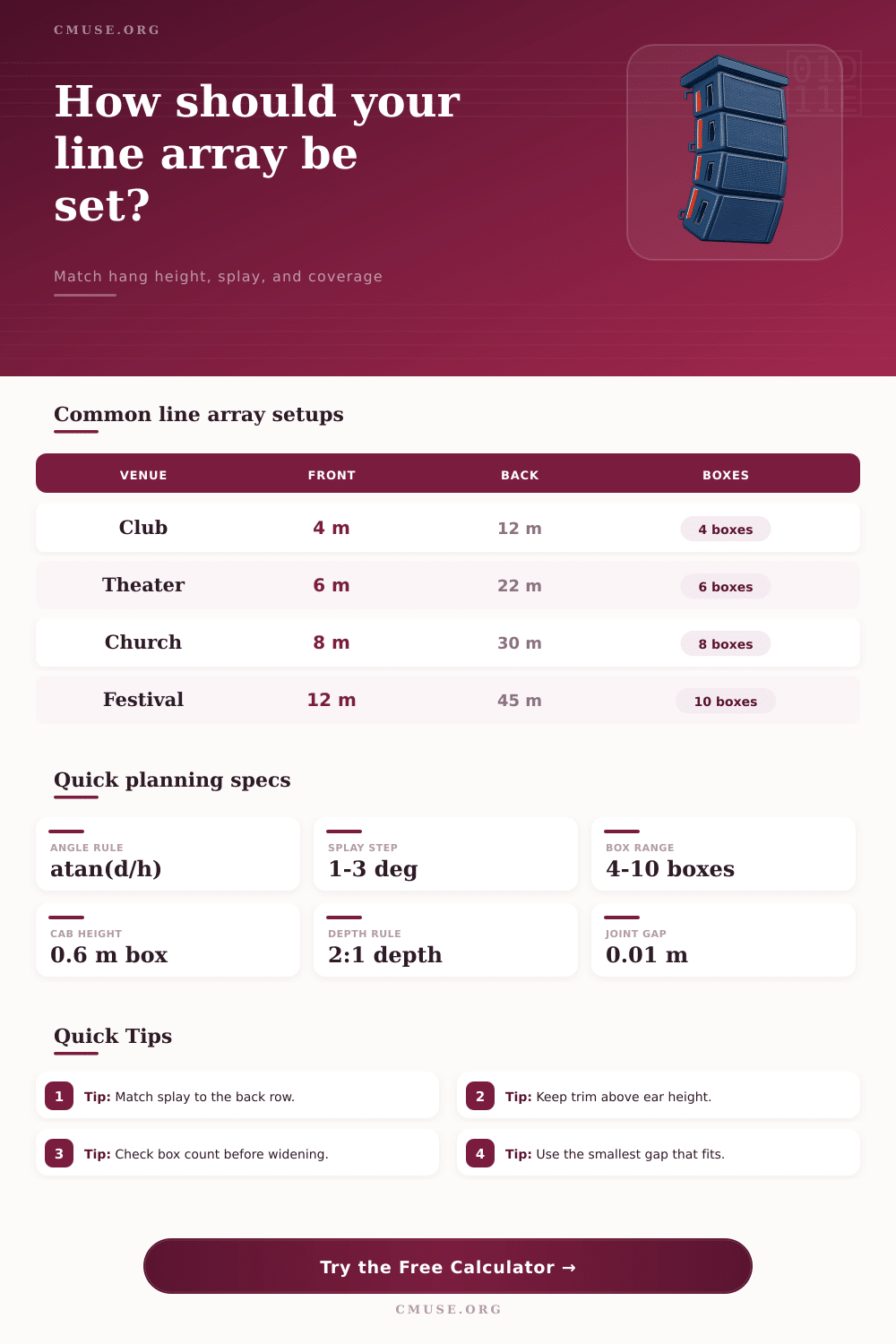
| Venue | Front | Back | Boxes |
|---|---|---|---|
| Club room | 4 m | 12 m | 4-6 |
| Worship hall | 6 m | 22 m | 6-8 |
| Theater stalls | 8 m | 28 m | 6-8 |
| Outdoor bowl | 12 m | 45 m | 8-12 |
| Joint | Use | Spread | Note |
|---|---|---|---|
| 0.5° | Long throw | Tight | Far rows |
| 1.0° | Small hall | Low | Even top |
| 2.0° | Worship | Medium | Good blend |
| 4.0° | Near fill | Wide | Front focus |
| Boxes | Height | Gap | Use |
|---|---|---|---|
| 2 | 1.2 m | 0.0 m | Front fill |
| 4 | 2.4 m | 0.0 m | Club stack |
| 6 | 3.6 m | 0.01 m | Hall stack |
| 10 | 6.0 m | 0.01 m | Festival |
| Band | Coverage | Splay | Note |
|---|---|---|---|
| 80-250 Hz | Wide | Small | Keep phase |
| 250-1 kHz | Medium | Low | Main vocals |
| 1-4 kHz | Narrow | Fine | Tight aim |
| 4-16 kHz | Tight | Tiny | HF control |
A line array is a system of loudspeaker cabinet that are hung in a vertical array to even out the sound in the venue. Line arrays is used to even out the sound that reaches the front of the audience with the sound that reaches the back of the audience. In order to use a line array, the engineer has to calculate the geometry of the loudspeaker cabinets because the geometry of the loudspeaker cabinets will even out the sound throughout the venue.
The first step in setting up a line array is to determine the trim height of the loudspeaker array. The trim height is the distance from the floor to the point at which the line array is hung. If the trim height is too low, the front of the audience will experience too much bass from the loudspeakers.
How to Set Up a Line Array
However, if the trim height is too high, the sound will not reach the back of the audience with enough volume. The next step in determining the proper configuration of the line array is to measure the depth of the audience. The depth of the audience is the distance from the front to the back of the audience.
Knowing the depth of the audience and the trim height of the loudspeaker array allows the sound engineer to calculate the vertical spread of the loudspeakers. Using the depth of the audience and the trim height, the engineer can calculate the angles at which the loudspeakers will project the sound to the front and back of the audience. The difference between these two angle will determine the vertical spread of the loudspeakers.
The splay angle of the loudspeaker array are the angles that are formed between the loudspeaker cabinets within the line array. Tight splay angles are used when the loudspeakers need to project sound over a long distance to the audience. Wide splay angles are used when the loudspeakers only need to project sound to a near field area of the audience.
Many loudspeaker cabinets has a nominal coverage of 10 degree of spread of the sound waves. However, 10 degrees is not always the splay angle that is use between loudspeaker cabinets within a line array. Many sound engineers use splay angles between 1 and 3 degrees between loudspeaker cabinets within the line array.
Splay angles of 4 or 5 degrees and beyond can cause issues in the propagation of the low frequency sound waves from the loudspeakers; these phase issues are most common below 250 Hz. The type of venue that is to be used with the line array will help to determine the number of loudspeaker cabinets that should be include within the line array. For instance, line arrays can include as few as four loudspeaker cabinets for use in a music club.
Music clubs tend to be relatively shallow in relation to the depth of concert venue like theaters. Theaters, in contrast, may require line arrays that include six to eight loudspeaker cabinets. Churches may use splay angles in the middle range between 1 and 3 degrees, around 2 degrees, so that the sound can evenly reach both the choir and the church congregation.
Line arrays for sound festivals, however, may require loudspeaker cabinets in line arrays of more than 10 loudspeaker cabinets. The reason that large line arrays are used at sound festivals is that the sound has to travel over large distance to reach each member of the audience at sound festivals. Additionally, the engineer should ensure the throw ratio of the loudspeaker array is not greater than a 2:1 ratio.
The throw ratio is the ratio of the depth of the audience to the height of the loudspeaker array. If the throw ratio is 2:1 or greater, the sound may not even cover the audience to the back of the venue. Another consideration in the configuration of a line array is the frequency of the sound that is to be played through the loudspeakers.
Low frequencies will require minimal splay angles between the loudspeaker cabinets in the line array because the sound has to remain coherent throughout the venue in order for the audience to hear the low frequencies clearly. High frequencies are more forgiving than low frequencies with regard to splay angles. Another consideration in the configuration of a line array is the rake of the venue.
The rake of the venue is the slope of the seats in the audience. The slope of the raked seats will change the drop of the sound that emerges from the loudspeakers; this must be factored into the calculations of the splay angles of the loudspeakers. Sound engineers can use software to model the sound that will emerge from the loudspeaker array.
However, physical calculations of the line array must be performed to ensure that the loudspeaker array is to be configured in the way that will evenly distribute the sound throughout the venue. The ear positions of the audience can be mark on the floor of the venue. By using these markings, engineers can determine whether the sound will be even throughout the audience.
If the sound is not even throughout the venue, the engineer can adjust the splay angles of the loudspeakers or the trim height of the loudspeaker array. Additionally, additional loudspeaker cabinets can be added to or removed from the line array to change the coverage of the loudspeakers. By ensuring that the math calculations are performed correctly and the splay angles are set to the appropriate angle, line arrays can even out the sound that is played for each person in the venue.