🎧 Limp Mass Bass Trap Calculator
Calculate cubic yards, bag counts, and weight for your bass trap project
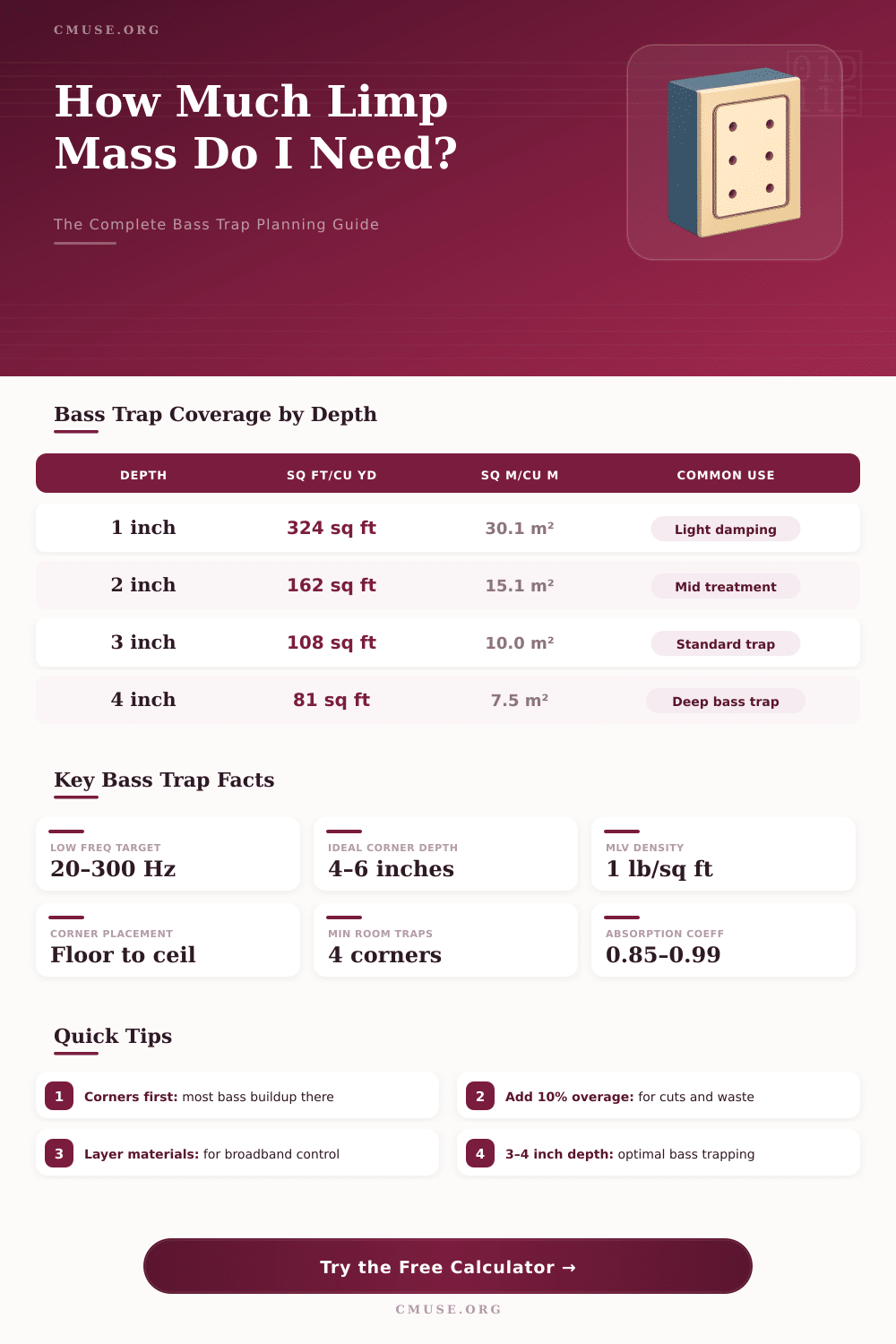
| Depth | Sq Ft per Cu Yd | Sq M per Cu M | Cu Ft per Cu Yd | Typical Use |
|---|---|---|---|---|
| 1 inch (2.54 cm) | 324 sq ft | 30.1 m² | 27 cu ft | Thin overlay / stacking |
| 2 inches (5.08 cm) | 162 sq ft | 15.1 m² | 13.5 cu ft | Mid-range treatment |
| 3 inches (7.62 cm) | 108 sq ft | 10.0 m² | 9 cu ft | Standard bass trap |
| 4 inches (10.16 cm) | 81 sq ft | 7.5 m² | 6.75 cu ft | Deep low-end control |
| 6 inches (15.24 cm) | 54 sq ft | 5.0 m² | 4.5 cu ft | Broadband corner trap |
| Bag Size | Volume per Bag | Bags per Cu Yd | Coverage @ 3 in | Coverage @ 4 in |
|---|---|---|---|---|
| 2 cu ft bag | 2 cu ft | 13.5 bags | 8 sq ft | 6 sq ft |
| 3 cu ft bag | 3 cu ft | 9 bags | 12 sq ft | 9 sq ft |
| 1.5 cu ft bag | 1.5 cu ft | 18 bags | 6 sq ft | 4.5 sq ft |
| Bulk (loose) | 1 cu yd | 1 unit | 108 sq ft | 81 sq ft |
| Project | Area (sq ft) | Cu Yds @ 3in | 2 cu ft Bags | 3 cu ft Bags |
|---|---|---|---|---|
| DJ Booth 6x4 | 24 sq ft | 0.22 cu yd | 3 bags | 2 bags |
| Recording Booth 5x5 | 25 sq ft | 0.23 cu yd | 4 bags | 3 bags |
| Practice Room 8x8 | 64 sq ft | 0.59 cu yd | 9 bags | 6 bags |
| Home Studio 10x12 | 120 sq ft | 1.11 cu yd | 16 bags | 11 bags |
| Mixing Room 14x10 | 140 sq ft | 1.30 cu yd | 18 bags | 12 bags |
| Live Room 18x14 | 252 sq ft | 2.33 cu yd | 32 bags | 22 bags |
| Stage Area 20x16 | 320 sq ft | 2.96 cu yd | 40 bags | 27 bags |
Deep traps have big value for reaching good sound in any space. It does not matter whether dealing about home cinema, studio or listening room, for having balanced bass you need more than only good speakers. Big part depends on acoustic treatment, that focuses on the management of low frequencies.
When low frequencies bounce through the room, they create standing waves. That happens because of interference, when reflected sound from walls crashes with the direct sound from the speaker. In some frequencies those interferences strengthen the sound in certain places, pushing it louder.
How Deep Traps Help Bass in a Room
In other cases, they cancel the original sound, what lowers the volume or even erases it complete. That decline of amplitude levels the peaks down and the valleys upward, by means of weakening of one or several interfering waves.
Deep traps work by absorbing the energy of low sounds. They convert sound energy into mechanical vibrations, that later release as small amounts of heat. Because of that process, deep traps cannot truly expand the whole volume.
On the contrary, they lower the peaks everywhere, what gives more uniform answer for the bass. Notably, those traps weaken the interferences that cause nullities, thus indeed can riase the sound in those frequencies. Hence, installation of deep traps commonly creates the impression of richer bass, not less.
The ideal places for deep traps starts in wall-to-wall corners, then wall-to-ceiling corners and finally panels directly on walls. Focusing first on the main corners is almost always a wise starting step. From that base, one can extend the setup according to listening attempts and ratings.
Graphics of the sound before and after the treatment usually show smoother declines, fewer resonant stings and clearer difference between notes.
The size of the trap is a key cause. “Small” and “deep traps” simply do not match between themselves. Panels of six inches can seem useful, but they mainly reach middle and higher frequencies, without truly settling low-end troubles.
To address the bass, one should use thick porous absorbers, set Limp Mass Bass Trap style absorbers or Helmholtz resonators or even active bass traps. A trap of around 12 inches of depth, fully filled with rock wool and placed in a corner, can really help for the ends of the room. Leaving the material 15 to 20 centimeters in front of the wall also is useful, because rock wool absorbs most effectively hear, where the sound wave moves and the motion is nearly zero at the wall surface.
The real content and structure of the room itself give the simplest way to beat low frequency challenges. In odd shaped spaces, the physical size of deep traps becomes the main obstacle. Filling large spaceswith rock wool will calm the bass and also controls unwanted high frequencies.
The main targets are to add enough absorb volume instead of simply covering the surface.