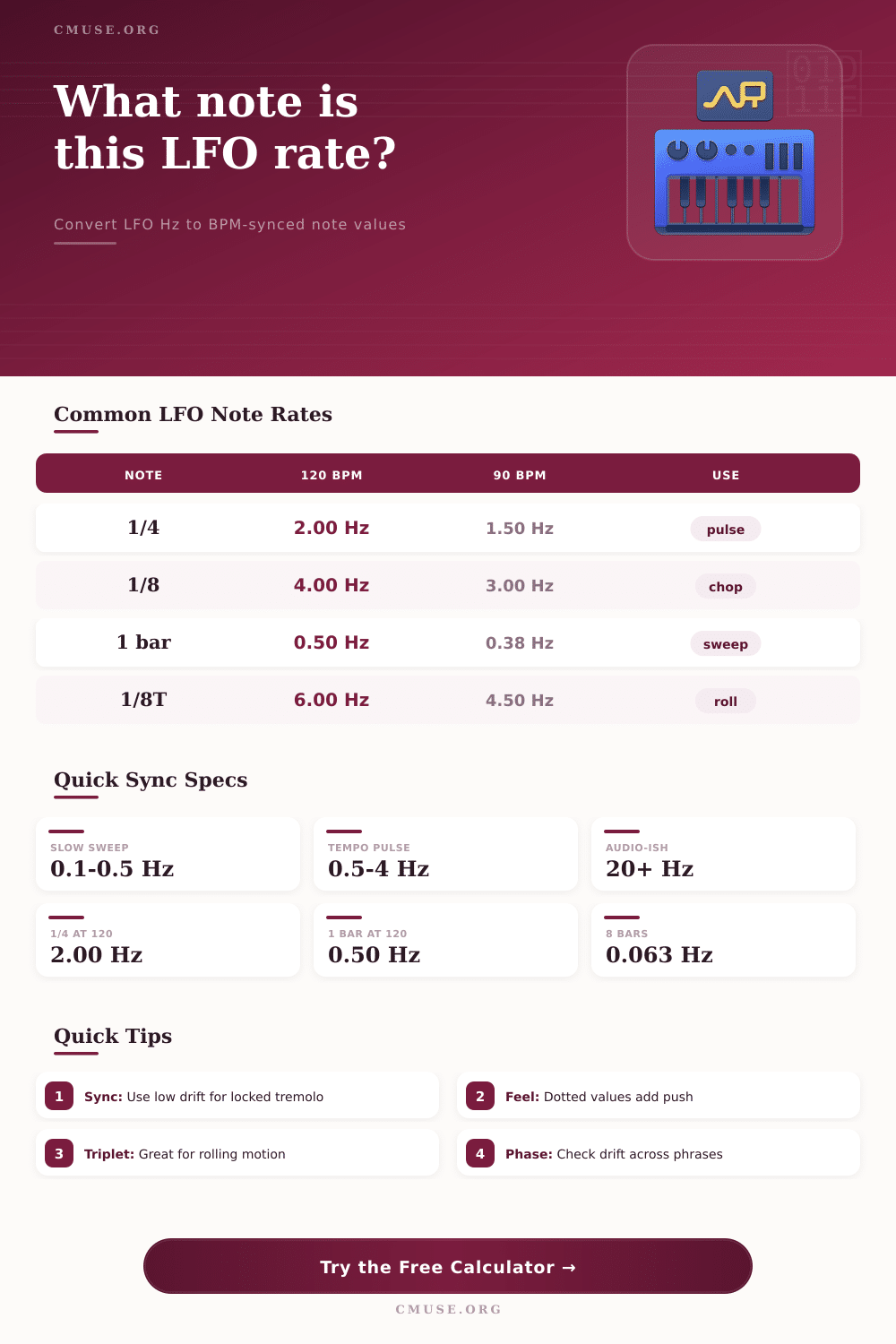
LFO Hz to Note Calculator
Convert free-running LFO frequency into tempo-synced note divisions, dotted and triplet matches, cycle time, bars per cycle, percent error, and phase drift.
Presets fill a real modulation scenario, then calculate immediately so you can compare sync accuracy and musical feel.
Formula Breakdown
| Family | Closest Note | Note Hz | Error | Bars/Cycle |
|---|
| Note Division | Beats | Hz at 120 BPM | Cycle Time | Common Modulation |
|---|---|---|---|---|
| 1/16 note | 0.25 | 8.000 Hz | 125 ms | Fast gate tremolo |
| 1/8 note | 0.5 | 4.000 Hz | 250 ms | Chopped pan or filter |
| 1/4 note | 1 | 2.000 Hz | 500 ms | Pulse tremolo |
| 1/2 note | 2 | 1.000 Hz | 1000 ms | Slow wah or vibrato |
| 1 bar | 4 | 0.500 Hz | 2000 ms | Filter sweep |
| 2 bars | 8 | 0.250 Hz | 4000 ms | Phrase movement |
| 4 bars | 16 | 0.125 Hz | 8000 ms | Long evolving pad |
| Feel | Formula | Example at 120 BPM | Musical Effect |
|---|---|---|---|
| Straight 1/8 | 0.5 beats | 4.000 Hz | Centered on the grid |
| Dotted 1/8 | 0.75 beats | 2.667 Hz | Pushes across the beat |
| 1/8 triplet | 0.333 beats | 6.000 Hz | Rolling three-feel motion |
| Dotted 1/4 | 1.5 beats | 1.333 Hz | Syncopated phrase wobble |
| 1/4 triplet | 0.667 beats | 3.000 Hz | Fast shuffle pulse |
| LFO Range | Tempo Feel | Best Targets | Watch For |
|---|---|---|---|
| 0.03-0.25 Hz | 4 to 32 bars | Pad filter, shimmer, ambience | May feel static in short clips |
| 0.25-1 Hz | 1/2 to 2 bars | Wah, pan, evolving sends | Phrase drift is easy to hear |
| 1-5 Hz | 1/2 to 1/8 notes | Tremolo, vibrato, filter pulse | Needs tight sync for rhythm |
| 5-12 Hz | 1/8T to 1/32 notes | Gates, rhythmic chops, FM motion | Can blur transients |
| 12-20 Hz | Very fast divisions | Ring-like texture, pitch flutter | Near audio-rate perception |
| 20+ Hz | Audio-rate | FM, AM, sideband color | Pitch and timbre shift |
| Division | 90 BPM | 120 BPM | 128 BPM | 140 BPM |
|---|---|---|---|---|
| 1/16 note | 6.000 Hz | 8.000 Hz | 8.533 Hz | 9.333 Hz |
| 1/8 triplet | 4.500 Hz | 6.000 Hz | 6.400 Hz | 7.000 Hz |
| 1/8 note | 3.000 Hz | 4.000 Hz | 4.267 Hz | 4.667 Hz |
| Dotted 1/8 | 2.000 Hz | 2.667 Hz | 2.844 Hz | 3.111 Hz |
| 1/4 note | 1.500 Hz | 2.000 Hz | 2.133 Hz | 2.333 Hz |
| 1 bar | 0.375 Hz | 0.500 Hz | 0.533 Hz | 0.583 Hz |
| 4 bars | 0.094 Hz | 0.125 Hz | 0.133 Hz | 0.146 Hz |
| Scenario | LFO Hz | BPM | Nearest Note | Drift Over 8 Bars |
|---|---|---|---|---|
| Locked quarter pulse | 2.000 | 120 | 1/4 note | 0.0 cycles |
| Slightly fast tremolo | 2.050 | 120 | 1/4 note | 0.8 cycles |
| Slow filter sweep | 0.250 | 120 | 2 bars | 0.0 cycles |
| Triplet roll | 6.000 | 120 | 1/8 triplet | 0.0 cycles |
| Dotted wobble | 1.333 | 120 | Dotted 1/4 | -0.0 cycles |
Ever tweak the filter sweep on a synth and find it wandering off? After a while, the modulation have gone all wonky and isn’t locked to the drums anymore. It’s a mess! If you’re like most people, you probably did this by ear rather then any sort of math.
Enter the Hertz to Note Calculator, which turns Hertz into note values so that you can visually map out where your modulation fall in relation to the beat grid. LFO measurement is in cycles per second; this is a linear measure of time. Musical time are divided rhythmically and these divisions alter according to tempo. At a tempo of one-hundred-and-twenty beats per minute, each ‘beat’ is half a second long. At 120 beats per minute, an LFO at two Hertz make a single cycle every beat.
How to Sync Your LFO with the Beat
Slow down the beat to, say, ninety beats per minute and keep the frequency unchanged. Now the LFO runs out ahead of the pulse and sounds disjointed and frantic; no longer in sync. Knowing this relationship will let you correct timing. If you have a target tempo and an LFO frequency, you can enter these into the tool and it will calculate phase drift and percent error.
It doesn’t simply provides you with the closest note value. If you’re working on a long arrangement, phase drift becomes a factor. What may only be a five percent error in a single bar begins to accumulate, and this has potential to show up as a rush or lag. The tool shows you number of cycles that are gained or lost until loop repeats.
For rhythmic effects such as tremolo, you want the result to be near zero percent error. Any drift can kill effect by causing it to miss downbeat. With ambient pads, however, you can get away with some drift as a livig feel is more wanted than rigid sync here.
Also covered by the tool are triplet and dotted divisions. These bring groove that is missing from straight values. A dotted eighth note for example pushes then pulls. There is a forward movement to this division of a note. Triplets rolls along with momentum. At a one hundred and twenty beat per minute track your LFO set to three Hertz will match a quarter-note triplet. The division into triplets bring a shuffling feel different from straight sixteenth notes.
Knowing if your frequency hits a triplet or dotted value can lead to fresh ideas about where to take your moddern modulation design. As with any modulation, it’s the mix of time and wave form that counts. For a gentle filter sweep or vibrato, use a sine wave that blends smoothly. For harder changes like a robot chord or gate, try a square wave. The calculator suggest these.
If the wave form isn’t cutting through well enough at high rates, they will all blend into one another. Too little depth and slow rates can sounds static. Get an idea of what your rate sounds like so you can pick correct shape.
LFO sync is a question of control. How does it support the harmony, drive the rhythm, evolve the texture? With the numbers lining up, you know how to dial-in the shape and depth. It’s solid. Pulse locks in. Drift dissapears. The mix feels like you intended it, because you did.