Leq Calculator
Combine changing sound levels into one equivalent continuous level, then check SEL, normalized exposure, dose, and peak headroom for studio, stage, venue, or location audio work.
🎵Preset Sound Scenarios
📊Sound Level Segments
Enter each measurement block as an A-weighted equivalent level and its duration. The calculator uses acoustic energy, so a short loud block can dominate the final Leq.
⚙Exposure Settings
Formula Used
📐Leq Formula Reference
| Quantity | Formula | Best use | Watch point |
|---|---|---|---|
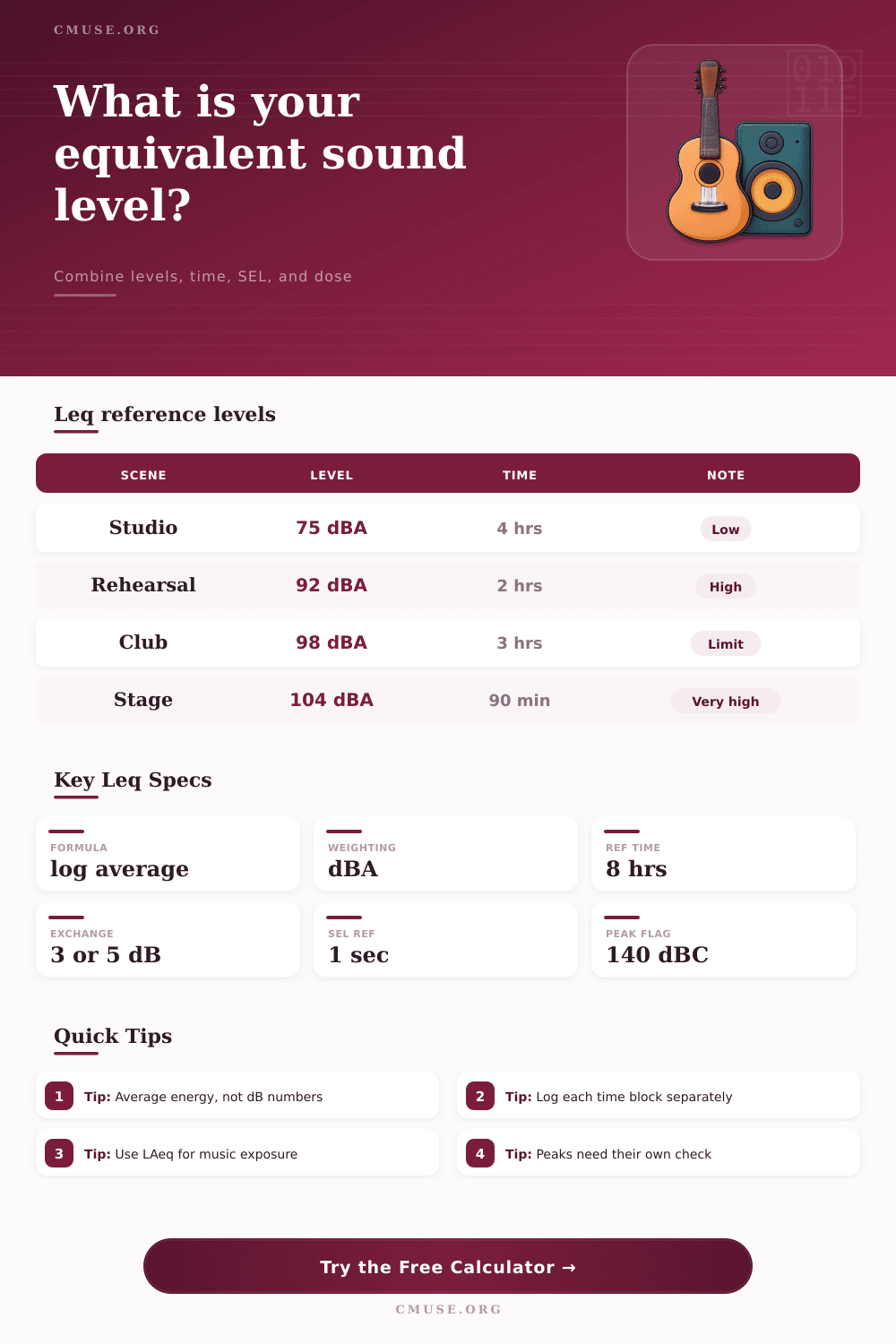
| Leq | 10 log10(sum tE / T) | Average sound energy over a session | Needs matching time units |
| SEL | Leq + 10 log10(T sec) | Compare events of different length | Grows with duration |
| Lavg | 5 dB exchange average | OSHA-style workday checks | Not pure energy average |
| TWA | Normalized Leq or Lavg | Shift-length comparison | Depends on chosen rule |
| Dose | sum duration / allowed duration | Exposure limit percentage | Criterion must match rule |
🎙Common Audio Level Table
| Audio scene | Typical LAeq | Common duration | Calculation note |
|---|---|---|---|
| Quiet mix editing | 68 to 78 dBA | 2 to 6 hours | Usually safe, but fatigue still matters |
| Band rehearsal | 90 to 100 dBA | 1 to 3 hours | Short breaks reduce normalized dose |
| Drum tracking room | 98 to 112 dBA | 15 to 90 minutes | Peaks often need separate capture |
| Club or DJ booth | 94 to 104 dBA | 2 to 5 hours | Monitor level can exceed room level |
| Stage side fill area | 96 to 106 dBA | 1 to 4 hours | Position changes can swing exposure |
| Orchestra pit | 86 to 100 dBA | 2 to 4 hours | Brass and percussion blocks dominate |
🧭Exposure Rule Comparison
| Rule | Criterion | Exchange | 100 percent dose means |
|---|---|---|---|
| Energy hearing check | 85 dBA / 8 hr | 3 dB | Full daily energy allowance |
| NIOSH style | 85 dBA / 8 hr | 3 dB | Conservative occupational limit |
| OSHA PEL style | 90 dBA / 8 hr | 5 dB | Regulatory exposure baseline |
| Short music session | 85 dBA / 2 hr | 3 dB | Custom rehearsal comparison |
| Peak screen | 140 dBC peak | Not used | Instantaneous peak flag |
📋Preset Scenario Data
| Preset | Segments | Primary result | Why it matters |
|---|---|---|---|
| Quiet Edit Suite | 72, 76, 70 dBA | Low Leq | Long duration with modest level |
| Practice Room | 90, 94, 88 dBA | Moderate to high | Loud blocks drive the average |
| Drum Tracking | 105, 110, 96 dBA | Very high | Short hits carry heavy energy |
| FOH Mix Shift | 88, 96, 101 dBA | High shift level | Show time dominates setup time |
| Venue System Tune | 92, 98, 85 dBA | High check level | Pink noise time adds up quickly |
💡Calculation Tips
Equivalent continuous sound level, or Leq, is a measurement of an average sound energy exposure over time. Many people believes that the average sound level is determined by taking the sum of all the decibel readings and dividing that sum by the number of decibel readings taken. However, this calculation are incorrect due to the fact that decibel measurements is made on a logarithmic scale.
Because of this logarithmic scale, a short period of loud noises contains more sound energy than a long period of quiet sound levels. To calculate Leq, a person converts each sound segment to linear energy, the energy of each sound segment is weighted according to its length, the total energy is averaged, and that average is converted to a decibel measurement. Thus, the Leq measurement provide a number that represents the total sound energy that was exposed to a person during a specific time frame.
What is Leq and How It Measures Sound Energy
To calculate the Leq of a set of sound measurements, the exchange rates between those sound measurements must be determined. The exchange rate for sound levels determine how the calculation of the Leq weights the sound energy of each sound segment. An exchange rate of 3 dB is often used for sound energy calculations because when sound energy is increased by 3 dB, that sound energy double.
An exchange rate of 5 dB is used in some regulations regarding sound levels in the workplace, however, because using a 5 dB exchange rate leads to a lower overall sound energy penalty for loud sounds, which allows the person in that workplace to be exposed to loud sounds for longer periods of time. Additionally, a criterion level for sound energy must be established for a specific time period. The criterion level is the standard sound level that is allowed for a specific period of time.
For instance, some regulation state that the sound energy level should not exceed 85 dBA for an eight hour period. By knowing the Leq of a space and the criterion level for sound energy, it is possible to calculate a dose percentage. The dose percentage indicates the portion of the allowable sound energy dose that the listener has used during that period.
While the Leq determine the average sound energy level over a specific period of time, the Leq does not account for sound peaks. Sound peaks are short burst of loud sounds, such as a snare drum hit or feedback from sound systems. Sound peaks can cause damage to the ears of individuals without regard to the Leq measurement of that area.
Thus, in addition to calculating the Leq of a location, it is also necessary to calculate the sound energy create by sound peaks in order to ensure that those sound peaks are within the allowable limits for hearing damage. For instance, it is possible for a listener to have a low Leq while at a music concert, but if there are loud sound peaks that occur during those concerts, those sound peaks could still lead to hearing damage for those individuals. Additionally, the Sound Exposure Level can be calculated for sound energy exposure in a given location.
The Sound Exposure Level help to compare different sound energy exposures, such as by comparing a short, loudly sound exposure to a long, loud sound energy exposure. When calculating the Leq of a location, it is important to include all sounds during the measurement session. Thus, it is necessary to include quiet periods in the measurement of sound levels in order to accurately reflect the average sound energy exposure of the individuals in that location.
If quiet periods is not included during the measurement of sound energy, the Leq will register higher than the actual sound energy exposure of the individuals during that session. However, if the person accurately records the sound energy of the session, the quiet periods will contribute to the dilution of the total sound energy of the session. In addition to accurately measuring sound energy at a location, it is also important to record the measurement position.
The position of the sound measurement can change the sound energy in decibels by a large amount. For instance, an individual standing near a speaker will register higher decibel level than an individual standing a distance from that speaker. Finally, while the measurement of sound energy exposure can provide an accurate measurement of the physical sound energy of a location, it does not account for the mental fatigue that individuals feel after being exposed to loud sounds for long period of time.