Leading Tone Calculator
Find the scale degree 7 spelling, semitone pull, tonic resolution, seventh-chord option, and applied leading tone for major, minor, modal, or chromatic harmony.
Preset use: Load a real theory situation, then adjust tonic, tonality, harmonic target, spelling policy, chord form, register, and resolution style.
Calculation Breakdown
| Resolution Key | Major Leading Tone | Minor Raised 7 | Natural Subtonic |
|---|---|---|---|
| C | B to C | B to C | Bb to C |
| G | F# to G | F# to G | F to G |
| D | C# to D | C# to D | C to D |
| A | G# to A | G# to A | G to A |
| E | D# to E | D# to E | D to E |
| F | E to F | E to F | Eb to F |
| Bb | A to Bb | A to Bb | Ab to Bb |
| Eb | D to Eb | D to Eb | Db to Eb |
| Context | Seventh Degree | Distance To Tonic | Common Use |
|---|---|---|---|
| Major / Ionian | Natural leading tone | 1 semitone | Authentic cadences and tonal melodies |
| Harmonic minor | Raised 7 | 1 semitone | Minor-key V and vii diminished chords |
| Melodic minor ascending | Raised 7 | 1 semitone | Smoother minor melodic ascent |
| Natural minor / Aeolian | Subtonic | 2 semitones | Modal color or descending minor lines |
| Dorian | Subtonic unless raised | 2 or 1 semitones | Modal writing or borrowed cadential pull |
| Mixolydian | Flat 7 subtonic | 2 semitones | Dominant-mode color without leading pull |
| Harmony | Formula Above Leading Tone | Example In C | Resolution Habit |
|---|---|---|---|
| Scale degree 7 | single tone | B | Usually rises to C |
| vii diminished triad | 1, b3, b5 | B-D-F | Root rises, tritone resolves inward |
| vii half-diminished 7 | 1, b3, b5, b7 | B-D-F-A | Common in major keys |
| vii fully diminished 7 | 1, b3, b5, bb7 | B-D-F-Ab | Common in harmonic minor and modulations |
| Dominant seventh | 3rd of V7 | B inside G-B-D-F | Third of V rises to tonic |
| Applied vii chord | leading tone to target | F#-A-C to G | Temporarily tonicizes another degree |
| Musical Setting | Input Context | Leading Tone Result | Best Reading |
|---|---|---|---|
| Classical cadence | C major, V7 to I | B to C | Strong tonal resolution |
| Minor-key cadence | A harmonic minor | G# to A | Raised seventh supplies pull |
| Modal folk line | E Phrygian natural 7 policy | D to E | Subtonic color, not true leading tone |
| Secondary dominant area | V of V in C | F# to G | Applied pull toward dominant |
| Choir alto line | Bb major cadence | A to Bb | Small upward semitone needs clean tuning |
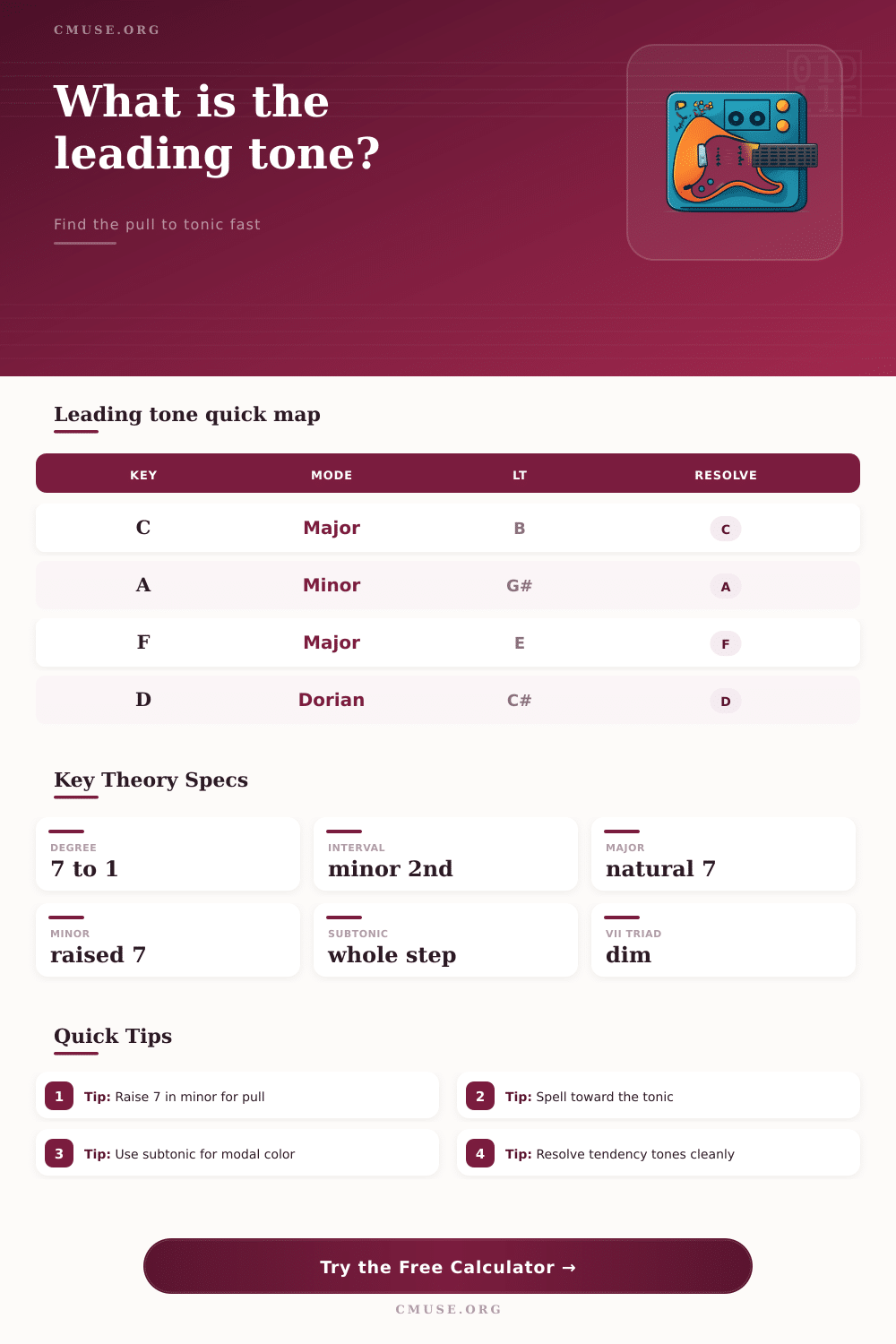
The leading tone is an specific note within a musical scale. This particular note is important in tonal music because the leading tone help the music to create a sense of arrival. The leading tone creates a sense of tension within the music because the leading tone normaly rest a semitone below the tonic note.
The resolution to this tension occur when the leading tone moves up by a semitone to reach the tonic note. When the seventh degree of a musical scale move to the tonic note within that scale, the listener experiences a sense of completion. This sense of completion within listeners occur because the leading tone naturaly creates a sense of tension that resolve into a feeling of arrival within the listener.
How the Leading Tone Works and How to Use the Calculator
A person must understand the difference between a leading tone and a subtonic within a scale. A leading tone and a subtonic is different in that each of them have a different distance from the tonic note within a scale. In a major key, the seventh degree of a scale is a leading tone because it is a semitone below the tonic note.
In a natural minor key, the seventh degree of a scale is a subtonic because it is a whole step below the tonic note. Because the subtonic does not create the same sense of arrival as does the leading tone, the subtonic creates the arrival in the music to sound more soft. In a harmonic minor key, the musician raises the seventh degree of a scale to create a leading tone similar to that of a major key.
Modal scales, like the Dorian and the Mixolydian modes, contains a lowered seventh degree which creates a subtonic. The decision to use a leading tone or a subtonic in a musical composition will determine whether the music sound tonal or modal. The calculator included at the top of this page will help you to manage the mathematical distances of each of these scale notes, as well as help you to manage the spelling of each of these notes.
To use the calculator, all you must do is enter the tonic note, mode, and function of the chord you are create within your composition. The calculator will output for you whether the seventh degree of your scale should rise or stay flat. Furthermore, the calculator will also output for you the quality of chord that should follow the degree of the seventh note in your composition.
Additionally, the calculator will also output for you how the choice of the seventh degree will affect the chord within your composition. For example, if you change the minor policy from auto to raise, the calculator will change the subtonic to a leading tone, as well as change the chord spelling from a major or minor chord to a diminished chord. Besides understanding the difference between leading tones and subtonics, you can also use leading tones to point towards other scale degree besides the tonic note.
Furthermore, you can also use leading tones to create secondary dominants and vii chords. There is also a target selector within the calculator that will allow you to see how the leading tone can resolve to the dominant note instead of the tonic note. The spelling preference will allow you to keep the note letters correct in your composition.
The correct note letters will allow for clean voice leading in your composition. The register choice allow you to choose in which range you would like to place the leading tone within your composition. However, the register does not have an effect upon the leading tone itself.
Many people tend to make mistake with these notes and their functions within a composition. One common mistake is treating every seventh degree note in a composition as if it is the same note. For instance, many singers will flatten a leading tone because it is easier to sing a lowered note.
However, flattening the leading tone will make the singer lose the cadence in the song. Another example of a mistake is a guitarist who may choose to play a subtonic in a rock composition. The guitarist may make this mistake because of the groove and the feel of the genre of rock music.
However, playing a subtonic note will cause the song to lack a sense of punch when it resolve to the final chord. The calculator will help to prevent these types of mistake. The calculator will tell the musician the distance of each note in the composition in semitones, as well as the quality of the chord that result from each note choice.
Although the musician will still have to make the decision of whether they wish to use the modal coloring or the tonal pull of the leading tone, the calculator will help to show the musician the number behind these two options. Another consideration of leading tones is the resolution of that leading tone to the tonic note. Leading tones will naturally tend to resolve up to the tonic by a semitone.
However, other resolution styles exist which will delay the resolution of this leading tone. For example, a suspension or a deceptive motion can occur which will delay the leading tone to its goal note. The resolution selector within the calculator will account for these resolution style.
Thus, the output of the calculator will reflect the resolution of the leading tone within the composition. As long as the tendency tone note eventually resolve to its goal note, clean voice leading is attainable. Leading tones allow a musician and composer to hear the difference between tension and color within a composition.
The raised seventh note in a composition will normally create a sense of urgency, whereas a lowered seventh note will create a sense of weight within that composition. Knowing the difference between a raised seventh note and a lowered seventh note allows the composer and musician to use the calculator as a tool to double-check their work. While the ear will make the final decision as to the resolution of each leading tone within a composition, the calculator will allow the composer to have the musical options clear within their mind prior to begin to rehearse the composition.