Lateral Fraction Calculator
Calculate early lateral fraction from figure-8 lateral energy and omnidirectional early energy, with SPL, energy, or reflection-angle inputs.
🎵Measurement Presets
🎙Early Energy Inputs
Use integrated pressure-squared energy for each measurement window.
Early Lateral Fraction
18.0%
JLF 0.180Omni Early Energy
5.000
0-80 ms denominatorLateral Energy
0.900
5-80 ms numeratorSpatial Reading
Balanced
Useful width without major blur📐Formula Spec Grid
📊Reference Tables
| LF Band | JLF Decimal | Typical Impression | Calculation Note |
|---|---|---|---|
| Under 10% | Below 0.10 | Narrow or strongly frontal image | Lateral numerator is small versus direct and early omni energy. |
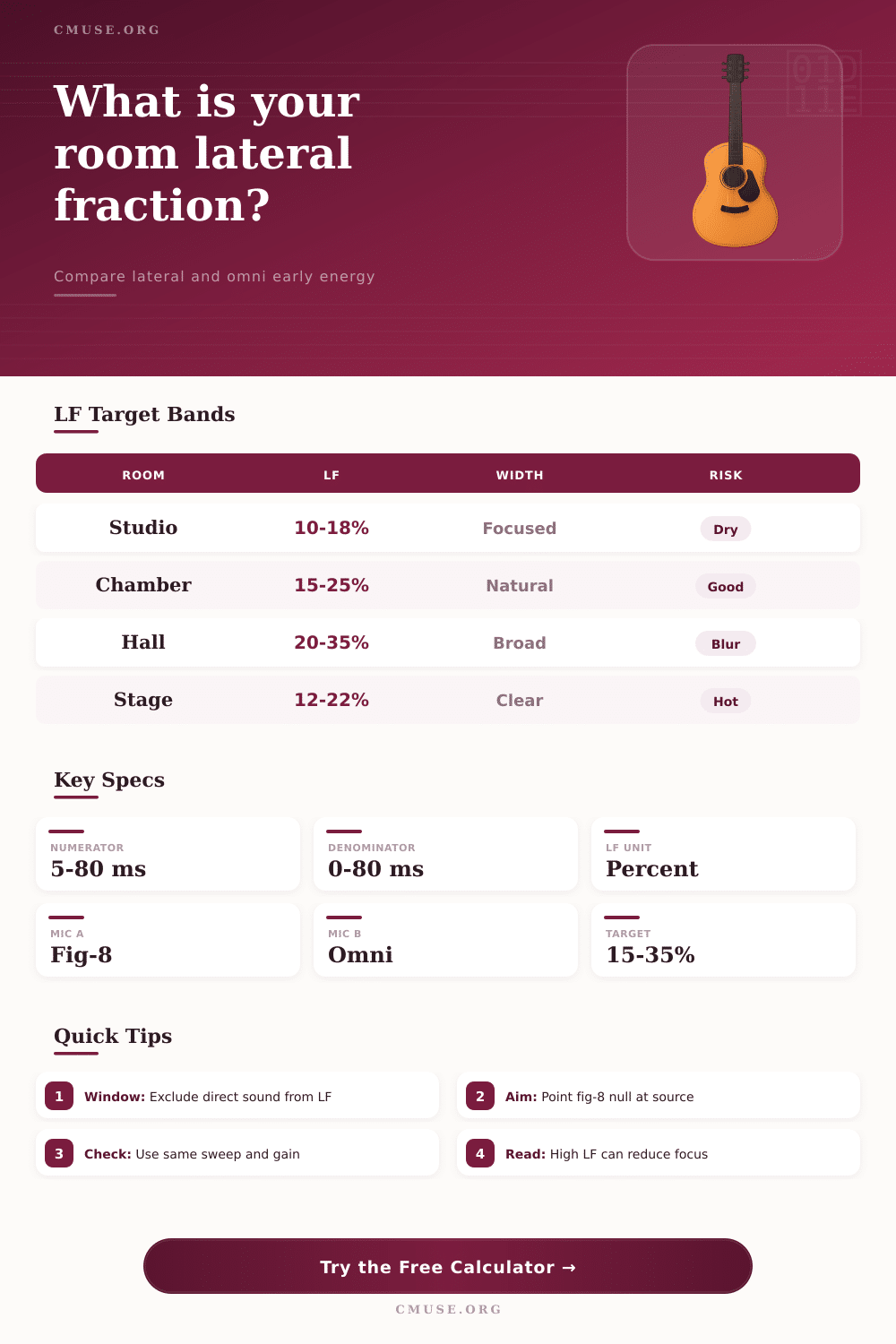
| 10-20% | 0.10-0.20 | Focused image with controlled width | Common for small control rooms and damped practice spaces. |
| 20-35% | 0.20-0.35 | Broad apparent source width | Often desirable in recital and ensemble listening positions. |
| Over 35% | Above 0.35 | Very spacious, possible localization softness | Check clarity if the direct window is weak or the room is highly reflective. |
| Energy Term | Time Window | Receiver Pattern | Formula Role |
|---|---|---|---|
| Lateral early energy | 5 ms to 80 ms | Figure-8, null toward source | Numerator: ∫ pL²(t) dt |
| Omni direct energy | 0 ms to 5 ms | Omnidirectional | Included in denominator only |
| Omni early reflections | 5 ms to 80 ms | Omnidirectional | Added to direct omni energy |
| Angle estimate | 5 ms to 80 ms | Modeled side response | Uses sin²(θ) for front-axis angle |
| Space Type | Common Area | Useful LF Range | Secondary Check |
|---|---|---|---|
| Vocal booth | 25-50 ft² | 8-16% | Watch boxy early reflections near 80 ms. |
| Mix room | 100-220 ft² | 10-20% | Compare left and right receiver positions. |
| Live room | 180-500 ft² | 16-30% | Check LF with absorbers open and closed. |
| Recital hall | 800+ ft² | 20-35% | Seat-to-seat spread matters more than one reading. |
| Preset | Area | Starting LF | Use Case |
|---|---|---|---|
| Home Studio 10×12 | 120 ft² | 18% | Nearfield image and sidewall check |
| Recording Booth 5×5 | 25 ft² | 11% | Controlled vocal or amp capture |
| Stage Area 20×16 | 320 ft² | 21% | Monitor zone lateral balance |
| Small Recital Hall | 900 ft² | 30% | Audience spatial impression |
💡Measurement Tips
Lateral fraction measure the quality of the lateral energy in a room. The lateral energy in a room is the sound that come from the sides of the room. The fraction of that lateral energy to the total early energy that reaches a listener is the lateral fraction.
This measurement can help you to determine whether a recording or performance is feeling open or if it is losing clarity. Low lateral fraction will make the sound image on a listening position collapse, while high lateral fractions will make the sound source blur. The concept of lateral fraction began in concert halls in the 1970s. Researchers discovered that concert halls received higher ratings from listener when the early reflections came from the sides of the concert halls rather than from the ceiling or the front wall of the concert hall.
Lateral Fraction and Room Sound
These discoveries led to the creation of the lateral fraction. The lateral fraction is an important measurement because it is both repeatable and it align with human perception of width and distance. To measure the lateral fraction, two microphones must be placed at the same location.
One of the microphones must be omnidirectional to pick up all of the sounds in the space. The other microphone is a figure 8 patterned microphone that has its null point pointed at the sound source so that it picks up only the lateral sound. The two sound signals is integrated within a time window that is between five and eighty milliseconds after the direct sound reaches the measuring location.
The two energy measurements and the time window can be entered into a calculator that will provide the percentage of lateral energy. The percentage of lateral fraction will vary based on the type of room that is being measured. Small control rooms and small vocal booths has lateral fractions that are between ten and twenty percent.
This is due to the proximity of the walls to the control rooms and vocal booths as well as the acoustic treatment of those walls. Live rooms and recital spaces have lateral fractions that are between twenty and thirty-five percent. This range of lateral fraction ensures that the musicians can hear each other in the room as well as that the audience feels as if they are being enveloped by the musicians sounds.
If the lateral fraction percentage reads above thirty-five percent, the room will compete with the sound source and cause a blurring of the sound source as well as smear the transient details of the sound. Depending on an engineer or sound designer goals for a recording, there will be different target lateral fractions. For instance, a tracking engineer will want the lateral fraction to be lower so that the center image of the recording is going to be more focused.
In contrast, a sound designer will accept a higher lateral fraction because there goal is for the listening listener to be enveloped by the sounds. To switch the priority label in the lateral fraction calculator will allow engineers and sound designers to determine the lateral fraction of a recording based on what they want the lateral fraction of that recording to be. Several factors will impact the lateral fraction of a room.
For instance, the figure-8 microphone must be aim correctly. If the figure-8 microphone is not aimed correctly, the lateral fraction will appear to be lower than it should of been. Additionally, the time window will impact the lateral fraction measurement.
If the integral that measures the lateral sound begins before five milliseconds, the direct sound will be integrated into the measurement of the lateral sound. The same principle applies if the time window extends beyond one hundred milliseconds. Many people use the five to eighty millisecond time window because this is the time window that the ear uses to determine the distance between sound sources and the size of the source itself.
The two microphones must be calibrated to one another. If there is a small difference in the sensitivity of the two microphones, the difference will become readily apparent when the ratio of the lateral energy to the total early energy is calculated. Before measuring the lateral fraction of a room, the same frequency sweep should be played through both capsules to note the offset between the two microphones.
The offset can be entered into the lateral fraction calculator to determine the lateral fraction with accuracy. Unlike the reference tables for the lateral fraction, real rooms may not behave the same. Due to the presence of people and furnitures in the rooms, different listeners will hear slightly different lateral fractions within the same room.
However, if one listener hears a different lateral fraction than another listener within the same spot within the room, then the lateral fraction reading will tell a sound engineer that there is a problem in the room. The sound engineer can fix the problem by adding an acoustic treatment to the area of the room that is causing that problem. Although the lateral fraction can be a helpful measurement, it only describes the early part of the impulse response of a room.
The lateral fraction does not describe the late part of the reverberant sound field within the room as well as it does not describe if the low-frequency sound modes are even throughout the room. It is possible to have a perfect lateral fraction number yet have boom and flutter reflections within the room. As such, sound engineers must consider the lateral fraction to be just one data point when treating a rooms acoustic problems.
After taking many lateral fraction measurements, a sound engineer will have an intuition for the appropriate lateral fraction measurements for a given type of room. For instance, a practice room that measures twelve percent may feel natural for playing instruments alone but having a lateral fraction of twenty-four percent may be too open for quiet vocal performances. While the lateral fraction calculator will calculate the lateral fraction of a room, it is up to the engineers and the musician to determine if that lateral fraction is useful for that given performance and recording.