🐟 Largemouth Bass Weight Calculator
Estimate bass weight from length & girth using the official fishing formula
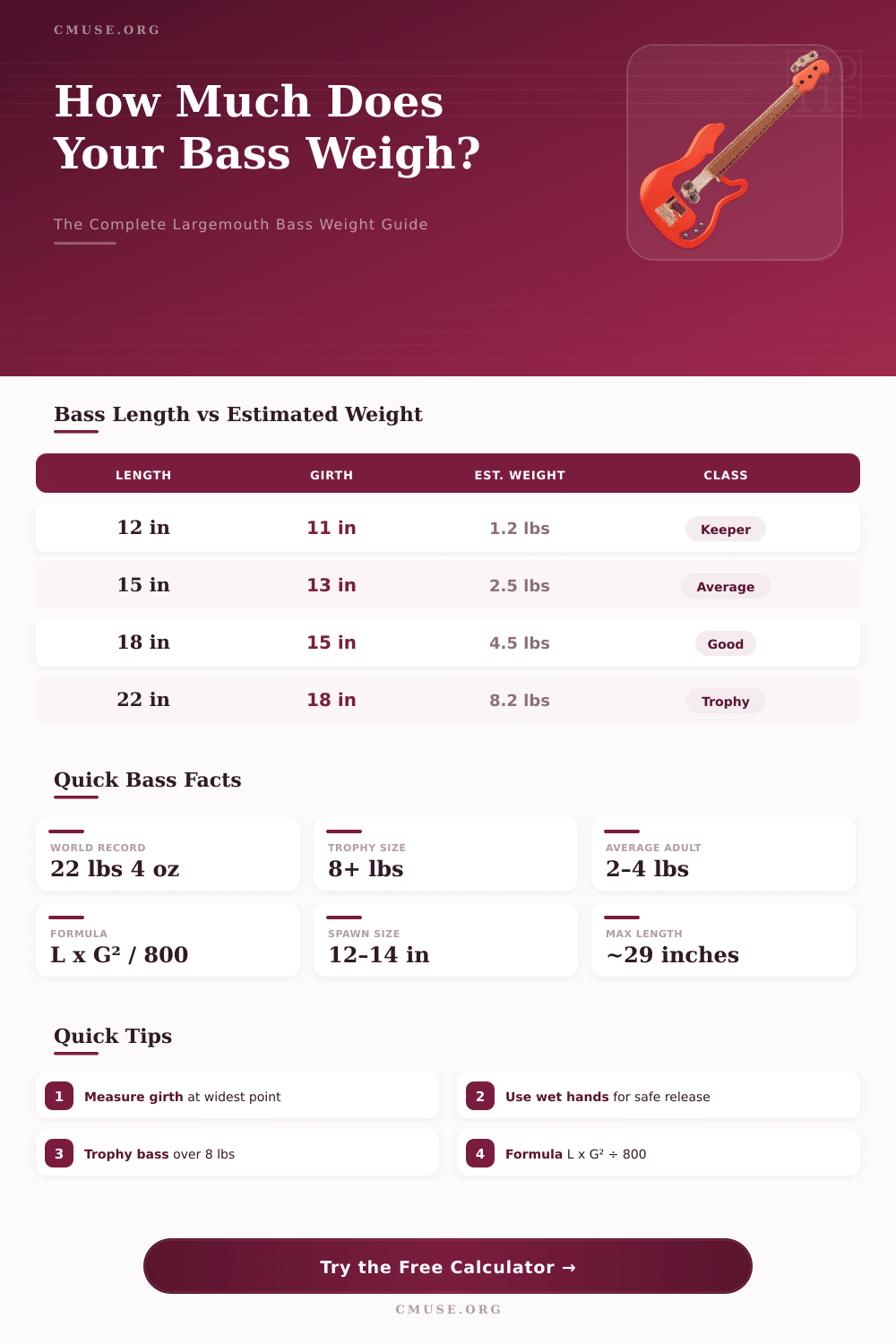
| Length (in) | Length (cm) | Est. Girth (in) | Est. Weight (lbs) | Est. Weight (kg) | Class |
|---|---|---|---|---|---|
| 10 | 25.4 | 5.8 | 0.42 | 0.19 | Sub-Keeper |
| 12 | 30.5 | 7.0 | 0.74 | 0.34 | Keeper |
| 14 | 35.6 | 8.1 | 1.18 | 0.54 | Keeper |
| 15 | 38.1 | 8.7 | 1.50 | 0.68 | Average |
| 16 | 40.6 | 9.3 | 1.75 | 0.79 | Average |
| 17 | 43.2 | 9.9 | 2.08 | 0.94 | Average |
| 18 | 45.7 | 10.4 | 2.44 | 1.11 | Good |
| 19 | 48.3 | 11.0 | 2.87 | 1.30 | Good |
| 20 | 50.8 | 11.6 | 3.38 | 1.53 | Good |
| 21 | 53.3 | 12.2 | 3.90 | 1.77 | Good |
| 22 | 55.9 | 12.8 | 4.49 | 2.04 | Trophy |
| 23 | 58.4 | 13.3 | 5.08 | 2.30 | Trophy |
| 24 | 61.0 | 13.9 | 5.79 | 2.63 | Trophy |
| 26 | 66.0 | 15.1 | 7.38 | 3.35 | Wall Mount |
| 28 | 71.1 | 16.2 | 9.24 | 4.19 | Wall Mount |
| Bass Type | Range | Max Weight | Avg Adult | Trophy Size |
|---|---|---|---|---|
| Northern Largemouth | Northern US / Canada | 10–13 lbs | 2–4 lbs | 6+ lbs |
| Florida Largemouth | Florida / South | 22 lbs 4 oz | 3–6 lbs | 8+ lbs |
| Spotted Bass | Central / Southeast US | 5–6 lbs | 1–2 lbs | 3+ lbs |
| Smallmouth Bass | Northeast / Midwest | 11 lbs 15 oz | 1–3 lbs | 4+ lbs |
| Length (in) | Lean Girth (in) | Avg Girth (in) | Fat Girth (in) | Lean Wt (lbs) | Avg Wt (lbs) | Fat Wt (lbs) |
|---|---|---|---|---|---|---|
| 15 | 7.5 | 8.7 | 10.0 | 1.05 | 1.42 | 1.88 |
| 18 | 9.0 | 10.4 | 12.0 | 1.82 | 2.44 | 3.24 |
| 20 | 10.0 | 11.6 | 13.3 | 2.50 | 3.38 | 4.43 |
| 22 | 11.0 | 12.8 | 14.6 | 3.33 | 4.49 | 5.87 |
| 24 | 12.0 | 13.9 | 16.0 | 4.32 | 5.79 | 7.68 |
The largemouth bass weight commonly comes to surprising levels, whether one talks about the fish itself or about the instrument. Each of them has its own troubles and ways for estimating their real weight.
If you involve yourself with largemouth bass as fish, there are some ways to reach a good guess of its weight. The easiest method applies a simple rule: one takes the length squares it, later multiplies it by the girth and divides the result by 1 200 to receive pounds. Both measures happen in inches.
Weight of Largemouth Bass Fish and Bass Guitars
Length and girth, where girth simply shows the beam of the fish at its thickest place. Except that rule, there are online calculators where you enter your values, or you simply trust length-based tables if you want to simplify the cause.
The whole length, measured from the peak of the muzzle directly left until the end of the tail; forms the usual way to estimate. Healthy 22-inch largemouth bass usually weigh around 6.2 pounds. Even so, consider a strong 20-inch sample, and it can easily reach 7 pounds or more.
Interesting is, how the year affects hear. If the largemouth bass weight is filled with fat or if it is female preparing herself for bearing, your rating will grow a bit. There is also the idea of relative weight, that one receives dividing the actual weight by the normal weight and multiplying by 100.
It helps to trace the health of the fish.
What is the record for the biggest largemouth bass ever fished? It weighed 22 pounds and 4 ounces, seized by George Perry in 1932 in Montgomery Lake beside Valdosta in Georgia. For most fishers in the north, “lunker” means anything passing 5 or 6 pounds.
Truly, when largemouth bass reach 3 pounds, there starts the real excitement, the mass truly values the time in the struggle.
Bass guitars form an entirely other cause, and the weight decides how much time you can play comfortably. Standard jazz or precise bass weighs between 8 and 9 pounds, although some samples pass 10. The Hofner Violin Bass stays light at only a bit more than 5 pounds.
Around 8.5 pounds is the spot where most folks feel themselves entirely well. If it arrives to 9, the tiredness starts more quickly. At 11 pounds, you risk shoulder pain after maybe 10 minutes of playing.
Commonly more lightweight instruments get a name for richer sound. A broader body… Something in the 4-inch range…
Truly helps to spread the burden for heavy basses. Problems with the back and neck make heavy instruments truly difficult during long time. Basses with hollow body move the weight forward to the head, which throws off the balance.
Searching for something lightweight thatsounds well quietly? That forms the main challenge for anyone caring about comfort.