Key Transpose Calculator
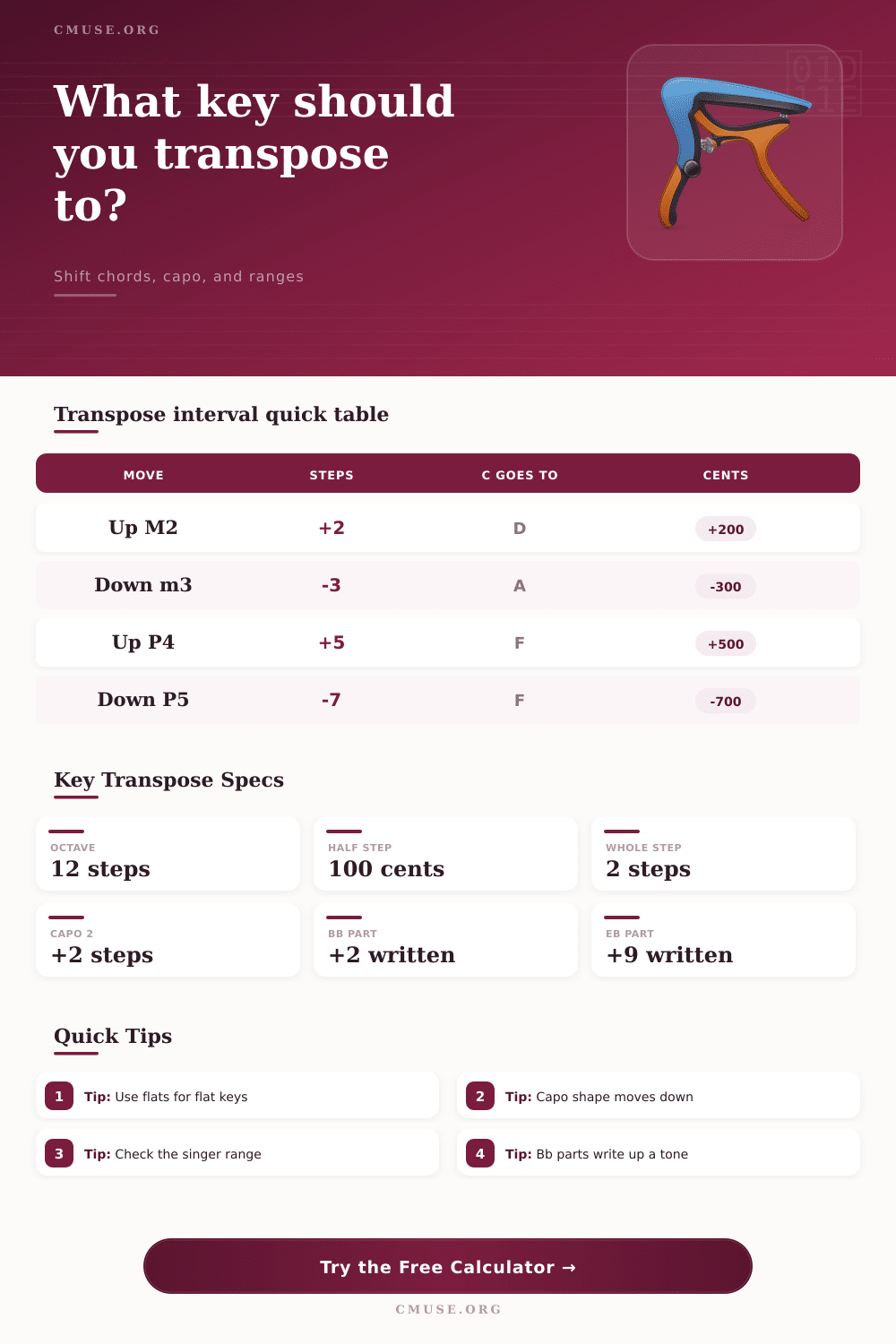
Transpose chords between keys, choose clean enharmonic spelling, find capo shapes, write for transposing instruments, and check shifted melody range.
🎵 Quick Presets
🎹 Transposition Inputs
📊 Core Transposition Specs
⚙ Spec Comparison Grid
📘 Interval Reference Table
| Interval | Semitones | Cents | Frequency Ratio |
|---|---|---|---|
| Minor 2nd | 1 | 100 | 1.0595 |
| Major 2nd | 2 | 200 | 1.1225 |
| Minor 3rd | 3 | 300 | 1.1892 |
| Major 3rd | 4 | 400 | 1.2599 |
| Perfect 4th | 5 | 500 | 1.3348 |
| Tritone | 6 | 600 | 1.4142 |
| Perfect 5th | 7 | 700 | 1.4983 |
| Octave | 12 | 1200 | 2.0000 |
🎺 Transposing Instrument Table
| Instrument Family | Concert C Written As | Written Offset | Example Concert D |
|---|---|---|---|
| Concert pitch | C | 0 semitones | D written |
| Bb trumpet / clarinet | D | +2 semitones | E written |
| Eb alto / bari sax | A | +9 semitones | B written |
| F horn | G | +7 semitones | A written |
| Guitar / bass octave | C | 0 key, octave displacement | D written |
🎸 Capo Shape Table
| Sounding Key | Capo 1 Shape | Capo 2 Shape | Capo 4 Shape |
|---|---|---|---|
| D | C# / Db | C | Bb |
| E | Eb | D | C |
| F | E | Eb | C# / Db |
| G | F# / Gb | F | Eb |
| A | Ab | G | F |
🔑 Key Signature Reference
| Concert Key | Major Signature | Relative Minor | Common Spelling |
|---|---|---|---|
| C | 0 sharps/flats | A minor | Neutral |
| D | 2 sharps | B minor | Sharp |
| E | 4 sharps | C# minor | Sharp |
| F | 1 flat | D minor | Flat |
| Bb | 2 flats | G minor | Flat |
| Eb | 3 flats | C minor | Flat |
Transposing a song involve changing the key to accommodate the singer and the instrumentalists. The key will change according to whether the song is too high or too low for the singer. Furthermore, changing the key will also change the guitar chord, the horn part, and the song’s melody.
The first order of business in transposing a song is to determine the original key and an target key. Recognizing the original key will allow you to calculate transposition mathematicaly. Furthermore, recognizing the target key will allow you to determine the destination of the transposition.
How to Change the Key of a Song
Recognizing these two key is the first step in using the transposition calculator to determine the mathematical calculations that will create the new key of the song. However, the calculator wont determine whether the new key will be comfort for the singer. The range of the singer are another essential consideration in determining whether the singer can perform the transposed song.
If the song is transposed, the notes in the song’s melody will change. Therefore, using the melody note field will allow you to determine whether the high and low notes will be within the singers capability of sing them. If the high or low notes of the transposed song are outside the range of the singer, then the singer will struggle to sing the song.
Therefore, checking the singer’s range will ensure that problem are avoided during the song’s rehearsals. Another consideration in the song’s transposition is the placement of the capo for the guitar player. The capo will change the pitch of the guitarist’s instrument.
However, the guitarist will still use specific shape for the chords. The placement of the capo will tell the guitarist which chord shapes to use for the song to reach the proper sounding key. Furthermore, if the guitarist is using a tuning other than the standard tuning for the guitar, you must account for the tuning offset.
Specifically, you must subtract the tuning offset from the sounding key to determine the proper chord shape for the guitarist’s song. Not accounting for the capo and tuning will force the guitarist to play the wrong chords in the wrong key for the song. Furthermore, the transposing of instruments such as the trumpet require specific mathematical adjustments.
The trumpet part will be written in a different key to what the trumpet will sound. For example, the trumpet part will be written in the key of D but will sound a whole step lower than the key of D. In this instance, the concert key must be adjusted upwards to account for the sounding key of the trumpet. The instrument selector for the trumpet part will automatically account for these offset.
However, the musician should of be able to easily read the newly calculated written key for the trumpet part. Furthermore, the chord progressions must be changed according to the new key of the song. The chord progressions will move in the same interval as the key change.
For example, if the key of the song is changed up by a whole step, then every chord in the song will also move up by that same whole step. The inclusion of slash note in the chord progression will ensure that the slash notes move up by the same interval as the key change. Furthermore, the inclusion of chord extension will ensure that the extensions move up by the same interval as the key change.
This will allow the tool to calculate the chords that the musician should use. However, this is unable to calculate whether the new chord spelling is easy for the musicians to read. The reference table included at the end of this page provide information about the size of musical interval, the offsets of transposing instruments, and the relationship of different caps with specific note.
These tables can be utilized in instances in which the singer or instrumentalist doesnt wish to use the transposition calculator. These tables can be used to verify the mental calculation that were performed when calculating the transposition of the song, as well as to be able to explain the math to other musician in the ensemble. Singers often discover during musical session that the original key is uncomfortable for them.
In these instance, the key will have to be recalcuated to find a comfortable note for the singer. The transposition calculator can ease the need for the musician to utilize manual mathematics for these calculation. The goal of the transposition of a song is to find a key that is comfortable for each member of the ensemble.
When the proper key is found for the ensemble, they will be able to play the song without struggling against the key of the song.