Key Signature Sharps Calculator
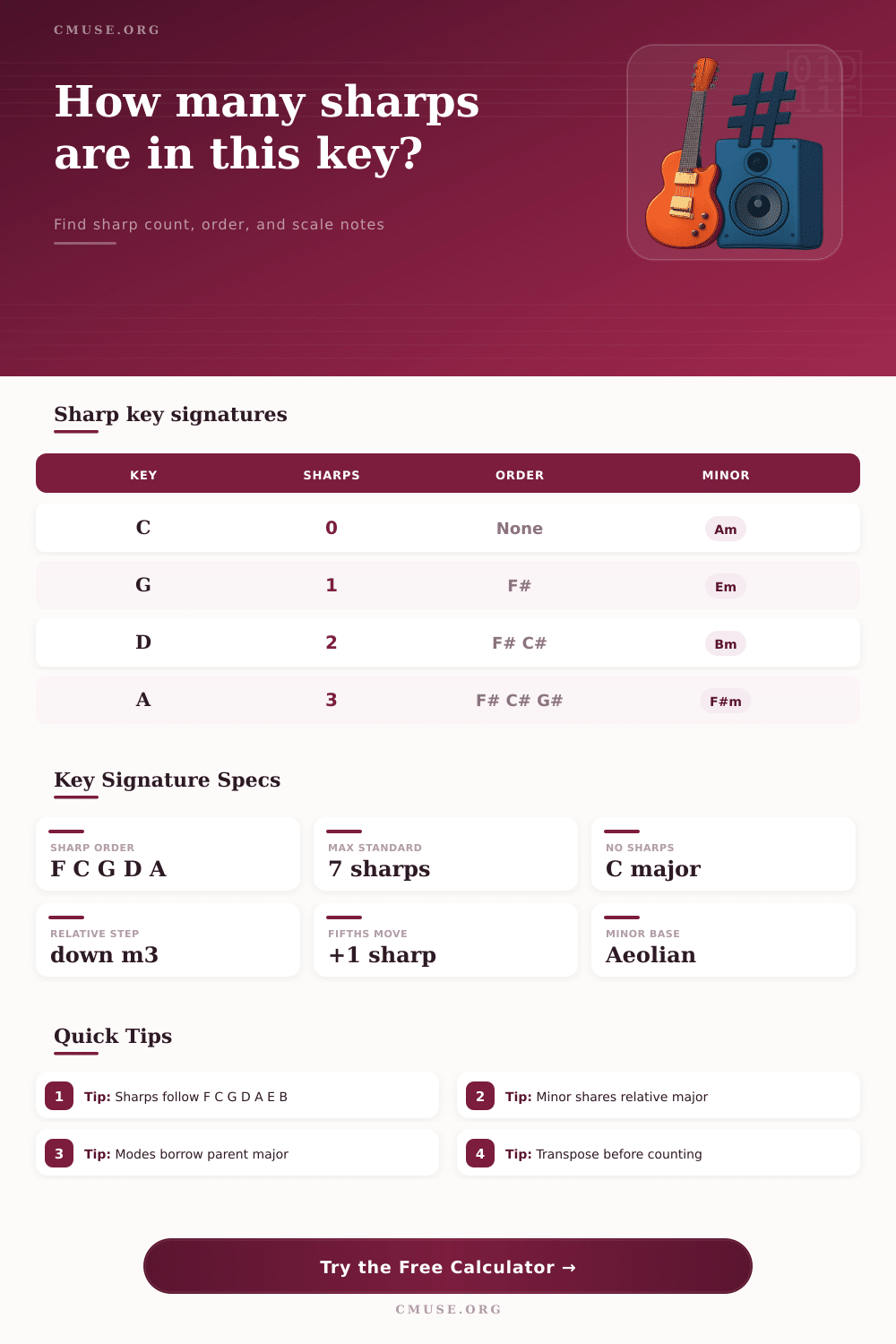
Count the sharps in a key signature, list the correct sharp order, identify the parent major key for modes, and preview scale spelling after transposition.
Preset use: Load a common notation situation, then adjust tonic, mode, transposition, notation policy, and display options for the part you are writing.
Calculation Breakdown
| Major Key | Sharps | Sharp Order | Relative Minor |
|---|---|---|---|
| C major | 0 | None | A minor |
| G major | 1 | F# | E minor |
| D major | 2 | F# C# | B minor |
| A major | 3 | F# C# G# | F# minor |
| E major | 4 | F# C# G# D# | C# minor |
| B major | 5 | F# C# G# D# A# | G# minor |
| F# major | 6 | F# C# G# D# A# E# | D# minor |
| C# major | 7 | F# C# G# D# A# E# B# | A# minor |
| Mode | Scale Degree In Parent Major | Parent Key From C Mode | Sharp-Side Example |
|---|---|---|---|
| Ionian / major | 1 | C major | D major has 2 sharps |
| Dorian | 2 | Bb major for C Dorian | E Dorian uses D major, 2 sharps |
| Phrygian | 3 | Ab major for C Phrygian | F# Phrygian uses D major, 2 sharps |
| Lydian | 4 | G major for C Lydian | A Lydian uses E major, 4 sharps |
| Mixolydian | 5 | F major for C Mixolydian | B Mixolydian uses E major, 4 sharps |
| Aeolian / natural minor | 6 | Eb major for C minor | F# minor uses A major, 3 sharps |
| Locrian | 7 | Db major for C Locrian | C# Locrian uses D major, 2 sharps |
| Sharp Number | Sharp Added | Treble Placement | Bass Placement |
|---|---|---|---|
| 1 | F# | Top line F | Fourth line F |
| 2 | C# | Third space C | Second space C |
| 3 | G# | Above staff G | Top space G |
| 4 | D# | Fourth line D | Third line D |
| 5 | A# | Second space A | Bottom space A |
| 6 | E# | Fourth space E | Third space E |
| 7 | B# | Middle line B | Second line B |
| Part Reference | Written Shift | Example Concert Key | Written Sharp Result |
|---|---|---|---|
| C instrument | No shift | G concert | G major, 1 sharp |
| Bb instrument | Write up whole step | G concert | A major, 3 sharps |
| Eb instrument | Write up major sixth | G concert | E major, 4 sharps |
| F instrument | Write up perfect fifth | G concert | D major, 2 sharps |
| A instrument | Write up minor third | G concert | Bb/A# spelling warning |
Key signatures is groups of sharps or flats. The purpose of the key signature are to tell the musician which note are to be played as sharps or flats, and it also affect the musician in that it affects in what way they play there instrument. Should the musician not understand the key signature in which the musician are to play, they will play the wrong notes and will struggle with reading the music for that section.
The order of sharps in a musical composition follow a specific cycle. The first sharp are F sharp, followed by C sharp, followed by D sharp, followed by E sharp, and then the cycle repeat. This order is fixed and musicians always follow it.
How Key Signatures Work
Within this order, musicians can figure out the number of sharps that the composition will use by following the cycle of fifths. For instance, if the composition are in the key of G major, there will be one sharp in the key signature. However, if the composition is in the key of D major, there will be two sharp in the key signature.
D is a perfect fifth away from G major, so moving to the next perfect fifth add one more sharp to the key signature. Modes use the key signatures of the parent major scale from which the mode is derived. For instance, if a musician are to play in the key of E Dorian, the musician will use the key signature of D major, as E Dorian is the second note of the D major scale.
Many musician make mistake with modes due to the fact that they dont remember the major scale from which the mode was derived. For this reason, they use the incorrect key signature for the mode that they are to play. Transposition affect the number of sharps that are in a key signature.
Transposition is used when an instrument play a written note that is not of the same pitch as the note that the instrument plays. For instance, if a clarinet player are to play a composition that is written in the key of G major, they will actualy need to play the composition in the key of A major due to the fact that clarinets is Bb instruments. A major uses three sharps in its key signature while G major only use one sharp.
To correctly play the composition for the instrument, the musician must account for transposition and number of sharps in each key signature. Key signatures does not use all of the sharps that might be used in a piece of music. For instance, there are piece of music that use harmonic minor scales or melodic minor scales, both of which include extra sharps beyond those that are shown in the key signature of the composition.
These extra sharps is referred to as accidentals, and are written next to the notes of the composition. The key signature only indicates the sharps for the natural minor scale of that composition, never the accidentals that is used for melodic or harmonic changes to the music. By understanding the concept of key signatures, musicians is able to correctly play the music that is written.
By understanding the relationship between tonics, modes, and transposition, musicians are able to correctly determine the number of sharp that will be used in that composition. By correctly determining the number of sharps that the musician is to use in the composition, the music will be easier for individual to read and play.