Key Signature Calculator
Find the sharps, flats, relative key, and accidental order for major and minor keys in a fast, theory-first format.
Sharps order
Continue A E B
Flats order
Continue G C F
Major keys
All common spellings
Minor keys
Relative to majors
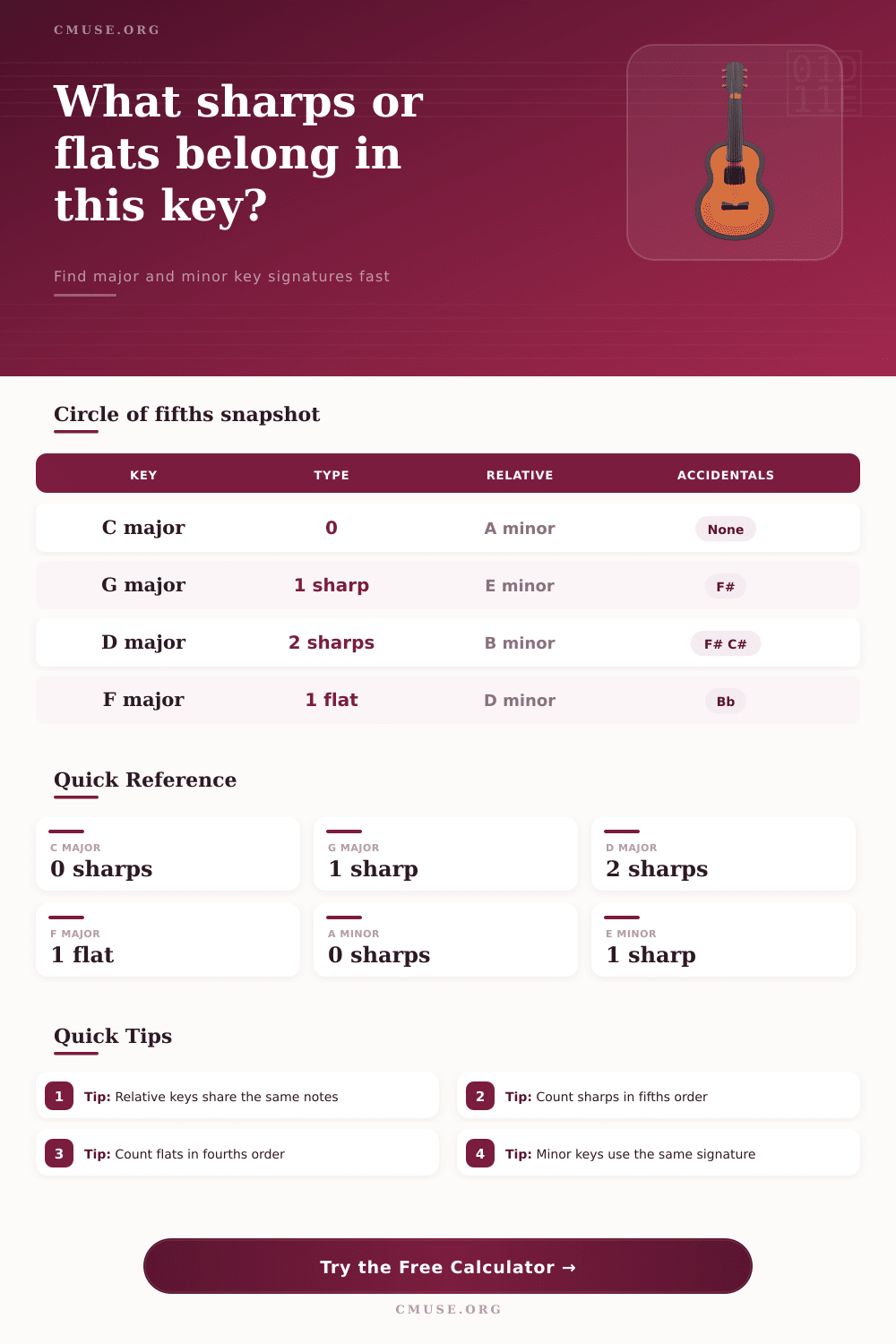
| Key | Signature | Relative minor | Accidentals |
|---|---|---|---|
| C | 0 | A minor | None |
| G | 1 sharp | E minor | F# |
| D | 2 sharps | B minor | F# C# |
| F | 1 flat | D minor | Bb |
| Key | Signature | Relative major | Accidentals |
|---|---|---|---|
| A | 0 | C major | None |
| E | 1 sharp | G major | F# |
| B | 2 sharps | D major | F# C# |
| D | 1 flat | F major | Bb |
Key signature is made up of some sharp or flat signs that stand on the staff at the start of a musical part. In a piece of music it appears for the first time just after the clef on the first line. Later it comes before the time signature and repeats after the clef at every new line
The signs remind the musician which sharps or flats are in the scale of the piece. Like this the composer does not need to write each of them every time it appears. You use for that accidentals that you best know as sharps and fltas.
What Is a Key Signature?
When such signs stand on lines or spaces, they show that the relevant notes in each octave must be raised or lowered from their natural sound.
Key signature points out that notes adjust so that the gaps between the tones of the scale stay the same. It shows which notes will be sharp or flat and also helps to understand the key center. The scale belongs to one of the two related keys, major or minor.
Every major or minor scale has its own key signature, for instance “three sharps” or “two flats“. No two major keys have the same mix of sharps and flats.
Although each key has its key signature, that is only a notation convention to simplify the reading of the pitches that form the musical key. Do not use “key” and “key signature” as synonyms. Key is what actually happens in the music.
Key signature is only a tool to ease the reading.
Key signature alone does not decide the key or style of a piece. It only suggests it. To really know the pitch center, you must study the actual sounding materials.
Only the content of the music can reveal what key it is in.
That helps to learn the Circle of Fifths. Every added sharp or flat in the signature is a fifth away from the last. Sharp keys progress upward by fifths: one sharp gives G Major, which is a fifth above C Major; two sharps give D Major, a fifth above G Major.
The newest sharp always is the seventh step of the major scale.
In standard musical notation the key signature stands at the start of every line. If you remove sharps or flats, you mark that with warnings at the end of the prior line. You can also change the key in the middle of a bar using the right accidentals, but the new key signature counts from the nextfull bar.