Kalimba Tine Length Calculator
Estimate active tine length, total blank length, pitch frequency, and stiffness from note, metal, thickness, and tuning reserve.
Presets load common kalimba ranges; edit the metal and measured dimensions to match your own tine stock.
Calculation Breakdown
| Target Note | Frequency | Active Length | Blank with 22 mm Extra | Common Use |
|---|
| Material | Elastic Modulus | Density | Length Effect | Use Case |
|---|---|---|---|---|
| Spring steel | 200 GPa | 7850 kg/m³ | Baseline | Common bright kalimba tine |
| High carbon steel | 205 GPa | 7850 kg/m³ | Slightly longer | Firm handmade tines |
| Stainless steel | 193 GPa | 8000 kg/m³ | Slightly shorter | Corrosion resistant builds |
| Phosphor bronze | 110 GPa | 8800 kg/m³ | Much shorter | Warm experimental tine |
| Hard brass | 100 GPa | 8500 kg/m³ | Much shorter | Soft, mellow prototypes |
| Nickel silver | 125 GPa | 8600 kg/m³ | Shorter | Bright non-steel test stock |
| Layout | Typical Range | Lowest Tine | Highest Tine | Planning Note |
|---|---|---|---|---|
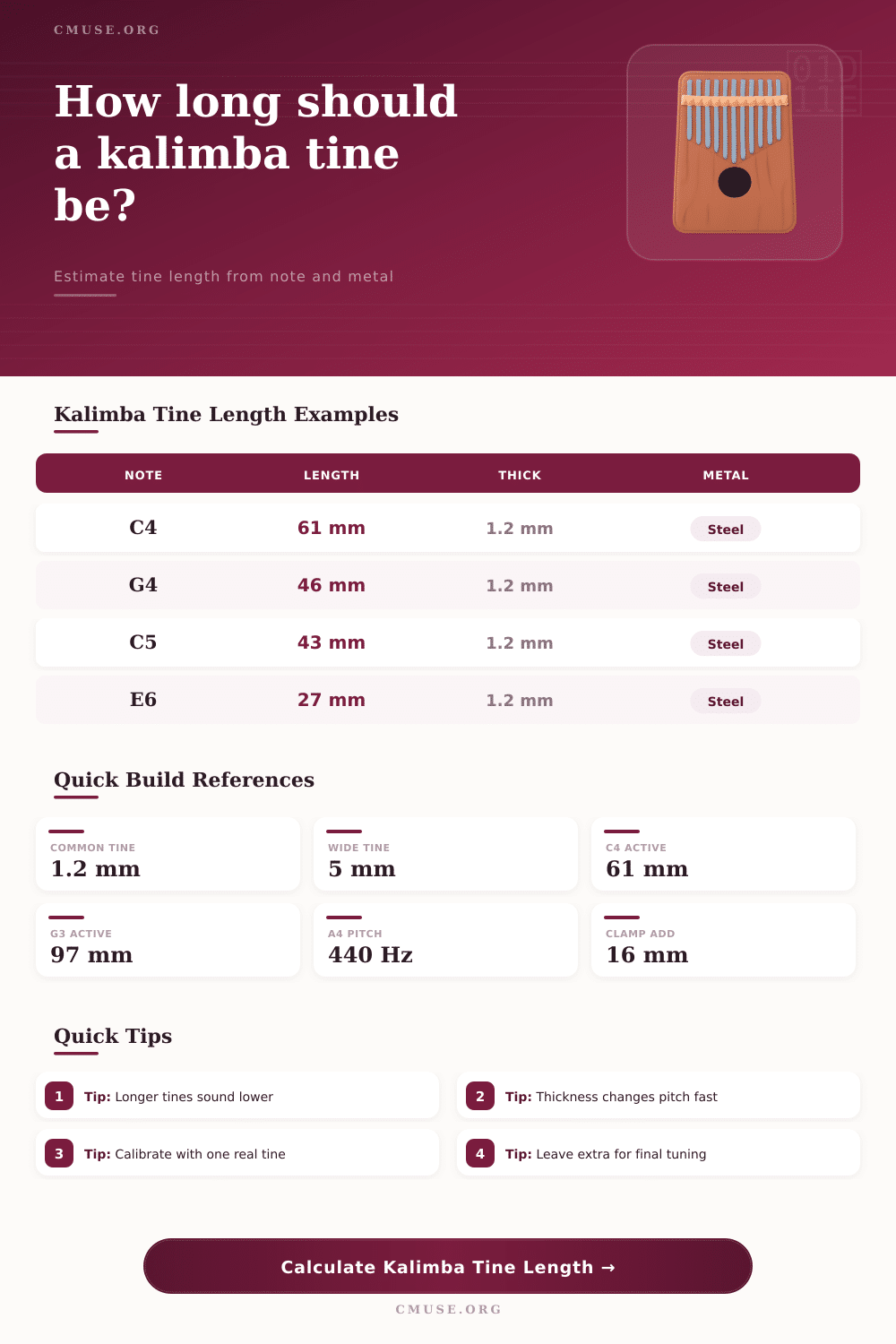
| 17-key C kalimba | C4 to E6 | About 61 mm active | About 27 mm active | Most common replacement range |
| 21-key kalimba | F3 to E6 | About 103 mm active | About 27 mm active | Needs longer center tines |
| Alto kalimba | G3 to G5 | About 97 mm active | About 32 mm active | Lower range, wider spacing |
| Bass prototype | C3 to C5 | About 122 mm active | About 43 mm active | Needs stiff stock and clearance |
| Chromatic build | Varies by row | Match lowest row | Short upper row | Separate rows may need offsets |
| Thickness | C4 Active Length | A4 Active Length | E6 Active Length | Build Character |
|---|---|---|---|---|
| 0.9 mm | 53 mm | 41 mm | 24 mm | Soft, easier to bend |
| 1.0 mm | 56 mm | 43 mm | 25 mm | Light handmade stock |
| 1.2 mm | 61 mm | 47 mm | 27 mm | Common kalimba range |
| 1.5 mm | 68 mm | 53 mm | 30 mm | Firm, louder attack |
| 1.8 mm | 75 mm | 58 mm | 33 mm | Stiff bass-oriented stock |
A snap at the bridge has you panicking as you hold the snapped off tine in one hand and an instrument held mute in the other. You cut a piece of nearby metal and clamp it in place, hoping it’s the right pitch. Not so good because sound isn’t even. Physics is what make the tines. You have to deal with factors like how long they vibrate, their density, and their bending stiffness.
When you add dimensions and your note requirements into the calculator it takes over and manages the variables for you. You won’t have to guess what coefficient will work with different thicknesses or types of metal.
How to Make Kalimba Tines the Right Size
The Kalimba Tine is actualy a cantilever beam, meaning that one end is clamped. The mass and stiffness of this beam determine its pitch. The geometry of the beam plus the elastic modulus (a measurement of how much something bends) of material determines stiffness. Think of thickness as the lever for controlling stiffness.
Because stiffness is cubed by thickness, changing the thickness slightly have a huge impact on the frequency. Doubling the thickness make the beam eight times stiffer. It is not twice as stiff. So thinner stock will sound higher than thicker stock (even though both has the same length).
Spring steel are commonly used by most builders due to its durability and brightness. Around 1.2 millimeters is typical for spring steel. This produces a nice bright tone. Using thicker stock like 1.8 millimeters produce a deeper tone, but you need a longer tine to play the same notes.
Geometry isn’t everything: what they are made off is equally important. Steel remains common choice. It is easy to use, stiff, and acts predictably. Other metals such as brass or bronze are far less stiff. They’re often more dense too. Because they’re soft, the tines needs to be shorter in order to produce a given pitch. As table of references shows, phosphor bronze tines has to be much shorter then their steel counterparts to produce an equivalent note. That in turn impacts on the look of the instrument. Unless you plan for different lengths when making a set from different materials, it will look disjointed.
Theory meets reality with calibration: No two pieces of rolled up metal is the same. Some heat treatments differs slightly. Some amount of cold working differs slightly. Each time they roll, it is slightly different based off thickness differences. That’s why there is a calibration factor built into the tool. Locate an existing tine that is perfectly pitched. Measure actual length of the tine from the end of the clamp to the point where the tone starts. Note what the note is and record size on the calculator. Adjust the percent till the calculated value equals the measured value. Apply that percent to all other tines in the batch.
Ten minutes now will save you hours of frustration when trying to get it right later. Cut all blanks at least as long as the calculated active length. Metal yield will be different. Clamps will vary. Leave yourself another six to ten millimeters so you have room to tune up at the end. If it’s sounding too low, move the tine forward in the clamp or file down the end of the tip to raise the pitch. A tine that is too short is almost impossible to fix unless you replace it. Work short, start long and then listen with your ears for final say on intonation.
You should of worked longer. The numbers will get you close, but vibration is very much a physical thing demanding a bit of respect when it comes to small variances. Nail the first couple of notes, and the rest of the scale falls into place like a rhythm machine.