Just Intonation Frequency Calculator
Turn a tonic frequency into pure ratios, compare them with equal temperament, and map consonant intervals fast.
🎹 Presets
⚙ Calculator Inputs
📊 Core Ratios
📋 Family Scale Map
| Degree | Ratio | Just Hz | ET Semitones |
|---|
📐 Interval Reference
| Interval | Ratio | Cents | Current Hz |
|---|
🎸 Chord Builder
| Chord | Ratios | Voicing | Result |
|---|
📖 Tuning Notes
| System | Base | Use Case | Note |
|---|
Just intonation are a method of tuning musical instruments. In just intonation, the pitch of the instruments are determined by simple ratios of whole number. The reason that certain ratio are used is because the vibration of the notes with those ratio create a pure sound.
Moddern instrument use a system known as equal temperament. With equal temperament, the octave are divided into twelve equal step. This system is helpful in that it allow musicians to play in every key.
Just Intonation and Equal Temperament
However, when instruments use equal temperament, the third in music sound out of tune. Just intonation can fix the problem of the thirds sounding out of tune. However, just intonation only work perfectly in one key.
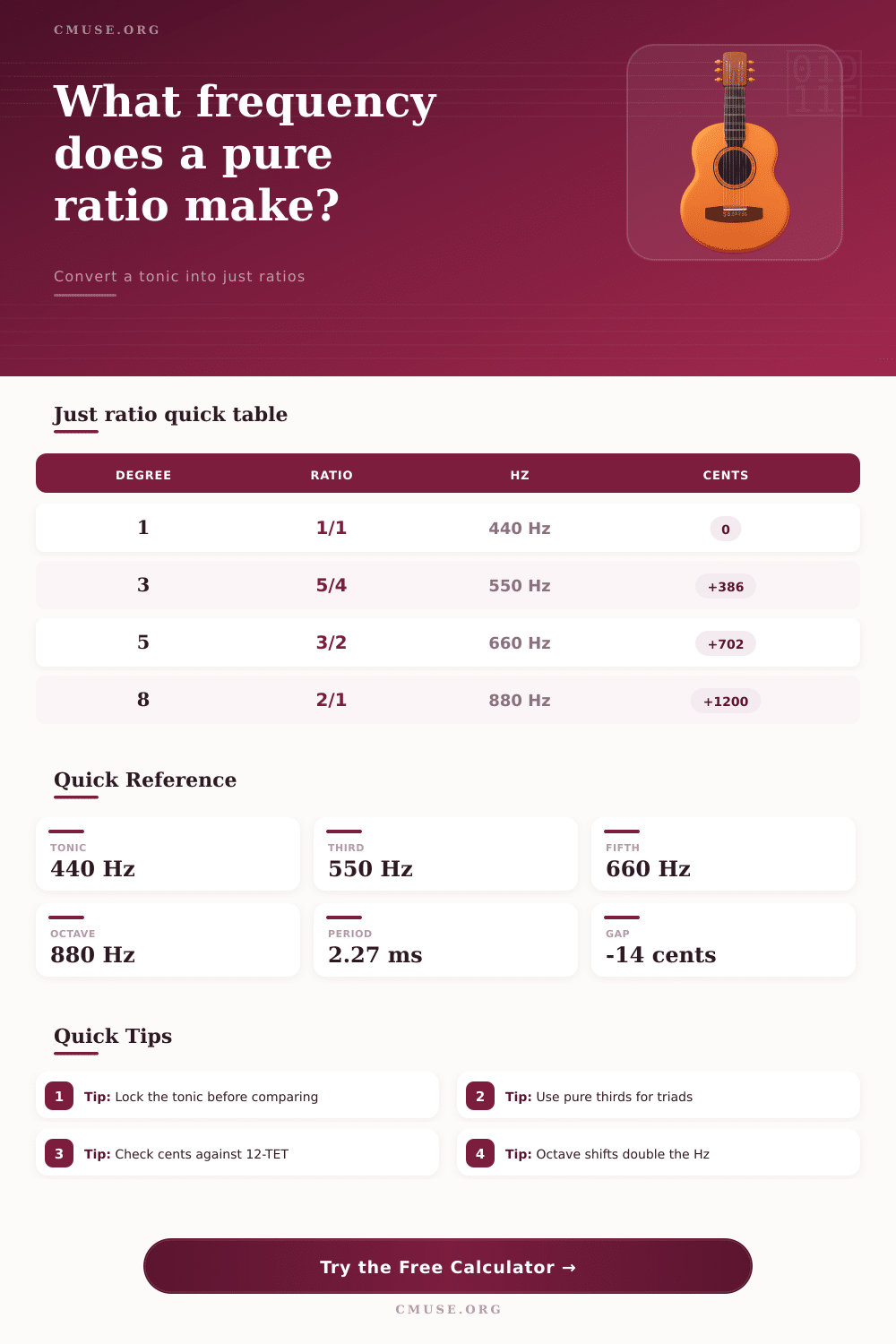
The difference between just intonation and equal temperament can be seen by look at both major triads. The interval within major triads in equal temperament are slightly approximated resulting in a beating sensation in the instruments. With just intonation, the frequency of the root note is used such as 440 Hz.
Multiplying the frequency by the ratio of 5/4 will result in the frequency of the major third which is 550 Hz. For equal temperament, multiplying the frequency of 440 Hz by 554 Hz create a difference of 4 Hz resulting in the difference in the sound of just intonation and equal temperament. There are different family of tuning because no ratio work perfectly for each musical mode.
For example, a 5-limit major scale use the ratio of 5/4 for the third and 3/2 for the fifth. The 5-limit major scale is based upon the first five harmonic. Pythagorean tuning use the ratio of 3/2 which create pure fifths however the thirds created using this system is dissonant to most listeners.
7-limit tuning use the ratio of 7/4 which create a seventh note which sound different than standard musical tuning. Just intonation makes it difficult for musicians to play in different key. If instruments are tuned to a specific key, moving to another key create difficulties in the instruments due to commas which are the adjustments needed to account for the difference in frequencies between keys.
A person can use custom ratio to create different musical effect. Custom ratio can be used to define a sharp leading tone or a natural minor fourth. Octave shift are also used in tuning instruments.
The difference between just intonation and equal temperament can be measured in cents. Cents is a unit of measurement of the difference between two notes. If a note has a frequency that is flat in comparison to equal temperament, the value will be negative cents.
If a frequency is sharp in comparison to equal temperament it will have a positive value in cents. Additionally, another way to find the difference between just intonation and equal temperament is to look at the period of the sound wave. The period is the length of time in which a sound wave create one cycle of a frequency.
There are various way that different musical groups use just intonation. Orchestras has the string instruments tuned to just fifths however, the wind instrument use equal temperament to make it easy for the players to transpose their instruments to different keys. A cappella group want to use just intonation so that the singer can tune to the purest frequencies.
Electronic music producer may use just intonation for the background sound however they may use equal temperament for the lead melody in the song. To use just intonation a musician must tune to one specific note. All other note in the song are defined by the ratios in relation to that one specific note.
A person can make some mistake when using just intonation. One mistake would of be to attempt to achieve perfect purity in every key. If a musician attempt to do so they will have to constantly adjust the instruments for commas.
A second common mistake is to not be aware of the period of the frequencies of the instruments. The period have an impact on how the sound interact with the reverb of the musical room. A musician can use reference table to determine the ratios of just intonation and they can use frequency preset to hear how different tuning system sound.
Just intonation is based upon the mathematical ratios of frequencies. By using these ratio musicians can achieve pure harmonic in their music.