Just Intonation Calculator
Convert rational tuning ratios into exact frequencies, cents, 12-TET offsets, harmonic-limit checks, and audible beat-rate estimates.
🎶 Named Just-Intonation Presets
⚙ Ratio And Pitch Inputs
📊 Harmonic Limit Spec Grid
🧮 Current Ratio Comparison Grid
Numerator over denominator after octave shift.
Largest prime factor in the selected ratio.
Nearest equal-tempered step for the chosen EDO.
Limit status and estimated beating severity.
🎼 Core Just-Intonation Interval Table
| Interval | Ratio | Cents | 12-TET Offset | Common Use |
|---|---|---|---|---|
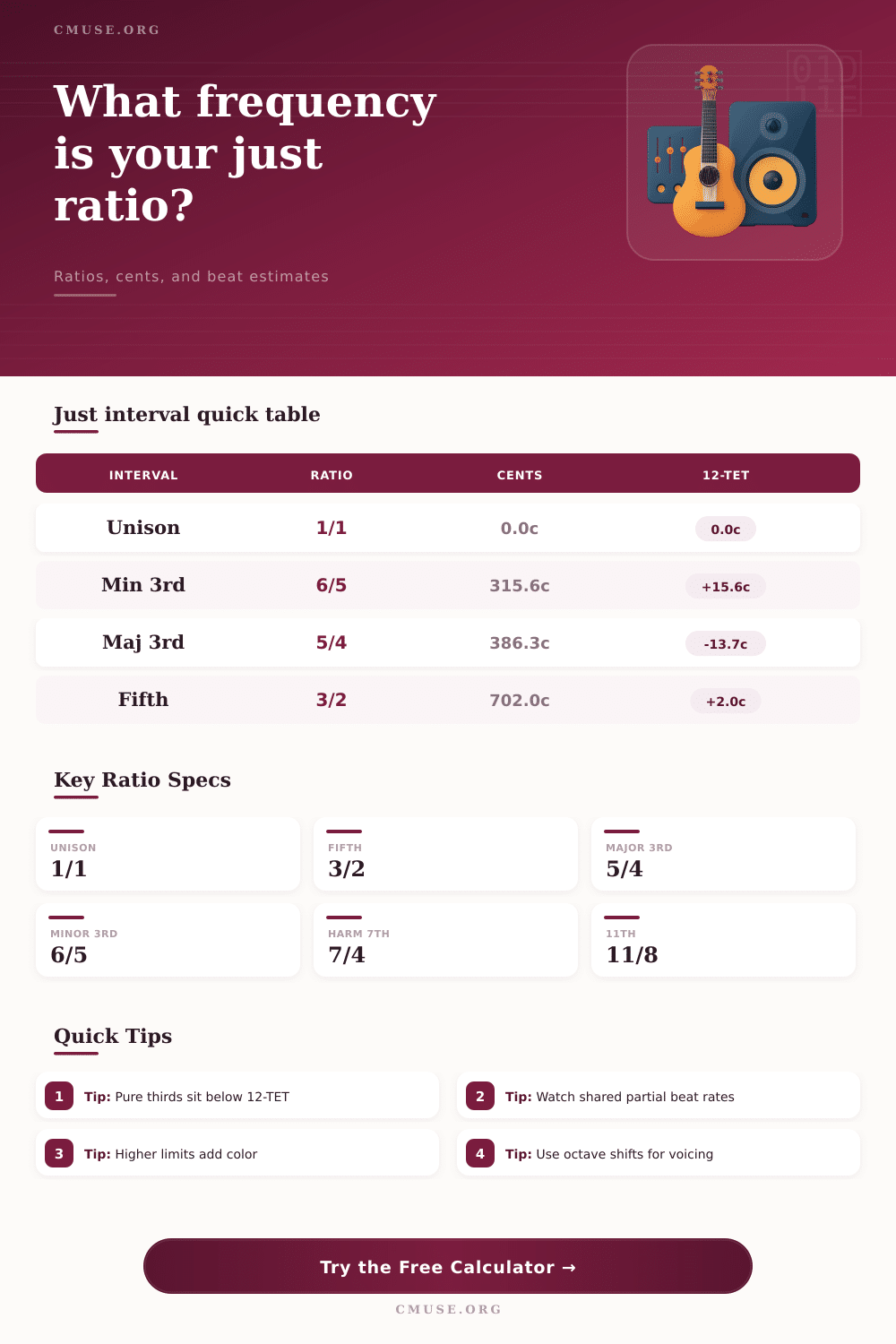
| Unison | 1/1 | 0.00 | 0.00 | Drone, tonic lock |
| Minor Third | 6/5 | 315.64 | +15.64 | Pure minor triads |
| Major Third | 5/4 | 386.31 | -13.69 | Pure major triads |
| Perfect Fifth | 3/2 | 701.96 | +1.96 | Open fifths, drones |
| Harmonic Seventh | 7/4 | 968.83 | -31.17 | Dominant color, barbershop |
| 11th Harmonic | 11/8 | 551.32 | +51.32 | Neutral fourth color |
🔍 Harmonic Limit Comparison
| Limit | Allowed Primes | Typical Ratios | Sound Character | Best Fit |
|---|---|---|---|---|
| 3-limit | 2, 3 | 3/2, 4/3, 9/8 | Bright fifth-based tuning | Modal drones |
| 5-limit | 2, 3, 5 | 5/4, 6/5, 5/3 | Smooth triadic consonance | Choirs, strings |
| 7-limit | 2, 3, 5, 7 | 7/4, 7/6, 7/5 | Bluesy dominant color | Brass, quartets |
| 11-limit | 2 through 11 | 11/8, 11/9 | Neutral, luminous tension | Microtonal writing |
| 13-limit | 2 through 13 | 13/8, 13/10 | Complex upper partial color | Spectral harmony |
🎙 Beat-Rate Reference At A4 = 440
| Pure Ratio | 12-TET Target | Shared Partials | Approx Beat Rate | What To Listen For |
|---|---|---|---|---|
| 5/4 Major Third | 4 semitones | 5th vs 4th | 8.06 Hz | Fast shimmer in ET thirds |
| 6/5 Minor Third | 3 semitones | 6th vs 5th | 10.07 Hz | Wide minor-third motion |
| 3/2 Perfect Fifth | 7 semitones | 3rd vs 2nd | 1.50 Hz | Slow fifth wobble |
| 7/4 Harmonic Seventh | 10 semitones | 7th vs 4th | 48.89 Hz | Very different from ET seventh |
📝 Preset Scale Ratio Table
| Ratio Set | Degrees Included | Prime Limit | Strongest Consonance | Use Case |
|---|---|---|---|---|
| 5-Limit Major | 1, 2, 3, 4, 5, 6, 7 | 5 | 5/4 and 3/2 | Major triads and cadences |
| 5-Limit Minor | 1, 2, b3, 4, 5, b6, b7 | 5 | 6/5 and 3/2 | Minor chorale tuning |
| 7-Limit Dominant | 1, 3, 5, 7, b7 | 7 | 7/4 and 7/6 | Dominant chords and blues color |
| 11-Limit Lydian | 1, 3, #4, 5, 7 | 11 | 11/8 color | Microtonal extensions |
When you try to tune a chord by ear, you’re not trying to determine how many cent the interval is from the theoretical grid of cents. Instead, you’re trying to determine whether the interval feels locked or if it feels restless. You’re trying to determine if the shared partials of the interval line up or if the shared partials of the interval fights.
Just intonation help to determine these answers using simple ratio. The simple ratios that can be used is the number that determine how many vibration one note makes against another note. A calculator can determine the frequency, the cents offset, and the number of beats that is introduced using these ratios, removing the need for the musician to perform the arithmetic calculations necessary to determine each value.
Tuning Chords with Simple Ratios
The reference frequency for tuning will establish the parameters for the entire chord. Many individual will choose 440 Hz as the frequency of the note A. Any changes to the reference frequency will impact each of the tones that are create from that reference frequency, but the ratios between each of those tones will remain the same. The calculator will first ask for the concert pitch, as this will determine the instrument or voices that are to be used in the piece of music.
The tonic note and the octave will establish the location of the tonic note, and the tonic and the octave will ensure that the ratio of each interval lands on the correct absolute pitch for that chord. The ratio between each note can be established as a relationship between each of those notes. For instance, the ratio of a major third is 5:4, which means that the higher pitch note vibrates five times for every four vibrations of the lower pitched note.
Each of these ratios can be represented by a smaller set of numbers through the reduction of the larger numbers by their common factor. The calculator will determine this reduced ratio automatic. Additionally, the calculator will determine the prime limit for that interval, which is the largest prime number in either the numerator or the denominator of that reduced fraction.
This number will indicate the distance of the interval from the basic tuning world of octaves and perfect fifth, indicating if the interval includes pure major thirds (5), dominant seventh chords (7), or neutral tone (11 or 13). The last parameter that the calculator can establish is the harmonic limit selector. This parameter allow musicians and composers to ensure that the intervals that are used within a composition are within the harmonic palette that is to be used within that piece of music.
Any ratios that contain a prime number higher than the limit will contain a prime number that the remainder of the music do not contain. The introduction of that new prime will either create the tension that is required for that piece of music, or it will become a distraction from the remaining chord in that chord. Finally, the beat estimate will indicate the tension created by each of these intervals, both relative to equal temperament, and relative to a detuned interval using that same ratio.
Equal temperament is the default reference because most instruments and most audiences already use equal temperament. The offset that the calculator returns is not a judgment of whether a given pitch is correct or not; rather, the offset represents the distance between the frequency ratio and the nearest note in the equal division of the octave that you have chosen. You can leave the offset alone for small adjustment, but larger offsets indicate either that the interval will begin to beat noticeable, or that the performers will need to make real-time adjustments to their pitch to accommodate the just ratio.
Often, an octave shift or detune will be used for voicing reason. Raising or lowering an interval by an octave does not change the identity of the interval. Instead, it changes the register in which the interval is hear.
In some instances, it may also be helpful to detune an interval slightly, in units of cents, to find the narrow range in which the interval begins to develop motion. In the beat-mode choice, you can choose to compare the just intonation ratio to either equal temperament, or to a detuned interval. Each of these choices will help you to answer a different question of your performer in the rehearsal room.
The tables that accompany the calculator show common ratio values and their musical role. The ratio of 3/2, which represent perfect fifths, is almost identical to the equal temperament value; most listeners will accept a 3/2 ratio without any adjustment. A 5/4 ratio, which represents major third, is noticeably lower than the equal temperament value.
This is one of the reasons that just intonation major triads feel more stable than those in equal temperament. A 7/4 ratio, known as a harmonic seventh, sits even lower than a 5/4 third, but has a characteristic color that is often found in both barbershop music and brass music. Higher ratios have character that are more difficult to name, but are immediately audible when they are encountered.
In any musical context, there is a limit to the length of time that a sound can be held. Sounds that have slow beating values can be musically appropriate and beautiful, especially if the beating is intentional. However, fast and complex beating value will quickly become tiresome for the listener unless the musical texture permit such restlessness.
Thus, the beat estimate serves as a warning to the performer of what may become tiresome performance for the audience. Finally, the beat estimate also indicate the performers how much work will be required of them to hold the interval that is being played. The ratios are always simple, but the context of those ratios can change.
The context of the ratios can include the reference pitch to which the ratios relate, the limit of the ratios that will be allowed in the music, and the amount of motion in the music that is to be expected. The arithmetic has cleared the way for the musician’s ears to determine if the ratios create the sound that is needed for the music.