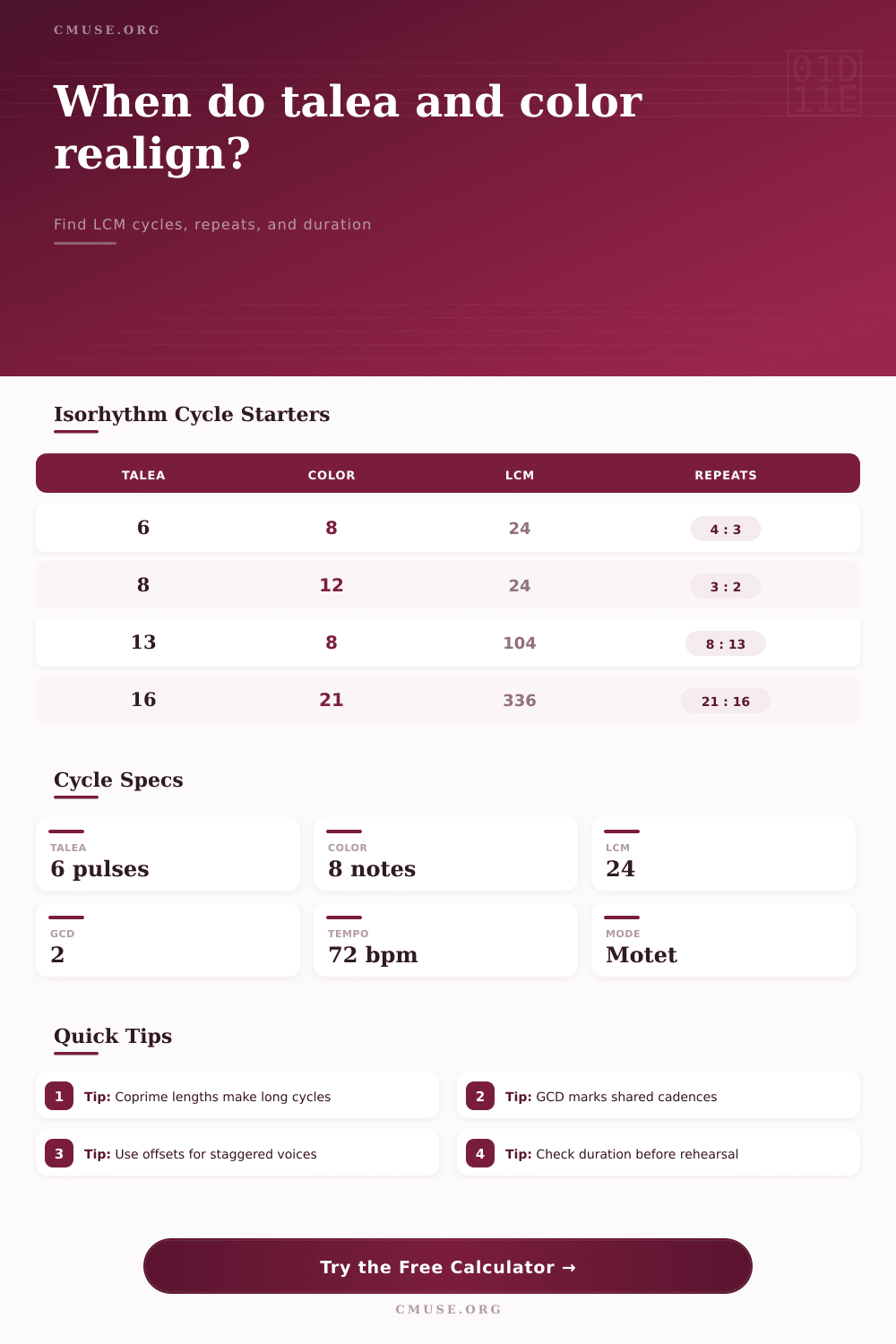
Isorhythm Talea Color Cycle Calculator
Calculate when a rhythmic talea and melodic color reunite, how many repeats each layer needs, where cadences can align, and how long the complete isorhythmic cycle lasts.
Choose a medieval motet model or a modern compositional sketch, then edit the pulse counts, offsets, tempo, and pattern labels. The calculator uses least common multiple math for the full cycle.
Cycle Breakdown
3:4
Color To Talea Ratio
2
Greatest Common Divisor
Moderate
Cycle Complexity
24
Mapped Events
| Pair | GCD | LCM | Talea Repeats | Color Repeats | Use |
|---|---|---|---|---|---|
| 6 / 8 | 2 | 24 | 4 | 3 | Compact motet practice cycle |
| 8 / 12 | 4 | 24 | 3 | 2 | Clear shared midpoints |
| 13 / 8 | 1 | 104 | 8 | 13 | Coprime modern color drift |
| 16 / 21 | 1 | 336 | 21 | 16 | Long ceremonial or process span |
| 24 / 28 | 4 | 168 | 7 | 6 | Large design with audible joins |
| Model | Talea | Color | Cycle Logic | Listening Check |
|---|---|---|---|---|
| Ars nova motet tenor | Short rhythmic talea | Long chant color | Color usually outlasts talea | Follow tenor rhythm first |
| Machaut-style mass planning | Balanced spans | Reusable melodic cell | Cadential joins clarify sections | Mark each structural arrival |
| Dunstaple tenor layout | Measured support | Singable color | Moderate LCM supports texture | Check textural entry points |
| Dufay ceremonial ratio | Proportional layer | Architectural color | Durations may change by section | Compare section lengths |
| Approach | Talea Role | Color Role | Good Pair | Result |
|---|---|---|---|---|
| Messiaen-style mode cycle | Fixed duration cell | Mode or pitch set | 7 / 12 | Coprime unfolding |
| Reich-inspired phase grid | Looped attack pattern | Rotating pitch loop | 12 / 13 | Slow phase return |
| Ligeti texture layer | Fast pulse strand | Register cycle | 11 / 15 | Dense compound surface |
| Serial row with talea | Duration row | Pitch-class row | 10 / 12 | Predictable row reunion |
| Counting Unit | Tempo | LCM 24 | LCM 60 | LCM 120 |
|---|---|---|---|---|
| Quarter note | 60 BPM | 24 s | 1:00 | 2:00 |
| Quarter note | 72 BPM | 20 s | 50 s | 1:40 |
| Eighth note | 72 BPM | 10 s | 25 s | 50 s |
| Sixteenth note | 96 BPM | 3.75 s | 9.38 s | 18.75 s |
Rhythm and melody are divided apart. For the very first time in Western musical history, this was done by Philippe de Vitry in his fourteenth-century motets. The talea is rhythmic element, carried by one voice while the other sing the melodic contour (color). The two parts then repeat independently until they reaches the end of each other’s length.
It is an almost inevitable structure for the ear. And here’s the thing: What you’re measuring isn’t just a number of beats; it’s the meeting of two independent cycles. Let’s say your talea is six pulses long and your color eight notes long. They won’t coincide for another twenty-four pulses. That’s a pile of music to keep track of before the pattern resets itself.
How Isorhythm Works
Fortunately, the calculator above figure out that math for you if you input length of both layers, saving you the staring-at-a-spreadsheet exercise to locate the least common multiple. It informs you precisely where each layer lands on the next cadence point as well as how many times each layer repeat, so you know when the structure takes a breath.
Other tensions arise from selecting coprimes. Selecting an eight as your color length and a thirteen as your talea length ensures that none of their values has any divisors in common. Each note in one set will eventually encounter each pitch in the other without any repeats until you return to home base. This makes for an enormous cycle, sometimes more than a hundred pulses long. This is useful if you wish to create a feeling of gradual change or endless drift, but not so much for performing musicians who requires periodic anchors.
The table on the page shows this, indicating how slight adjustments to length radically affect the span of the cycle. Six-by-eight feels like a manageable size, tight and do-able, while a sixteen-by-twone pairs a marathon.
What else? There are also offsets. In other words, in Medieval times there was no guarantee that both layers would enter simultaneously. Staggering the entries adds more complexity because it change why they need to be aligned. By doing so, what you’re really doing is postponing the meeting of melody and rhythm, or the handshake. The result is a more fluid surface on which the structural joints are less obvious to the ear. Instead of feeling like the music ticks its way along a grid, it feels as if it’s growing organicly.
Sadly most moddern composers omit this nuance; they just begin everything from zero and end up with predictable, rigid phrasing. Remember that along with the ratio, comes time. On paper, a theoretical alignment may be attractive, but in practice, it can fail because it lasts for four minutes or more. If the cycle is extended too far then the performers loses their bearings and even the listener begins to switch off for lack of audible markers. Before committing to the design, therefore, it’s well worth seeing how long it will take at the speed planned and whether that’s going to work.
Then there’s the issue of density. The larger your greatest common divisor, the more often you’ll have partial alignments. Those become small rhythms, structural checkpoints along the way. Something for the ear to grab on to as it travels the extended distance. Without those checkpoints, when the GCD is 1, you’re left with a smooth stream that only settles in the final beat. It is continuous motion versus clear architecture. It depends based off what you prefer.
So isorhythm is all to do with control of time. It’s about creating a machine that repeats but also varies. The magic is in how it balances the certain return of the pattern against the unexpected mixtures it produces as each overlaps another. For the composer, the trick is mastering the cycle and giving their work its spine, even if it is a minimalist loop or one for a choir. Without the spine there is nothing more than a mass of noise. With it, each note have its place in the plan.