Inversion Figure Calculator
Identify triad and seventh-chord inversions from the bass note, then generate figured bass, Roman numeral labels, chord tones, intervals above the bass, and a staff or keyboard reference.
Calculation Breakdown
Keyboard Reference
Staff Reference
| Chord Member | Note | Scale Degree | Interval Above Bass | Figure Number |
|---|
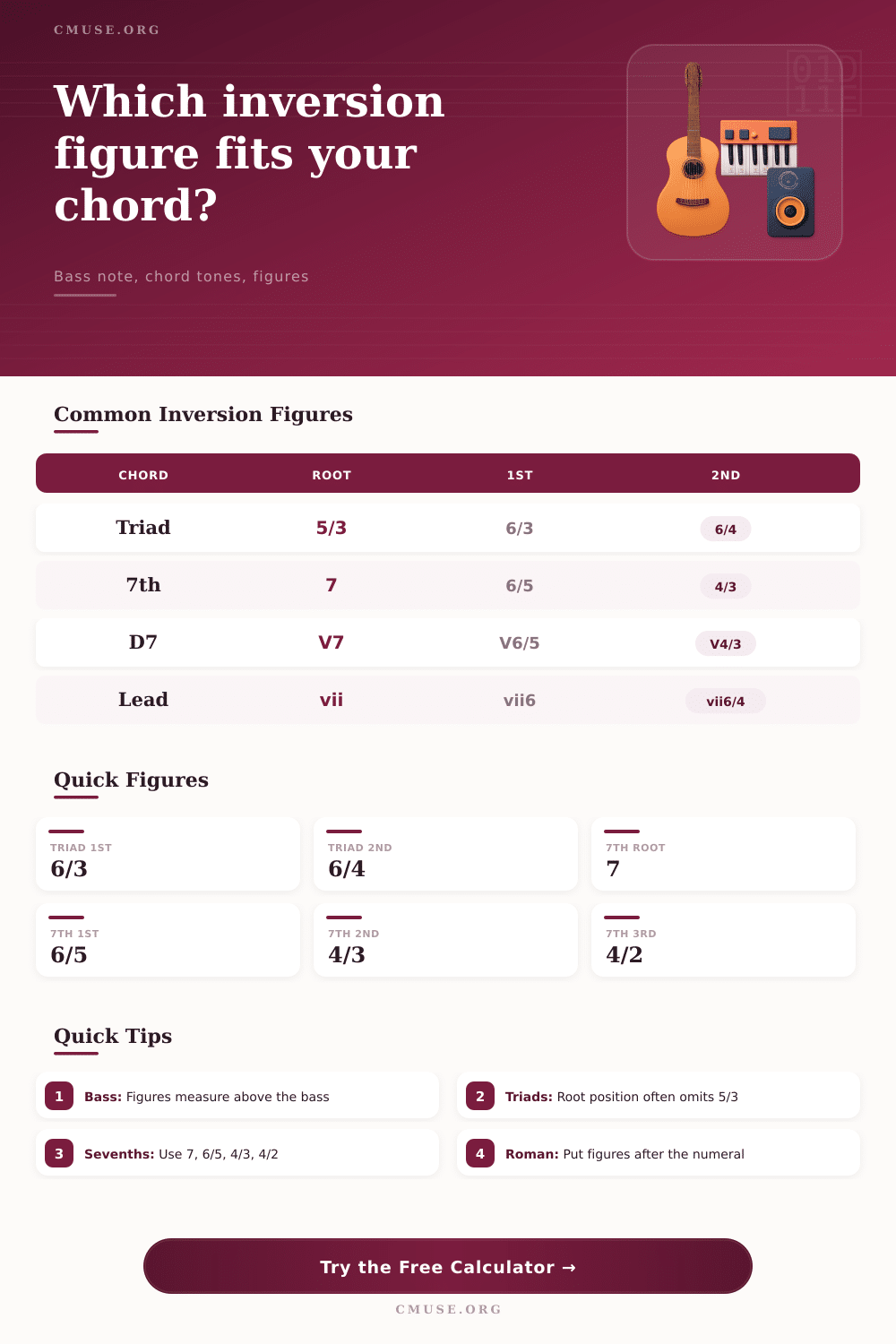
| Position | Bass Member | Triad Figure | Seventh Figure | Common Label |
|---|
| Degree | Root | Default Triad | Default Seventh | Example Inversion |
|---|
| Figure | Chord Type | Bass Contains | Intervals Above Bass | Typical Use |
|---|---|---|---|---|
| 5/3 or blank | Triad | Root | 3rd and 5th | Stable root-position sonority |
| 6 or 6/3 | Triad | Third | 3rd and 6th | Smooth bass motion and passing harmony |
| 6/4 | Triad | Fifth | 4th and 6th | Cadential, passing, or pedal six-four |
| 7 | Seventh | Root | 3rd, 5th, and 7th | Root-position seventh chord |
| 6/5 | Seventh | Third | 3rd, 5th, and 6th | First-inversion seventh chord |
| 4/3 | Seventh | Fifth | 3rd, 4th, and 6th | Second-inversion seventh chord |
| 4/2 or 2 | Seventh | Seventh | 2nd, 4th, and 6th | Third-inversion seventh chord |
Functionally, a chord are dependent on the bass note. This rule is at the heart of harmonic analysis and frequentely bewilders students. The notes of a C major triad are C, E, and G. We could write them that way. But what happens when we move G down into bottom voice? Suddenly our chord has changed. It’s not acting as a tonic anymore. Instead, it is a cadential six four, a chord that gets its power from the dominant to create tension leading toward resolution.
That’s where the calculator comes in. Above it will studies your chord without you having to think about whether it is in root position or an inversion. It simply maps the intervals onto the bass note removing the problem. The note above that bottom note are called figured bass notation. What this means is the note is used as a short-hand way of denoting interval above the lower note. Commonly these figures is written without the number part as it is taken for granted by experts.
How Bass Notes Change Chord Meaning
If we consider the chord in its root position, then the figure would normaly be 5/3. In first inversion, the third become the bottom note, creating a third and a sixth above it, so the figure is 6/3. Second inversion bring in a fifth, which becomes the bass note, giving us a sixth and a fourth above it; therefore, the figure are now 6/4. If we add a seventh to our triad, there is new figures involved. Root position with a seventh include a seven and is indicated by just using the number 7. First inversion is now 6/5; second inversion is 4/3 and third inversion is either 4/2 or just 2. So why not memorize all this? Well, it’s actualy shape-based and works out how far away each figure are from the lowest note upwards.
Why should we care about this? It determines harmonic function as well as voice leading. In Classical music, a 6/4 chord is not likely to sit still. It will either move to another harmony or resolve firm towards a dominant triad. When working out a counterpoint or analyzing a Bach chorale, mistaking a 6/4 for a I chord create a false sense of stability that throws your analysis off course. The table of references on the page indicate which figures relates to common uses and intervals. This enables you to hear when a particular inversion feel stable and when it sounds more transitional.
You have the option of putting in chords manually, or using Roman numerals to work out what is needed. It fills a gap between learning how to study things at college level and playing them out in the real world. Slash chords are an example from pop or jazz where you may well see a chord written like this: C/G Slash chords like C/G is exactly the same as 6/4 but in current common usage. You can enter the two together and see that they both mean the same thing. Select the mode and key, the type of chord (quality), and the inversion. The system will then display the complete spelling with the right sharps and flats if the progression is in harmonic minor, etc.
In certain keys (for example, E flat major; F sharp minor), enharmonic spellings is common and can trip up many learners. To deal with this, the calculator defaults to a key signature rather than a purely flat or sharp system unless instructed otherwise. This avoids the potential problem that arises when a note would appear as A or G double-sharp. They may sound exactly the same note but they has different spelling implications in theory. If your Roman numerals matches the correct scale degrees then you will of got the spelling right. Although small, it make a difference for proper analysis.
Bringing this into a visual form help solidify learning. The idea of an interval becomes clear as you look at notes that is stacked up on a stave or lit up on a piano keyboard. What you hear is now visible, where one note is used as a foundation and others pass by, above and below it. This will be important later if you begin to arrange music for various instrument or improvise. You no longer rely on memorization, but on logic based off what you can see. It reads more smoothly once you understand how the bass establishes the harmony. Suddenly you are not looking at single notes but blocks of function.
The inversion figure show the role of the chord at that point. Does it support the melody? Create tension? Pass through? Answering these questions promptly lets you spend less time trying to work out what is going on and more time focusing on how to express it. That is the true benefit of understanding this notation whether handwritten or with a digital aid. Accepting the bass note change everything and makes harmony understandable.