Inversion Axis Calculator
Invert pitch sets, rows, cells, and melodies around a fixed axis note with chromatic or tonal mapping.
Inversion Results
| Input | Pitch Class | Axis Distance | Inversion | Normalized |
|---|---|---|---|---|
| C4 | 0 | 0 | C4 | C4 |
| E4 | 4 | +4 | Ab3 | Ab3 |
| G4 | 7 | +7 | F3 | F3 |
| Bb4 | 10 | -2 | D3 | D3 |
| Step | Original Interval | Semitones | Inverted Interval | Use |
|---|---|---|---|---|
| 1 | C4 to E4 | +4 | C4 to Ab3 | Descending mirror |
| 2 | E4 to G4 | +3 | Ab3 to F3 | Minor third flips |
| 3 | G4 to Bb4 | +3 | F3 to D3 | Same size, opposite direction |
| Context | Best Mode | Axis Practice | What To Check |
|---|---|---|---|
| Twelve-tone row | Chromatic | Use exact pitch-class arithmetic with a fixed integer or half-integer axis. | Confirm all twelve pitch classes remain unique after inversion. |
| Melodic motive | Chromatic or tonal | Choose chromatic for exact intervals, tonal for scale-degree contour. | Compare interval direction, registral contour, and singable range. |
| Pitch-class set | Chromatic | Ignore octave first, then re-voice the inverted set musically. | Compare normal order, complement, and shared invariants. |
| Countermelody | Tonal | Mirror scale degrees around the chosen key tone or modal center. | Check tendency tones and avoid unintended chromatic clashes. |
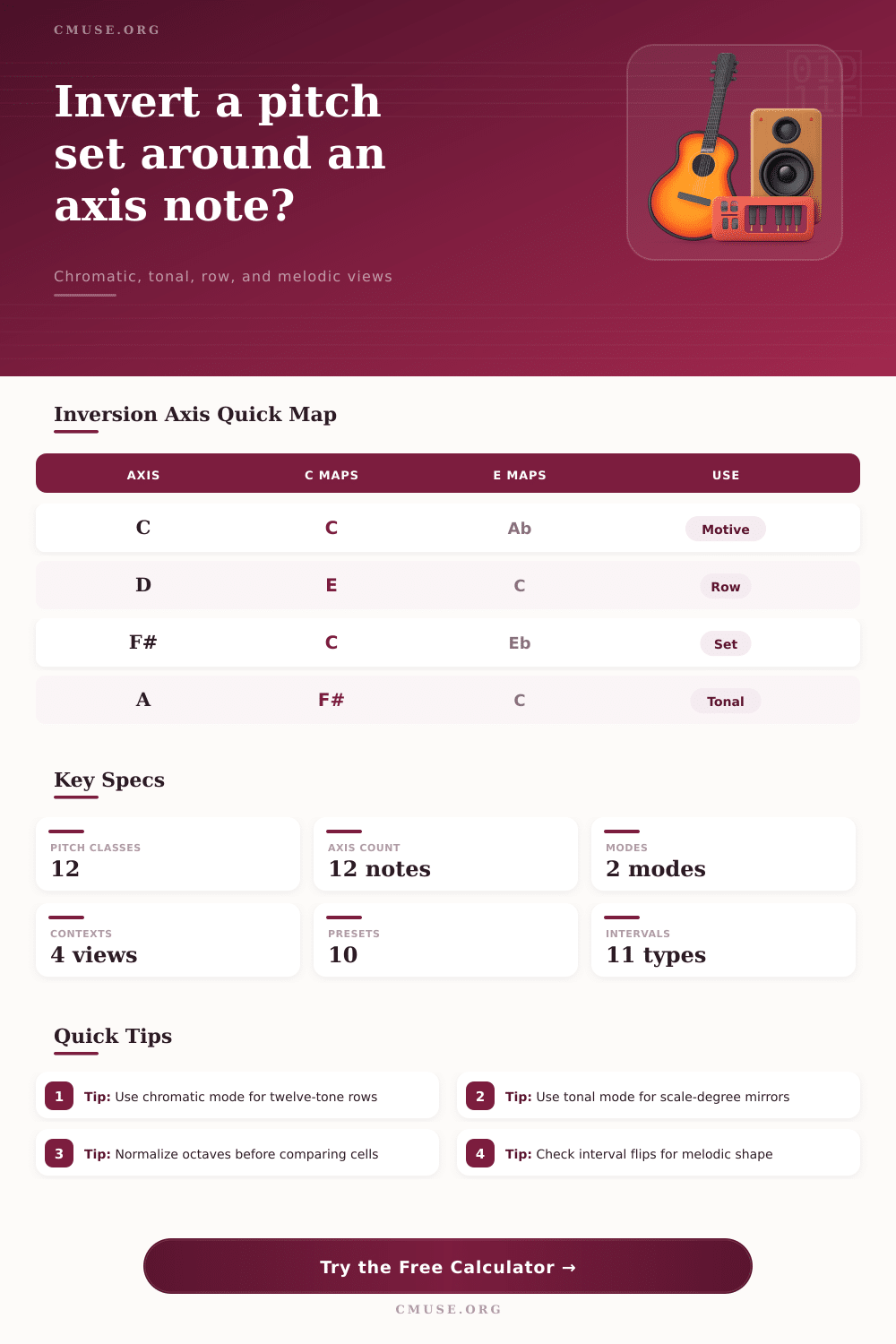
| Axis Note | Formula | C Maps To | E Maps To | Common Reading |
|---|---|---|---|---|
| C | 2(0) - x | C | Ab | Direct mirror around tonic |
| D | 2(2) - x | E | C | Serial row transposition axis |
| F# | 2(6) - x | C | Eb | Tritone-centered inversion |
| A | 2(9) - x | F# | C | Relative minor mirror center |
Inversion makes arithmetic look like music. You start with a melody, turn it inside out through some central point and the intervalic relationships remains unaltered, although the shape of the contour is reversed. This symmetry has been employed by composers for hundreds of years to provide structure without creating monotonous result. For instance, Anton Webern constructed complete symphonic pieces based off mirrored structures. He discovered that the emotional weight of inverted row can be just as strong than the prime version, but with a different directional pull.
Once you enter your notes into the calculator above it does the maths for you. You don’t have to guess about octave displacement or any other kind of moddern arithmetic. It sounds straightforward enough to explain over dinner, but it is difficult to do without software: choose an axis note, which is face of the mirror. For example if the axis is C then a pitch four semitones above, say E, will be mirrored as Ab (four semitones down). This rigid symmetry function well in chromatic settings where each semitone has equal weight.
How to Use Musical Inversion
Music doesn’t always consist only of pitch classes; it also exist in keys. In this case, switching to the ‘tonal’ mode, tool takes account of the scale degree, rather than bare semitones. An axis chosen on C major will map E back towards A (not Ab) and maintain the inverted line within the scale. Why does it matter? Chromatic inversion may, quite by accident, bring in notes that jar against your harmonic framework; what started out as a clear mirror becomes a muddy mess.
The most common place amateurs fail is in selection of correct axis. Far too often the composer defaults to G or C, neither of which comes without their own set of interval changes on your material. For example, a tritone related axis will invert major intervals into minor, greatly altering the harmonic color. To help see what this means and hopefully avoid committing until you are ready with a draft, table below shows the mapping of each note depending on the selected axis. This allows you to visualize it ahead of time so you can find an axis on F#, for example, that makes a more compelling counterpoint to your given row than you ever would of found on an axis of D. There is no wrong answer here, just one that proves most effective to your compositional aim.
There is also the practical challenge of octave normalization. Register is completely ignored when inverting in pitch class space, where C4 equals C7. Melodies inhabit registers though. An upward leap of an octave following inversion sounds very different than one that remains in a more comfortabley range for singing. You can choose to keep original melodic shape or compact it around the axis octave. That decision will determine if the inverted melody becomes a practical counterline or a structural mirror. Where you are composing for voice, even if the inversion looks mathematically pure, you may force all the notes into same octave making the phrase unsingable.
For serial compositions, composers often obsess over integrity of the prime form. No repeated pitch class are allowed. Nor may the order of the row ever alter. The chromatic mode also cannot bend. These limitations is upheld by the calculator and you’ll see exactly where the notes fall into the twelve-tone space. For a melodic writer, strictly preserving the structure can feel rigid. Sometimes it’s better music to allow a small change to accommodate the tonal context rather than have a perfectly symmetrical but harmonically awkward line. The display showing intervals flipped gives you an exact picture of how far the direction has altered so you can judge whether the new contour sounds close enough to your initial idea.
Inversion is not restrictive; instead, it expands a motif to allow for variation without losing the original. From a simple folk-like counterpoint to a complex piece based on a twelve-tone row, being aware of the axis and its effect can help you shape what comes out of it. One line becomes two. One voice becomes a conversation between two adult-sized sofa who have the same DNA but speak in opposite directions. The mathematics keeps us connected so we can concentrate on the musical flow.