Inverse Square Law dB Calculator
Estimate SPL change with distance, source count, and boundary gain for speakers, mics, and room checks.
🎧 Distance Law Presets
⚙ Source Setup
📊 Spec Grid
📈 Reference Tables
| Ratio | Change | Power | Use |
|---|---|---|---|
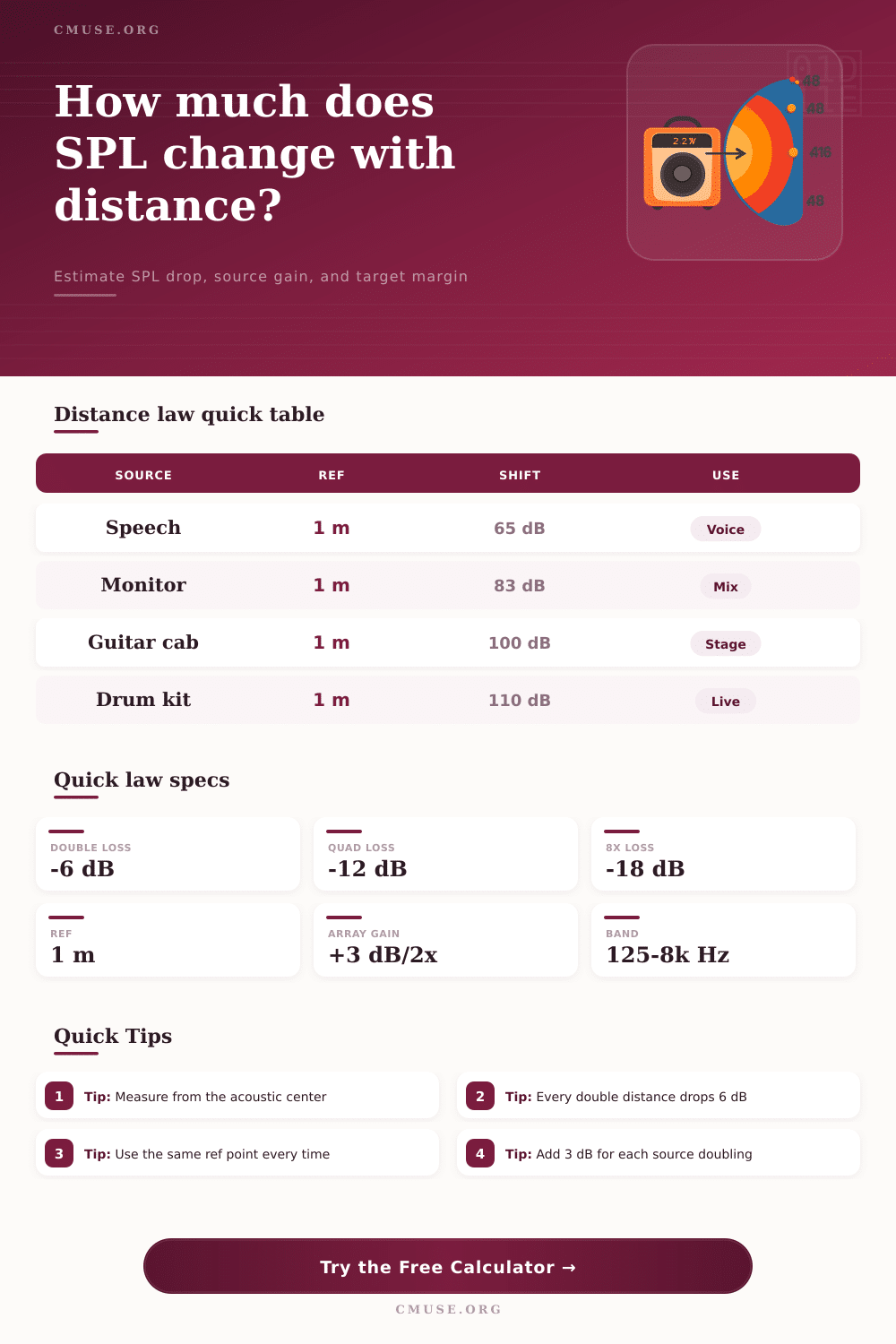
| 2x farther | -6 dB | 1/4 | Quick check |
| 4x farther | -12 dB | 1/16 | Room throw |
| 8x farther | -18 dB | 1/64 | Long reach |
| 16x farther | -24 dB | 1/256 | Far field |
| Source | Ref SPL | Ref dist | Scene |
|---|---|---|---|
| Podcast mic | 68 dB | 0.5 m | Close voice |
| Nearfield monitor | 83 dB | 1 m | Desk mix |
| Guitar cabinet | 100 dB | 1 m | Stage amp |
| Drum kit | 110 dB | 1 m | Live peaks |
| Condition | Boost | Space | Note |
|---|---|---|---|
| Open air | 0 dB | Full sphere | Free field |
| Ground plane | +3 dB | Half space | Floor lift |
| Wall plus floor | +6 dB | Quarter space | Stage corner |
| Corner load | +9 dB | Eighth space | Room corner |
| Band | 10 m | 30 m | Note |
|---|---|---|---|
| 125 Hz | 0.0 dB | 0.0 dB | Bass stays |
| 1 kHz | 0.0 dB | 0.1 dB | Speech core |
| 4 kHz | 0.2 dB | 0.6 dB | Brighter fade |
| 8 kHz | 0.4 dB | 1.2 dB | Dry air loss |
The inverse square laws describes the relationship between sound intensity and distance from the source of the sound. The farther away from the sound source that a person move, the less intense the sound will be. The inverse square law follow the geometry of a sphere, where the sound energy from the source radiate outward in all directions to the surface area of the sphere.
If the distance from the sound source are doubled, the intensity of the sound will drop 6 dB because the sound energy is distributed over four time the area. If the distance from the sound source is quadrupled, the intensity of the sound will drop 12 dB due to the sound energy being distributed over sixteen times the area. The initial intensity of a sound source will influence how powerful the sound is at any given distance.
How Sound Gets Quieter with Distance and Reflections
For instance, a podcast microphone may produce a sound intensity of 68 dB at a distance of half a meter, while a drum kit may produce a sound intensity of 110 dB at that same distance. Each sound source have its own initial intensity, and youll must account for each intensity before calculating the intensity of that sound source at any other distance. If two sound sources are combined, the total sound intensity will increase by 3 dB, as the sound energy from each source combine together.
This relationship between sound intensities are a logarithmic relationship, meaning that each increase in the number of sound sources will have a diminishing impact on the total sound energy of the sources. The boundaries of a sound environment will impact sound intensity according to an inverse square law. In an outdoor environment, the sound energy radiate in a sphere, and the boundaries of that environment provide no additional sound boost to the sound.
If the sound source is placed on the ground, however, the sound radiates in a half-space. In this case, the sound intensity increase by 3 dB, as the ground reflects some of the sound energy. If the sound source is placed in a corner, the sound radiates in an eighth-space.
In this case, the sound increases in intensity by 9 dB due to the reflections of the sound from the two boundaries of the corner. Air absorption will impact the intensity of sound as the sound travels away from the sound source. Air absorption impacts high frequencies more than it impact low frequencies.
Air molecules absorb some of the sound energy of a sound source based off the temperature and humidity of the air. Frequencies of 1 kHz may be absorbed negligibly by air over a distance of 10 meters, while frequencies of 8 kHz may lose 0.4 dB of intensity over 10 meters of travel through the air. High frequencies are absorbed more often than low frequencies, causing high frequencies to fade more quick from the sound over distance than low frequencies do.
The noise floor represent the level of ambient sound in a given environment. If the noise floor of a recording studio, for instance, is 42 dB, the sound that the recording instruments create must reach a significantly higher value than 42 dB or the ambient noise of the studio will drown it out. The margin of sound energy created by a sound source is the difference between the sound intensity that is desired to be create and the noise floor of the environment.
The noise floor, distance from the source of the sound, and the number of boundary reflections can each be considered when planning for a sound setup to ensure that there is enough sound energy reaching the listener. When planning a sound installation, it is important to avoid some common mistakes. For instance, one should avoid measuring the distance from the grille of a speaker, as that measurement is not necessarily the distance from the sound source to the listener.
Another mistake is to apply the same laws to incoherent sound sources as are applied to coherent sound sources; the sound created by a crowd of randomly arranged individuals will not coherently add together the same than two speakers emitting the same sound into the same space. Finally, another mistake to avoid is to apply the inverse square law to indoor sound environments. The reflections of sound from the walls and ceilings of an indoor environment will cause the sound to deviate from the inverse square law at large distances from the sound source.
By understanding these factors that influence sound energy, it is possible to calculate the sound intensity that will be present in any sound installation scenario.