Intro Length Calculator
Convert BPM, bars, beats, meter, pickup notes, tempo ramps, seconds, frames, cue points, and radio edit targets into a clear intro timing map.
Calculation Breakdown
| BPM | 4 Bars 4/4 | 8 Bars 4/4 | 16 Bars 4/4 | Typical Intro Use |
|---|---|---|---|---|
| 72 | 13.33 s | 26.67 s | 53.33 s | Ballad, cinematic, worship |
| 90 | 10.67 s | 21.33 s | 42.67 s | Hip-hop, soul, midtempo pop |
| 100 | 9.60 s | 19.20 s | 38.40 s | Pop, indie, broadcast beds |
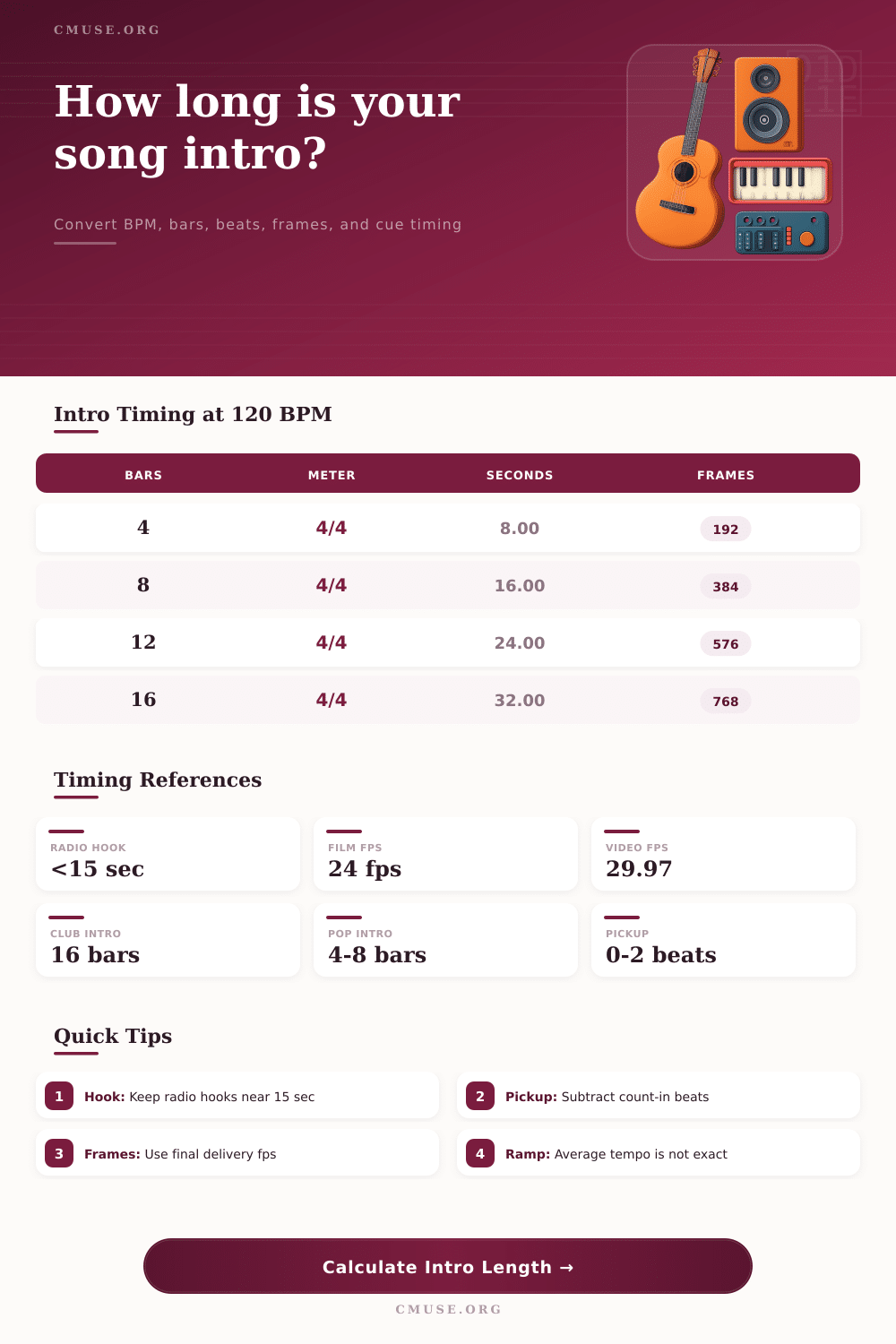
| 120 | 8.00 s | 16.00 s | 32.00 s | Dance-pop and general scoring |
| 128 | 7.50 s | 15.00 s | 30.00 s | House, club, DJ transitions |
| 140 | 6.86 s | 13.71 s | 27.43 s | Trap, drum and bass half-time |
| Meter | Beats Per Bar | Bar Time at 120 BPM | 8-Bar Intro | Counting Note |
|---|---|---|---|---|
| 4/4 | 4 quarter beats | 2.00 s | 16.00 s | Quarter note pulse |
| 3/4 | 3 quarter beats | 1.50 s | 12.00 s | Waltz downbeat cycle |
| 6/8 | 6 eighth beats | 1.50 s | 12.00 s | Eighth-note notation beat |
| 7/8 | 7 eighth beats | 1.75 s | 14.00 s | Grouped 2+2+3 or 3+2+2 |
| 5/4 | 5 quarter beats | 2.50 s | 20.00 s | Five quarter pulses |
| 12/8 | 12 eighth beats | 3.00 s | 24.00 s | Compound eighth pulse |
| Seconds | 24 fps | 25 fps | 29.97 fps | Use Case |
|---|---|---|---|---|
| 5 s | 120 | 125 | 150 | Short-form logo or sting |
| 8 s | 192 | 200 | 240 | Four-bar pop intro at 120 BPM |
| 15 s | 360 | 375 | 450 | Radio hook timing checkpoint |
| 30 s | 720 | 750 | 899 | Ad bed, promo, DJ phrase |
| 45 s | 1080 | 1125 | 1349 | Long cinematic lead-in |
| 60 s | 1440 | 1500 | 1798 | Full cue sheet minute mark |
| Intro Type | Common Range | Edit Concern | Calculator Setting |
|---|---|---|---|
| Streaming pop | 4 to 8 bars | Hook should arrive quickly | Target 8 to 15 seconds |
| Radio single | 0 to 8 bars | Vocal entrance usually checked | Compare against 15 seconds |
| Club mix | 16 to 32 bars | DJ-friendly phrase alignment | Use full bars, no pickup subtraction |
| Trailer cue | 1 to 4 bars | Hit point and picture sync | Use cue at intro end or last bar |
| Podcast bed | 5 to 20 seconds | Voice-over timing matters | Add start offset for silence |
| Score cue | Picture-driven | Frame-accurate cue sheets | Set delivery frame rate first |
| Preset | Tempo | Bars / Meter | Result Focus |
|---|---|---|---|
| Pop 4-Bar Hook | 118 BPM | 4 bars of 4/4 | Fast vocal entry timing |
| Club 16-Bar Mix Intro | 128 BPM | 16 bars of 4/4 | DJ phrase length and frames |
| Waltz Pickup Cue | 84 BPM | 8 bars of 3/4 | Pickup subtraction before downbeat |
| Ballad Rubato Ramp | 70 to 82 BPM | 6 bars of 4/4 | Integrated tempo ramp duration |
| Odd Meter Prog Intro | 104 BPM | 7 bars of 7/8 | Non-4/4 cue mapping |
When it comes to making a song play well, the first three seconds will tell if someone skims over the track or sticks around for the whole thing. For radio, we count these initial moments in beats and bars; on screen, we count them in cue points and frames. Most producers end up tripping themselves up bridging technical side with the musics natural structure. You might be able to tap your foot to the groove, but converting that feel to specific time-stamps to hand off to a DJ or editor takes more than a toe-tap.
This page does that math for you: plug in the number of bars and tempo and the calculator figure out how many frames equal a tricky time signature. No need to guess! The tempo is engine, and the meter is the chassis. At 120 BPM with a standard four-four track, every bar will last precisely two seconds, so if you multiply that by eight bars, you’ve got sixteen seconds of opening music.
How to Time Music for Video and Radio
That’s enough time in a club setting for a DJ to beatmatch his or her way into some sweet jams, but it’s an eternity when we’re talking about streaming singles, where the goal is to hit the hook before your listener swipes to something else. This is where understanding the trade-off comes into play: Pop records sprint to the chorus; club tracks breathe in long phrases. It’s simply a question of how many bars you’re willing to sacrifice for atmosphere versus immediacy.
It gets more complicated with tempo ramps and pickup notes. A pickup note is that short count-in before the first downbeat, the musical inhale before the exhale. You likely don’t want this in there when syncing to video because then your cue points should be where the music starts, usually on the first heavy drum hit. On the other hand, if you’re timing out for a radio edit, you may wish to have included that inhalation within your overall time. Keeping these values apart ensures your cue sheet remain true.
Ramps in tempo is quite different. An average BPM when a song slowly rises and falls doesn’t really help. The steeper the curve in the middle, the longer it takes, which is why the ramp has to be part of the beat span and give you a closer figure than simple maths can account for.
The other problem is that video doesn’t care if something is musical or not. Frames don’t care about musicality. There are twenty-four images in each second (at 24 frames per second). So an eight second intro isn’t eight seconds, it’s one hundred ninety-two frames. Your video editor has to know precisely which frame corresponds with the downbeat if they want to cut on the beat. Missing even a tiny fraction of a second will make a visual punch look lazy. When it comes to cueing action or dialogue, this attention to detail matter.
On the page, I’ve laid out the conversions neatly so you won’t have to do the mental math while under the gun. It is a small detail, but it makes a big difference. But radio has very specific targeting by nature. In most markets, a golden rule is to get a hook no later than 15 seconds into a song. This timing matches both ad breaks and the listener’s attention span.
So if your intro doesn’t pay off or build until then, you’re going to lose listeners before the verse ever begins. Knowing exactly when you come in enables you to clearly measure yourself against the norm. Rather than hoping it’s short enough, you’ll know precisely how close (or not) you landed to the target. And that empowers more intelligent editing choices different than just going based off of gut feel.
Finally, the intro becomes a guarantee; a promise of things to follow. How long it lasts is secondary to the purpose. It’s there to fill out a song if necessary, but more importantly it serves the narrative. Whether it is a sixteen bar cinematic swell or a four-bar pop hook, knowing how much time it takes up in the song helps you match it to any broadcast slot or visual medium.
It’s the number that gives the intro its limit, but it’s the music that gives it its life. Once you are confident in translating bars into seconds and seconds into frames, you cease to be preoccupied by the mathematics and instead consider the mood. This is when the timing stops being a limit and starts becoming part of the music.