Intonation Length Compensation Calculator
Convert measured 12th-fret cents error, scale length, string gauge, action height, relief, construction, and available bridge travel into a practical saddle movement and compensated speaking length.
🎯 Intonation Presets
⚙ Scale, String, And Bridge Inputs
Calculation Breakdown
🧮 Active Setup Snapshot
🔧 Bridge Comparison Grid
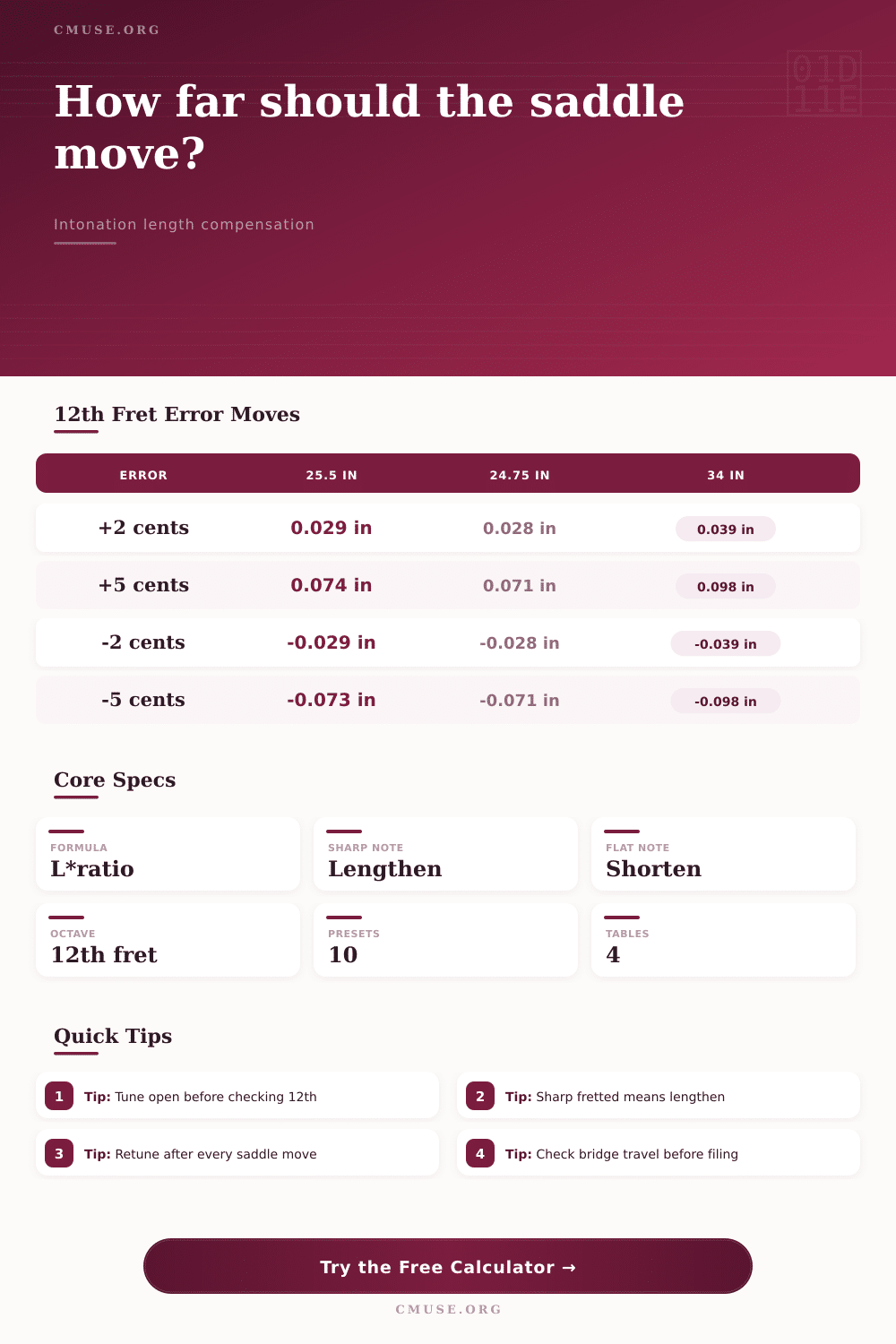
📏 Cents Error To Saddle Move Table
| 12th fret error | Saddle direction | Move on current scale | New total compensation | Travel note |
|---|---|---|---|---|
| Calculate to fill the intonation correction table. | ||||
🎸 Scale Length Compensation Table
| Instrument scale | Nominal length | Move for +3 cents | Move for +6 cents | Typical use |
|---|---|---|---|---|
| Calculate to compare common scales. | ||||
📊 Gauge And Tension Reference Table
| String example | Gauge | Estimated tension | Stiffness tendency | Intonation note |
|---|---|---|---|---|
| Calculate to fill string tension references. | ||||
🎯 Bridge Travel Reference Table
| Bridge style | Typical travel | Compensation pattern | Best check | When travel runs out |
|---|---|---|---|---|
| Hardtail electric | 0.30 to 0.55 in / 7.6 to 14.0 mm | Wide per-string saddle range | Check screw length and spring compression before the saddle bottoms out. | Reverse spring, inspect neck relief, or confirm the bridge placement. |
| Tune-o-matic | 0.18 to 0.30 in / 4.6 to 7.6 mm | Limited travel with saddle orientation options | Compare wound strings against the bridge-post angle and saddle flip direction. | Flip the saddle if appropriate, then evaluate bridge location. |
| Acoustic saddle | Fixed ramp, usually 0.08 to 0.18 in / 2.0 to 4.6 mm | Carved witness line across one saddle | Check nut slot height and action before changing the saddle crown. | Use a compensated saddle blank or recut the witness points. |
| Bass bridge | 0.50 to 0.90 in / 12.7 to 22.9 mm | Large travel for heavy low strings | Retune after every adjustment because large strings settle slowly. | Confirm string taper, witness point, and scale before relocating hardware. |
| Mandolin bridge | Moveable bridge plus small saddle steps | Whole bridge plus course-level notches | Check paired courses together; one string can hide the other's error. | Shift the bridge first, then refine individual witness notches. |
The tuner displays the note and you press the 12th fret and it’s sharp. Ok you back off on the saddle screw and move the saddle back some more. Check the pitch. It is still sharp. Back it off again, all of a sudden you’re flat. Backing off more causes you to be stuck in a loop where you can’t get the pitch to settle.
What’s going on here? Anyone who have set up a guitar knows this is a very common occurrence. The frustrating part is that we treat it like a simple math problem. But it isn’t.
Why Guitar Intonation Is Hard to Fix
The math is easy enough, but physics of how a string vibrates are complex. A string is not an ideal flexible line. It has mass, thickness and some degree of stiffness. If you push a string down onto a fret then you will also be stretching it a little. This increase its pitch.
The degree of stretch is determined by the string’s thickness and how far the string is from the fretboard. A thin high E string bends more easy than a thick low E string does. So it requires less speaking length to make up for that stretch in pitch. This is why bridge saddle is angled. The low strings has a greater distance behind them than higher strings do.
Typically players will estimate correction and use the number of cents as their measurement of error. A single cent is very little distance; it’s roughly a fraction of a millimeter of movement, however that change depending on scale length. The longer your instrument’s string length, the more that single cent differ. The twenty-five inch scale doesn’t behave like a thirty four inch bass scale.
Once you input all of your variables, the calculator do the math for you. No need to guess at any conversion or coefficient. It takes the number of cents your tuner provides and converts it to actual distance away from the string. This means you can use either a feeler gauge or simply a ruler to take measurement.
The physical setup itself can’t be ignored. When you’re fretting an instrument with a high action, you are stretching the string out more. That requires greater compensation. So if you drop the action without compensating for intonation, in the higher positions the guitar go sharp. The tool takes into account the action height and neck relief you enter. It combines the geometry of the strings and neck with the pitch error.
You enter your string gauge, construction, and pitch. It calculates the tension and stiffness factors that a simple formula doesn’t accounts for.
Many of the set-up issues arise from hitting bridge travel limit. I’m thinking that I should of pulled my saddle back by eight millimeters. But my old bridge can’t go back any more than five millimeters. That’s what the tool test. When it detects you’re nearing the end of available track it tells you so.
Once you’ve reached the max, you cannot simply turn the screw in any further. Time to either flip the saddle, file down the contact point, or take a small compromise. A constraint of hardware and not something that can be solved by tuning.
Don’t get hung up on perfect tuning. With amps and drums happening in a live room, even 5 cent errors goes undetected by human ears. You don’t need lab accuracy; you’re going for neck-consistency.
Do it one string at a time. Then after each adjustment, retune that open string, followed by an octave check. When you move the saddle, this alters the tension which moves the open pitch. It is a little step, but it is a meaningful one. You won’t be checking what you think you’re checking if you skips the retuning step.
So in conclusion, it’s all about that tug-of-war between acoustics and geometry. On one hand you have the physics of the fretboard, on the other you have the stiffing effect of the metal. The calculator provides your initial good guess. And then what? When do you quit?
That’s where your ears come into play. Once you understand how the string stretches and how the saddle counteracts that stretch, it will feel more mechanical than magical. Press down at the twelfth fret. The note sings out true, and the circle is complete.