Interval Count in Melody Calculator
Paste a melody as note names, count every adjacent melodic interval, and see interval classes, direction, range, average leap size, contour, and style balance.
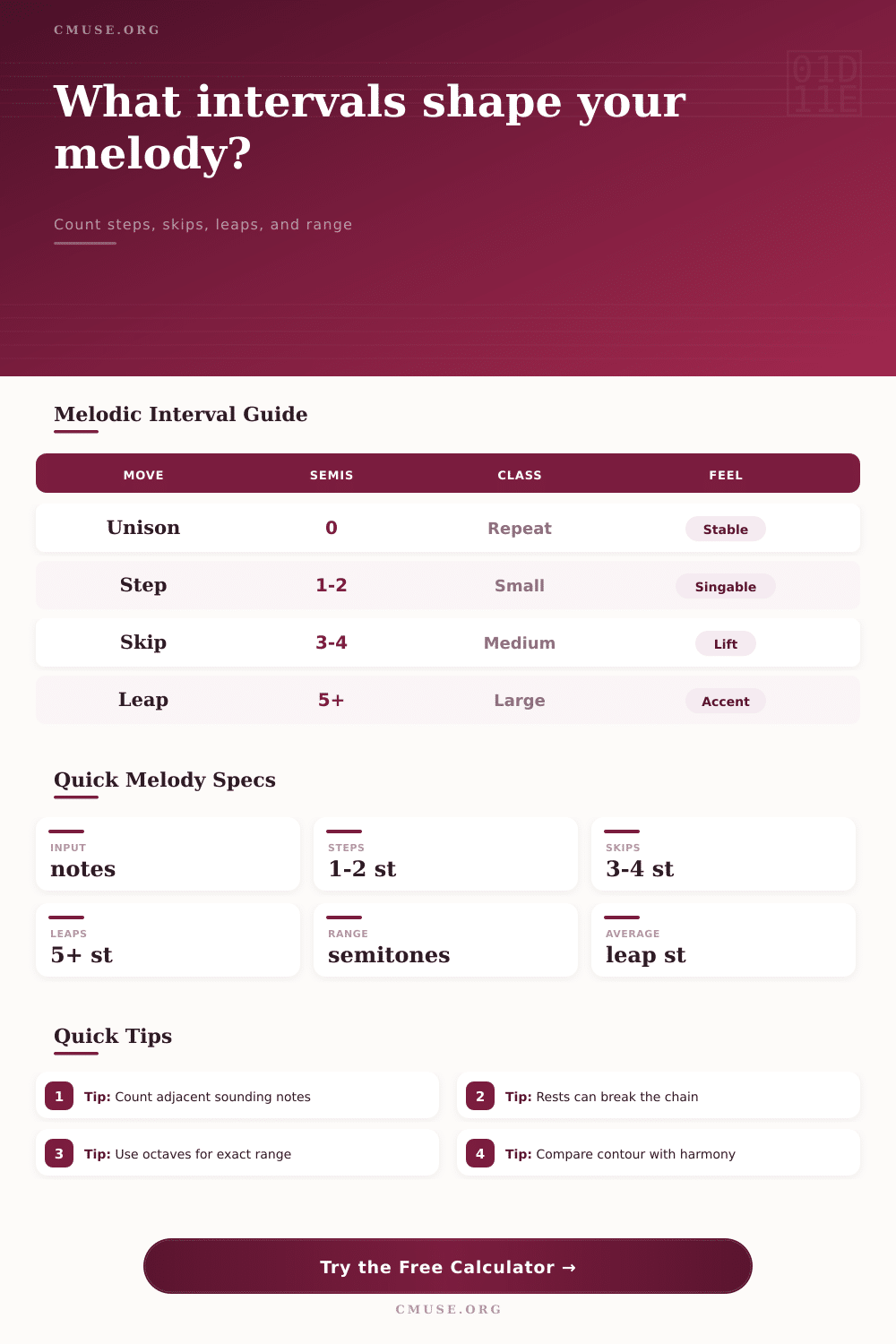
How it counts: The calculator parses adjacent sounding notes, converts them to semitone positions, then classifies each move as unison, chromatic step, diatonic step, skip, leap, octave, or compound leap.
| Semitones | Common name | Class used here | Melodic role |
|---|---|---|---|
| 0 | Perfect unison | Repeat | Stability, emphasis, chant-like focus |
| 1 | Minor second | Chromatic step | Tension, approach tone, close neighbor |
| 2 | Major second | Diatonic step | Smooth scale motion and singable connection |
| 3-4 | Minor or major third | Skip | Triad outline, hook lift, melodic color |
| 5-7 | Fourth or fifth | Leap | Phrase arrival, call shape, harmonic outline |
| 8-11 | Sixth or seventh | Wide leap | Expressive reach, dramatic accent, register contrast |
| 12+ | Octave or compound | Compound leap | Register jump, instrumental figure, high emphasis |
| Profile | Step share | Leap share | Typical use |
|---|---|---|---|
| Stepwise vocal | 70% or more | Under 15% | Pop verse, choir inner voice, chant, folk melody |
| Balanced song line | 50-69% | 15-30% | Hooks, standards, lyrical instrumental themes |
| Angular melody | 30-49% | 31-45% | Jazz lines, film motifs, prog figures, riff writing |
| Leaping figure | Under 30% | Over 45% | Fanfare, arpeggio study, instrumental pattern |
| Range span | Semitones | Vocal reading | Instrumental reading |
|---|---|---|---|
| Narrow cell | 0-4 | Very contained and speech-like | Ostinato or riff fragment |
| Comfort phrase | 5-7 | Easy for most short vocal phrases | Compact motif or lead line |
| Octave frame | 8-12 | Full hook span, check tessitura | Clear register shape |
| Wide line | 13+ | Needs singer-specific range check | Idiomatic for many instruments |
| Counting choice | Best when | What changes | Check first |
|---|---|---|---|
| Count unisons | Repeated attacks matter rhythmically | Repeat class increases | Tied notes should not be retyped |
| Ignore repeats | Studying pitch contour only | Total intervals may drop | Repeated lyrics may hide pitch motion |
| Break at rests | Phrases breathe or stop | No interval over a gap | Rests must be typed as R |
| Bridge rests | Analyzing full pitch skeleton | Counts next pitch connection | Large leaps may cross phrase breaks |
Singing-first contour
High step share, low average leap, and narrow range usually read as smooth, memorable, and easy to place over lyrics.
Harmony-outline line
Many thirds, fourths, and fifths suggest arpeggiation, chord-tone targeting, or a riff built from harmonic anchors.
Motivic contrast
Alternating direction with frequent leaps can create a memorable identity, especially when the rhythm repeats the same cell.
Wide-span gesture
Octaves and compound intervals draw attention to register shifts. They can be strong hooks, but they raise performance demand.
Melody is a mysterious thing for most songwriters, yet a professional arranger need to think in terms of concrete geometry. You may be missing an amazing line whose narrow range feel stuck. You might have a riff that seems all over the map because its intervals aren’t grounded in time. Or, the difference between a compelling hook and a throwaway run is how you’ve spaced out the leaps, the skips and the steps. There’s no magic. It is only math disguised as emotion.
What do you see when you look at a melody? You’re looking at a bunch of choices regarding distance. The smallest move (usually a second) is called a step. It’s smooth and connect the notes with very little effort from singer. It is also the bread and butter of vocal melodies. Next are skips (typically thirds), that adds a bit of lift to the tune while outlining harmony without straining voice. Leaps is anything larger than a fourth and bring in the drama as well as an accent. They mark the end or beginning of a phrase, or they can convey sense of urgency.
Melody Is Like Math
To take the guess work out of your analysis, just plug in the numbers in calculator above and let it count up all the adjacent moves and classify them for you. First and foremost we need to think about how balanced these moves are. Melodies made up of seventy percent steps and fifteen percent leaps read as lyrical and stable. This is the typical profile for folk song and pop verses. They are easy to sing and easy to follow. At the other end of the spectrum, melodies with more than forty five percent leaps and less than thirty percent steps will sounded aggressive or intellectual. These are common in metal riffs, film motifs or jazz lines. The energy is dictated by leap share. Too many steps will feel like a lullaby if you’re writing a thriller score, or shouting out loud if it’s a ballad.
Interval size isn’t everything either. Equally important is range. Something that only covers four semitones sound limited, like speech, an ostinato, or a chant. Cross eight semitones and you’re into the territory of a full hook span. Here you need to consider vocal range. A large range might be exciting when written down but a nightmare for a vocalist if it fall at the wrong end of their range. You can see exactly what range of notes you’ve created with this tool. This lets you know if you’ve written something that fits your singer or just your keyboard.
But it’s the small details of your count that alter the image. A big one is rests. Does the interval chain stop at the point where the melody pauses? You might skip over the rest and create a huge leap that doesn’t actualy exist. It’s theoretical, not physical. Another option is to ignore repeats. Repeat notes bring rhythmic emphasis and drive but do not alter pitch. Do you count them as unisons or choose to ignore them: Are you analysing rhythmic attack or pitch contour? The page has a reference table that shows the effect different counting options have on the perceived profile of the line.
At last. Ultimately, you’re looking to match the profile of the intervals to the emotional intention. Because if a melody uses mostly fifths and thirds then it’s going to sound resolved and harmonious. Why? That is because the chords do as well too. And if your melody contains lots of half-steps (chromatic), it will sounded unresolved and tense.
Does this mean you have to work out each interval every time you compose? No. But check your completed hooks. What’s the range? What’s the leap average? Feel like your melody is too flat? Add a leap or two. Something that sounds all over the place? Add some steps. The ear takes in the geometry of the notes even though the listener thinks he/she is just feeling the music. You begin with a note. And you end with a choice.