Interval Between Two Notes Calculator
Choose two written notes and octaves to calculate semitone distance, interval spelling, cents, equal-tempered frequency ratio, inversion, and consonance.
| Semitones | Common Name | Cents | Equal-Tempered Ratio |
|---|---|---|---|
| 0 | Perfect unison | 0 | 1.0000:1 |
| 1 | Minor second or augmented unison | 100 | 1.0595:1 |
| 2 | Major second or diminished third | 200 | 1.1225:1 |
| 3 | Minor third or augmented second | 300 | 1.1892:1 |
| 4 | Major third or diminished fourth | 400 | 1.2599:1 |
| 5 | Perfect fourth or augmented third | 500 | 1.3348:1 |
| 6 | Augmented fourth or diminished fifth | 600 | 1.4142:1 |
| 7 | Perfect fifth or diminished sixth | 700 | 1.4983:1 |
| 8 | Minor sixth or augmented fifth | 800 | 1.5874:1 |
| 9 | Major sixth or diminished seventh | 900 | 1.6818:1 |
| 10 | Minor seventh or augmented sixth | 1000 | 1.7818:1 |
| 11 | Major seventh or diminished octave | 1100 | 1.8877:1 |
| 12 | Perfect octave | 1200 | 2.0000:1 |
| Compound Number | Simple Equivalent | Extra Octaves | Common Use |
|---|---|---|---|
| 8th | Octave | 0 full extra octaves | Doubling, register match |
| 9th | Second plus octave | 1 octave | Chord color, melody spread |
| 10th | Third plus octave | 1 octave | Piano voicing, bass to melody |
| 11th | Fourth plus octave | 1 octave | Suspension color |
| 12th | Fifth plus octave | 1 octave | Open harmony, orchestration |
| 13th | Sixth plus octave | 1 octave | Jazz and pop extension |
| 15th | Double octave | 1 octave above 8th | Wide doubling |
| Original | Inverts To | Quality Flip | Semitone Sum |
|---|---|---|---|
| Unison | Octave | Perfect stays perfect | 0 + 12 |
| Second | Seventh | Major becomes minor | 2 + 10 or 1 + 11 |
| Third | Sixth | Minor becomes major | 3 + 9 or 4 + 8 |
| Fourth | Fifth | Augmented becomes diminished | 5 + 7 or 6 + 6 |
| Fifth | Fourth | Diminished becomes augmented | 7 + 5 or 6 + 6 |
| Sixth | Third | Major becomes minor | 9 + 3 or 8 + 4 |
| Seventh | Second | Minor becomes major | 10 + 2 or 11 + 1 |
| Reference | Value | Formula | Use |
|---|---|---|---|
| Equal-tempered semitone | 100 cents | 2^(1/12) | Chromatic pitch spacing |
| Octave | 1200 cents | 2:1 | Same pitch class higher |
| A4 standard | 440 Hz | A4 x 2^(n/12) | Scientific pitch estimates |
| Cent offset | 1/100 semitone | 2^(cents/1200) | Tuning and intonation checks |
| Frequency ratio | higher/lower | f2 / f1 | Compare measured notes |
Perfect consonance
Unisons, octaves, and perfect fifths usually sound settled and strongly centered in tonal music.
Imperfect consonance
Thirds and sixths sound consonant but carry major or minor color that defines chord quality.
Seconds and sevenths
Seconds and sevenths usually want context, preparation, or resolution in harmony and counterpoint.
Tritone
Six semitones divides the octave evenly and often sounds unstable until it resolves by step.
The perfect fifth is defined as having seven semitones which most musicians is aware of. However, that’s where the definition ends.
Beyond being a measure of pitch height, it do not take into account how notes are spelled out musically, which is a rather messy affair. In equal temperament, a perfect fifth and a diminished sixth can be zero cents apart but they has completely distinct harmonic functions: one implies rest and stability while the other imply tension and resolution. This is why simply counting piano keys are insufficient for serious music theory or composition.
Why Note Spelling Matters
You require something that recognizes both the acoustical distances of notes together with its identities. Once you enter the spellings of your own choice into the calculator above, it’ll do the hard work for you, saving you from making mistakes when manually counting intervals and confusing there quality.
You also need to specify the note’s context in terms of accidentals as well as simply name (e.g., C to C-sharp vs. C to D-flat), which makes a difference as the first interval is an augmented unison; the other a minor second. They are both one semitone away from each other but has very different theoretical consequences. One is a change of pitch class that move chromatically. The other is a step-wise melody movement.
If you ignore spelling, your harmonic analysis will be flawed regardless of how accuratly you measure the frequency ratio.
A further option here is to change reference pitch that defaults to an ‘A’ at 440Hz. Altering this value doesn’t impact the intervals themselves but changes actual frequency of each note relative to the reference point. This may be helpful if you use a non-standard tuning system or need to play pieces for historical reasons.
Here is where you find the Frequency Ratio that give you the mathematical relationship between the two notes. For example, the ratio for a perfect fifth is around 1.5:1, something our ears have connect with for thousands of years. This puts these intervals into context if you understand idea of consonance.
A perfect consonance is one where the partials line up close together, like a fifth or an octave that sound stable. Thirds and sixths are imperfect consonances that give color to the chord but also indicate whether it’s major or minor. Seconds and sevenths is dissonant as they create tension and need to be resolved in traditional counterpoint.
The tritone falls neatly at six semitones. It divide the octave equally into two parts. Because of this, it was considered unstable. Historically, it has been treated with some suspicion and used carefuly in voice leading.
Simple intervals can be extended by adding octaves; this give compound intervals. For example, an octave added to a second makes a ninth. These interval are frequently used in piano voicings to give width without cluttering the middle register.
The table of inversions illustrates what happens to the intervals if either higher note drops one octave or the lower note rises one octave. The minor sixth, for instance, is the inversion of major third. The total number of semitones will always add up to twelve per octave. This is the symmetry found in the twelve-tone system.
Beyond this coarse measurement of semitones, you can use cents to exactly analyse your tunings. It’s measurable data instead of simply a vague impression like “that singer was sharp but not too much”. That 20 cent value is something you could of work with in a digital audio workstation if you want to microtune things. It bridges the gap between world of abstract theory and what we hear.
Things become useful when we connect numbers to musical meaning. For example, you know that 700 cents is an interval; fine, now you know it’s a fifth. However, if you know it is spelled as C to G-flat you know it is a diminished fifth. It is a distinct colour used within the world of dominant seventh chords.
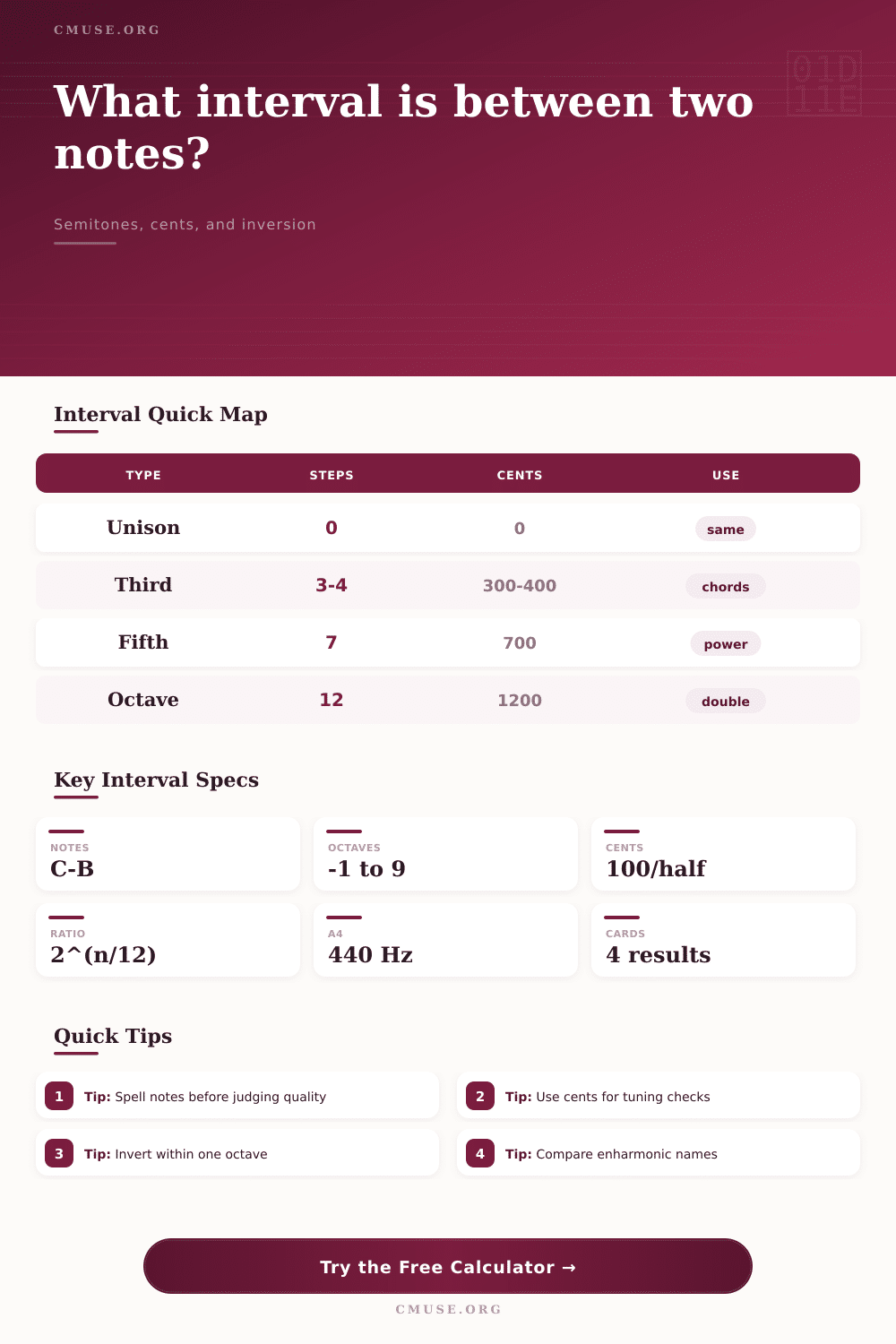
The visual reference table on this page explain and verifies these relationships quickly.
To conclude, Interval calculation boils down to the accuracy of your sound and therefore the accuracy of your words. For creating a new sound or studying a Bach fugue, knowing precisely how far apart one note is from another determine that interval’s role. This removes the math, letting you focus on what you create.
You enter two letters and have a full harmonic profile at the other end. That clarity turns guesswork into craft, and the secret is knowing what you are realy measuring. Measure the right thing with this calculator.