ITD Calculator
Estimate interaural time difference from listener head width, source azimuth, distance, air temperature, sample rate, and cue strength.
🎧Listening Presets
🎚ITD Inputs
📊Timing Results
📌Reference Specs
📐Angle and Head Width Table
| Azimuth | 14 cm Head | 17.5 cm Head | 20 cm Head | Use Case |
|---|---|---|---|---|
| 0° | 0 us | 0 us | 0 us | Centered vocal, kick, bass, dialogue |
| 15° | 119 us | 149 us | 170 us | Narrow stereo placement |
| 30° | 235 us | 294 us | 336 us | Moderate pan with stable center |
| 45° | 348 us | 435 us | 497 us | Wide acoustic instrument cue |
| 60° | 456 us | 570 us | 652 us | Strong side image without hard lateral |
| 75° | 558 us | 697 us | 797 us | Near-side effects and spatial audio cues |
| 90° | 654 us | 817 us | 934 us | Hard side or dummy-head reference |
💾Sample Rate Timing Grid
| Sample Rate | 1 Sample | 300 us ITD | 600 us ITD | Best Use |
|---|---|---|---|---|
| 44.1 kHz | 22.68 us | 13.23 samples | 26.46 samples | Music release sessions |
| 48 kHz | 20.83 us | 14.40 samples | 28.80 samples | Video, games, broadcast |
| 88.2 kHz | 11.34 us | 26.46 samples | 52.92 samples | High-rate music editing |
| 96 kHz | 10.42 us | 28.80 samples | 57.60 samples | Spatial audio production |
| 192 kHz | 5.21 us | 57.60 samples | 115.20 samples | Measurement and research |
🔬Model Comparison
| Model | Formula Core | Strength | Watch For | Best Fit |
|---|---|---|---|---|
| Simple path | d x sin(theta) / c | Clear and fast | Understates side angles | Speaker spacing sketches |
| Woodworth | r x (theta + sin theta) / c | Natural head curve | Assumes spherical head | Binaural and headphone work |
| Duplex blend | 70% Woodworth, 30% path | Useful low-band average | Not a full HRTF | Low-frequency localization |
| Manual offset | Calculated ITD + offset | Checks delay lines | Can exceed natural range | Plugin or routing compensation |
🎵Common Audio Scenarios
| Scenario | Typical Angle | Head Width | Approx ITD | Practical Read |
|---|---|---|---|---|
| Lead vocal or dialogue | 0° | 17.5 cm | 0 us | Keep timing centered for image lock |
| Acoustic guitar pair | 30° | 17.5 cm | 294 us | Audible width with stable blend |
| Wide piano cue | 45° | 17.5 cm | 435 us | Strong lateral image |
| Footstep in game audio | 60° | 17.5 cm | 570 us | Fast directional cue |
| Dummy-head side source | 90° | 18 cm | 840 us | Hard lateral reference |
💡Calculation Tips
Interaural time difference are the delay in which sound arrive at each ear, and the brain use interaural time difference to determine the locations of a sound source in horizontal space. When a sound is coming from one side of an individual, the sound will arrive at the ear closer to the sound source before it reach the ear that is further from the sound source. The width of an individuals head determines the distance that sound have to travel to each ear.
Individuals with wider heads will have a longer distance for sound to travel to one ear compared than the other. An individual with a narrow head will have a shorter distance for the sound to travel to each ear. In order to calculate interaural time difference for each ear, it is necessary to measure the distance between an individuals ears at the temples, because the width of an individuals head will impact how they hear sound.
How Time Differences Between Ears Tell Us Where Sound Comes From
Additionally, the distance between the sound source and the listener will also impact the interaural time difference between the sound that reaches each ears. An individuals temperature impact the speed at which sound travels, which impacts interaural time difference. If the temperature of the air increase, the speed of sound increase by around 0.6 meters per second for every degree in Celsius.
Therefore, if the temperature change, it can impact the interaural time difference. The angle from which a sound reaches an individual will also impact there interaural time difference. If a sound is coming from zero degrees, it will be directly in the center of an individual’s hearing.
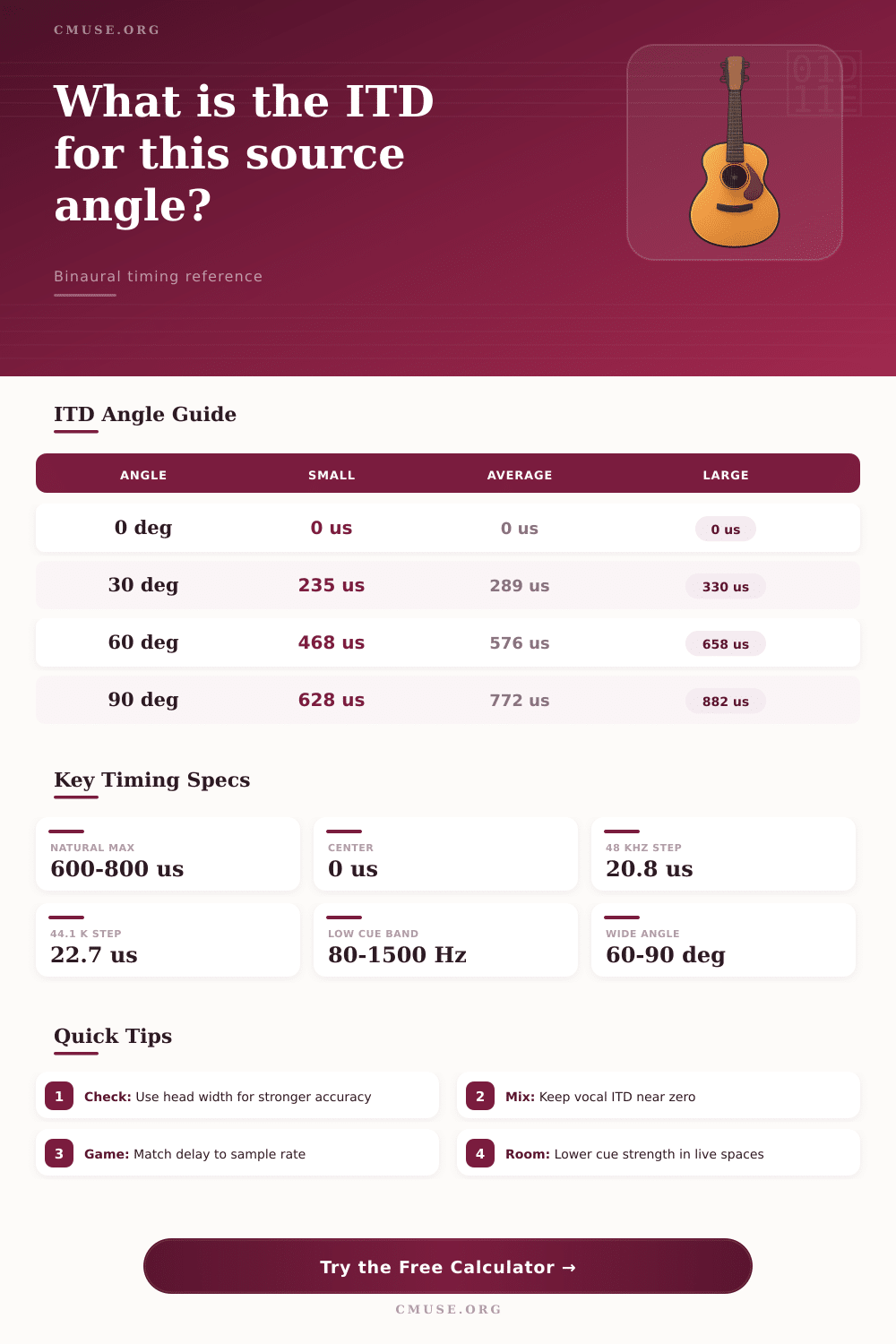
If a sound is coming from 90 degrees, the interaural time difference will be the widest, between 600 and 800 microseconds. For audio production, engineers utilize interaural time difference for sound frequencies below 1500 hertz. For frequencies below 1500 hertz, interaural time difference is the main element that the brain use to determine the location of a sound source.
However, for frequencies above 1500 hertz, the brain uses interaural level difference to determine the location of the sound source. For those creating binaural or game audio, interaural time difference can be used to create the perception of where a sound is coming from. For example, if a producer wants to create a sound to come from a 60 degree angle, sample offsets can be used to adjust the interaural time difference of the sound.
The offset can be determined through the sample rate of the audio system. Using the correct sample offsets will allow an audio system to create the perception of a sound coming from a specific direction. The conditions in which an audio system play back sound can also impact an individuals perception of interaural time difference.
For example, in an anechoic chamber or with headphones, the interaural time difference for sound will be the clearest for an individual. In a live sounds room, with numerous sound reflections, those reflected sounds may alter an individuals perception of interaural time difference. To fix this issue, sound engineer can use different angles for different sound instrument.
For instance, vocal sounds can be played back from zero degrees (center), and guitars can be played from an angle like 30 degrees. The sample rate at which an audio system measure sound also impacts interaural time difference. At 44.1 kilohertz, each sample represent 22.7 microseconds in length.
However, at 96 kilohertz, each sample represent only 10 microseconds in length. Therefore, using 96 kilohertz will provide a more smoother interaural time difference. Additionally, other considerations must be made within audio engineering for interaural time difference.
For instance, engineers must be aware of phase shift. Additionally, there are some common mistake that sound engineers may make when working with interaural time difference. One of the most common is using the width of headphone cup to determine interaural time difference, rather than the width of an individuals skull.
Using the width of the headphone cups would lead to an incorrect reading of the interaural time difference of an individuals skull. Another mistake is ignoring near-field correction. If near-field corrections are ignored, close miked sound instruments may sound unnatrually to listeners.
To avoid these mistakes, sound engineers can use signed delays for interaural time difference. With this model, any delays for sounds that occur on the left side of an individual are represented by negative numbers, and any delays for sounds on the right side of an individual is represented by positive numbers. Additionally, models like Woodworth’s spherical model can be used to describe interaural time difference.
Woodworth’s spherical model is more accurate in determining where a sound source is when utilizing low-frequency sound than other models for interaural time difference.