Instrument Resale Value Calculator
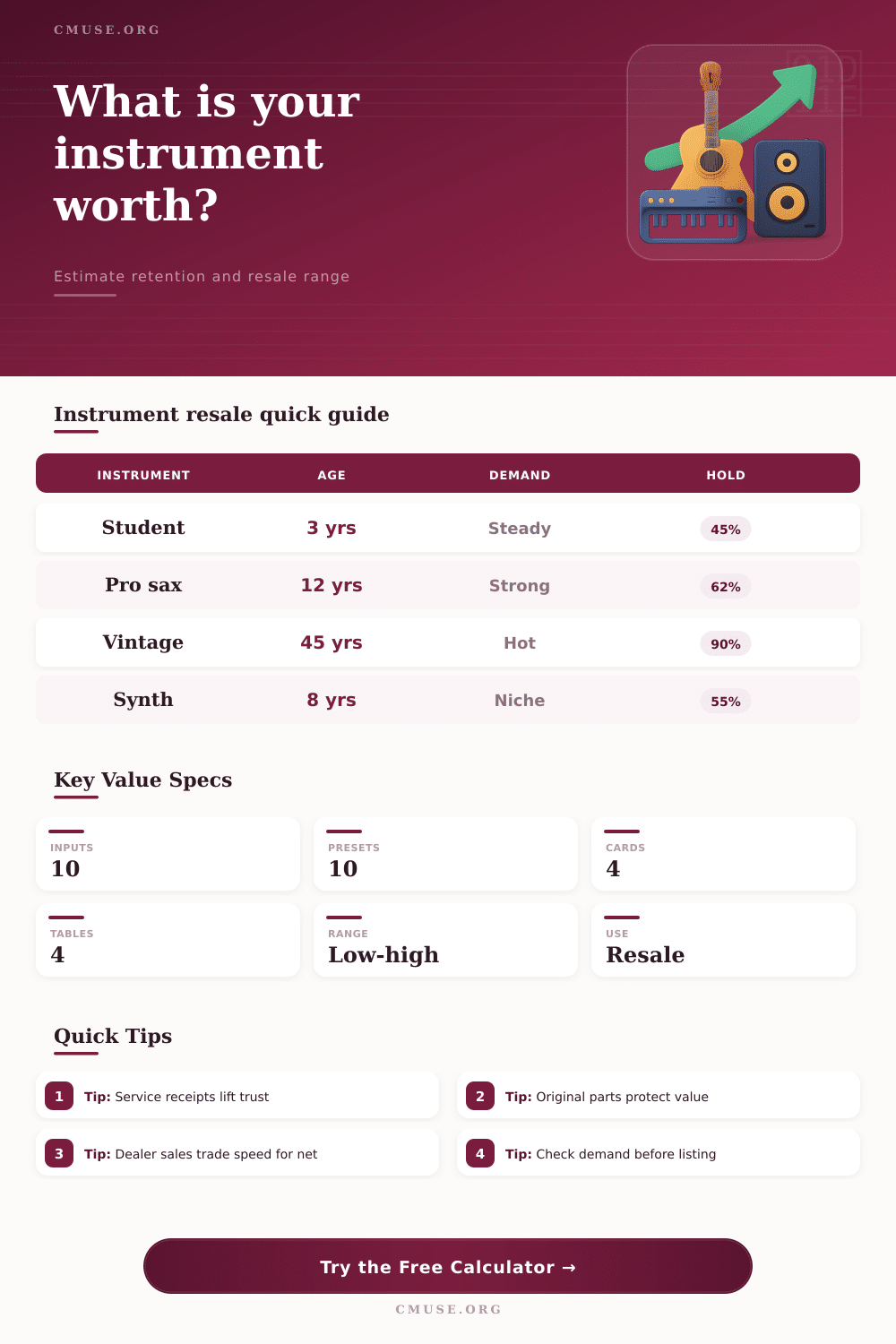
Estimate a used instrument's resale value from original value, brand tier, instrument family, condition, age, rarity, service history, market demand, documentation, originality, and selling channel.
Choose a named preset or enter your own details. The calculator models retention from musical instrument market factors; it is a planning estimate, not an appraisal or live marketplace quote.
Calculation breakdown
| Measure | Value | How to use it | Watch point |
|---|
| Instrument family | Typical early dip | Long-run floor | Resale note |
|---|---|---|---|
| Student / beginner instrument | Fastest in first 3 years | 28% to 42% | Condition, included case, and playability matter more than age. |
| Acoustic guitar / fretted acoustic | Moderate first-owner dip | 45% to 60% | Solid wood, original finish, and desirable body size improve retention. |
| Electric guitar / bass | Moderate, model dependent | 48% to 64% | Original pickups, frets, electronics, and finish influence buyer confidence. |
| Orchestral string instrument | Slow if properly set up | 52% to 70% | Maker, shop certificate, bow/case quality, and luthier condition carry weight. |
| Woodwind or brass | Pad and dent risk early | 40% to 58% | Recent overhaul, leak-free pads, valves, and finish condition help greatly. |
| Acoustic piano | High moving-cost drag | 20% to 45% | Local demand, tuning stability, cabinet size, and regulation decide liquidity. |
| Digital keyboard / production gear | Technology depreciation | 30% to 50% | Current compatibility, keybed wear, firmware, and included power supply matter. |
| Vintage or collectible instrument | Low if desirable | 60% to 95%+ | Era, originality, provenance, and active collector demand can outweigh age. |
| Factor | Low setting | Neutral setting | High setting |
|---|---|---|---|
| Brand tier | Unknown maker: 0.78 | Mainstream brand: 1.00 | Collectible maker: 1.34 |
| Condition | Repair project: 0.38 | Excellent: 1.00 | Near mint: 1.08 |
| Rarity | Very common: 0.88 | Common: 0.96 | Rare with buyers: 1.30 |
| Service | Unknown: 0.84 | Playable now: 1.00 | Overhauled: 1.14 |
| Demand | Cold niche: 0.78 | Steady: 1.00 | Hot market: 1.22 |
| Originality | Heavy mods: 0.82 | Normal upkeep: 1.00 | Verified original: 1.07 |
| Demand / channel | Value effect | Typical speed | Best use |
|---|---|---|---|
| Dealer trade-in | Lower net, lower friction | Fastest | Use when speed and certainty matter more than maximum value. |
| Consignment | Commission reduces net | Medium | Useful for instruments that benefit from shop trust and setup verification. |
| Local private sale | Balanced net | Medium | Good for common instruments where buyers want to try before purchase. |
| Online private sale | Higher reach, more risk | Medium to slow | Good for specialized gear with buyers outside your local market. |
| Specialist collector listing | Highest when desirable | Slow to medium | Best for rare, vintage, boutique, or documented professional instruments. |
| Example profile | Original value | Likely retention | Main resale driver |
|---|---|---|---|
| Student violin outfit, 5 years old | $800 | 38% to 50% | Playable setup, included bow, case, and local lesson demand. |
| Professional tenor sax, 12 years old | $4,900 | 55% to 72% | Pad condition, brand reputation, lacquer wear, and recent service. |
| Custom shop electric guitar, 8 years old | $4,200 | 62% to 82% | Model desirability, originality, case candy, and finish condition. |
| Vintage acoustic dreadnought, 50 years old | $4,200 | 80% to 125% | Era, cracks/repairs, originality, neck angle, and collector demand. |
| Stage keyboard, 4 years old | $2,300 | 42% to 58% | Technology cycle, keybed wear, current support, and included accessories. |
| Studio upright piano, 18 years old | $6,500 | 22% to 42% | Moving friction, tuning stability, cabinet size, and local buyer pool. |
To determine the resale values of a musical instrument, you need to understand several different variable. The resale value of a musical instrument doesnt depend on the age of the musical instrument alone. The resale value of a musical instrument depend on the condition of the musical instrument, the documentation for the musical instrument, and the demand for the musical instrument.
To distinguish between the original purchase price of the musical instrument and the resale or market value of the musical instrument, you must understand each of these variable. The condition of the musical instrument is one of the primary factor to consider when determining the resale value of a musical instrument. If the musical instrument is in mint condition, the resale value of that musical instrument will be more higher than if the musical instrument is in poor condition.
What Affects the Resale Value of a Musical Instrument
An example of poor condition is a musical instrument with a dent in the body or musical instrument with worn frets. Musicians who buys musical instruments in poor condition often have to pay for repairs to bring that musical instrument to the same quality as new musical instruments. Therefore, the condition of a musical instrument is a key variable in determining its resale value.
The service history of a musical instrument is another important factor to consider when determining its resale value. Musical instruments with documented service histories indicate to potential buyers that the musical instrument is still in good working condition. If a musical instrument dont have a documented service history, potential buyers may assume that the musical instrument may require service.
This assumption may lead to a lower resale price for that musical instrument. Documentation of a musical instruments service history provides receipts and documentation that buyers can use to reduce there uncertainty when viewing the musical instrument. The demand for a musical instrument has a direct impact on the resale value of that musical instrument.
If other musicians demand musical instruments of a specific make and model, then the resale price for those musical instruments will reflect the high demand for the instruments. Conversely, if the demand for a specific model or make of musical instrument is low, the resale value of that musical instrument may be low and it may take longer for the musical instrument to be sold. The channel through which a musical instrument is to be resold can also impact the resale value.
For instance, trade-in locations for musical instruments may provide a quick sale of the musical instrument but at a lower resale price. Conversely, a specialist in musical instruments may provide a higher resale price for the instrument but take longer to sell that instrument. Although the age of a musical instrument does impact its resale value, there are other factors besides age that determine that resale price.
Most musical instruments lose their resale value quite quick when new owners first purchase them. However, after a few years of use, most musical instruments begin to lose their value at a slower rate. However, vintage musical instruments may have a resale value that is higher than newer musical instruments of the same make and model if those musical instruments has collecter interest and originality in their design.
The originality and documentation of a musical instrument can also impact its resale value. If someone once replaced a musical instrument with parts that were not original to the instrument, the resale value of that musical instrument may be lower than musical instruments that use only original parts. However, if the musical instrument contains its original manuals and case, the resale value of the musical instrument may be higher due to the originality of the musical instruments accessories.
The resale value musical instrument calculator provide only a planning estimate for the resale value of a musical instrument. The percentage of the original purchase price of the musical instrument can be used to determine the current resale value of the musical instrument. The low to high resale price range can be used when negotiating with a buyer of the musical instrument.
The liquidity score provide an indication of how quickly the musical instrument can be sold. Finally, you can adjust the information that can be entered into the resale value calculator with new information regarding the musical instrument. By making these adjustments, you can run the resale value calculator again to provide a new resale value estimate.