IIC Impact Insulation Calculator
Estimate impact insulation class from a floor assembly, normalized impact level, and ASTM-style contour deficiency checks.
| Band | 100 | 125 | 160 | 200 | 250 | 315 | 400 | 500 | 630 | 800 | 1000 | 1250 | 1600 | 2000 | 2500 | 3150 |
|---|
| IIC Band | Typical Interpretation | Common Floor Feel | Planning Caution |
|---|---|---|---|
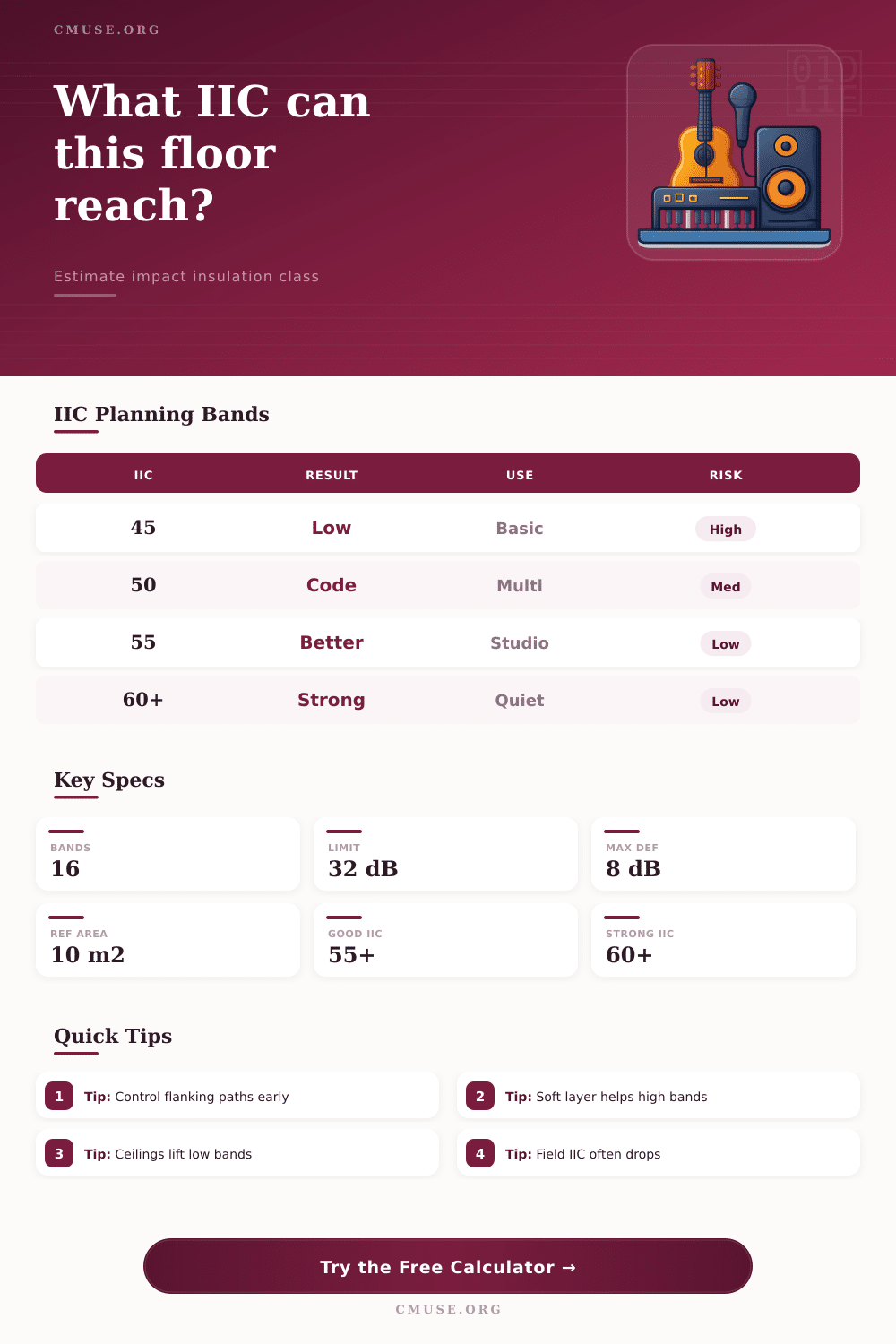
| Below 45 | Weak isolation | Footfall and chair noise are obvious | High complaint risk |
| 45 to 49 | Basic separation | Hard impacts remain noticeable | Usually needs soft finish |
| 50 to 54 | Common minimum target | Moderate impact control | Field IIC can fall below lab IIC |
| 55 to 59 | Improved residential comfort | Reduced walking and furniture noise | Protect perimeter isolation |
| 60 and higher | Strong impact isolation | Suitable for stricter quiet-room goals | Requires good detailing |
| Layer Type | Main Strength | Typical Delta IIC | Best Use |
|---|---|---|---|
| Dense carpet pad | High frequency impact damping | 18 to 26 dB | Residential soft finish |
| Rubber underlayment | Broadband resilient break | 10 to 22 dB | Hard finish over slab |
| Floating floor | Mass-spring isolation | 18 to 30 dB | Studio or rehearsal rooms |
| Isolation clip ceiling | Low and mid band control | 6 to 14 dB | Wood or steel framed floors |
| Concrete topping | Mass and stiffness shift | 3 to 10 dB | Joist floors needing mass |
| Step | Formula | Meaning | Calculator Use |
|---|---|---|---|
| Normalize | Ln = Li + 10 log(A / 10) | Corrects for room absorption area | Uses volume and RT |
| Absorption | A = 0.161 V / T | Equivalent absorption in square meters | Metric internally |
| Deficiency | D = max(0, Ln - contour) | Only levels above the contour count | Each one-third octave band |
| Pass contour | sum D <= 32 and max D <= 8 | Limits total and single-band mismatch | Finds highest class |
| Scenario | Floor Area | Likely Target | Watch Point |
|---|---|---|---|
| Apartment piano room | 120 to 180 ft² | IIC 55+ | Pedal and bench movement |
| Dance practice room | 250 to 450 ft² | IIC 60+ | Low frequency heel drops |
| Home studio above bedroom | 100 to 200 ft² | IIC 55 to 60 | Perimeter short circuits |
| Condo hard floor retrofit | 300 to 800 ft² | IIC 50 to 55 | Lab rating versus field rating |
Impact noise happen when a person walk across a floor and the sound of that movement travel down into the space beneath the floor. Impact noise is dificult to control once the building are completed. This is because impact noise is a structural vibration.
One measurement of a floor assemblys ability to prevent impact noise from traveling into the space below the floor is called the Impact Insulation Class, or IIC. The IIC is not the measurement of impact noise that a lab test report provide for the floor assembly. Instead, the IIC is a result of a contour fit between the impact noise levels measure on the floor and a standard shape.
How the Floor Impact Noise Calculator Works
The contour fit will determine if the floor assemblys impact noise levels falls within the limits necessary for that floor assembly to provide adequate sound insulation between the floor and the space beneath it. The choices for the different layer of a floor assembly can be understood after understanding the IIC number for that floor. The inputs for the calculator include the individual component of the floor assembly that will influence the impact noise that is measured within the space.
The base floor assembly is the structural portion of the floor that will allow for vibrations to travel through the structure. The addition of a resilient layer on top of the base floor assembly will reduce the transmission of impact noise. A ceiling treatment that is located below the floor assembly will work to decouple the flooring finish from the structural floor, which will reduce the ability of those vibrations to become sound in the space beneath the floor.
Furthermore, the choice of topping for the floor will change the way that the floor respond to low frequency impacts from individuals walking on the floor. The dimensions of the room and the reverberation time of that space will impact the measurement of impact noise levels that are measured within the space, so they must be accounted for within the calculator. Finally, the potential for sound to leak out of the floor assembly through flanking path must also be considered.
The output of the calculator is not a single number. Instead, there are several different measurement of the impact noise levels of the space beneath the floor that will result from the choices made in the calculator. For example, one measurement is the level of sound that will radiate from the space at 500 Hz.
Additionally, the calculator will indicate whether the floor assembly pass the IIC rating requirement, based off the contour fit within the floor assembly. Finally, the deficiency within each band will allow the designer to understand the potential causes of a floor that does not pass the IIC rating. Many people who use the calculator will become surprised at the outcome.
While the IIC rating for the floor assembly will provide an average measurement of the impact noise that will radiate from the space beneath the floor, the IIC rating does not provide a guarantee that it will be effective at reducing each type of impact noise. For example, the floor may efficiently reduce the impact noise created from walking, but another type of impact noise, such as that created when an individual drop a weight into the space, may travel through the floor assembly. Furthermore, the band table will help to determine the causes of a failure of the assembly to pass the IIC rating requirement.
The calculator provides a value for the flooring that will help to determine the impact noise levels within the space beneath the floor. However, the value that is calculated is only based upon the component of the floor assembly. In field conditions, the performance of the floor assembly may differ than that calculated in the laboratory.
For instance, baseboards that contact the floor and the wall will allow sound to transmit along those paths. Additionally, electrical box or HVAC ducts that contact the floor may allow sound to travel between floor unit. As such, an allowance for these flanking path can be added to the calculation of the impact noise levels to account for the difference between the laboratory and field conditions.
In these cases, improving the floor assembly may not be the best use of resource and effort. Instead, efforts should of been invested into improving the isolation of the edge and penetrations in the floor assembly. The use of the space will determine the IIC rating that should be used in the construction of that space.
For instance, in a condo where the unit beneath the condo contain a sleeping area, the IIC level should be low to prevent sleeping individuals from being disturbed by individuals that walk in the hallway of the condo. Additionally, in a home studio where sound is recorded, the IIC level will have to be low to ensure that the sound that are recorded are not contaminated by vibrations that travel through the floor. Finally, the IIC level will have to be high in spaces that are used for dancing or musical performance to ensure that the vibrations caused by these activities do not travel to the spaces beneath them.
Thus, the calculator will allow individuals to test various floor assembly design within their homes or structures. The reference table provided on the calculator will allow individuals to better understand the outcome of their calculations. For instance, the reference table will display different type of flooring and their performance.
Additionally, the reference table can indicate which IIC rating should be used for different type of spaces. Finally, another table will show why certain floor assembly design perform better than others, according to the IIC rating. These table will provide context for the outcome of the calculator that can assist individuals in making decision regarding flooring choice.
When using the calculator, individuals will become more aware of the different component of the structure that will influence the IIC value of the building. Such knowledge will allow individuals to make change to the structure before purchasing the flooring for that structure. Thus, the calculator will help to reduce the cost of construction of the structure.