Hz to BPM Calculator
Convert pulse frequency into quarter-note tempo, pulse length, bar time, and sample counts for rhythm and music timing work.
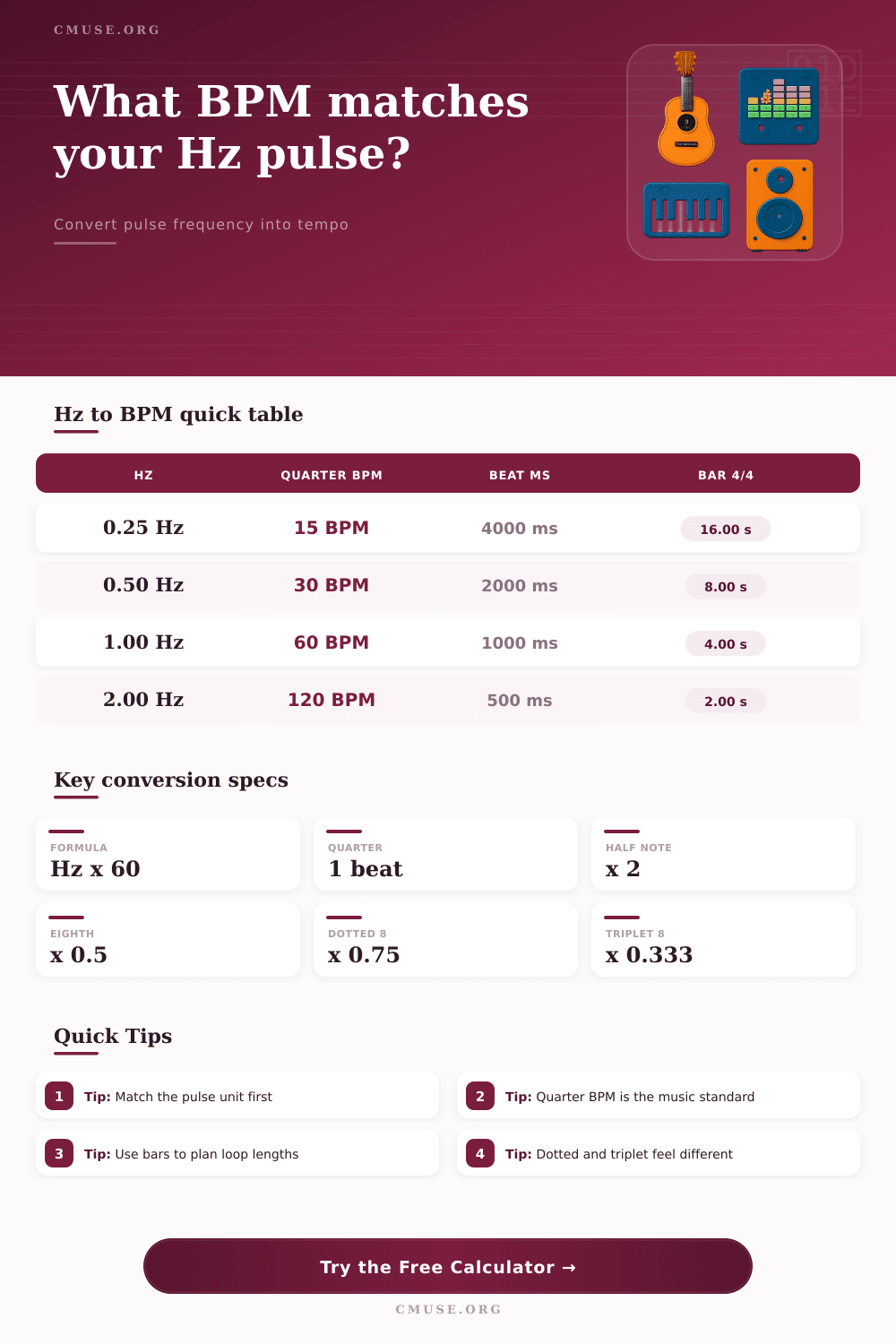
| Hz | Quarter BPM | Beat ms | Bar 4/4 |
|---|---|---|---|
| 0.25 | 15 BPM | 4000 ms | 16.00 s |
| 0.50 | 30 BPM | 2000 ms | 8.00 s |
| 1.00 | 60 BPM | 1000 ms | 4.00 s |
| 2.00 | 120 BPM | 500 ms | 2.00 s |
| 4.00 | 240 BPM | 250 ms | 1.00 s |
| Pulse | Factor | Formula | 1 Hz |
|---|---|---|---|
| Whole | 4.00x | Hz x 240 | 240 BPM |
| Half | 2.00x | Hz x 120 | 120 BPM |
| Quarter | 1.00x | Hz x 60 | 60 BPM |
| Eighth | 0.50x | Hz x 30 | 30 BPM |
| Triplet 8 | 0.33x | Hz x 20 | 20 BPM |
| BPM | 1 Bar 4/4 | 8 Bars | 16 Bars |
|---|---|---|---|
| 60 | 4.00 s | 32.00 s | 64.00 s |
| 90 | 2.67 s | 21.33 s | 42.67 s |
| 120 | 2.00 s | 16.00 s | 32.00 s |
| 128 | 1.88 s | 15.00 s | 30.00 s |
| 174 | 1.38 s | 11.03 s | 22.07 s |
| Rate | 500 ms | 1 Bar 4/4 | 8 Bars |
|---|---|---|---|
| 44.1 kHz | 22050 | 88200 | 705600 |
| 48 kHz | 24000 | 96000 | 768000 |
| 88.2 kHz | 44100 | 176400 | 1411200 |
| 96 kHz | 48000 | 192000 | 1536000 |
To understand the relationship between Hertz and Beats Per Minute, and how to use that relationship to synchronize a pulse with a musical grid, it is first important to understand each of these unit of measurement. Hertz is an unit that measures the number of cycle that occur in a period of one second, while BPM measure the number of quarter-note beat that occur in a one minute period. Because Hertz measure cycles per second and BPM measure beats per minute, it is necessary to use mathematical conversion to calculate how many BPM there is in a certain measurement in Hertz.
If the BPM calculation does not account for the specific type of note that make up the pulse, however, the BPM will be calculated to an incorrect value. The specific type of note that make up a pulse can have an impact upon the mathematical conversion of Hertz to BPM. For example, if the type of note are quarter notes, then the number of cycles in the pulse is the same than the number of beats in the BPM calculation.
How to Convert Hertz to Beats Per Minute
If, however, the type of note is eighth notes, then the number of cycles in the pulse is equal to half of the BPM calculation. Thus, if the user use the incorrect type of note in the calculation of BPM from Hertz, the calculated BPM will either be double or half of the actual BPM value for that musical track. Therefore, it is important to first determine the type of note that make up the pulse prior to perform the mathematical conversion of Hertz to BPM.
Furthermore, it is also important to understand that there is specific examples of the relationship between Hertz and BPM. For instance, a house track that has a tempo of 128 BPM will have a pulse frequency of approximately 2.13 Hz if the kick drum hit on every quarter note. However, if the tempo remain the same at 128 BPM, but the track has a pulse that hit on every eighth note, that pulse will have a frequency of 4.27 Hz.
In addition to these example, it is also important to consider the time signature for the musical sections of the track. For instance, a 4/4 time signature will contain four quarter notes per bar, while a 3/4 time signature will contain three quarter notes per bar. Thus, the length of each bar will be different in each type of time signature.
Another concept that is important to understand is the concept of pulse duration. Pulse duration is the amount of time that pass between each cycle of the pulse. For instance, a pulse with a frequency of 2 Hz will have a duration of 500 millisecond for each cycle.
The duration of the pulse can help to calculate the length of each musical bar. Finally, understanding the concept of pulse duration can help to plan the transition between one section of a musical track to another. In the creation of BPM from Hertz measurements, many mistake are made by individuals that dont account for both the note value and the sample rate of the musical track.
For instance, if an individual measure the hi-hat on a track to have a pulse of 1 Hz, the individual may believe the BPM is 60. That BPM, however, may actualy be 120 if the hi-hat are performed on eighth notes. Additionally, another mistake that a person may make is if the individual does not account for the sample rate of their Digital Audio Workstation (DAW).
The sample rate will determine the number of digital sample that will occur within a single millisecond. Thus, if the sample rate is ignored, a track may be slice incorrectly. These concepts and methods for creating BPM from Hertz values can be used in a variety of musical situations.
For instance, the BPM can be used to sync a delay effect to the pulse of a track. Field recording can be translated into BPM values for use in a musical track. Additionally, if working with a live drummer, you can measure the snare drum hit and use it to create a click track for that drummer.
Finally, the use of these mathematical conversion method will ensure that any loop that are created for a digital audio workstation are synchronized to the musical grid within that DAW.