🐟 Hybrid Striped Bass Weight Calculator
Estimate your hybrid striped bass weight from length & girth measurements using the standard fish weight formula
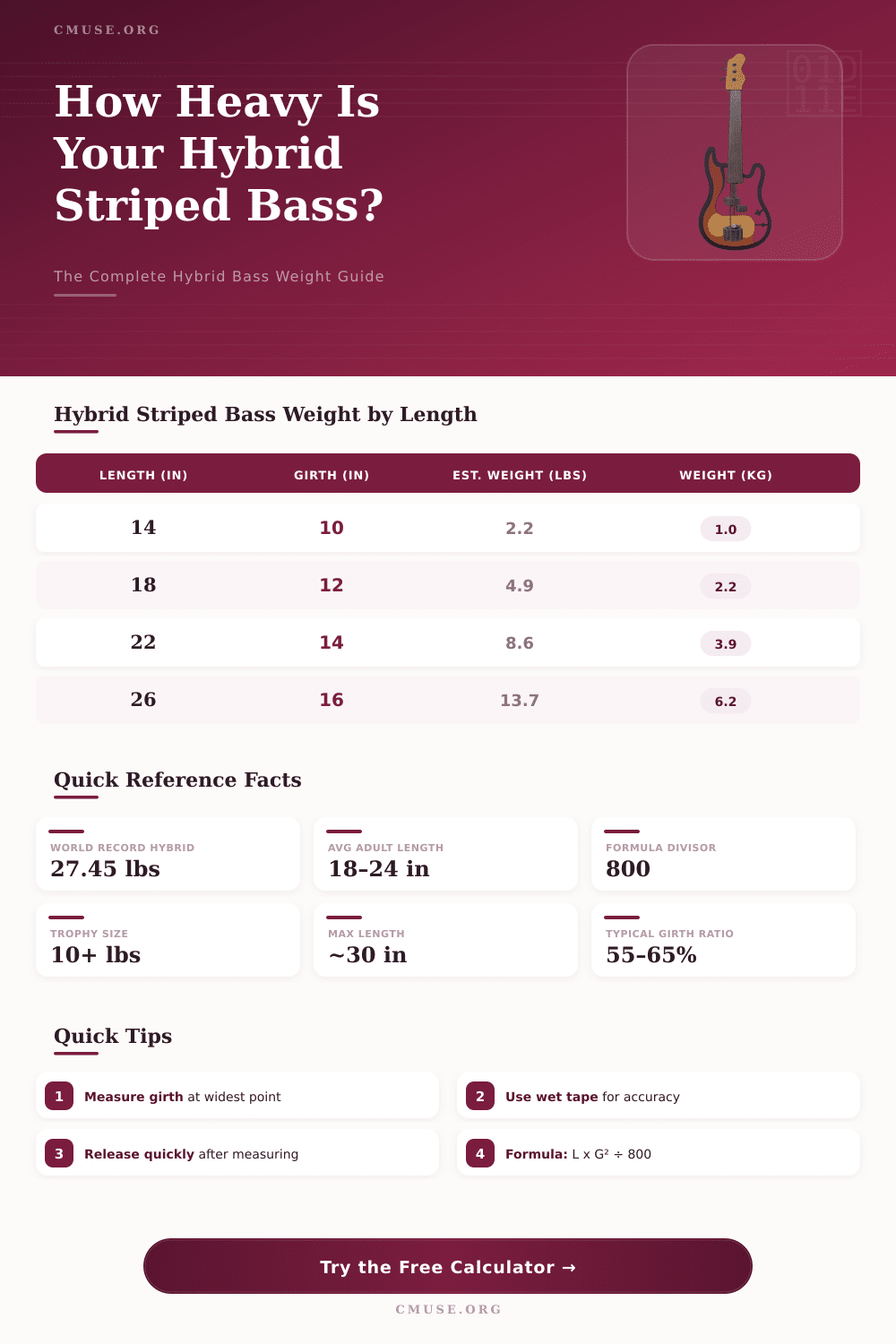
Estimated weights using the standard formula (Length x Girth² ÷ 800) at average girth-to-length ratio.
| Length (in) | Typical Girth (in) | Est. Weight (lbs) | Weight (kg) | Category |
|---|---|---|---|---|
| 12 | 8.5 | 1.1 | 0.5 | Juvenile |
| 14 | 9.5 | 1.6 | 0.7 | Keeper |
| 16 | 10.5 | 2.2 | 1.0 | Keeper |
| 18 | 11.5 | 3.0 | 1.4 | Good Fish |
| 20 | 13.0 | 4.2 | 1.9 | Good Fish |
| 22 | 14.0 | 5.4 | 2.4 | Nice Fish |
| 24 | 15.0 | 6.8 | 3.1 | Trophy Candidate |
| 26 | 16.0 | 8.5 | 3.9 | Trophy |
| 28 | 17.0 | 10.1 | 4.6 | Trophy |
| 30 | 18.5 | 12.9 | 5.8 | Wall Mount |
| Length (in) | Lean Girth (in) | Avg Girth (in) | Fat Girth (in) | Weight Range (lbs) |
|---|---|---|---|---|
| 16 | 9.5 | 10.5 | 11.5 | 1.8 – 2.7 |
| 18 | 10.5 | 11.5 | 12.5 | 2.5 – 3.5 |
| 20 | 11.5 | 13.0 | 14.0 | 3.4 – 4.9 |
| 22 | 12.5 | 14.0 | 15.5 | 4.3 – 6.6 |
| 24 | 13.5 | 15.0 | 16.5 | 5.5 – 8.1 |
| 26 | 14.5 | 16.0 | 17.5 | 7.0 – 10.4 |
| 28 | 15.5 | 17.0 | 18.5 | 8.6 – 12.8 |
| 30 | 16.5 | 18.5 | 20.0 | 10.5 – 15.0 |
| Length (cm) | Girth (cm) | Est. Weight (kg) | Weight (lbs) |
|---|---|---|---|
| 35 | 22 | 0.5 | 1.0 |
| 40 | 25 | 0.7 | 1.5 |
| 45 | 28 | 1.0 | 2.2 |
| 50 | 31 | 1.5 | 3.3 |
| 55 | 33 | 2.0 | 4.4 |
| 60 | 36 | 2.8 | 6.2 |
| 65 | 39 | 3.8 | 8.4 |
| 70 | 42 | 5.0 | 11.0 |
| 76 | 46 | 7.0 | 15.4 |
The weight of bass commonly comes up in conversations, whether you want to estimate the weight of largemouth bass or ask yourself, how heavy feels that electric bass guitar, hanging around your neck during whole night. Both topics appear quite commonly, so we look at what truly matters here.
When talking about fishing, there are some ways to estimate the weight of bass without using a heavy scale. The most used way applies a base formula: one takes the length, squares it later multiplies by the girth and divides the result by 1 200. One measures length and girth in inches, the girth is the broadest part of the fish, and gets the result in pounds.
How Heavy Are Bass Fish and Bass Guitars?
Usually the length is the whole length, from the tip of the mouth to the end of the tail fin.
Another option is to use a chart to convert length to weight, that gives an approximate number only based on the length of the fish. But here is the problem… Those are only rough guesses mostly.
Thick bass or female fish, that are loaded before spawning, can greatly beat the expectations of any chart, so one must add a bit to the number. There is also relative weight, that one counts by taking the real weight, dividing it by the standard weight and multiplying by 100. A healthy 22-inch bass reaches around 6.21 pounds, while a fat 20-inch largemouth bass can reach 7 pounds.
The confirmed world record for largemouth bass is 22.25 pounds, caught by George Perry in 1932 at Montgomery Lake near Valdosta in Georgia. Especially in northern regions, a 5- or 6-pound bass is called a big one. The physical mass becomes really notable, when won reaches 3 pounds.
Electric bass guitars are an entirely different topic, where weight affects the comfort during playing. A jazz bass or precision bass weighs on average between 8 and 9 pounds. The Hofner violin bass is on the more lightweight side of the range, with only a bit more than 5 pounds.
Rather, most traditional electric basses have weight between around 7 and 10 pounds.
Playing a heavy bass guitar night after night truly wears on the body. Around 8.5 pounds seems the most comfortable level for playing a whole show. If it reaches 9 pounds, your shoulders will start hurting after maybe 20 minutes.
An 11-pound bass can feel good, when one is young, but becomes more difficult with time. A wider strap, around 4 inches, does make a clear difference. More lightweight basses commonly sound more resonant, what is a pleasant bonus.
Outside the business, short-scale or hollow-body basses sometimes suffer from neck dive because of the weight of the body, what moves the balance to the headstock. Weight and playability gotogether, so finding a lightweight bass guitar, that feels good to play, deserves the research.