Horn Cutoff Frequency Calculator
Estimate horn cutoff from mouth size, throat area, length, flare constant, speed of sound, mouth loading, and wavelength for exponential, tractrix, conical, and folded horn layouts.
Presets
Horn Type Grid
Horn Geometry
Calculation Breakdown
Sensitivity Table
| Change | Cutoff | Mouth limit | Expansion | Read |
|---|
Horn Type Comparison
| Type | Cutoff basis | Practical knee | Strength | Caution |
|---|
Mouth And Wavelength Table
| Frequency | Wavelength | Quarter wave | Equivalent mouth diameter | Status |
|---|
Preset Reference Table
| Preset | Type | Mouth area | Throat | Length | Cutoff |
|---|
Two Practical Tips
All the pieces is in place: You’ve cut the wood, measured out the horn and checked the seams, but when you hit your driver, what’s that? It is a muffled thud rather then the tight sound of a bass note. Unfortunately, more times than not, the issue isn’t in the cabinet build. More often than not, it’s the science of flare (or lack thereof) that are at war with mouth size. A big looking horn doesn’t automatically create low frequencies. It creates low frequencies only when geometry matches the acoustic need for those particular wavelengths. Get math wrong, and you end up with a box with a hole in it. It is acousticaly disappointing and costly to remedy.
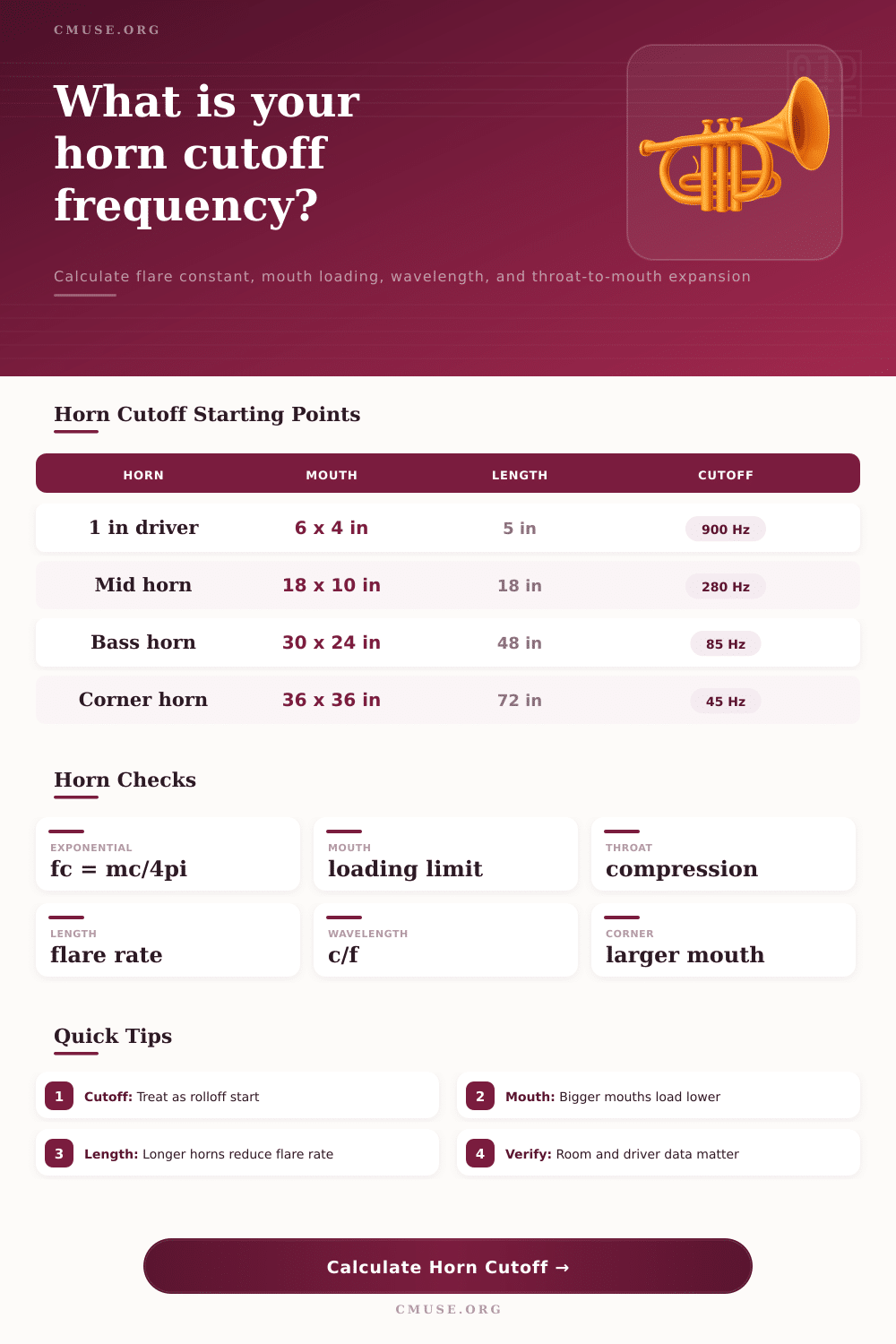
At some point, the horn cease being an efficient transformer and becomes more similar to just a simple pipe. This is its cutoff frequency. Below this frequency, impedance decreases (reducing load on driver) and the sound are weakened. In case of an exponential horn, the cutoff depends on two things: the speed of sound and the flare constant. The math get done for you in the calculator above, but knowing what each input represents will keep you from falling into certain traps.
Basic Horn Design Tips
Your throat needs to be the same size as the effective piston area of your driver so as not to cause any distortion before reaching the mouth of the horn. Too big, and you’ll sacrifice the high-frequency efficiency that originaly made the horn appealing. Most designs fail quietly at their mouths. They may have a perfect calculation for the exponential flare rate. However, the mouth is smaller then the lowest frequency you want to produce, so it unloads too early. This is distinct from the flare cutoff. They are two different concepts that the tool isolates with an independent mouth loading limit based off wavelength ratios.
As a starter point, a quarter-wave rule state that circumference of the mouth should be about half the wavelength of your desired low note. Because the boundaries of the corners act as acoustic mirrors, corner loading greatly alters this dynamic. Essentially it create a larger virtual mouth without needing any additional physical material in your enclosure.
The horn adds a new layer of complexity: folded horns. Straight line math only goes so far here. Bending it to save space introduces discontinuities (bends) in the centerline where reflections occurs and phase shifts happens that can throw off your desired smooth response. Acoustic length along the centerline is what the calculators rely upon for their estimates. That’s theoretically the right input. In practice, however, bends needs to be treated well to get the smooth response. Gradual turns and large radii help preserve the wave front. Sharp ninety-degree corners tend to scatter more. This increase the practical cutoff frequency above your calculated value.
You must consider that air isn’t static and temperature variation affects its density, affecting velocity, which affect each frequency response curve differently. So a horn designed for a warm club in the summer won’t sound the same outdoors when it’s cold. You can model this with the speed of sound adjustment and then adjust to match. This helps you get a better idea as to whether or not your design is robust in varying conditions.
There isn’t really an objective best answer for the profile (exponential, tractrix, or conical); it’s a matter of which compromise you want. Exponential horns are efficient, have a well-defined cutoff point, but if you don’t get your mouth size correct it may reflect back into the horn and color things. Tractrix designs tends to soften the mouth transition. You typically need a long physical path but it could of also let you get away with a lower practical knee compared to other types. Conical horns don’t have that hard flare cutoff like the others. Instead, their low end extension depend largely on total volume and the size of the mouth.
Finally, these numbers are simply guidelines. They’re a guide to the physics of the situation and don’t take into consideration the acoustical environment of your space or the quirks of your particular driver. Run the math and eliminate geometry options until you arrive at a design. Create a model. Hear it. Tweak things. You aren’t looking for a magic number on a sheet of paper. You are chasing a feeling. It is that instant where everything lines up cleanly and the sound come from your backside like a physical thing. This is what horns are all about in the first place, after all.