Cutoff Frequency of High Pass Filter Calculator
Calculate RC and RL high-pass cutoff frequency, required capacitor or inductor value, filter order slope, phase lead, tolerance spread, and practical audio crossover references.
🎛Named High-Pass Presets
⚙Filter Inputs
📊Live Filter Spec Cards
🔎Comparison and Spec Grid
RC Coupling High Pass
RL High Pass
Crossover Target
Synth and Studio HPF
📚High-Pass Formula Reference
| Filter type | Cutoff formula | Required component | Audio use |
|---|---|---|---|
| RC one-pole high pass | fc = 1 / (2 x pi x R x C) | C = 1 / (2 x pi x R x fc) | Coupling capacitor, line input, synth DC blocking, rumble trim |
| RL one-pole high pass | fc = R / (2 x pi x L) | L = R / (2 x pi x fc) | Shunt-inductor speaker networks and simple driver protection checks |
| Cascaded high-pass poles | Nominal pole fc per stage | Repeat or scale sections | Steeper rumble filters, active crossovers, DSP-modeled analog stages |
| Acoustic high-pass target | Electrical filter plus driver response | Measure final response | Tweeter and midrange protection where impedance and natural roll-off matter |
🧮Common Component Reference
| Scenario | Example R or load | Example C or L | Approx cutoff |
|---|---|---|---|
| Line input subsonic filter | 10 k ohms | 0.82 uF capacitor | About 19.4 Hz |
| Studio vocal rumble trim | 20 k ohms | 82 nF capacitor | About 97.1 Hz |
| Guitar pedal tightener | 47 k ohms | 33 nF capacitor | About 102.6 Hz |
| 8 ohm tweeter first-order start | 8 ohms | 6.8 uF capacitor | About 2.93 kHz |
| 8 ohm RL shunt high pass | 8 ohms | 0.51 mH inductor | About 2.50 kHz |
📐Slope, Phase, and Rolloff Table
| Order | Nominal slope below fc | Phase at fc | Typical audio meaning |
|---|---|---|---|
| 1st order | 6 dB/oct or 20 dB/dec | +45° lead | Gentle cleanup with modest low-frequency attenuation |
| 2nd order | 12 dB/oct or 40 dB/dec | About +90° total | Common active filter block and light driver protection |
| 3rd order | 18 dB/oct or 60 dB/dec | About +135° total | Sharper low-end removal with more crossover phase rotation |
| 4th order | 24 dB/oct or 80 dB/dec | About +180° total | Popular steep crossover or subsonic protection target |
| 6th order | 36 dB/oct or 120 dB/dec | About +270° total | Very steep protection or synthesis filtering |
🎼Named Preset and Use Reference
📋Preset Comparison Table
| Preset | Topology | Target range | Primary design caution |
|---|---|---|---|
| Vinyl Rumble 20 Hz RC | RC | Subsonic cleanup | Too high a cutoff reduces deep bass extension |
| Vocal Cleaner 90 Hz | RC | Voice low-end trim | Check male voices and proximity effect before committing |
| Guitar Tightener 120 Hz | RC | Pre-gain mud control | Pickup, cable, and input impedance all interact |
| Bass Cab Protect 45 Hz | RC | Excursion protection | Cabinet tuning and amplifier power change the safe point |
| Tweeter 3 kHz RC | RC | Speaker high-pass start | A real tweeter needs impedance and power checks |
| RL Shunt 2.5 kHz | RL | Passive network estimate | Inductor DCR and driver impedance shift the curve |
When you build a signal path for audio applications, you have to determine where the low end of the signal should begin. One way to determine where the low end of the signal should begin is to use a high-pass filter. A high-pass filter will allow all frequencies above the cutoff frequency to pass through the filter but will attenuate all frequencies below the cutoff frequency.
The cutoff frequency determines where the high-pass filter will attenuate the frequencies below it. A higher cutoff frequency will allow more frequencies below the cutoff frequency to pass through than a lower cutoff frequency. The cutoff frequency cant be too high or too low in the signal path.
How to pick and check a high-pass filter cutoff
If the cutoff frequency is too high, the signal will lose warmth and body. However, if the cutoff frequency is too low, rumble, DC offset, and excursion can enter the signal path into the audio circuitry. To calculate the corner frequency of a high-pass filter, you must enter three value into the calculator: resistance, capacitance, and inductance.
The calculator will then provide the mathematical result for you. You must also enter the target frequency into the calculator. Each of the values represent a different parameter of the circuit.
For example, the resistance parameter is the load that the capacitor will see in the circuit. This load can be an input stage, a speaker voice coil, or a bias network. The capacitance value will determine how much reactance is present in the circuit at a specific frequency.
The capacitance value will produce different cutoff frequencies if it faces a 10 k ohm line input than if it faces an 8 ohm tweeter. Inductance perform the same function in RL topologies. For RL topologies, the inductor is in shunt with the load component, and the resistance will determine the corner frequency of that RL topology.
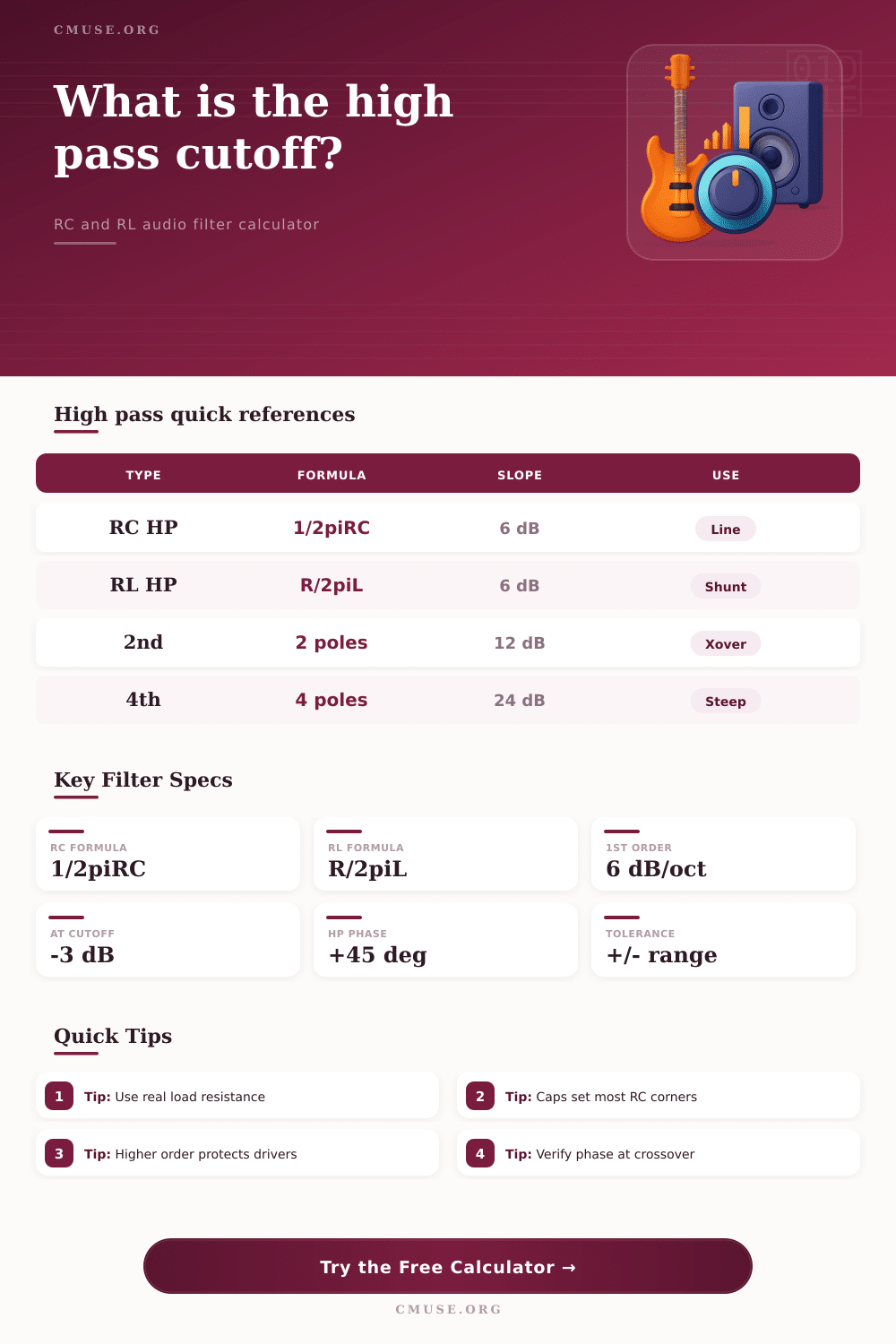
The order of the filter roll-off will change the shape of the filter, but the order will not change the corner frequency of the high-pass filter. For example, a first order filter will provide a six-decibel-per-octave roll-off but will also produce a forty-five-degree phase shift. Two first order filters will roll off at twelve decibels per octave but will produce a phase shift of ninety degrees.
Four poles will roll off at twenty-four decibels per octave. A twenty-four decibel-per-octave roll-off is common in active crossovers and subsonic protection. The phase lead that the calculator projects at your selected frequency will allow you to determine any phase summing issue that may occur with your audio circuitry.
Additionally, real loads will not always match the values that you calculate for these circuits. The load that an audio circuitry component presents may change with frequency. For example, an eight-ohm driver can measure six ohms at two kilohertz but twelve ohms at resonance.
Because the measurement of the driver changes, the acoustic corner will also change even if the electrical calculation remains the same. The impedance of the source is another variable that must also be considered; if the output resistance of the stage driving the capacitor is significant, the resistance presented to the capacitor will increase. With an increased resistance, the corner frequency will shift upward on the frequency spectrum.
The tolerance field tells you how much the components can drift from their calculated values, which can inform your choice between a five-percent capacitor and a twenty-percent capacitor. The phase of the signal is another factor that can generaly be ignored when designing a filter. However, if the signal passes through another filter after the high-pass filter, the phase of the signal becomes a factor in the sound of the system.
The high-pass filter lead in phase relative to the other filters in the system. In a two-way speaker system, you must account for the phase lead of the high-pass filter, which can be done by adjusting the low-pass filter’s slope or by reversing the polarity of one speaker driver. The phase rotation of a signal can also impact the operation of a microphone preamp, especially in regard to the processing of the low-frequency content from a musical instrument like a kick drum or vocal plosives.
A twelve-decibel filter will attenuate the low-frequency sound without thinning the transient; however, a twenty-four-decibel filter can thin the attack of the low-frequency sound if the cutoff frequency is too close to the musical content. The calculated corner frequency is a figure that many people treat as if it is the corner frequency that will exist in the acoustic world. This is true for the electrical filter, but there are other factors that will add a high-pass component to the sound of the system.
These include the resonance of the speaker driver and the gain of the listening room. To determine the true corner frequency of the system, you must measure the finished system with the filter engaged. This is the only way to determine whether the calculated corner frequency is accurate.
While the filter calculator will give you an idea of what the performance of the filter should be, it is up to you and your ears to decide whether the displayed number is accurate or needs to be adjusted. First, you need to decide what problem the filter will solve. For use in a synth patch, an eight-hertz corner frequency with a single pole is sufficient.
However, if the goal is to protect a compression driver from moving beneath 1500 hertz, then you must consider the alignment of the drivers and the impedance of the speakers at various frequencies. Once you have decided the other variables, these remaining variables will settle into place. The cutoff frequency is the boundary that one establishes for the signal to pass through to the next section of the signal path without fighting against the low-frequency sound emanating from the speaker.
You should of considered the room acoustics too. Its important to remember that the corner frequency can be different than what you calculated. If you want to recieve the best result, you should check the speakers length and placement.
The furnitures in the room might change teh result. Youll need to listen carefuly to see if the signal path works.