Hemiola Cycle Calculator
Calculate how a hemiola or cross-rhythm resolves across pulses, beats, bars, and phrases, then view the accent map that shows where each layer lands.
Choose a practical rhythm situation, then adjust the accent groups, subdivision grid, meter, tempo, phrase length, and feel. The calculator treats the smallest repeated subdivision as the counting pulse.
Calculation Breakdown
The map marks one full cycle. X means both layers accent together, A means only layer A accents, B means only layer B accents, and dots are silent grid pulses.
| Pulse | Beat Position | Accent | Timing | Practice Count |
|---|---|---|---|---|
| 1 | Beat 1 | Both | 0.00 s | Count one cycle |
| Cross Ratio | Cycle Pulses | Common Feel | Use Case |
|---|---|---|---|
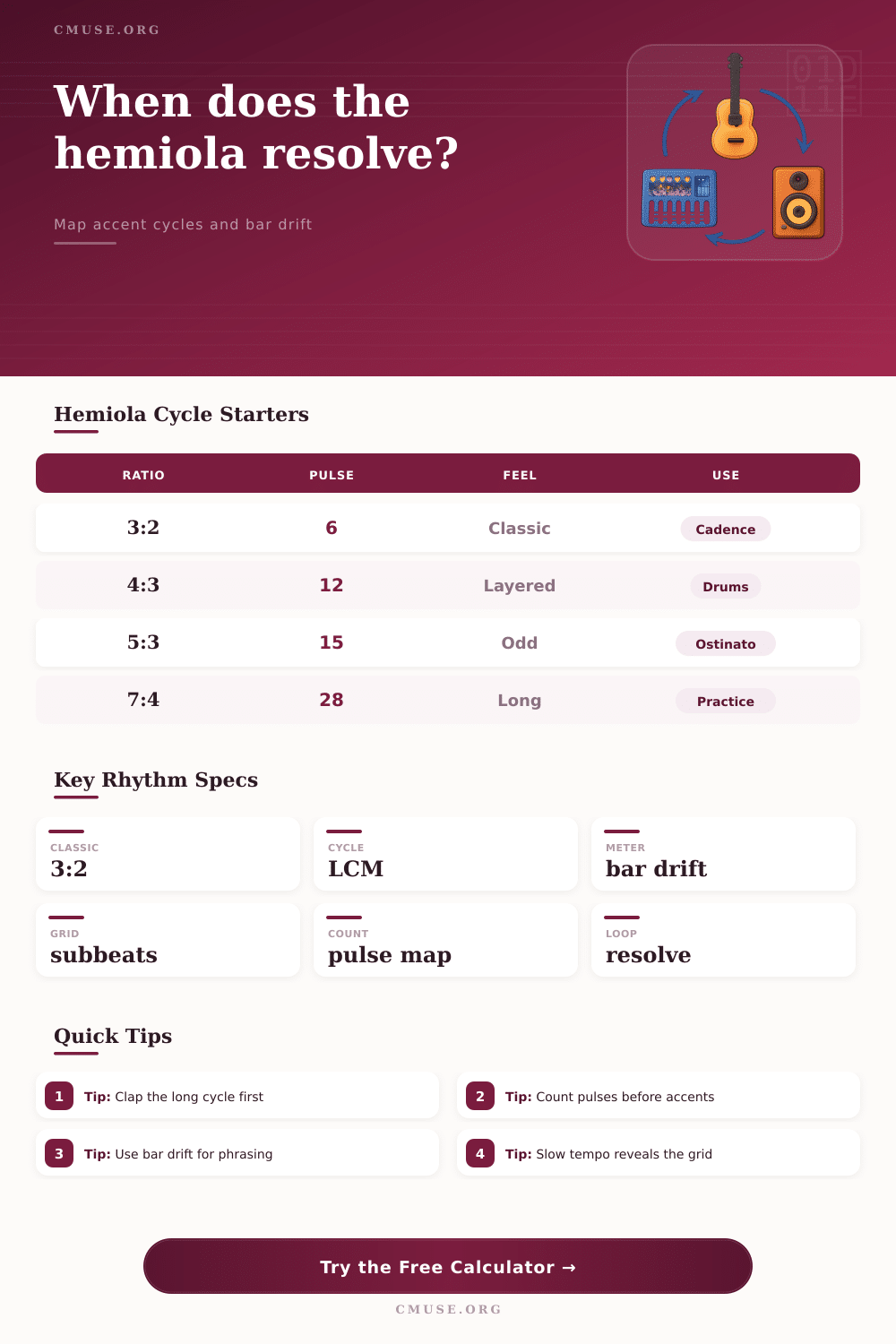
| 3:2 | 6 pulses | Classic hemiola | Cadences, dance meters, choir stress shifts. |
| 4:3 | 12 pulses | Square against triplet | Drum fills, piano ostinatos, layered synth patterns. |
| 5:3 | 15 pulses | Odd-meter shimmer | Film ostinatos, contemporary ensemble grooves. |
| 7:4 | 28 pulses | Long practice loop | Advanced metronome work and extended phrasing. |
| 5:4 | 20 pulses | Even pulse tension | Minimalist keyboard, marimba, and sequencer figures. |
| Tempo | Beat Length | 6-Pulse 3:2 | 12-Pulse 4:3 | Practice Note |
|---|---|---|---|---|
| 60 BPM | 1.000 s | 3.00 s at 2 subdiv | 6.00 s at 2 subdiv | Best for first clapping work. |
| 72 BPM | 0.833 s | 2.50 s at 2 subdiv | 5.00 s at 2 subdiv | Good slow ensemble tempo. |
| 96 BPM | 0.625 s | 1.88 s at 2 subdiv | 3.75 s at 2 subdiv | Common moderate practice zone. |
| 120 BPM | 0.500 s | 1.50 s at 2 subdiv | 3.00 s at 2 subdiv | Stable before performance speed. |
| 144 BPM | 0.417 s | 1.25 s at 2 subdiv | 2.50 s at 2 subdiv | Use only after accents are even. |
| Meter | Best Grid | Typical Hemiola | Bar Result |
|---|---|---|---|
| 3/4 | 2 pulses per beat | 3 groups of 2 vs 2 groups of 3 | Resolves in one bar when using 6 pulses. |
| 6/8 | 3 or 2 pulses per beat | 2 dotted beats vs 3 straight beats | Classic compound-to-simple stress shift. |
| 4/4 | 3 pulses per beat | 4 groups of 3 vs 3 groups of 4 | Resolves in one bar on 12-pulse grids. |
| 12/8 | 3 pulses per beat | 4 dotted beats vs 6 duple accents | Can resolve every bar or every half bar. |
| 5/4 | 2 or 3 pulses per beat | 5:3 or 5:4 overlays | Longer cycles create phrase-level drift. |
| Practice Context | Input Pattern | Primary Result | Secondary Result |
|---|---|---|---|
| Choir cadence | 3:2 in 3/4 | 6-pulse cycle | One-bar resolution. |
| Drum independence | 4:3 in 4/4 | 12-pulse cycle | Four triplet beats. |
| Guitar 12/8 riff | 3:2 in compound meter | 6-pulse cell | Two cells per bar. |
| Odd ostinato | 5:3 over 4/4 | 15-pulse cycle | Drifts against bars. |
| Advanced metronome | 7:4 at 80 BPM | 28-pulse cycle | Long-form placement test. |
Maybe you have seen a choir conductor waving their arms to get everyone in rhythm, only to have group fall apart when bass section locks onto two beats while you count three. Your hands clap along one grid while your feet tap to another. It is physically uncomfortabel until the layers thud back into alignment. The thud is the resolution; the calculator up there will run the maths for you so you don’t have to work it out between bar of silence.
Often defined as three against two, this only touches on what’s occurring beneath the notes. Hemiola is actualy a battle between two distinct patterns of accents, both riding on top of same pulse grid. One groups time in twos, and the other group time in threes. They’re both counting different divisions of the same beat. So not only do their accents coincide initially, but then they begin to diverge until eventually they come back together again.
What Is Hemiola?
How long you’ll need to hold your breath before you get some relief depend on length of cycle. If it’s a simple ratio such as three over two, then there will be only six pulses before it resolve again. But when you layer something more complex like seven against four or five against four, the cycle stretch out a lot. This creates a longer tension curve that makes a passage feel urgent and unresolved for much long than expected.
Showing this cycle clearly helps you understand how bar displacements happen when your cross-rhythm does not line up exactly with written meter. In this case, the bar lines will be given different emphasis from one measure to the next. This results in a feeling of drift in odd-meter music that make it so compelling to listen to.
If you don’t work out the exact amount of phase shift, then you could of be practicing something that sounds right ‘in the moment’ but doesn’t quite match up with ensemble later in the phrase. The tool shows this drift and allows you to check if your pattern resolves neatly at the close of your two bar phrase or hangs limply off the beat. Knowing this can save rehearsal time because it show if there is a mismatch in the larger musical structure you are working on.
Most people don’t think about this until they hear it, but the inputs make all the difference, and getting the subdivision grid right means the mathematical model will mirror what’s happening inside your head when you’re counting. Notating a song in dotted quarter notes but playing it with the feel of a groove on the eighth note level, for example, is going to show a completely different pattern in terms of accent map, and messing around with the parameters allows you to “see” precisely where the stress points falls out on a tangible timeline, not just some abstract number game.
It makes something so intangible like rhythm into a concrete set of events that you know you can practice consciously. You can see which notes are double-accented and which is gaps in between. Note how tempo affects perception. A fast hemiola can also easily merge back into one sound if the accents happen to quickly for the ear to identify the separate beats. As you slow this down, the underlying grid becomes apparent making it easier to isolate each layer separately then combine them.
This is where many players stumble with cross-rhythms: not through lack of coordination but rushing the counting process in their head. Slow it down. Break it into small parts that are easy to manage. Check your math to make sure timing is right. From here you create a solid mental map of the phrase.
In conclusion, practicing hemiola is an exercise in both accuracy and timing. It is about knowing that discomfort will be brief and that if you have done the math correctly, there is no reason not to resolve the feeling. The mismatching of the accented beats creates the tension. However, the way these distinct currents comes together into one smooth flow is what makes it beautiful. Hold your breath, have faith in the measured cycle, and allow the music to naturaly resolve itself according to its own time.