Helmholtz Frequency Calculator
Estimate the resonant pitch of bottles, ports, sound holes, and acoustic cavities from volume, neck geometry, air temperature, and end correction.
🎼 Resonator Presets
⚙ Resonator Inputs
Frequency uses f = c / (2 pi) times the square root of neck area divided by cavity volume times effective neck length. Temperature changes the speed of sound, while end correction adds acoustic length at the neck openings.
📊 Live Resonator Spec Grid
📐 End Correction Reference
| Opening Model | Length Added | Typical Use | Pitch Effect |
|---|---|---|---|
| No correction | 0 radius | Ideal math only | Highest result |
| Two free openings | 1.22 radius | Loose tube in air | Moderate lowering |
| One flanged, one free | 1.46 radius | Bottle neck, sound hole | Lower than free tube |
| Two flanged openings | 1.70 radius | Thick panel or duct | Lowest of these |
🎚 Common Helmholtz Resonator Ranges
| Resonator | Typical Volume | Neck Scale | Useful Range |
|---|---|---|---|
| Small bottle | 0.25 to 0.50 L | 1.6 to 2.4 cm | 160 to 300 Hz |
| Large bottle | 0.70 to 1.50 L | 2.0 to 3.0 cm | 90 to 170 Hz |
| Ocarina body | 0.10 to 0.30 L | 0.8 to 1.8 cm | 400 to 1000 Hz |
| Bass reflex box | 10 to 80 L | 4.0 to 10 cm | 25 to 80 Hz |
🎹 Musical Frequency Reference
| Note | Frequency | Octave Relation | Resonator Context |
|---|---|---|---|
| C2 | 65.41 Hz | Two octaves below C4 | Large ported boxes |
| A2 | 110.00 Hz | One octave below A3 | Cajon and large bottles |
| C4 | 261.63 Hz | Middle C | Small bottles |
| A4 | 440.00 Hz | Concert reference | Small chambers |
🔍 Geometry Comparison Grid
| Change | Formula Term | Frequency Move | Best Tuning Use |
|---|---|---|---|
| Double cavity volume | V increases | Frequency drops by about 29% | Lower a resonator broadly |
| Double port area | A increases | Frequency rises by about 41% | Lift pitch without shortening port |
| Double effective length | L increases | Frequency drops by about 29% | Fine tune downward |
| Add matching port | Total A increases | Frequency rises by square root | Raise tuning while sharing airflow |
📌 Practical Calculation Notes
A Helmholtz resonator is an object that will emit a specific frequency of sound when air move in and out of one of its openings. Helmholtz resonators can be seen in objects like empty bottle when they are blown across, ocarinas, subwoofer boxes, and guitars. The physics of the Helmholtz resonator is the same for each of these objects, but the pitch of the object will change based off the volume of the object, the length of the neck of the object, the width of the neck of the object, and the temperature of the air within the object.
The pitch that a Helmholtz resonator object emits follow a specific mathematical equation, which allows for the calculation of the frequency that that object will emit. The frequency of a Helmholtz resonator is created by the relationship of the air that is within the resonator to the air that is within the neck of the object. If the volume of the object is increased, the air within that cavity will have an increased mass to push against, creating a lower pitch from that object.
How a Helmholtz Resonator Makes Sound and How to Find Its Pitch
Similarly, if the width of the neck opening or length of the neck is increased, air will be able to move more freely in and out of the object, resulting in a higher pitch. Finally, if the temperature of the air within the object is increased, the sound will travel at a faster rate through that object, increasing the pitch of that object by a few hertz for every degree in the Celsius scale. These factors make it difficult to intuit the frequency that will be created by the object.
Thus, a calculation is required to determine the frequency of the object. The calculator that is presented on this webpage allow for the performance of these calculations. The parameters of the calculator are: the volume of the cavity of the object, the diameter and length of the neck of the object, the number of ports within the object, the temperature of the air within the object, and the type of end correction for the object.
The volume of the cavity can be entered as a direct measurement of that object, or a user can enter the dimensions of the object as a user interface field. The diameter and length of the neck of the object are similarly entered as direct measurements. The number of ports is the number of openings in the object.
The temperature of the air is to be entered in either the Celsius or Fahrenheit scale. Finally, end correction is applied to account for the fact that air within the object behaves as if the length of the neck is longer than the physical length of that neck. An end correction factor will be applied to either the radius of the neck (if the end correction factor is determined from the radius), or the end correction factor will adjust the length.
An adjustment to the end correction will shift the frequency by 10 or 15% of the calculated frequency. Thus, adjustments to the end correction will impact the accuracy with which the frequency is calculated. When the user enters the parameters of the object, the calculator will provide information regarding the resonant frequency of that object, the musical note that will be played when the object is blown across, and the deviation of that frequency from 12-tone equal temperament in a unit of cents.
Thus, the calculator can inform the user of whether the object will create the desired frequency. Additionally, the calculator will also provide information regarding the effective length of the neck of the object after end correction, which can also be used to determine whether adjustments to the length of the neck should be made to that object. Finally, if the user enters the target frequency that the object should produce, the calculator will provide information regarding the cent error of the object from that target frequency and the length of the neck that should be produced to achieve that target frequency.
Thus, an understanding of the calculated frequency will allow the user to determine if any adjustments to the object should be made. In the real world, few objects will behave according to the ideal conditions within the formula for calculating the pitch of a Helmholtz resonator. For instance, the walls of many resonator objects will absorb some of the sound that is created by that object, lowering the pitch that is created by that object.
Additionally, the ideal calculation assumes that the walls of the object are rigid and that there are no leaks in that object. Thus, the calculation of the resonant frequency of any object will provide an ideal frequency that differs from the actual frequency of that object. Consequently, the object’s creator will need to adjust the calculated frequency to account for the difference between the two frequencies.
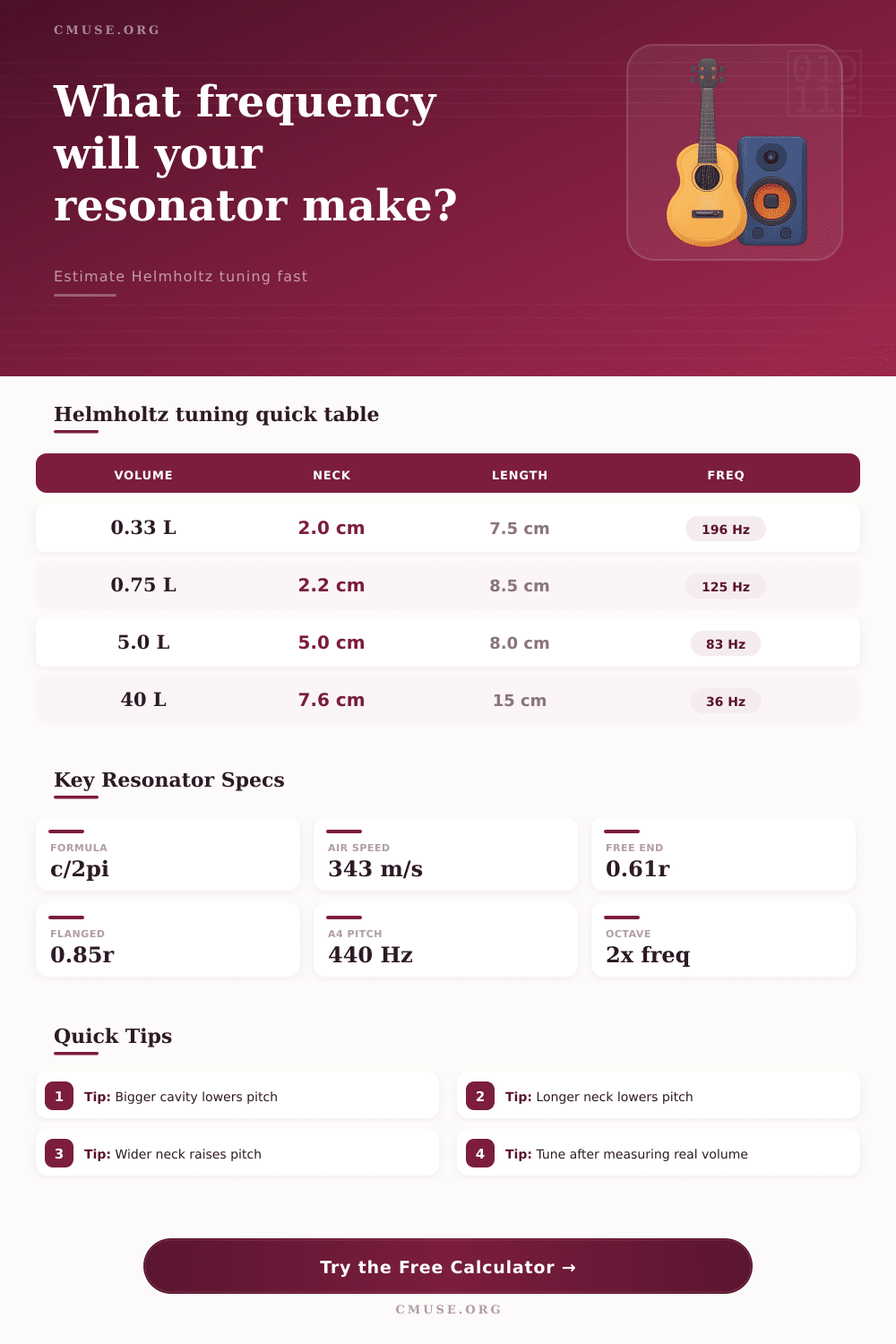
The resonant frequency of a Helmholtz resonator can apply to objects of all sizes. For instance, a bottle with a volume of 330 ml and with a short neck may have a resonant frequency of 200 hz, while a subwoofer enclosure of 40 liters with a long neck may have a frequency of 35 hz. Thus, the formula for calculating the frequency of a Helmholtz resonator will always apply to those objects of different sizes.
An instrument maker that is creating an ocarina can use this formula, or an audio engineer that is creating a subwoofer box can use it. In each of these examples, the engineer will need to enter the volume of the objects interior, not its exterior dimensions. As mentioned above, most resonators will not exhibit the ideal conditions for calculating the pitch.
Thus, the calculated pitch may shift if the object shifts in temperature. For instance, if an object is tuned to a specific pitch in a warm room, that object may produce a different pitch when it is moved to a cold environment. Thus, the change in pitch is a result of the change in the speed of sound through the object due to the change in the temperature of the air.
Thus, the calculator can be used to calculate the shift in pitch that is created by the change in temperature, allowing the object to be reassessed for any necessary adjustments. Such a shift is important to calculate for musical ensembles in which precision in pitch is required. The calculated resonant frequency is accurate if the user enters the correct parameters of the object.
After entering those parameters, though, some physical work will be performed on the object until the pitch that is created by the object begins to match the calculated frequency of that object. The calculation of the frequency and the adjustment of the object to allow for the matched frequency are steps that may be performed regardless of the size of the object that is to be created. Thus, each object that is created can be adjusted according to the understanding of how each parameter impacts the resulting frequency of that object.
Understanding the relationship between the parameters of a Helmholtz resonator and the resulting frequency of that resonator allows the creator of that object to make adjustments to that object to ensure that it creates the desired frequency.