Hearing Damage Time Calculator
Estimate recommended exposure time, dose percent, effective protected level, and recovery margin for rehearsals, shows, headphone sessions, and loud audio work.
Start with a common listening or production scenario, then edit the measured average dBA, duration, breaks, and protection settings. Results are planning estimates, not a medical diagnosis.
NIOSH dBA for 8 hr
NIOSH exchange rate
OSHA PEL dBA for 8 hr
Full daily dose marker
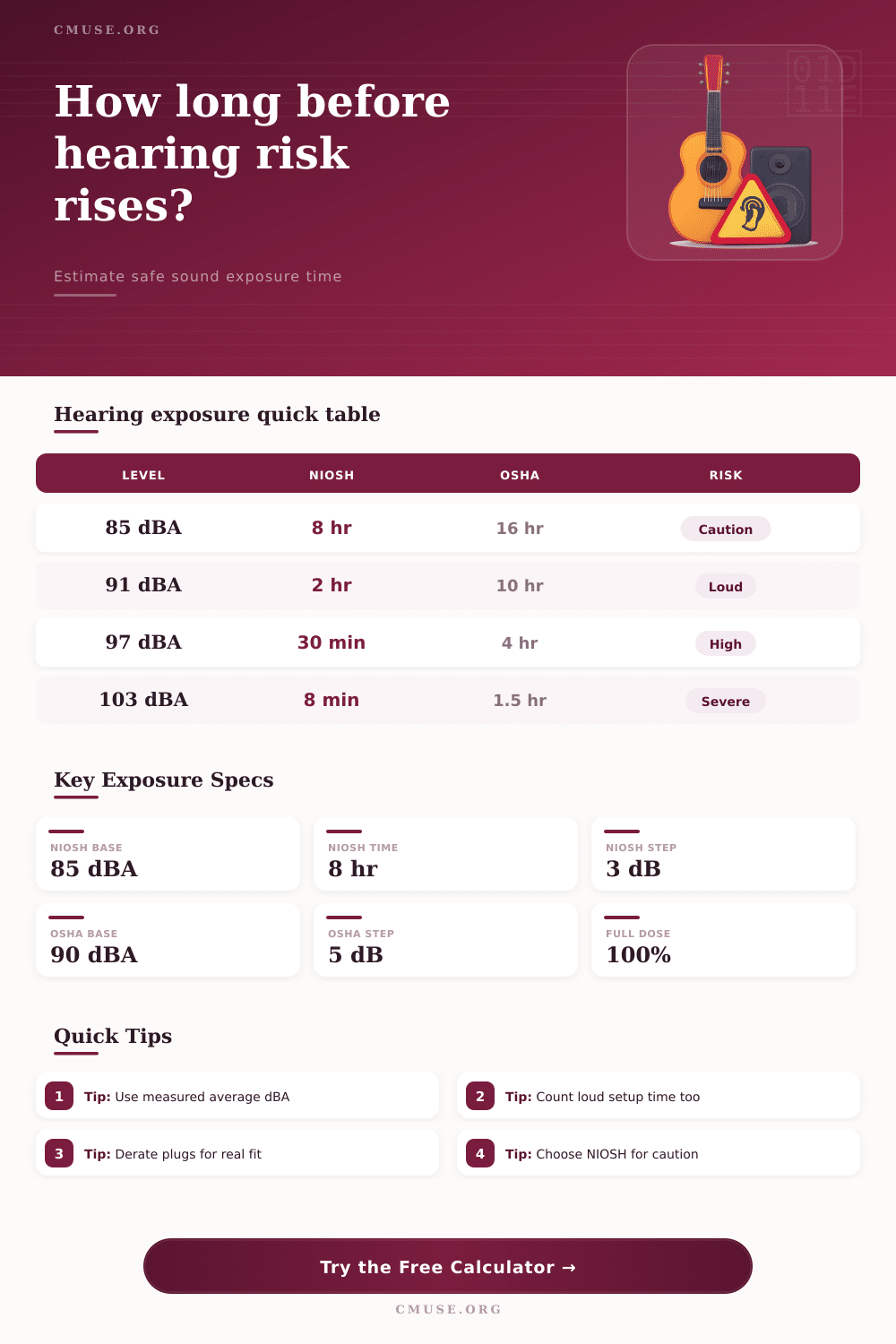
| Average Level | Recommended Time | Daily Dose in 1 Hour | Typical Music Context |
|---|---|---|---|
| 82 dBA | 16 hours | 6% | Moderate control room |
| 85 dBA | 8 hours | 13% | Long rehearsal floor |
| 91 dBA | 2 hours | 50% | Loud ensemble room |
| 97 dBA | 30 minutes | 200% | Drums or small venue |
| 103 dBA | 8 minutes | 800% | Club or stage edge |
| Rule | Criterion | Exchange | Planning Use |
|---|---|---|---|
| NIOSH REL | 85 dBA for 8 hr | 3 dB | More protective for repeated listening |
| OSHA PEL | 90 dBA for 8 hr | 5 dB | Workplace compliance reference |
| Custom | User selected | User selected | Match a policy, venue rule, or study method |
| Protected | Effective dBA | Selected rule | Applies derated attenuation before dose |
| Scenario | Typical Average | NIOSH Time | Control Lever |
|---|---|---|---|
| Critical editing | 72 to 80 dBA | All day range | Keep monitor level steady |
| Choir or acoustic group | 84 to 90 dBA | 10 hr to 2.5 hr | Rotate positions when possible |
| Drum rehearsal | 96 to 104 dBA | 38 min to 6 min | Use plugs and distance |
| DJ booth or club | 98 to 106 dBA | 24 min to 4 min | Lower booth monitors first |
| Festival workday | 88 to 100 dBA | 4 hr to 15 min | Split loud zones into segments |
| Listed NRR | 50% Field Estimate | At 100 dBA | Practical Note |
|---|---|---|---|
| 9 dB musician plug | 1 dB after -7 | 99 dBA | Flat sound, modest reduction |
| 15 dB musician plug | 4 dB after -7 | 96 dBA | Useful for rehearsal blocks |
| 25 dB foam plug | 9 dB after -7 | 91 dBA | Needs careful insertion |
| 31 dB foam plug | 12 dB after -7 | 88 dBA | Strong fit-dependent option |
This calculator estimates exposure from standard noise-dose formulas. Sudden pain, ringing, muffled hearing, or one-sided changes should be handled by a qualified hearing professional.
Hearing loss are a process that occurs gradualy. Hearing loss often occurs as a result of exposure to loud sounds over a long period of time. Hearing loss may not be immediately obvious to the individual who experience it, but over time, hearing loss can result in the inability of those individuals to hear certain high frequency within certain sounds.
Despite the fact that many individuals believe that hearing loss is a normal part of the career that they have within their careers, hearing loss is actualy a preventable issue for those individuals who take steps to manage their sound exposure in their careers. One of the factor that must be measured in relation to sound exposure is the level of sound that those individuals’ environments create, as well as the length of time that those individuals are exposed to those loud sounds. Each of these factors must be accounted for in the creation of a calculator that will determine the safety of an individual’s exposure to loud sounds.
How to Use a Hearing Protection Calculator
Each of the inputs that are required to utilize this calculator include the average sound level that is to be measured, the length of time that the individual will be exposed to those loud sounds, the number of quiet break that the individual will take during those sound exposures, and the amount of hearing protection that the individual will use during those sound exposures. In order to calculate the allowable time for sound exposure, there are different rules that can be applied. For example, one rule is that each three decibel increase in sound level will halve the allowable time for exposure to that loud sound.
An alternative rule is that each five decibel increase in sound level will halve the allowable time for sound exposure. Each of these rules may be applied according to the level of sound exposure that the individual can stand over time, and the use of one of these rules will permit the hearing exposure calculator to determine allowable time to expose individuals to loud sounds within their careers. The consistency of the sound levels that are exposed to individuals over time can be compared using these rules and parameters.
Another variable in the hearing protection calculator is the variable of the performance of the hearing protection. Hearing protection will not necessarily perform at the level that is represented for the package of hearing protection. For instance, the number represented for the package of hearing protection is representative of how loud sounds will be heard in a laboratory for individuals who wear those hearing protection device.
However, hearing protection may not perform to the same extent in the ear of the individual with the hearing protection devices. Therefore, adjustment to the hearing protection devices need to be made in order to account for the possibility of underperformance of those devices. Small adjustments to the hearing protection devices will alter the sound level calculations that the calculator performs.
Quiet breaks are different than hearing protection devices. Quiet breaks will not reduce the sound levels that are created in the workplace, but will reduce the length of time that the individual is exposed to those loud sounds. Therefore, quiet breaks need to be accounted for in the calculator in order to permit individuals to spend more time exposed to loud sound levels while taking quiet breaks to rest their hearing.
Finally, the hearing protection calculator should account for weekly pattern in sound exposure. Each individual may experience loud sounds or noise exposure for several days in a row. Therefore, each individual should be able to view the weekly dose for loud sounds exposure to ensure that the individual’s sound exposure schedule is sustainable week after week.
The calculator will display the weekly dose in the hearing protection devices to provide individuals with this information. In addition to the factors mentioned above, the sound level that is to be exposed will not necessarily be a fixed level. Each individual can adjust the sound levels that are created in their work environment.
For instance, each individual can lower the sound levels of computer monitors, subwoofers, or adjust the distance at which they stand from the source of the loud sounds. These adjustments will be reflected in the sound exposure calculator for each individual once they enter the new average sound level of the environment with the loud sounds. Each individual must make a decision to adjust the sound level if the individual’s sound exposure plan is to be too tight with the allowable amount of time for exposure.
Finally, the last factor in the hearing protection device calculations is the amount of time that the individual will take to recover from loud sound exposure. This recovery time is the length of time between loud sound exposures. While the hearing protection calculator will not measure the amount of time it takes for hearing to recover from loud sounds, the calculation of the amount of time that remains between sound exposures will alert individuals if additional days of loud sound exposures should of been added to their schedule for the week.