Headstock String Angle Calculator
Estimate break angle behind the nut, string tension, downward nut load, slot friction, and the extra tuner-post drop needed for a cleaner headstock string path.
Pick a common instrument and string path, then adjust the measured nut-to-post run and vertical drop. Each preset fills a realistic single-string case rather than averaging the whole headstock.
Calculation Breakdown
Break angle
Angle = atan((drop + wrap lowering) / nut-to-post run). This is the string bend directly behind the nut.
String tension
Tension = unit weight x (2 x scale x frequency)^2 / 386.4. Gauge and construction set the unit weight estimate.
Nut downforce
Downforce = tension x sin(angle). Paired courses multiply the result after calculating one string.
Slot drag
Estimated drag = downforce x friction coefficient. High drag predicts tuning jumps when the string releases.
Medium
Angle zone
0 lb
Slot drag
0 lb
Bearing force
0 deg
Post wrap turn
| Angle Range | Nut Load Behavior | Tuning Risk | Typical Action |
|---|---|---|---|
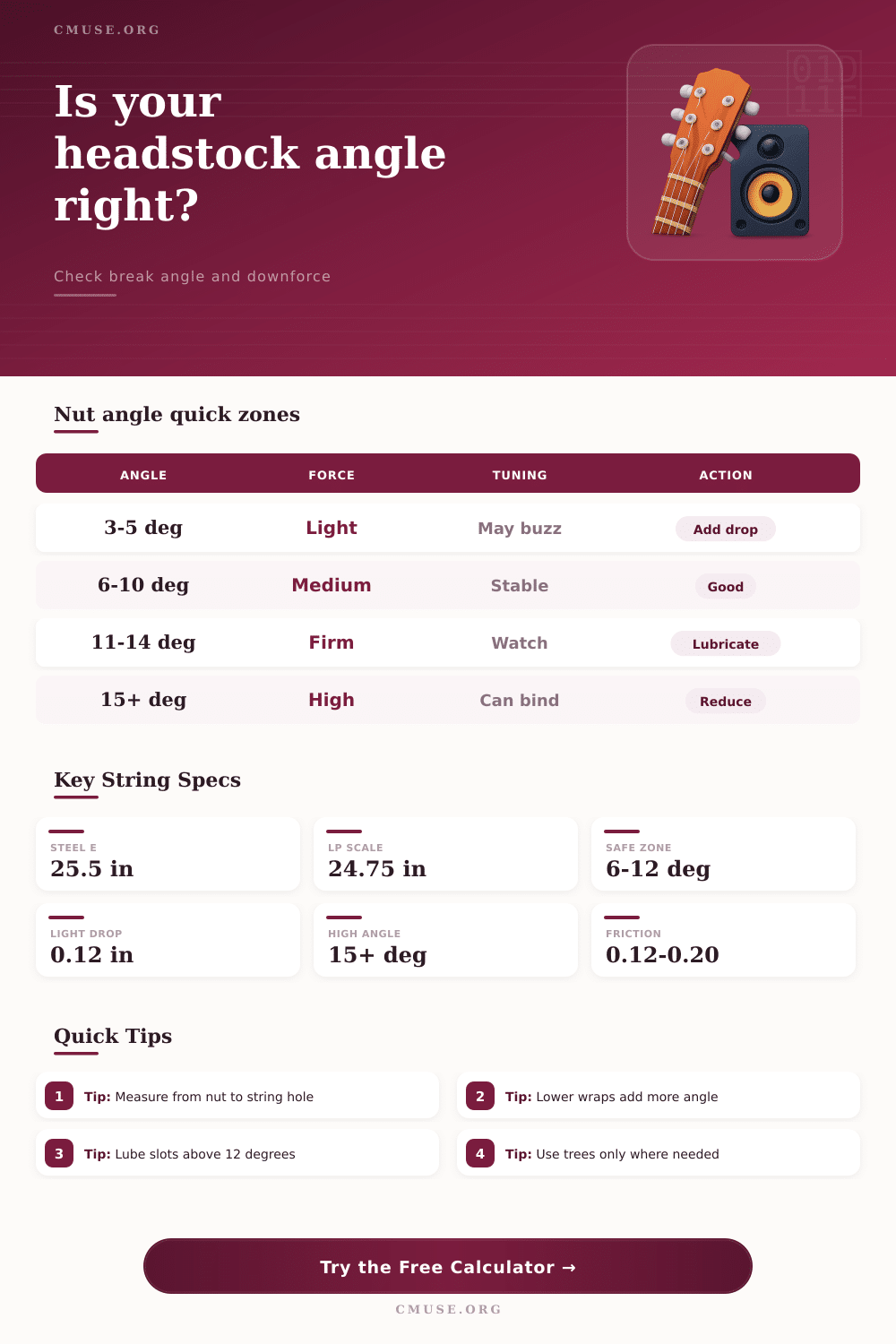
| 3 to 5 deg | Very light downforce; open strings may chatter in low slots. | Low friction, but possible sitar buzz or weak witness point. | Add lower wraps, a string tree, or a lower post only where needed. |
| 6 to 10 deg | Balanced pressure for most electric and acoustic nut slots. | Usually stable if the slot is smooth and correctly sized. | Good default zone for plain steel, wound guitar, and many bass strings. |
| 11 to 14 deg | Firm seating at the nut with noticeably higher slot loading. | Watch for pinging, sharp return, or slow tremolo recovery. | Polish and lubricate the slot; avoid excessive wrap stacking. |
| 15 deg and up | High localized pressure, especially on wound strings and angled headstocks. | Higher chance of binding, premature nut wear, or unstable bends. | Reduce drop, reshape string path, or improve slot geometry. |
| Instrument Path | Scale | Common Run | Useful Angle |
|---|---|---|---|
| Straight electric high E without tree | 25.5 in / 648 mm | 1.5 to 2.3 in | 5 to 9 deg with staggered posts or low wraps |
| Electric B or E with string tree | 25.5 in / 648 mm | 0.7 to 1.3 in to tree | 7 to 13 deg depending on tree height |
| Angled 3+3 electric headstock | 24.75 in / 629 mm | 1.0 to 2.2 in | 10 to 17 deg, often limited by nut friction |
| Steel-string acoustic wound bass | 24.9 to 25.5 in | 1.4 to 2.6 in | 8 to 15 deg with moderate wraps |
| Classical slot-head treble | 650 mm / 25.6 in | 1.1 to 2.0 in | 5 to 11 deg with lower tie-block tension |
| Bass A or D string path | 34 in / 864 mm | 2.0 to 4.8 in | 4 to 9 deg, often helped by tapered posts |
| Construction | Model Use | Unit Weight Assumption | Downforce Note |
|---|---|---|---|
| Plain steel | Electric and acoustic plain strings | Solid steel cylinder at 0.283 lb/in3 | Small gauge means angle changes are often more audible than force changes. |
| Nickel wound guitar | Electric wound strings | Steel density with open-wrap fill factor | Wound surface can increase friction when the slot is too narrow. |
| Phosphor bronze wound | Steel-string acoustic wound strings | Bronze-weighted fill factor | Higher tension and rough wrap texture need a clean witness point. |
| Nylon treble | Classical trebles | Nylon density near 0.041 lb/in3 | Lower tension often accepts a slightly higher angle without binding. |
| Bass roundwound | Electric bass strings | Large gauge with lower effective fill | Long runs reduce angle quickly; tapered posts can be useful. |
| Symptom | Likely Angle Clue | Measurement To Check | Calculator Use |
|---|---|---|---|
| Open string buzzes behind the nut | Angle or drop may be too low. | Measure drop after the final wrap, not before winding. | Raise target angle until downforce is clearly above the buzz zone. |
| String pings while tuning | Angle and friction may be too high together. | Compare slot drag after selecting a dry or rough slot coefficient. | Reduce drop or polish the slot when drag rises sharply. |
| Tremolo returns sharp or flat | Nut force is seating the string, but release is sticky. | Check plain strings with the same angle as wound strings. | Use the friction estimate to judge whether lube or geometry matters more. |
| String tree feels necessary | Straight pull may lack enough vertical drop. | Measure nut-to-tree run and tree drop as the active break path. | Use a target of 7 to 10 deg before adding more hardware pressure. |
For instance, if you are using a whammy bar, especially on high E string, you may have found that your tuning has become unstable. It’s not usually due to bad technique or cheap strings but more likely because of a geometry issue behind the nut. How well the string sustains and stays tuned have much to do with the angle at which string sits above the nut slot. It’s something most players pay little attention to…until they has a problem.
To figure out if your set up is mechanically sound, you just have to use a calculator. All it requires is knowing your vertical drop and scale length of your instrument. To avoid buzzing on an open string, you want sufficient downwards pressure to maintain contact with the string at the nut. Too little and your string will float freely in the nut slot creating problems with intonation on the first few frets. Too much pressure will cause your string to bind too much when you try to tune or bend it, causing pitch to jump.
Why Your Guitar Loses Tune
Generally speaking, the best angle is somewhere between six and twelve degrees based off string gauge and nut material used. These are the actual inputs to calculation and represent the real-world physics of the guitar. Baseline tension is controlled by scale length; and then we make an adjustment based on construction and string gauge (since string material varies).
For example, a heavier wound string will push down with more force at any given angle different than a thinner plain string. So if you have a thicker bottom string like an E, you can get away with having a slightly more shallow break angle there without worrying about the string being pushed out of place. The calculator adjusts for this variation in weight, so when you’re looking at your results, it’s apples-to-apples.
Most setups fail at the vertical drop. And that’s not simply referring to the distance from the nut to the bottom of the fingerboard. Winding your string up or down on the tuner post adds and subtracts height as well. Lowering your string wraps even slightly changes the break angle by a few degrees. Adjusting them this way can solve buzzing on open strings without any hardware modification.
The headstock may be flat so you believe it has no drop at all, but if you wind one turn less or three turns instead, it effectively becomes a ramp. That slight modifcation changes the physics of the set-up. Tuning stability suffers due to friction. Even an angle of only ten degrees on a dry bone can bind real poorly, but polished graphite slides nicely even at steeper angles.
You can adjust for this wear factor with the tool and see how much drag force is in the slot. If the drag you calculate is high then lubrication wont completely solve a bad geometry problem. Time to rethink the string path!
Some instruments use adjustable saddles or string trees to create an artificial break angle. These parts help make up for lack of natural break angle in the headstock design. According to reference tables, each instrument has specific demands. According to reference tables, each instrument has specific demands. A bass guitar requires much less angle then a steel-string acoustic because its strings are heavier and stiffer. Baritone guitars and mandolins is somewhere in-between. Strings on a steel-string acoustic guitar would of required more angle than a bass guitar, for example. Baritone guitars and mandolins are somewhere in-between.
Always remember, it’s about balance. Too little downforce and your strings will buzz. Too much and you’ll stall out your tuning pegs. Understanding the factors gives you confidence in finding the right balance. Good geometry makes for a stable guitar. The strings should run freely from the tuning post through the nut and up onto the fingerboard without any slack or obstruction. Knowing exactly what your run and drop are removes the guesswork and puts you into the area of engineering as opposed to working against the instrument. Good geometry result in clear, steady pitch when strumming an open chord.