Harp String Tension Calculator
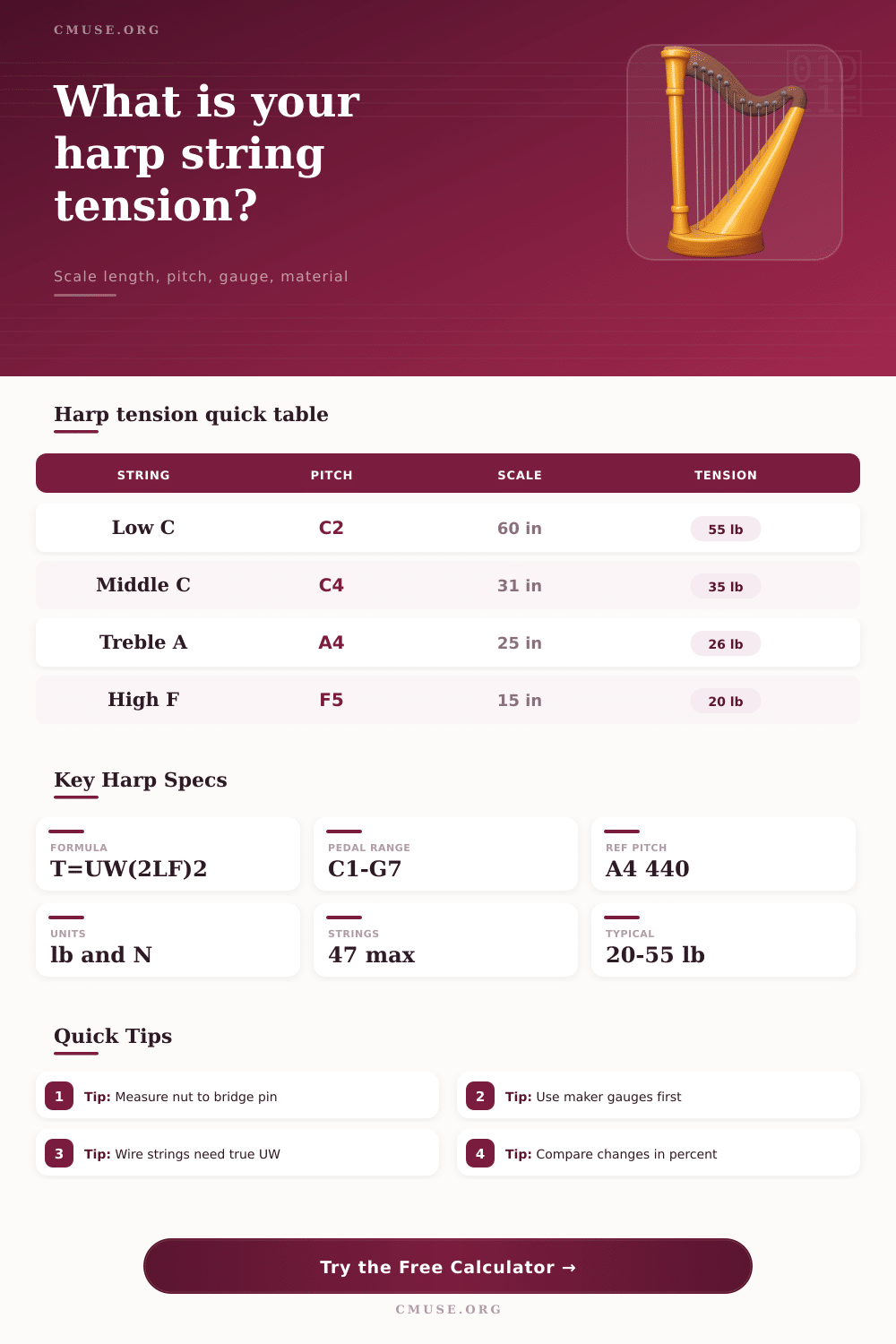
Estimate one harp string at a time from vibrating scale length, pitch, gauge, material density, and formula unit weight using T = UW(2LF)^2.
🎵 Named Harp String Presets
⚙ Scale, Pitch, Gauge, and Unit Weight
📊 Current String Spec Grid
📝 Harp Preset Comparison Table
| Named Harp Preset | String Pitch | Scale Length | Material | Gauge | Estimated Tension |
|---|---|---|---|---|---|
| Lyon & Healy Style 23 | C3 | 47.2 in / 119.9 cm | Pedal gut | 0.052 in / 1.32 mm | About 39 lb |
| Salvi Daphne 47 | G2 | 58.0 in / 147.3 cm | Wound bass equivalent | 0.070 in / 1.78 mm | About 58 lb |
| Camac Atlantide | A4 | 25.5 in / 64.8 cm | Nylon | 0.025 in / 0.64 mm | About 26 lb |
| Dusty Strings FH36S | C4 | 31.0 in / 78.7 cm | Nylon | 0.036 in / 0.91 mm | About 35 lb |
| Lyon & Healy Troubadour VI | F5 | 15.5 in / 39.4 cm | Nylon | 0.026 in / 0.66 mm | About 21 lb |
| Salvi Una 38 | E4 | 28.0 in / 71.1 cm | Lever gut | 0.038 in / 0.97 mm | About 30 lb |
🧪 Material Data for Harp Strings
| Material Family | Density Used | Common Harp Position | Typical Gauge Range | Calculation Note |
|---|---|---|---|---|
| Nylon monofilament | 0.0413 lb/in^3 | Treble and many lever harps | 0.018 to 0.050 in | Plain diameter works well for estimates. |
| Pedal gut | 0.0470 lb/in^3 | Concert pedal middle registers | 0.030 to 0.060 in | Use the octave and note from the string packet. |
| Lever gut | 0.0455 lb/in^3 | Pedal-tension lever harps | 0.028 to 0.056 in | Slightly lighter nominal density than pedal gut. |
| Fluorocarbon | 0.0642 lb/in^3 | Compact harps needing thinner strings | 0.014 to 0.038 in | Higher density gives more load at the same gauge. |
| Wound bass equivalent | 0.0450 lb/in^3 | Bass gut or wire substitutes | 0.050 to 0.120 in | Equivalent diameter is a model, not a measured core. |
🎼 Harp Note and Scale Reference
| Register | Example Pitch | Frequency at A440 | Common Scale Length | Usual Material |
|---|---|---|---|---|
| Low pedal bass | C1 to G2 | 32.70 to 98.00 Hz | 55 to 82 in / 140 to 208 cm | Wire or wound bass |
| Lower middle | C3 to G3 | 130.81 to 196.00 Hz | 38 to 50 in / 97 to 127 cm | Gut or nylon |
| Middle | C4 to A4 | 261.63 to 440.00 Hz | 24 to 34 in / 61 to 86 cm | Gut, nylon, carbon |
| Treble | C5 to G6 | 523.25 to 1567.98 Hz | 8 to 20 in / 20 to 51 cm | Nylon or carbon |
| Top pedal strings | A6 to G7 | 1760.00 to 3135.96 Hz | 3 to 8 in / 8 to 20 cm | Fine nylon |
🔎 Tension Band and Spec Comparison
| Harp Setup Band | Single-String Range | Best Use in Calculator | Watch Point |
|---|---|---|---|
| Light lever | 15 to 32 lb / 67 to 142 N | Small therapy, lap, and light Celtic harps | A pedal-gut replacement can overload the frame. |
| Medium lever | 22 to 45 lb / 98 to 200 N | Pedal-tension lever designs and larger folk harps | Compare total changes before moving many strings. |
| Concert pedal | 28 to 65 lb / 125 to 289 N | 47-string pedal harp gut and nylon registers | Octave numbering must match the string chart. |
| Bass wire | 35 to 85 lb / 156 to 378 N | Lowest wound or wire strings with maker unit weight | Use true unit weight when a string is wrapped. |
String tension is a factor that governs the functions of the harp. The tension of the strings will determine the response of the soundboard. Furthermore, the tension will impact how stable the harp’s pitch is when the temperature change.
Additionally, string tension will determine whether the neck or the soundbox of the harp retain its shape over time. If you manage the string tension of your harp correctly, it will be responsive to the finger playing it. However, if you manage the tension of your harp incorrect, you may lose the volume of the harp or cause permanent damage to it.
Why Harp String Tension Matters
There are several variable that you must consider to calculate the tension of the harp strings accuratley. The equation to determine the tension within the harp strings is the unit weight of the string multiplied by the square of twice the speaking length of the harp string multiplied by the frequency of the string. The scale length of the harp string is one of the variables because it indicates the length of the vibrating string.
Additionally, the pitch of the string is also one of the variables because the pitch will determine the frequency of the vibrating string. Lastly, the gauge and the material of the string are two of the variable because they will impact the unit weight of the string. The variables of scale length, pitch, and gauge interact with each other.
For example, if the scale length of the harp string is increased while maintaining the same pitch and gauge for the string, the tension that must be placed upon the string will be higher. This is why the bass strings on a concert pedal harp will have higher string tensions than the equivalent note on a smaller lever harp. Additionally, increasing the pitch of the note that is played on a short treble string will increase the tension of that string more than one might expect.
A string tension calculator will ask for the speaking length and the material of the string. Once these variables have been selected, the calculator can calculate the string tension for the harp. Many harp player must make a decision regarding the material of the harp strings.
The material of the string will impact the tension and the stability of the harp. For concert harps, players traditionally use gut strings. However, gut strings are very sensitively to changes in humidity.
Additionally, the gauge of the gut string must be carefully selected. Another material that can be used for the harp strings is nylon. This material is more stable than gut and is one of the reason that it is popularly used for lever harps.
Fluorocarbon strings have a density that is between gut and nylon strings. Using fluorocarbon strings allows the harp player to use thinner strings to achieve the same string tension on the harp. Finally, wound strings are another type of string that can be used on the harp.
However, the unit weight of a wound string is more complex than that of a solid string. There are reference tables of string tension according to the type of string material that is used. For instance, the tension of the low bass strings will be between thirty-five and eighty-five pounds.
The middle register strings will have a tension between twenty-eight and forty-five pounds. The tension of the treble strings will be even lower and may be in the low twenties or the teens for harps with very short scales. The frame and the soundboard of the harp are only designed to handle string tensions within these ranges.
Playing the harp outside of these ranges may result in neck rise or seam failure (high tension). Additionally, playing the harp with string tensions below the indicated range for the harp may cause the soundboard of the harp to become unresponsive. It is essential to ensure that the tension of the harp strings remains within the limit of the design of the harp.
Another variable to consider is the pitch offset. The pitch of a harp string may be tuned to A442 or A438 rather than the standard A440. String tension calculators allow players to enter a deviation in cents from A440 to ensure that the frequency of each string matches the pitch that the harp player intends to play. If the pitch of every string on the harp is increased, the tension will increase as well since the frequency is multiplied in the equation to calculate the string tension.
The additional hertz will increase the load upon the harp. This change in tension is significant if the harp is close to the tension limit of the instrument’s design. In addition to the calculations and the variables that impact the tension of harp strings, there are a few other factors that will impact the actual tension that the string will exhibit.
For example, the stiffness of the string will impact the tension that is felt by the harp if the string is tuned to an accurate tension value. A string with a smaller physical diameter will feel stiffer than one with a larger diameter even if the tension is the same. Additionally, the harp string manufacturer publishes a unit weight for the wound strings that are used for the bass strings of the harp.
The winding of these bass strings will impact the string tension and cannot be accurately represented by the unit weight of the unwound string. Finally, the properties of both the string and the wood of the harp will change with alterations in the humidity and the temperature of the environment in which the harp is being played. For harp players, the most essential habit to develop is to compare the tensions of different strings.
If a harp player is only replacing one string, they can use the tension of the other strings to guide the tension of the new string. Additionally, if a harp player is replacing an entire register of strings, they can only make adjustments to the tension if the adjustment is represented by a percentage change in the tension rather than an absolute measurement of that string’s tension. To calculate the string tension of a harp string, measuring the speaking length of the harp string is vital.
If the speaking length of the harp string is incorrectly measured, the tension of the string will be incorrectly calculated. The speaking length of the harp string is the vibrating portion of the string. The speaking length runs from the point of contact of the string with the nut or bridge pin to the soundboard eyelet or hitch pin.
Any portion of the string outside of this range does not contribute to the frequency of the vibrating string. Therefore, it should not be included in the measurement of the speaking length of the string. To measure the speaking length, a player can use a flexible tape measure to account for the curvature of the string.
Additionally, this measurement should be taken on several strings to ensure that the scale length of the harp is equal across all of the string. The goal of managing the tension of the harp strings is to ensure that the harp performs optimally. A harp player can use the tension calculator to test various string tensions before purchasing a set of harp strings.
The calculator will save players the time and money that they would spend on purchasing custom string gauges for a harp. Using the string tension calculator will provide an accurate measurement of string tension. However, it is up to the harp player to make the final adjustments to the string tensions.
Players should use their ears to make these adjustments so that each register of the harp has an even balance of pitches. Additionally, the player should ensure that all string tensions are within the safe range of the harps design.